
Reviewed · HISTORICAL TOURS
Split Walking Tour with History Professor
History comes alive in Split’s streets. This two-hour walk connects Diocletian’s Palace with the medieval and modern city, giving you far more context than a quick palace visit. I like the route’s range, from Roman cellars and imperial courtyards to Venetian, Ottoman, and Napoleonic influences. I also like the guide’s teaching style: Mario, a local history professor, uses questions, humor, and clear explanations to keep the past moving.
The main consideration is pace. You cover many places in two hours, with short stops at several landmarks. The Cathedral of Saint Domnius and Temple of Jupiter also require separate admission, and the uneven historic center is not suitable for wheelchair users.
In This Review
- Key points to know before you book
- Why this Split walking tour works
- Starting at the Riva Harbor model
- Roman Split below ground
- Peristyle and the Vestibule
- Cathedral of Saint Domnius and Temple of Jupiter
- The Golden Gate and Grgur Ninski
- Marmontova Street and Prokurative
- Fruit’s Square and the final stretch
- Mario’s teaching style makes the difference
- What the $23 price really buys
- Who should book this walk?
- Should you book the Split Walking Tour with History Professor?
- FAQ
- Where does the Split walking tour meet?
- How long does the tour last?
- What language is the tour in?
- Who leads the tour?
- What places are included?
- Are admission fees included?
- Is the tour suitable for all ages?
- Is the tour suitable for wheelchair users?
Key points to know before you book
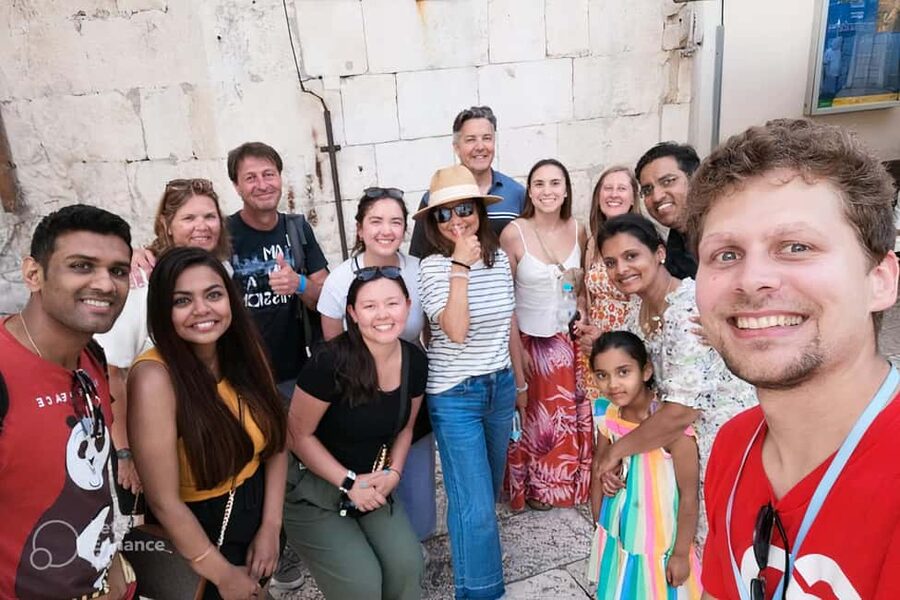
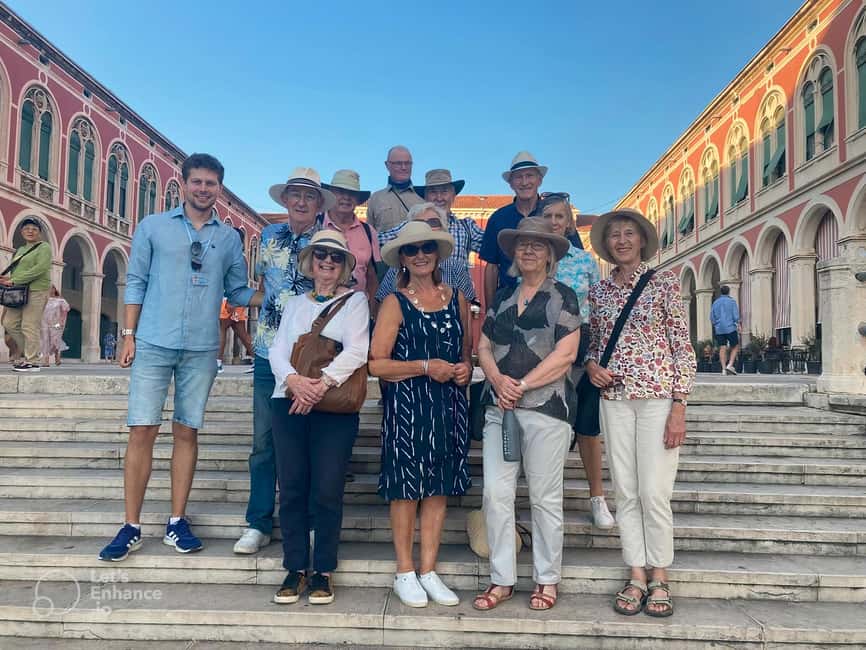
- Mario teaches as he guides: He explains the past with questions, humor, and plenty of audience interaction rather than delivering a dry speech.
- The route goes beyond Diocletian: You see Roman, medieval, Venetian, Ottoman, Napoleonic, and modern influences across central Split.
- The Palace is only the beginning: The tour includes the substructures, Peristyle, Vestibule, Cathedral, Temple of Jupiter, and Golden Gate, then continues into later parts of town.
- Game of Thrones fans get extra context: Several locations connect to the series, alongside local legends and everyday city life.
- The price is modest: At $23 per person, the tour offers two hours with a live English-speaking guide and a broad introduction to Split.
- Wear practical shoes: You will walk through historic streets and old stone spaces, so comfort matters more than style.
Why this Split walking tour works
Many first visits to Split focus on Diocletian’s Palace, and that makes sense. The palace is the city’s great attraction. Yet the Roman walls are only one chapter in Split’s story. This tour helps you see how later residents built homes, shops, churches, squares, and streets into the old imperial complex.
I like that the route does not treat the Palace as a sealed museum. You begin near the Riva Harbor, look at a model of Split’s historic center, then move through Roman spaces before heading into the wider city. That order gives you a useful map in your head. You can understand how the palace fits into modern Split instead of seeing isolated monuments with no connection.
The experience is listed at two hours, and the scheduled stops add up to that length. The promotional description also refers to two hours and fifteen minutes, so I would plan for roughly two hours and allow a little extra time around the start or finish. It is a compact introduction rather than a slow archaeological study.
The guide is Mario, a local history professor who conducts the tour in English. His strongest quality is not simply the amount of information he brings. It is the way he delivers it. He asks questions, encourages participation, and uses humor to prevent the Roman dates and architectural terms from becoming a blur.
More Historical Tours in Split
- Walking Tour of Split with a ‘Magister’ of History
★ 5.0 · 1,122 reviews - Split Walking Tour with Professor of History
★ 5.0 · 926 reviews - Split: History and Heritage Walking Tour
★ 4.9 · 650 reviews
Starting at the Riva Harbor model
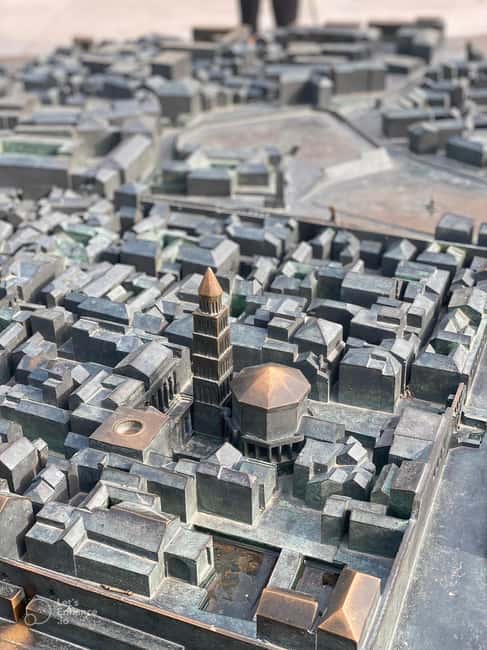
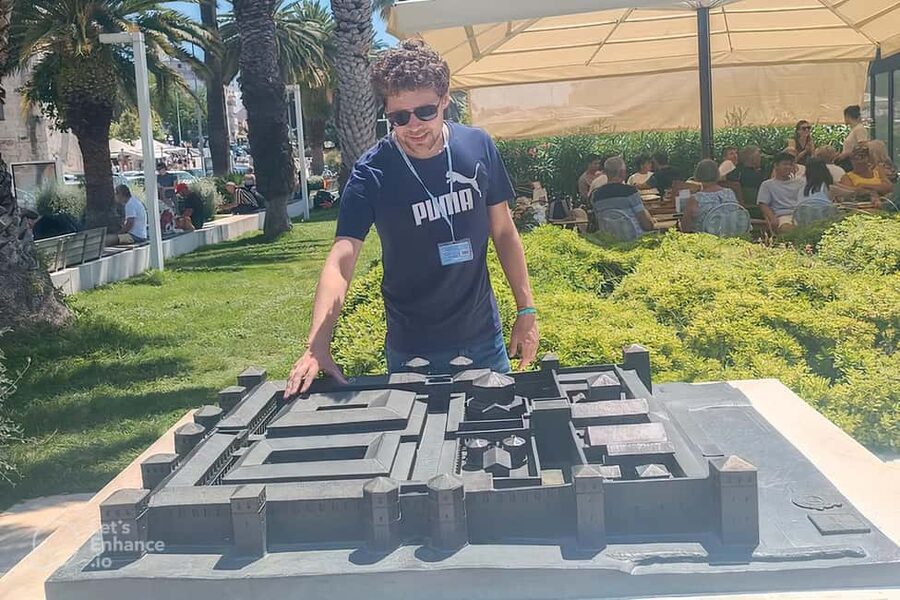
The meeting point is next to the Brass Gate of Diocletian’s Palace. From there, the first stop is a model of Split’s historic core near the Riva Harbor, with about ten minutes to get oriented.
This is a smart opening. Split’s old center can feel confusing at first because Roman walls, later buildings, narrow lanes, and open squares all overlap. A model lets you see the basic shape of the Palace before you walk inside it.
The Riva itself is also a useful point of reference. It is the waterfront promenade and one of the easiest places in town to identify. You are not being dropped straight into a maze of stone passages with no explanation. Instead, you start with the city’s broad layout and then move inward.
If you arrive early, check the exact meeting point carefully. The guide waits by the Brass Gate, not at an unspecified location somewhere inside the Palace.
Roman Split below ground
The next stop is the substructures of Diocletian’s Palace, with about five minutes scheduled here. The time is short, but the stop matters because the underground rooms help explain the Palace’s original construction.
The substructures supported the spaces above them and preserved the basic plan of the imperial complex. As you move through them, you get a clearer sense of the Palace as a planned Roman residence rather than a collection of unrelated ruins.
This portion may appeal most to anyone who likes architecture and practical details. You can better understand how the upper rooms were arranged when you see the lower level beneath them. It also adds a change of mood: the bright waterfront gives way to enclosed stone interiors.
The limitation is obvious. Five minutes is enough for an explanation and a look, but not for a long inspection of every corner. If underground spaces are your main reason for visiting Split, you may want extra time on your own after the tour.
Peristyle and the Vestibule
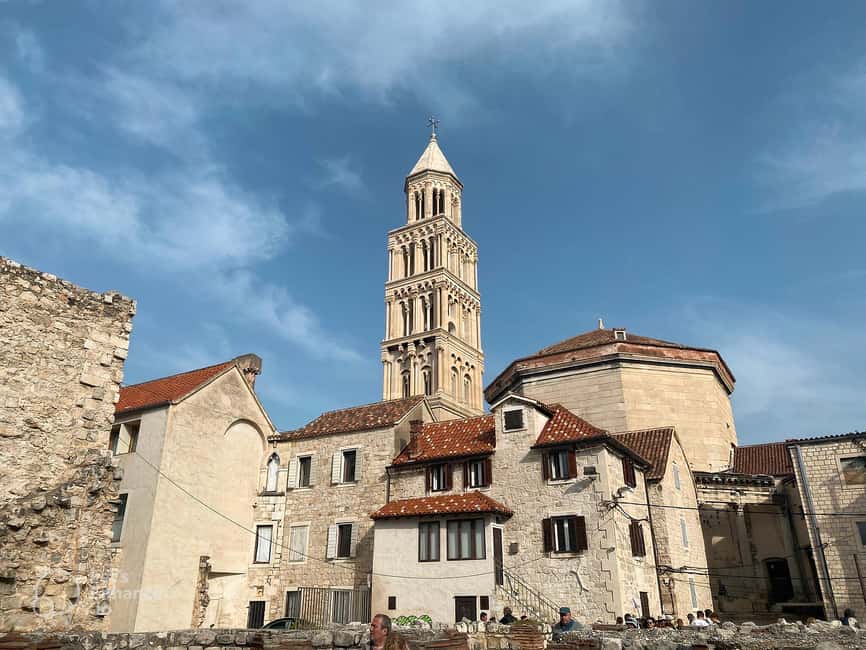
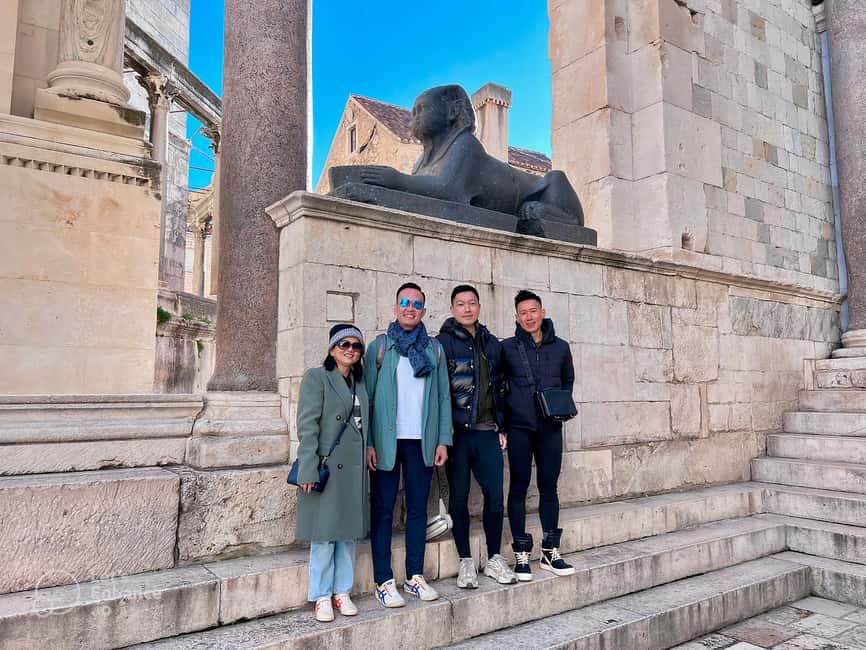
The Peristyle receives about ten minutes. This is the ceremonial central court of the Palace and one of the essential places on the route.
Here, Mario can help you read the space as a public stage. The columns, stone surfaces, and surrounding buildings make more sense when you know that the court once formed a key part of the imperial complex. The value of a guide is especially clear in a place like this, where the physical setting is impressive but the original purpose is not immediately obvious.
From there, the group continues to the Vestibule for another ten-minute stop. Its round form and unusual acoustics make it one of the more memorable Roman spaces in Split. The stop also shows how the Palace was not just a set of grand outdoor courtyards. It included carefully designed transitional rooms that led people from one section to another.
These two stops are close in theme, but they do different jobs. The Peristyle explains the public face of the Palace. The Vestibule gives you a sense of its interior design and movement through the complex.
More Walking Tours in Split
- Split: Old Town and Diocletian Palace Walking Tour
★ 4.9 · 4,727 reviews - Walking Tour of Split and Diocletian’s Palace
★ 5.0 · 2,588 reviews - Krka Waterfalls tour with Trogir Walking tour and Krka panoramic boat cruise
★ 5.0 · 1,659 reviews - Split & Diocletian’s Palace Walking Tour
★ 5.0 · 1,125 reviews
Cathedral of Saint Domnius and Temple of Jupiter
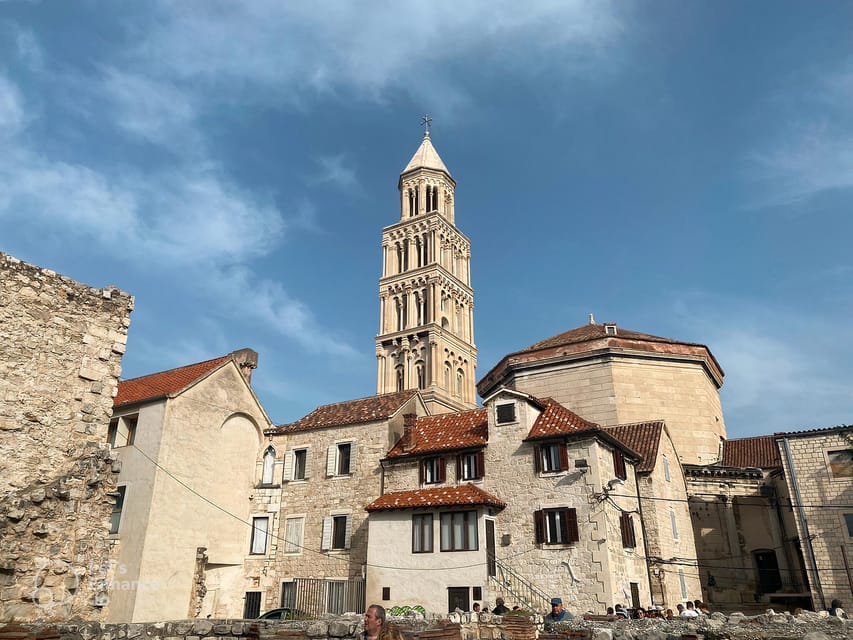
The Cathedral of Saint Domnius gets about twenty minutes, the longest scheduled stop on the route. Admission is not included, so you should expect to pay separately if the tour enters the paid area.
The building is especially useful for understanding how Split changed over time. A Roman imperial structure was later adapted for Christian worship, and the cathedral now sits within the Palace complex. That layering is one of the central ideas of this walk: the old city was not abandoned after the Roman period. Later generations reused it.
The longer stop gives Mario room to explain the cathedral’s place in the city and its relationship to the Palace. You should still keep your expectations in check. Twenty minutes is a concise visit, not a full religious art tour.
The Temple of Jupiter follows, with about ten minutes scheduled and admission excluded. Its presence adds another piece to the Roman religious setting. You can compare an ancient temple with the later cathedral and see how the same compact center carries different periods side by side.
Because both admissions cost extra, the $23 tour price is not the total cost of every possible interior visit. Still, the base price remains reasonable for a live guide and a route that covers the main historic center.
The Golden Gate and Grgur Ninski
The Golden Gate receives about ten minutes. This was a major entrance to the Palace, and it helps you understand the city’s defensive and ceremonial edges.
Large gates are easy to photograph and easy to pass through without a second thought. A guide gives the structure a role in the larger plan. You can place it in relation to the Palace and see how the old entrance still shapes movement through Split.
The tour then stops at the statue of Grgur Ninski for another ten minutes. This is a more local and playful part of the walk. The statue is tied to Split’s public identity, and the stop gives Mario a chance to shift from imperial history to local stories and customs.
That mix is one of the tour’s strengths. You are not spending the whole time with emperors, dates, and stone walls. The route also includes the people and legends that help make modern Split feel like a living city.
Marmontova Street and Prokurative
Marmontova Ulica marks a clear move into more recent urban Split. The scheduled ten-minute stop gives you a look at one of the city’s important modern streets and a chance to consider the influence of Napoleon’s period.
The tour description also points to Venetian and Ottoman influence, so this section helps widen your view beyond the Roman era. Split’s character was shaped by several powers and periods, not just by Diocletian. You may find this especially useful if you are deciding where to spend the rest of your time in town.
Prokurative follows for another ten minutes. The square has a different feel from the tight Roman lanes and enclosed Palace spaces. Its layout reflects later European tastes and shows how Split expanded and changed beyond the original walls.
Together, Marmontova and Prokurative prevent the walk from becoming a Roman-only experience. I value that balance because it gives you a better reason to explore outside the Palace after the tour ends.
Fruit’s Square and the final stretch
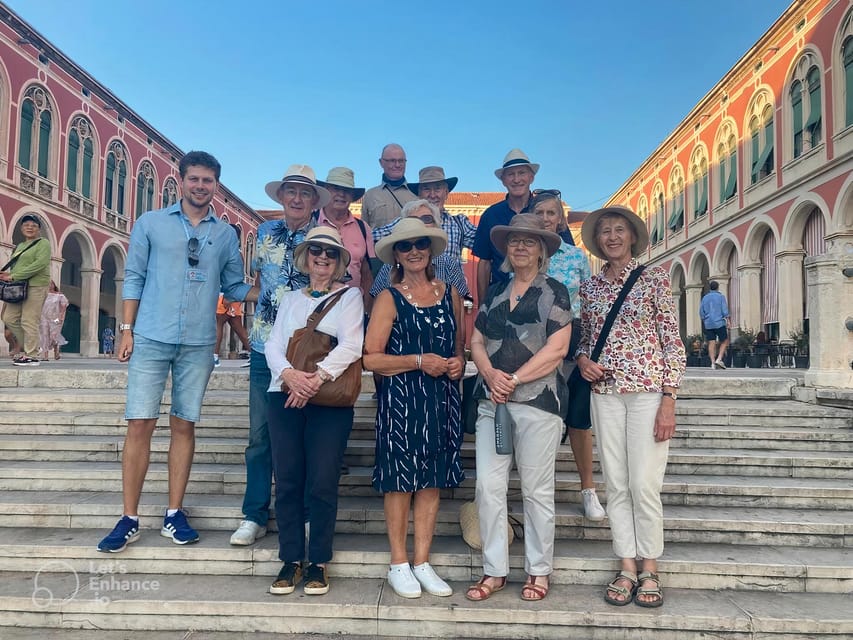
The last scheduled stop is Fruit’s Square, or Trg Brace Radic, with about fifteen minutes. It is a fitting finish because the square brings together architecture, local activity, and the city’s later development.
By this point, the route has moved from the waterfront to the underground Palace, through Roman ceremonial spaces, past religious landmarks and gates, and into streets and squares shaped by later centuries. Finishing outside the narrowest Roman core reinforces the main lesson: Split is not simply an ancient monument. It is a city that kept adapting.
This final stop also gives you a useful place from which to continue exploring. The information you receive about local life and legends may help you notice details that would otherwise pass without comment. I would treat the end of the tour as a good moment to ask Mario for general orientation if time allows, though the available information does not promise a separate recommendation session.
Mario’s teaching style makes the difference
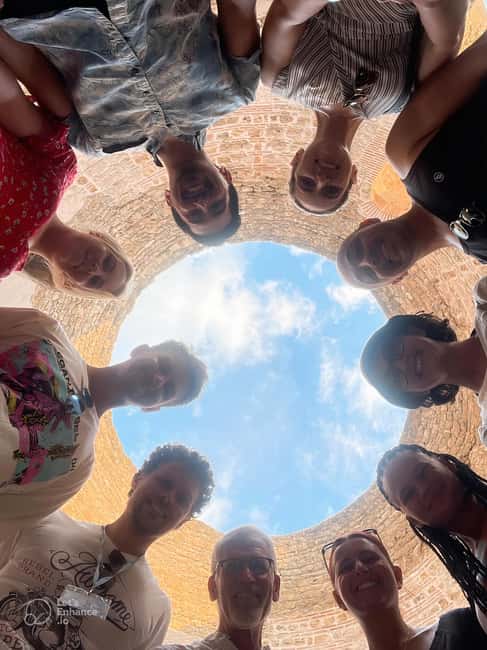
The praise for Mario is unusually consistent. He is described as friendly, funny, charismatic, enthusiastic, and very well informed. One particularly useful detail is his habit of posing questions and encouraging answers from the group.
That approach suits Split. The city contains enough history to overwhelm you, especially if you try to absorb every ruler, century, and architectural change. A guide who pauses to ask questions gives you a chance to connect the facts instead of simply hearing a long speech.
His background as a history professor may also appeal to you if accuracy matters. The strongest feedback describes a guide who explains history at several levels, from broad political change to details about the Palace and local life. That makes the tour suitable for curious beginners and for people who already have some interest in Roman history.
The style will not suit everyone. If you prefer to wander silently, take photographs without interruption, or stop for long periods at one monument, the short, interactive format may feel busy. This is a guided teaching walk, not an unstructured photo stroll.
What the $23 price really buys
At $23 per person, this is a good-value introduction to Split. You receive about two hours with a live English-speaking guide, a broad route, and interpretation that links several periods of the city’s past.
The value is strongest if you are new to Split and want a framework for the rest of your stay. You get the major Roman sights, several later city landmarks, local stories, and Game of Thrones connections in one compact walk. Paying for a guide also saves you from trying to piece together the Palace’s layers from signs and guidebooks.
The price is less compelling if you only want a detailed visit to the cathedral or underground rooms. Those stops are brief, and the two paid admissions are separate. You are paying for the whole story of central Split, not for extended time inside one attraction.
Small-group arrangements are offered, and private tours can be requested from Mario at [email protected]. The exact group size is not provided, so I would not assume that every departure is fully private. If personal attention is essential, ask about a private option before booking.
Who should book this walk?
I would recommend it to first-time visitors, couples, families, and history-minded people who want a clear introduction without spending half a day on their feet. The tour is listed as suitable for all ages, and the humor and questions may help keep younger participants involved.
It also suits anyone who wants more than Roman ruins. The route connects the Palace with medieval and modern Split, Venetian and Ottoman influence, Napoleon’s period, local legends, and Game of Thrones locations.
You should think twice if you use a wheelchair, since the experience is not suitable for wheelchair users. Comfortable shoes and comfortable clothing are specifically advised. The old center includes stone streets and historic interiors, so practical footwear is the sensible choice.
Free cancellation is available up to 24 hours before the tour, and you can reserve now and pay later. Those terms are useful if your Split schedule may change, but the main booking decision should come down to your interest in a guided, information-heavy walk.
Should you book the Split Walking Tour with History Professor?
Book it if you want a sharp introduction to the whole city, not only a look inside Diocletian’s Palace. Mario’s engaging teaching style, local perspective, humor, and questions are the main reasons to choose this walk over a basic monument tour.
Skip it if you want a slow archaeological visit, long photography stops, or a fully private experience without arranging one in advance. For $23, though, the route offers a lot: Roman remains, later streets and squares, local legends, and a guide who knows how to make history approachable. For most first visits to Split, that is a fair exchange.
FAQ
Where does the Split walking tour meet?
The guide waits next to the Brass Gate of Diocletian’s Palace, near the Riva Harbor area.
How long does the tour last?
The stated duration is two hours. The experience description also refers to two hours and fifteen minutes, so allow a little flexibility around the advertised timing.
What language is the tour in?
The tour is conducted in English with a live guide.
Who leads the tour?
The guide is Mario, a local history professor. Private tours can be requested by contacting [email protected].
What places are included?
The route includes a model of Split’s historic core, Diocletian’s Palace substructures, the Peristyle, Vestibule, Cathedral of Saint Domnius, Temple of Jupiter, Golden Gate, Grgur Ninski Statue, Marmontova Ulica, Prokurative, and Fruit’s Square.
Are admission fees included?
Admission to the Cathedral of Saint Domnius and Temple of Jupiter is excluded. The walking tour price does not cover those separate admissions.
Is the tour suitable for all ages?
Yes. The tour is described as appropriate for all ages.
Is the tour suitable for wheelchair users?
No. The experience is listed as not suitable for wheelchair users. Comfortable shoes and clothing are recommended.
Just added around Split
- Private VIP Blue Lagoon and 3 Islands Tour★ 4.5 · 9 reviews
- Split highlights – Evening walking tour★ 5.0 · 9 reviews
- Private boat transfer Split – Bol★ 5.0 · 9 reviews
- From Split: Trogir & Blue Lagoon Boat Tour with Snorkeling★ 4.6 · 9 reviews
- Private Photography Activity in Split★ 5.0 · 9 reviews
- Bike, Beer & Poljud Stadium Tour★ 5.0 · 9 reviews
- From Hvar: Blue cave group speedboat tour full day★ 5.0 · 9 reviews
- Split Walking Tour: History, Legends & Tales★ 5.0 · 9 reviews
Historical Tours, compared.


Walking Tour of Split with a ‘Magister’ of History
Read our review →


Split History and Gastro Small-Group Tour with Food and Drinks
Read our review →
PREMIUM Emperor’s Walking Tour for History Lovers + Museum
Read our review →Browse the lists this tour appears in