

Reviewed · HISTORICAL TOURS
Split Walking Tour: History, Legends & Tales
Split reveals itself one stone at a time. This 1.5-hour walk gives you a clear introduction to the city, from Emperor Diocletian’s palace to the lanes and squares of today’s Old Town. I especially like the local perspective and the small-group format, which should make it easier to ask questions and keep the tour personal. The guide, Lucija, is from Split and can discuss both the city’s past and everyday life there.
I also like the route’s strong mix of major sights: the Riva, Diocletian’s Palace, the Vestibul, Peristil, the Golden Gate, People’s Square, and Fruit Square. The main consideration is that this is an orientation walk, not a ticketed museum tour. Entrance fees to cultural and religious sites are not included, and the tour is not suitable for wheelchair users.
In This Review
- Key points at a glance
- Why this is a smart first walk in Split
- Meeting Lucija beside the Split model
- Starting along the Riva waterfront
- Entering Diocletian’s Palace after 1,700 years
- The Vestibul and the sound of the old center
- Peristil, the palace’s grand public space
- The Golden Gate and the northern edge
- People’s Square and Fruit Square
- What the local angle adds
- Is $28 a fair price?
- Who should book this walk?
- Weather, flexibility, and simple planning
- Should you book Split Walking Tour: History, Legends & Tales?
- FAQ
- How long does the Split walking tour last?
- Where does the tour begin?
- Where does the tour end?
- Which language is the tour conducted in?
- Are entrance tickets included?
- Is the tour suitable for children?
- What happens if bad weather cancels the tour?
Key points at a glance
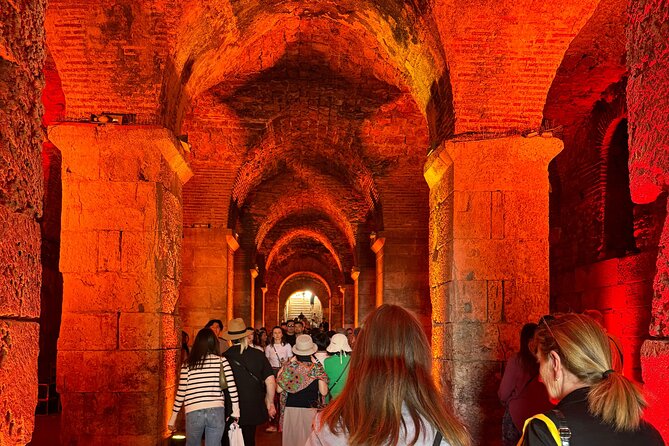
- A local guide named Lucija: She grew up in Split and can answer questions about the city beyond its ancient monuments.
- A focused 1.5-hour route: You see the core of the Old Town without giving up half a day.
- Diocletian’s Palace is the main event: The walk explains how a Roman emperor’s retirement residence became part of a living city.
- Seven useful central stops: The route links the Riva, palace courtyards, old gates, and popular squares.
- Good first-day value: At $28 per person, it can help you get oriented before exploring Split on your own.
- Bring sensible footwear: Cobblestones and an active walking route call for comfortable shoes.
Why this is a smart first walk in Split
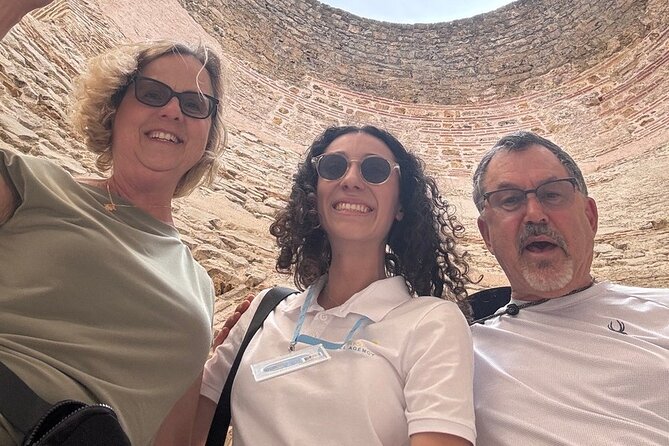
Split can be confusing at first because the oldest parts of the city are not sealed off as a single archaeological park. Diocletian’s Palace is woven into the modern center, with homes, cafés, shops, churches, and narrow lanes occupying spaces that began as a Roman imperial complex.
That makes a guided walk useful. Without context, you may see a stone wall, an arch, or a courtyard and move on. With an explanation of how the palace changed over roughly 1,700 years, you get a better sense of why old and new sit so closely together here.
I would choose this tour early in a Split visit. The route covers the central sights, so you can return later to places that catch your attention. It also gives you a chance to ask Lucija about local customs and present-day life, not only dates and rulers.
The short duration helps. At 1.5 hours, the walk should fit neatly into a morning or afternoon, leaving time for lunch, the waterfront, or independent sightseeing. You will not get every corner of Split, but you should finish with a practical map in your head.
More Historical Tours in Split
- Walking Tour of Split with a ‘Magister’ of History
★ 5.0 · 1,122 reviews - Split Walking Tour with Professor of History
★ 5.0 · 926 reviews - Split: History and Heritage Walking Tour
★ 4.9 · 650 reviews
Meeting Lucija beside the Split model
The meeting point is at Obala Hrvatskog narodnog preporoda 22, beside the model of Split. Your guide will hold a Tour4You sign, which gives you a clear way to identify the group.
The tour ends at the same place. That is helpful if you are arranging the walk around other plans, since you do not need to organize transport back from a distant neighborhood.
The activity operates in English. Children must remain with an adult for the full tour. Comfortable shoes are important, since the route follows the pedestrian streets and stone surfaces of the old center.
The group is described as small, though no exact maximum is provided. That wording matters. A smaller group generally makes it easier to hear the guide and ask a question, but you should not assume a private tour.
Starting along the Riva waterfront
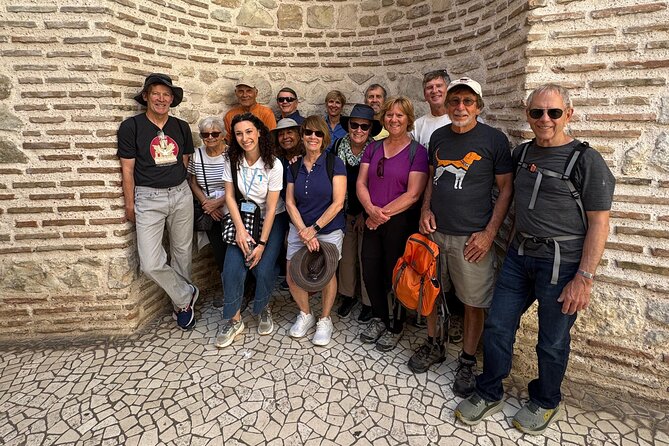
The first guided stop is the Riva, Split’s well-known waterfront promenade. This is a useful place to begin because it gives you a sense of the city’s public face before you move into the tighter streets of the Old Town.
From here, the tour introduces Split as a city shaped by several periods. The waterfront helps frame the contrast between the open seafront and the enclosed palace area just behind it.
I like this opening because it avoids dropping you straight into a maze of alleys. You start with room to orient yourself, then move toward the older core. If you arrive early, the meeting area also gives you a simple landmark while you get settled.
Do not expect a long waterfront stroll as a separate excursion. The focus quickly turns toward the historic center and the palace complex.
Entering Diocletian’s Palace after 1,700 years
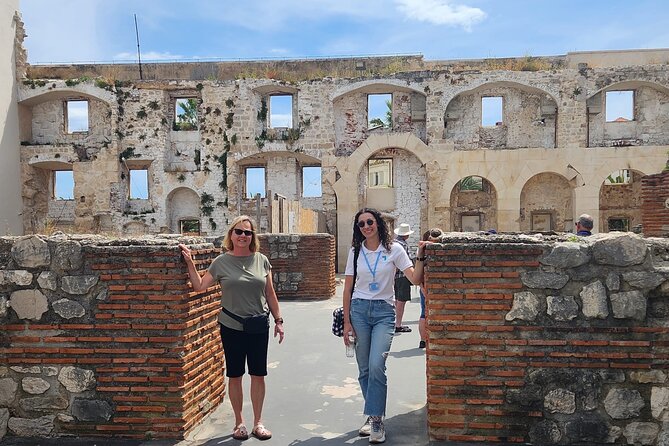
Diocletian’s Palace is the center of the experience. The palace was built as the emperor’s luxurious residence, and its walls and architecture remain part of Split’s daily life.
The important point is that you are not simply looking at a preserved Roman ruin. The palace area developed and changed over time. Streets now pass through spaces that once served an imperial household, and later residents adapted the old structure for their own needs.
A guide helps you read this layered setting. You can learn how the palace relates to Diocletian’s era and how it became part of the modern city. That transformation is more interesting than a simple list of construction dates.
The walk is especially useful if you have never visited Split. You get the broad explanation first, then can decide which palace areas deserve more time on your own. Since entry tickets are not included, the guide provides information rather than taking you inside every cultural or religious site.
That arrangement keeps the base price at $28, but it also means you should budget separately if you want to visit sites that charge admission. Ask Lucija what is worth seeing before you pay for anything later.
More Walking Tours in Split
- Split: Old Town and Diocletian Palace Walking Tour
★ 4.9 · 4,727 reviews - Walking Tour of Split and Diocletian’s Palace
★ 5.0 · 2,588 reviews - Krka Waterfalls tour with Trogir Walking tour and Krka panoramic boat cruise
★ 5.0 · 1,659 reviews - Split & Diocletian’s Palace Walking Tour
★ 5.0 · 1,125 reviews
The Vestibul and the sound of the old center
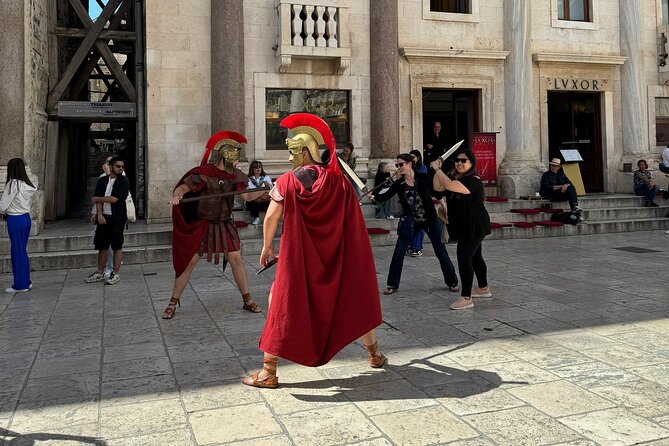
The Vestibul is one of the route’s key palace stops. It introduces the formal side of the imperial complex, where architecture and ceremony mattered.
You can expect the guide to explain the purpose and design of this space while placing it in the wider palace plan. The value here comes from seeing how one part connects to the next. The palace is easier to understand when you know how its entrances, courtyards, and internal areas relate to each other.
The Vestibul is also a good example of why this should be a walking tour rather than a rushed photo stop. The structure may look straightforward at first, but its role becomes clearer when someone explains what you are looking at and why it was built.
Because the route moves through public parts of the Old Town, the exact pace can depend on conditions in the streets. Stay close enough to hear the guide, especially in narrow sections.
Peristil, the palace’s grand public space

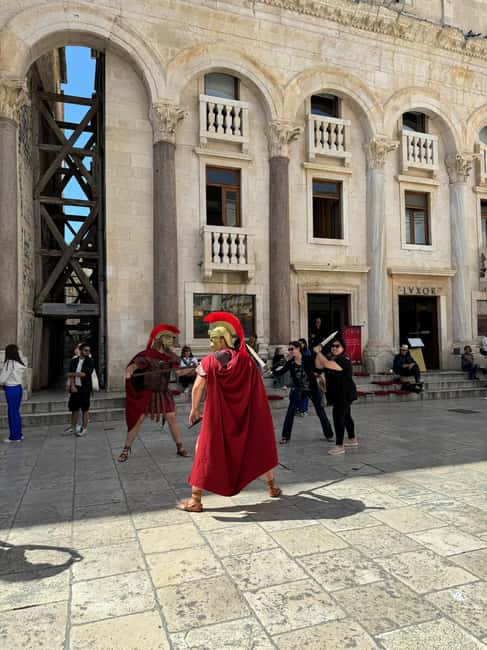
Peristil is another major stop, and it gives you one of the clearest views of the palace’s original authority. This open square was designed to make an impression, with the surrounding stonework creating a strong sense of order and scale.
I would pay close attention here to the connection between power and architecture. Diocletian did not build a modest country retreat. The palace expressed his position, and Peristil helped create that formal setting.
The square also shows how Split’s old center is used today. Ancient structures are not isolated behind barriers. They form part of a place where people move through, meet, and continue their daily routines.
This is one of the stops where a local guide can add useful texture. Lucija’s role is not only to explain the emperor but also to connect the old space with the city you see around you now.
The Golden Gate and the northern edge

The Golden Gate provides another look at the palace’s defensive and ceremonial design. It is one of Split’s must-see landmarks and a natural point for discussing how people entered and moved through the complex.
The gate helps you understand the palace as a planned structure rather than a random collection of old walls. Its position and design make more sense once you have seen the interior spaces and heard how the complex was organized.
This part of the tour also gives you a change of pace. After courtyards and interior streets, a major gate makes the palace feel larger and more deliberate.
The route does not promise a lengthy stop at every monument. If you prefer very detailed architectural study, you may want a specialist tour or additional time afterward. For a first look, though, the Golden Gate adds an important piece to the picture.
People’s Square and Fruit Square

People’s Square and Fruit Square shift the story away from the emperor and toward Split’s later urban life. These public spaces help show how the city grew around and within the old palace.
That change is one of the best features of the route. You are not asked to view Split only as an ancient site. The tour follows the city’s transformation into a place where people live, work, shop, and meet.
People’s Square gives you another central gathering point, while Fruit Square adds a different feel to the walk. Together, they help break up the Roman focus and show how the Old Town continued to develop.
I would use these stops to ask Lucija about modern Split. One of the strongest points of this experience is her ability to discuss local life, not just the official story. The direct feedback about her friendliness, answers, and personal connection to the city makes this more than a basic monument checklist.
What the local angle adds
A licensed guide is included, and the tour is led in English. The strongest praise has gone to Lucija’s warmth, clear explanations, and ability to answer questions about life in Split beyond the historical material.
That is valuable because a city walk can easily become a string of names and dates. A local guide can explain how residents relate to the Old Town and point out details you might pass without noticing.
You should still keep your expectations sensible. The tour lasts 90 minutes, so it cannot offer an exhaustive account of every period or neighborhood. Its strength is selection: the guide chooses the central sights and gives you enough background to continue exploring independently.
I also like that the experience leaves room for curiosity. You can note the places you want to revisit, then ask questions before the group returns to the starting point.
Is $28 a fair price?
At $28 per person, I consider this a reasonable price for a licensed English-language introduction to Split’s central sights. You are paying for the guide’s time, route planning, historical explanation, and local point of view.
The value is strongest if you are new to Split and want a fast orientation. A good first walk can save you from wandering past important places without understanding them. It can also help you decide which sites deserve separate entrance fees later.
The price is less compelling if you have already taken a detailed Split tour or have spent time studying Diocletian’s Palace. In that case, much of the route may cover ground you already know.
Remember that admission tickets are not included. This is not a disadvantage by itself, but it affects your total budget. The guide gives you information so you can choose cultural and religious sites later at your own pace, rather than bundling all admissions into the walk.
Who should book this walk?
I would recommend it to first-time visitors, couples, families with children, and anyone arriving in Split with limited time. It suits people who want the main story and central landmarks without committing to a full-day activity.
It is also a good match if you care about local conversation. Lucija’s background gives the walk a personal element, and the praise for her kindness and ability to answer questions is important here.
You may want something else if you need step-free access, since the tour is not suitable for wheelchair users. You should also reconsider if you dislike walking on cobbled streets or prefer indoor attractions with included entry.
The walk is conducted in English, so you will need enough English to follow the explanations and ask questions. Children are welcome, but an adult must accompany them throughout.
Weather, flexibility, and simple planning
The tour is subject to weather conditions. If poor weather causes cancellation, you can reschedule or receive a full refund. You can also cancel up to 24 hours before the activity for a full refund.
The reserve-now, pay-later option can help if your Split plans are still shifting. You can hold a place without paying immediately, which is useful when you are coordinating ferries, accommodation, or other activities.
Check the available start times before booking. Since the walk is only 1.5 hours, timing it early in your stay is usually the most useful choice, though the best time depends on your wider schedule.
Wear comfortable shoes and bring only what you need. The route is short, but the old center’s stone streets make sensible footwear more important than stylish footwear.
Should you book Split Walking Tour: History, Legends & Tales?
Book it if you want a friendly, local-led introduction to Split with the city’s key sights in one compact route. The combination of Diocletian’s Palace, the Old Town squares, and Lucija’s personal knowledge gives you a useful start for independent exploring.
Skip it if you want included entrance tickets, a longer specialist lecture, or wheelchair access. At $28, it offers its best value on your first day, when a clear explanation of the palace and its transformation can turn a confusing old center into a place you understand.
FAQ
How long does the Split walking tour last?
The tour lasts 1.5 hours. Check availability for the available starting times.
Where does the tour begin?
It begins at Obala Hrvatskog narodnog preporoda 22, next to the model of Split. The guide will hold a Tour4You sign.
Where does the tour end?
The activity ends back at the starting point, Obala Hrvatskog narodnog preporoda 22.
Which language is the tour conducted in?
The tour operates in English with a live English-speaking guide.
Are entrance tickets included?
No. Entrance tickets to cultural and religious sites are not included. The guide provides information so you can decide what to visit later.
Is the tour suitable for children?
Yes, children can take part, but they must be accompanied by an adult for the entire tour.
What happens if bad weather cancels the tour?
If poor weather causes cancellation, you can reschedule or receive a full refund. You can also cancel up to 24 hours in advance for a full refund.
Just added around Split
- Private VIP Blue Lagoon and 3 Islands Tour★ 4.5 · 9 reviews
- Split highlights – Evening walking tour★ 5.0 · 9 reviews
- Private boat transfer Split – Bol★ 5.0 · 9 reviews
- From Split: Trogir & Blue Lagoon Boat Tour with Snorkeling★ 4.6 · 9 reviews
- Private Photography Activity in Split★ 5.0 · 9 reviews
- Bike, Beer & Poljud Stadium Tour★ 5.0 · 9 reviews
- From Hvar: Blue cave group speedboat tour full day★ 5.0 · 9 reviews
- Morning Stand Up Paddle Tour in Split★ 5.0 · 10 reviews
Historical Tours, compared.


Walking Tour of Split with a ‘Magister’ of History
Read our review →


Split History and Gastro Small-Group Tour with Food and Drinks
Read our review →
PREMIUM Emperor’s Walking Tour for History Lovers + Museum
Read our review →Browse the lists this tour appears in