
Reviewed · WALKING TOURS
Split highlights – Evening walking tour
Split comes alive after sunset. This small-group walk links Diocletian’s Palace with lively squares, the Riva, and a hilltop view, giving you a useful first look at Croatia’s second city. I like the compact route and the local guides, especially Bosko Papic, Pavle, and Luka, who have been praised for making the past feel personal.
I also like that the group is capped at eight people, which should make questions and conversation easier. The main drawback is that the palace can still be busy in the evening, and the Cathedral of Saint Domnius requires a separate admission ticket.
In This Review
- Key points to know before you book
- Why an evening walk works so well in Split
- Starting beneath the Golden Gate
- Peristyle, where Roman power meets daily life
- Saint Domnius and the unusual history of the cathedral
- The Vestibule and the sound of klapa
- Pjaca, Split’s social stage
- Prokurative and the view toward the harbor
- The Riva, Split’s outdoor living room
- The climb to Prva Vidilica Na Marjanu
- The guides are a major part of the value
- Price, timing, and practical value
- Who should book this Split walk?
- Should you book the evening walking tour?
- FAQ
- How much does the Split evening walking tour cost?
- How long does the experience last?
- What time does the tour start?
- Where does the tour meet?
- Where does the tour end?
- What language is the tour offered in?
- What is included in the price?
- Is entry to the Cathedral of Saint Domnius included?
- How many people can join the tour?
- Can I cancel for a full refund?
Key points to know before you book
- A compact route through central Split: You visit eight important places in about 90 minutes to two hours.
- The palace is the star: The Golden Gate, Peristyle, Vestibule, and Cathedral reveal how Roman imperial space became a living city.
- A local guide makes the difference: Bosko Papic, Pavle, and Luka have been praised for history, anecdotes, restaurant suggestions, and insight into local life.
- The final view costs only your effort: The walk to Prva Vidilica Na Marjanu takes about 15 minutes from the old town.
- Small group, English only: The experience is offered in English and has a maximum of eight participants.
- Good value for a first evening: At $39.74 per person, you get a licensed local guide, but entrance to the cathedral is extra.
Why an evening walk works so well in Split
Split is not a museum city where you look at ancient stones from behind a rope. Much of Diocletian’s Palace is woven into ordinary city life. People live in its old rooms, walk beneath Roman arches, meet in its squares, and pass through spaces built for an emperor.
That makes an evening walk a sensible choice. At 7:00 pm, the heat of the day should be less of a concern, and the route moves from the palace toward the harbor as the city shifts into its evening rhythm. You get history, local habits, and a view without spending half a day on a formal sightseeing program.
The tour lasts approximately one hour and 30 minutes to two hours. That is long enough to cover the main sights but short enough to fit around dinner or other plans. I would place it early in a Split visit because the route helps you understand the old town’s layout quickly.
The price is $39.74 per person. That is not the cheapest way to wander through Split, since most of the places outside the cathedral are free to enter. Still, the value comes from having a licensed local guide explain why the stones matter and how the ancient palace became the modern center of town.
More Walking Tours in Split
- Split: Old Town and Diocletian Palace Walking Tour
★ 4.9 · 4,727 reviews - Walking Tour of Split and Diocletian’s Palace
★ 5.0 · 2,588 reviews - Krka Waterfalls tour with Trogir Walking tour and Krka panoramic boat cruise
★ 5.0 · 1,659 reviews
Starting beneath the Golden Gate
The meeting point is at the Golden Gate, at Dioklecijanova 7. The start time is 7:00 pm, so arrive with enough time to locate the gate and your guide rather than rushing in at the last moment.
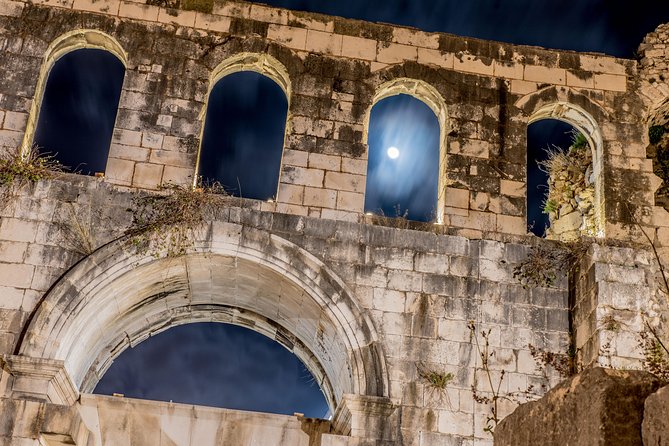
The Golden Gate was one of the main entrances to Diocletian’s Palace. The tour connects it with Emperor Diocletian’s retirement, when he entered the palace and made it his home. That detail gives the opening a useful human angle: this was not simply a military fort or grand public monument, but a place built for an emperor’s later life.
Above the gate, you will see the statue of Grgur Ninski, a Croatian bishop. Rubbing the toe is a familiar Split custom said to bring good luck. It is a small detail, but it gives you an immediate sense of how the city mixes formal monuments with playful local habits.
The stop lasts about 15 minutes and has no admission charge. It is a good introduction because the gate helps you see the palace as a planned complex rather than a random collection of old walls.
Peristyle, where Roman power meets daily life
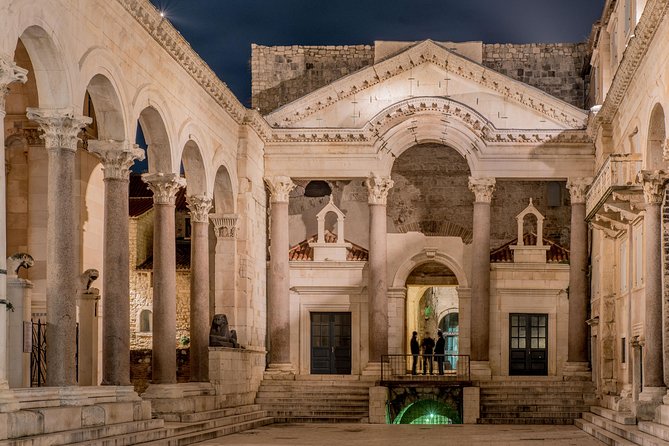
From the Golden Gate, the route reaches the Peristyle, the geographical and spiritual heart of Diocletian’s Palace. You will find this square surrounded by some of the city’s most important buildings, with ancient columns and Roman forms still shaping the space.
A 3,500-year-old sphinx guards the area. That single object connects Diocletian’s Roman world with an even older past. The Peristyle is one of those places where scale does much of the explaining. Even without a long lecture, the columns, stone steps, and surrounding walls show how much importance the emperor placed on ceremony.
The visit here lasts about 20 minutes. That is the longest stop on the route, and rightly so. You have time to look up, listen to the guide, and notice how modern Split continues around the ancient setting.
The palace may be busy in the evening. That is worth knowing before you book. Evening light can make the square atmospheric, but it does not guarantee peace and quiet. If you prefer an empty monument, this may disappoint you. If you enjoy seeing old places used as part of daily life, the activity is part of the appeal.
Saint Domnius and the unusual history of the cathedral
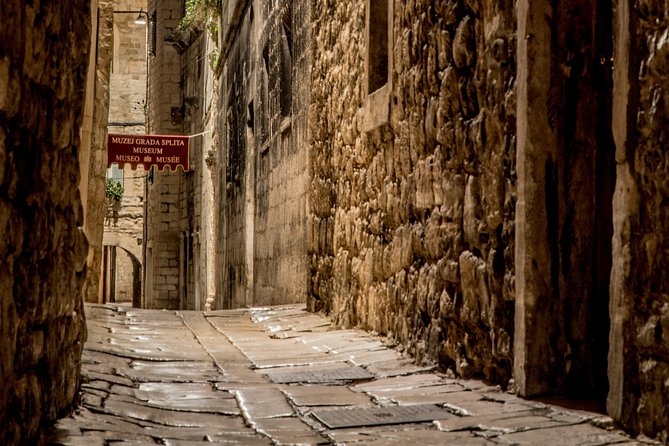
The Cathedral of Saint Domnius occupies a remarkable building. It was once the mausoleum of Emperor Diocletian, and it is described as the oldest building in the world in which a cathedral is situated.
That change in purpose tells you a great deal about Split. A structure built for a Roman emperor later became a Christian cathedral, and the city grew around it. The building is not just an isolated church stop. It is a clear example of how successive generations reused the center they inherited.
The stop takes about 10 minutes. Admission is not included, so you should expect to pay separately if you want to go inside. The supplied details do not give the extra ticket price, so check the current amount before deciding.
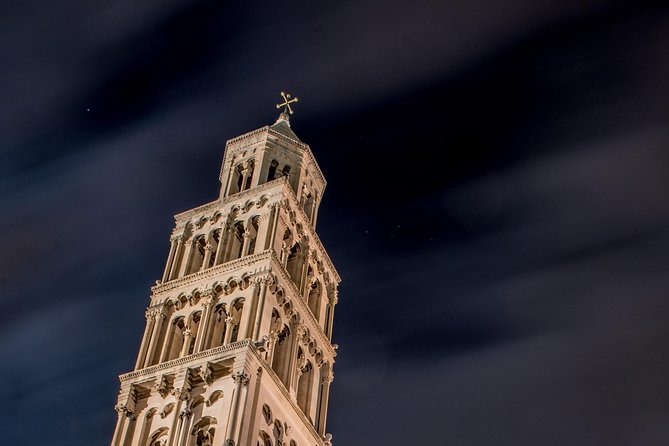
In front of the cathedral is the Romanesque bell tower. It adds a later medieval layer to the Roman setting and gives the square a distinctive profile. Even if you skip the paid entry, the exterior and the guide’s explanation make this a worthwhile stop.
Something different for another day:
- Split: Krka Waterfalls Trip with Boat Cruise and Swimming
★ 4.8 · 10,519 reviews - From Split: Krka Waterfalls, Food & Wine Tasting Tour
★ 5.0 · 9,326 reviews - Blue cave, Mamma Mia and Hvar, 5 islands speedboat tour
★ 5.0 · 7,150 reviews - From Split: Krka Waterfalls, Food & Wine Tasting Tour
★ 4.9 · 6,598 reviews
The Vestibule and the sound of klapa
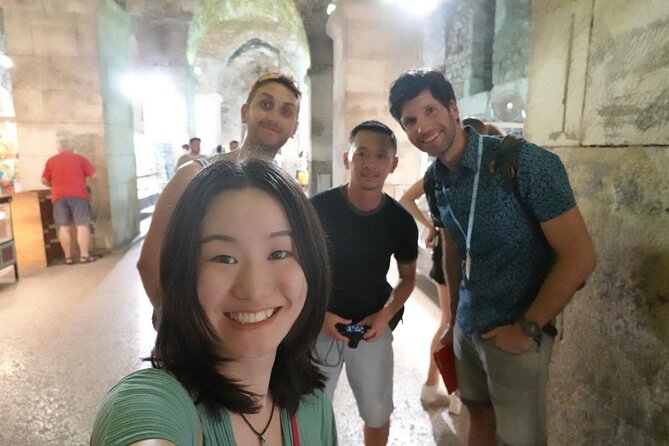
The Vestibule is a round passage leading toward the emperor’s chambers. Its shape makes it one of the more memorable spaces on the route, particularly because the bare stone carries sound so well.
The tour points out the possibility of hearing local klapa singing here. Klapa is a traditional form of Croatian vocal music, usually performed without instrumental backing. The acoustics give the singing a natural setting, although the details provided do not promise a performance at every departure.
This stop lasts about 10 minutes and is free. I like it because it adds an audible part of Split’s culture to a walk that could otherwise become a parade of architecture. Listen carefully, look up at the circular form, and let the guide explain how this entrance worked within the palace.
Pjaca, Split’s social stage
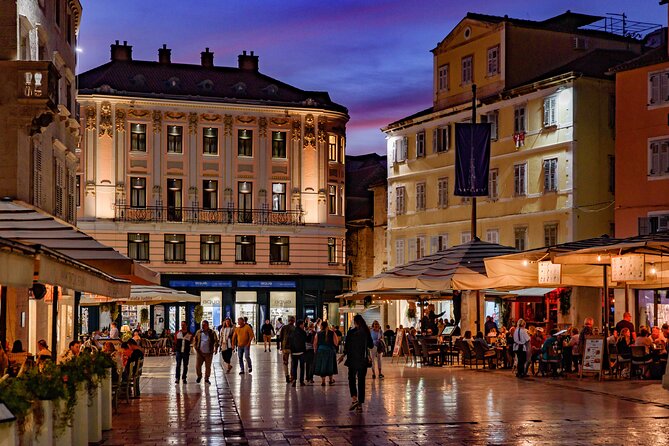
Pjaca is the central square of city life. It is a place to sit, meet, watch people, and, according to the tour description, discuss football, one of the subjects that matters most in Split.
This stop helps correct a common misunderstanding about old towns. The center is not preserved only for sightseeing. It remains a place where residents meet and spend time. That living quality is one of the strongest reasons to take a local walking tour rather than simply follow a map from monument to monument.
You spend about 10 minutes here, with no admission fee. The guide’s value is less about pointing out a single object and more about explaining how the square fits into local routines.
The short stop also keeps the route moving. You are not asked to stand through a long lecture in every location, which helps the experience feel like an evening walk rather than a classroom session.
Prokurative and the view toward the harbor
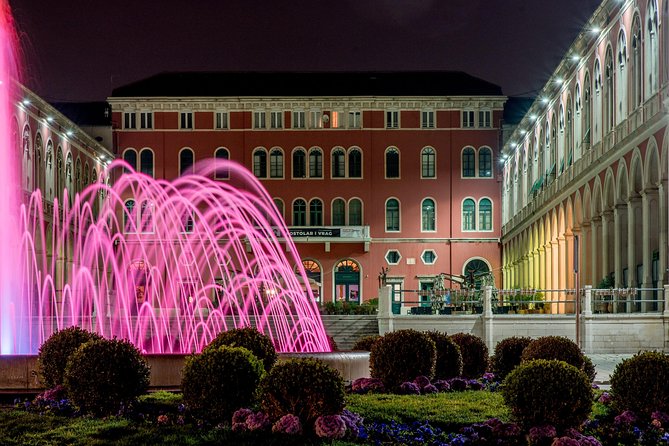
The official name for Prokurative is Republic Square. Its design resembles St. Mark’s Square in Venice, with arcaded buildings framing the open space.
The southern side is open toward the harbor and the Riva. That orientation gives the stop a change of pace. Inside the palace, you spend much of the time looking at Roman and medieval stone. Here, the view opens toward the water and the newer public face of Split.
The stop lasts about 10 minutes and is free. It is also a useful place to understand how Split has looked outward as a port city. The Venetian comparison gives the square a quick point of reference, but the harbor view keeps it tied to Split rather than turning it into a copy of somewhere else.
The Riva, Split’s outdoor living room
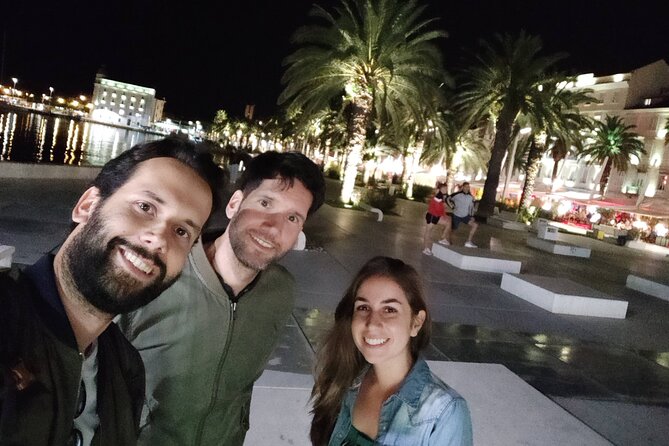
The Riva is the city’s main waterfront promenade. It is often described as Split’s living room, and that phrase makes sense once you see how central it is to public life.
The walk uses the Riva as more than a pretty harbor edge. It is the main stage for everyday activity and major public events. You will pass from the enclosed streets of the palace into a broad promenade where the city faces the water.
This stop takes about 10 minutes. It is a good point to pause and take in the change in atmosphere. The tour does not simply show you ancient Split, it also introduces the place where modern Split gathers.
The listed end point is Vodoskok, at Trg Franje Tuđmana, in front of the fountain at the beginning of the Riva promenade. The route also includes a final stop at Prva Vidilica Na Marjanu, so I would confirm the exact finishing arrangement with the guide on the day. The supplied meeting details connect the walk’s end with the fountain, while the viewpoint is described as the final stop.
The climb to Prva Vidilica Na Marjanu
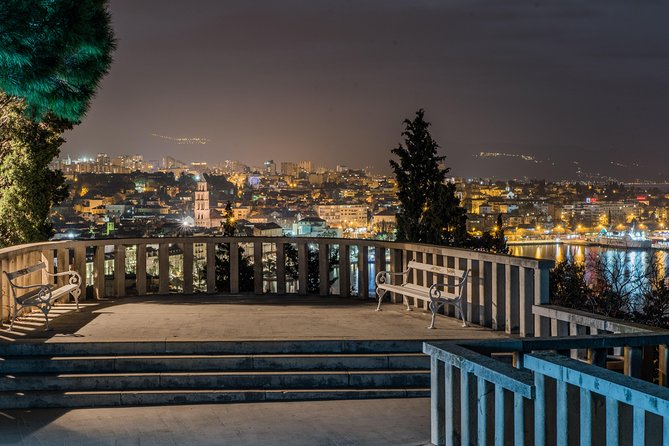
The final view comes at Prva Vidilica Na Marjanu, a terrace on Marjan Hill. From the old town, the walk to this viewpoint takes about 15 minutes on foot.
This is not a long mountain hike, but it is still the part of the route where comfortable shoes matter most. The reward is a broad view of Split, with the city laid out below you. After a tour focused on narrow lanes, walls, squares, and harbor activity, the viewpoint gives you a chance to see how the whole center fits together.
The stop itself takes about 15 minutes and is free. It is a strong ending because it gives you a visual map of the places you have just visited. If you plan to return to the palace later, the view can help you understand its position beside the waterfront and the wider city.
You should also keep the timing in mind. A 7:00 pm start, a route lasting up to two hours, and a final viewpoint stop mean the walk may finish after nightfall depending on the pace. The information provided does not give a precise finishing time.
The guides are a major part of the value
A city walk is only as good as the person leading it. Here, the guide is an English-speaking, licensed local, and the small group size gives the format a personal feel.
Bosko Papic received especially warm praise for being a Split native who could explain the palace, Croatian history, restaurants, and everyday life. That combination matters. You can ask where to eat, how to find your way around, or what local customs mean, instead of receiving only a prepared speech.
Pavle was praised for historical information and anecdotes that brought Split to life. A guide who can move between dates, stories, and practical details is useful on a first evening because you are still building a mental picture of the city.
Luka was also praised for sharing the story of his hometown. The personal connection is important here. Diocletian’s Palace has plenty of grand names and dates, but local affection helps explain why the place still matters beyond its Roman origins.
The small group is limited to eight people. One departure had only two participants, which can make the experience even more conversational, although you should not assume every date will be that small.
Price, timing, and practical value
At $39.74 per person, the tour costs more than walking the route alone. The Golden Gate, Peristyle, Vestibule, Pjaca, Prokurative, Riva, and Marjan viewpoint have no admission charge. The cathedral is the only listed stop with a separate entry fee.
So the price is mainly paying for structure, explanation, local advice, and efficient orientation. I think that is fair if you have just arrived in Split, want a quick introduction, or prefer asking questions as you walk. It is less compelling if you already know the palace well and enjoy researching each location independently.
The start time is fixed at 7:00 pm. The experience is offered in English and uses a mobile ticket. It is near public transportation, service animals are allowed, and most people can participate. Since the route includes walking for up to two hours and a 15-minute walk to the viewpoint, wear practical shoes.
The experience requires good weather. You can cancel for a full refund up to 24 hours before the start time. A cancellation made less than 24 hours in advance is not refunded, and changes inside that window are not accepted. If poor weather causes the operator to cancel, you will be offered another date or a full refund.
Who should book this Split walk?
I would recommend it most strongly if you have just arrived in Split. The route gives you a quick sense of direction, introduces the palace’s main spaces, and ends with a view that helps you understand the city’s layout.
It also suits anyone who wants local conversation rather than a large group lecture. The maximum of eight participants is a real advantage for questions about restaurants, football, history, and life in Split.
Families and older participants should consider the walking time and the route toward Marjan. The supplied information says most people can participate, but it does not provide detailed information about step-free access or the exact walking surface.
History fans will appreciate the shift from imperial mausoleum to cathedral, while first-time visitors may enjoy the balance of monuments and city life. If you want a long interior tour with extensive paid access, this is not that experience. It is a brisk outdoor introduction with one optional paid sight.
Should you book the evening walking tour?
Book it if you want a well-paced first look at Split, a small group, and a local guide who can connect Roman remains with present-day life. The palace, Riva, and Marjan viewpoint give you three different faces of the city in one short outing.
Think twice if you dislike crowds, do not want to walk uphill, or expect every stop to be quiet at night. The palace can remain busy, the cathedral costs extra, and the final viewpoint adds walking after the main old-town route.
For most first visits, I see this as a useful orientation tour with genuine local character. The strongest reason to choose it is not the number of stops. It is the chance to hear Split explained by someone who lives there, then look back at the city from above.
FAQ
How much does the Split evening walking tour cost?
The price is $39.74 per person.
How long does the experience last?
The tour lasts approximately one hour and 30 minutes to two hours.
What time does the tour start?
The tour starts at 7:00 pm.
Where does the tour meet?
The meeting point is the Golden Gate at Dioklecijanova 7, 21000 Split, Croatia.
Where does the tour end?
The listed end point is Vodoskok at Trg Franje Tuđmana, in front of the fountain at the beginning of the Riva promenade.
What language is the tour offered in?
The tour is offered in English.
What is included in the price?
An English-speaking licensed local guide is included.
Is entry to the Cathedral of Saint Domnius included?
No. Admission to the Cathedral of Saint Domnius is not included.
How many people can join the tour?
The maximum group size is eight participants.
Can I cancel for a full refund?
Yes, if you cancel at least 24 hours before the experience start time. Cancellations made less than 24 hours before the start are not refunded. If poor weather causes the tour to be canceled, you will be offered another date or a full refund.
Just added around Split
- Private VIP Blue Lagoon and 3 Islands Tour★ 4.5 · 9 reviews
- Private boat transfer Split – Bol★ 5.0 · 9 reviews
- From Split: Trogir & Blue Lagoon Boat Tour with Snorkeling★ 4.6 · 9 reviews
- Private Photography Activity in Split★ 5.0 · 9 reviews
- Bike, Beer & Poljud Stadium Tour★ 5.0 · 9 reviews
- From Hvar: Blue cave group speedboat tour full day★ 5.0 · 9 reviews
- Split Walking Tour: History, Legends & Tales★ 5.0 · 9 reviews
- Morning Stand Up Paddle Tour in Split★ 5.0 · 10 reviews
Walking Tours, compared.




Walking Tour of Split and Diocletian’s Palace
Read our review →


Krka Waterfalls tour with Trogir Walking tour and Krka panoramic boat cruise
Read our review →
City Walls Early Morning or Sunset Walking Tour
Read our review →Browse the lists this tour appears in