
Reviewed · HISTORICAL TOURS
Split Walking Tour with Professor of History
History gets personal in Split. This two-hour-20-minute walk brings Diocletian’s Palace and the old town to life with a professor of history, rather than a guide reciting dates from a script. I like the clear route from the Riva to Fruit’s Square, and I like the mix of Roman remains, Croatian culture, local stories, and practical food advice. The main thing to consider is the pace: the tour can run close to three hours, and Cathedral of Saint Domnius and the Temple of Jupiter are viewed from outside only.
Mario receives especially warm praise for his humor, strong command of Split’s past, and useful advice about restaurants, banks, shops, and onward travel. Anita is also described as thoughtful, proud of her Croatian roots, and attentive to her group. With a maximum of 17 people, this is small enough for questions, though it is not a private walk unless you choose the private upgrade.
In This Review
- What makes this Split tour worth your time
- Starting beside the Riva and the Brass Gate
- Beneath Diocletian’s Palace
- The Peristyle, where the emperor appeared as a god
- The Vestibule and the palace’s formal entrance
- Saint Domnius: a Roman mausoleum turned cathedral
- Jupiter’s Temple and the narrowest street
- The Golden Gate and Gregory of Nin
- Marmontova Street and the Prokurative
- Fruit’s Square and a taste of local life
- What the professor-led format adds
- Price, length, and practical value
- Who should book this walk?
- Should you book the Split history walk?
- FAQ
- Where does the Split walking tour start?
- Where does the tour end?
- How long does the tour last?
- What language is the tour offered in?
- Is the tour private?
- Are Cathedral of Saint Domnius and the Temple of Jupiter included?
- What is the cancellation policy?
What makes this Split tour worth your time
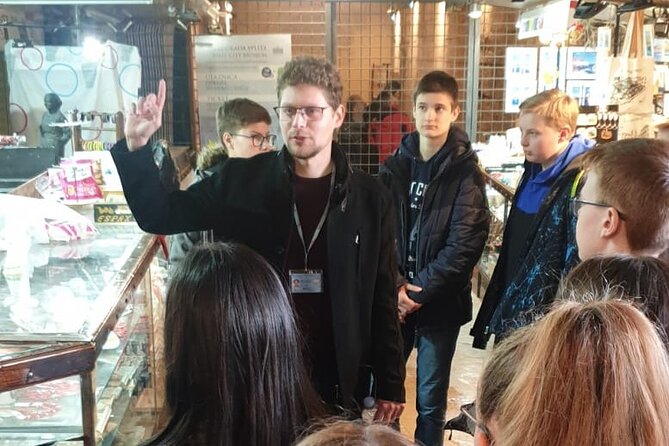
- A history professor leads the walk: Mario and Anita bring academic knowledge, stories, questions, and humor to the city’s Roman and Croatian past.
- The route covers more than Diocletian’s Palace: You move from the Riva and palace substructures through the Peristyle, Golden Gate, Marmontova Street, Prokurative, and Fruit’s Square.
- You see Split as a living city: Coffee culture, medieval lanes, modern streets, local food, and ancient stone all share the same route.
- The group is capped at 17 people: That gives you a better chance to hear the guide and ask questions than on a large coach-style walk.
- Important interiors are not included: The cathedral and Temple of Jupiter are explained from the outside, so you can decide later if you want to pay for entry.
- You get useful advice beyond history: Mario has offered tips on food, ATMs, banks, shops, and things to do after the walk.
Starting beside the Riva and the Brass Gate
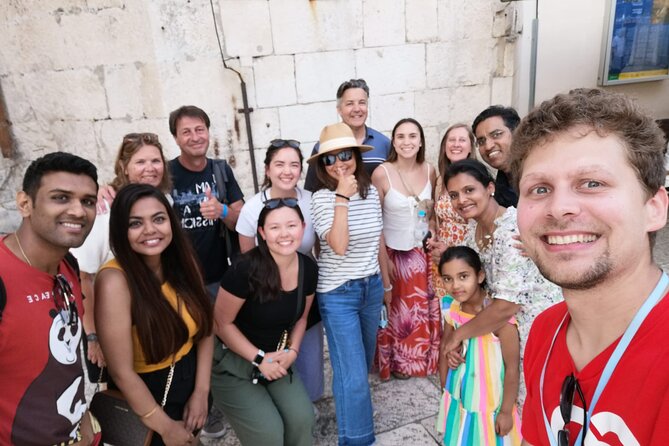
The meeting point is the Brass Gate, also called Porta Aenea, at Obala Hrvatskog narodnog preporoda 22. This puts you beside the Riva harbor promenade, one of the easiest places in Split to get your bearings.
The Riva is not just a pretty waterfront strip. It is where local life plays out over coffee, sunshine, and conversation. Starting here helps you understand that Split is not a museum locked behind glass. Ancient palace walls form the core of a working city, with homes, cafés, shops, and public squares inside and around them.
You spend about 15 minutes here, including an introduction near a model of the palace. This is a useful opening because Diocletian’s Palace is large and layered. A quick look at its shape gives you a better sense of how the emperor’s residence, military complex, religious buildings, and later town fit together.
The tour ends back at the meeting point. That is handy if you are staying near the harbor or arriving by public transport. The exact walking pace can vary, especially in crowded lanes or during hot weather.
More Historical Tours in Split
- Walking Tour of Split with a ‘Magister’ of History
★ 5.0 · 1,122 reviews - Split: History and Heritage Walking Tour
★ 4.9 · 650 reviews - Split History and Gastro Small-Group Tour with Food and Drinks
★ 5.0 · 375 reviews
Beneath Diocletian’s Palace
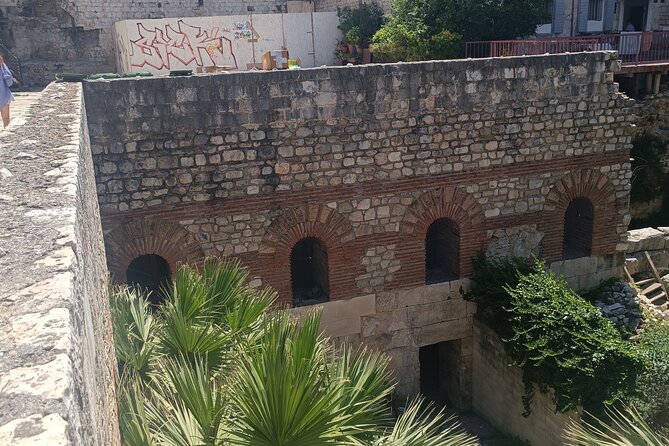
The palace substructures are one of the strongest parts of the route. These basement halls are unusually well preserved and help explain the shape of the rooms above them.
You spend about 15 minutes here. The substructures were not simply spare storage rooms in the modern sense. They supported and mirrored much of the imperial palace above, giving historians important clues about the original layout.
A professor-led explanation is valuable here because bare stone can be hard to read on your own. The guide can connect the walls, corridors, and construction methods to Diocletian’s larger plan. This is also where the scale of the palace begins to sink in.
The substructures are listed with free admission for the stop, while the tour price includes all fees and taxes. The cathedral and Temple of Jupiter have separate admission limitations, so do not assume every interior along the route is covered.
The Peristyle, where the emperor appeared as a god
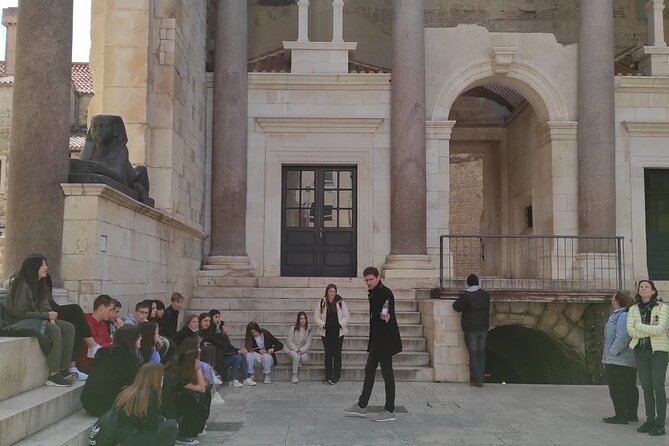
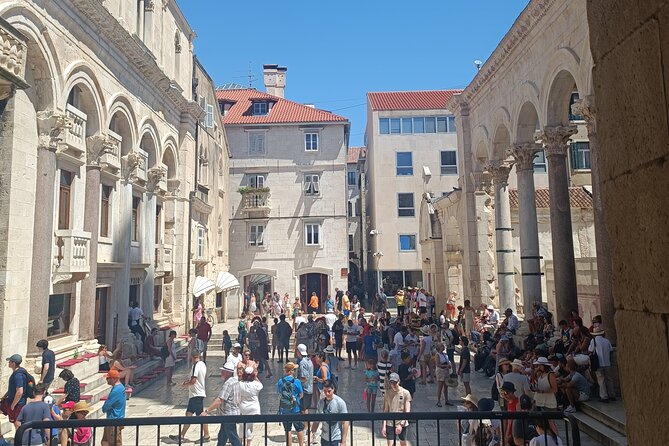
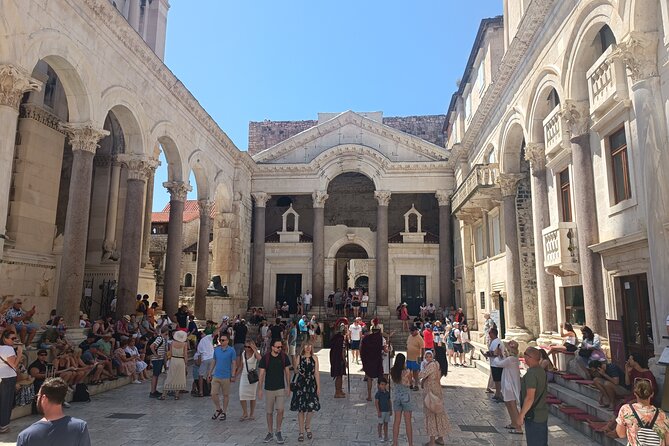
The Peristyle is the palace’s central square and one of Split’s most dramatic spaces. You spend about 10 minutes here, learning how Diocletian presented himself as the living son of Jupiter.
The square was designed for ceremony. The emperor would appear beneath the central architrave of the protyron while subjects approached in submission, kneeling, kissing the edge of his scarlet cloak, or lowering themselves fully to the ground. That detail gives the Peristyle a human scale. You are not only looking at columns. You are standing where power was carefully staged.
This is a good place to ask questions. The guide’s role is not just to point at stones, but to explain how architecture supported Roman politics and imperial image-making. Mario is praised for mixing serious information with humor and trivia, which should make this stop easier to follow than a string of formal dates.
Because the Peristyle is open and central, it can be busy. A small group helps, but you should still expect other people and occasional interruptions.
The Vestibule and the palace’s formal entrance
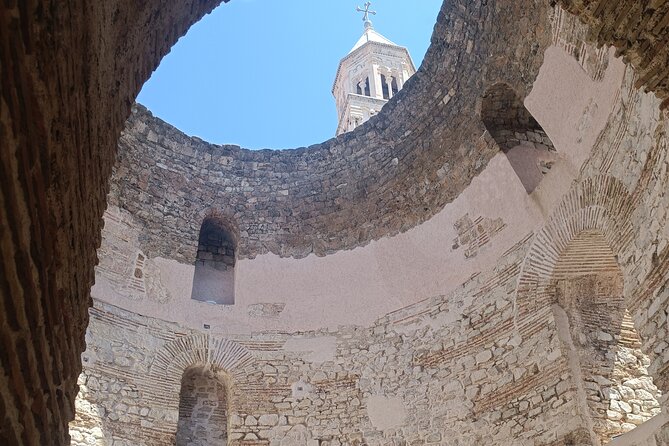
The Vestibule, also called the Rotonda, takes about 10 minutes. This circular hall was part of the imperial corridor leading from the Peristyle to the emperor’s apartments.
It was built by the beginning of the fourth century and originally had a dome. The dimensions are impressive: about 17 meters high and 12 meters across. This was not a casual hallway. It was a grand meeting space for selected audiences, including ambassadors.
The stop works best when you picture the room as a stage between public ceremony and private imperial quarters. The Vestibule helped control who could approach the emperor and how that approach happened.
You should expect to stand while listening, as with most stops on this walking tour. One useful detail from the tour feedback is that Mario has made an effort to keep groups in the shade when possible and move them around rather than leaving everyone fixed in one place. That matters in Split’s summer heat.
More Walking Tours in Split
- Split: Old Town and Diocletian Palace Walking Tour
★ 4.9 · 4,727 reviews - Walking Tour of Split and Diocletian’s Palace
★ 5.0 · 2,588 reviews - Krka Waterfalls tour with Trogir Walking tour and Krka panoramic boat cruise
★ 5.0 · 1,659 reviews - Split & Diocletian’s Palace Walking Tour
★ 5.0 · 1,125 reviews
Saint Domnius: a Roman mausoleum turned cathedral
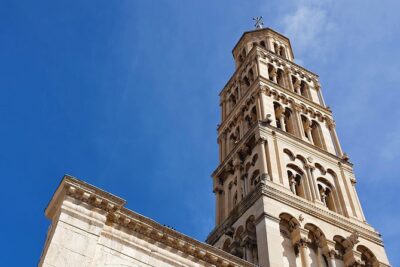
The Cathedral of Saint Domnius receives about 20 minutes, the longest single stop. You view it from outside, since entrance is not included, but the guide gives detailed information for anyone who wants to return later and pay for admission.
The building has had several lives. It began as a Roman temple and mausoleum connected to Diocletian. It later became a Christian church. That change tells you much about Split: the city did not erase its Roman foundation. It reused it, adapted it, and built new religious meaning around it.
A longer explanation here is helpful because the cathedral is easy to misread as a single-period building. The outside view gives you the basic story, while a separate visit would let you explore the interior more fully.
If you want to go inside after the walk, listen carefully to the guide’s explanation and ask about timing. The tour itself does not include that entry fee, so budget separately.
Jupiter’s Temple and the narrowest street
The Temple of Jupiter gets about 10 minutes and is also viewed from outside. Jupiter was the Roman sky and thunder god and the supreme god of Roman religion. The temple was later converted into a baptistery dedicated to Saint John the Baptist.
That change from Roman worship to Christian use is one of the clearest examples of Split’s layered past. A short stop can cover a lot, so this is another place where questions are welcome.
On the way to the Golden Gate, you pass a narrow lane called Let Me Pass Street. Local people believe it is the narrowest street in the world. The claim is part of the fun, but the lane is also a good reminder that Split’s medieval city grew in and around the old palace rather than replacing it with a clean modern plan.
The route through these tight streets may be awkward for anyone who dislikes crowded spaces. Still, the small lanes are part of what makes a walking tour more revealing than a quick look from the waterfront.
The Golden Gate and Gregory of Nin
The Golden Gate, or Northern Gate, takes about 15 minutes. It was one of the four main Roman entrances into the palace and the route through which Diocletian entered the complex.
The gate was once richly decorated to mark its importance. During the Middle Ages it was sealed and lost columns and statues, then later reopened and repaired. That history gives you a useful lesson: ancient monuments rarely arrive in the present exactly as their builders left them.
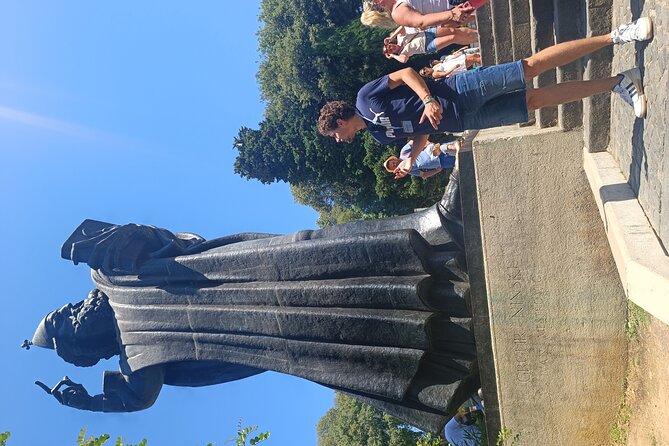
Next comes the statue of Gregory of Nin, which takes about 10 minutes. Created by Ivan Meštrović, the statue is 8.5 meters tall and honors Gregory of Nin, an important Croatian church figure.
The shiny toe is the obvious photo stop. Rubbing it is said to bring good luck, and years of touching have worn it smooth. It is a light moment after the heavier imperial material, but the statue also opens a door into Croatian identity and medieval church history.
Marmontova Street and the Prokurative
Marmontova Ulica takes about 10 minutes. It is named for Napoleon’s marshal Marmont, who helped urbanize Dalmatian cities despite being a conqueror.
That small fact is typical of this tour’s approach. History is not divided into simple heroes and villains. A military figure could be unpopular for political reasons and still influence the shape of a city. The street lets you shift from Roman and medieval Split into the period of French rule and later urban development.
The next stop is Prokurative, or Republic Square, with another 10 minutes. Three sides of the square are lined with elaborate neo-Renaissance buildings. Compared with the tight palace lanes, this open space feels broad and formal.
The name Republic Square and its architecture invite discussion of later civic life, public design, and the ways cities borrow from older architectural styles. It is also a natural place to pause, look around, and compare the newer square with the ancient core you have just crossed.
Fruit’s Square and a taste of local life
The final stop is Fruit’s Square, officially Trg Braće Radić. You spend about 15 minutes here.
The square takes its English nickname from the women who once sold fruit there. That detail shifts the focus from emperors and monuments to everyday trade. You also hear about the statue of Marko Marulić, often called the father of Croatian literature, and connect the square to Croatian culture and gastronomy.
This is a smart ending. You finish with a sense of how Split works as a town, not just how it functioned as an imperial palace. The guide may also offer ideas for food and places to visit after the walk. Mario has been praised for sharing restaurant advice, ATM and bank tips, and suggestions for onward travel.
The tour ends at the original meeting point, so Fruit’s Square is not the final stop in a remote part of the city. You can continue exploring from there or return toward the Riva.
What the professor-led format adds
The strongest reason to book this walk is the guide, not simply the route. Split has plenty of ancient stone, but stone alone does not explain why the palace survived, how Roman authority worked, or why modern homes and businesses occupy the old complex.
Mario is repeatedly praised for combining history with humor, trivia, current issues, food advice, and local recommendations. He is also described as careful with group comfort and good at moving people away from the worst crowds. Anita receives praise for her preparation, warmth, pride in Croatia, and attention to a group of 14 people.
The language offered is English. The group maximum is 17, which keeps the walk manageable without making it fully private. If you want more individual attention, a private upgrade is available.
You should expect a teaching style rather than a simple sightseeing loop. The guide may ask questions, challenge familiar stories, and separate well-supported facts from myths. That suits you if you want context and conversation. It may feel long if you prefer quick photo stops and little explanation.
Price, length, and practical value
At $24.19 per person, this is a reasonable price for a 140-minute walk led by a history professor, especially if you use the advice to plan the rest of your time in Split. You are paying for interpretation and orientation, not just access to sights.
The value is strongest for a first visit. In one route, you cover the palace core, Roman religious sites, medieval streets, Croatian culture, French-era urban design, and public squares. Afterward, you can choose which paid interiors deserve your time and money.
The stated duration is about two hours and 20 minutes, but one person found the actual walk closer to three hours. I would leave extra room in your schedule rather than booking a tight lunch reservation or ferry connection immediately afterward.
Wear comfortable shoes. The route is on foot through old streets and palace spaces, and you may spend time standing. Most people can participate, service animals are allowed, and the meeting point is near public transportation.
The experience is offered in English and requires good weather. You can cancel for a full refund up to 24 hours before the start time. If poor weather cancels the walk, you are offered another date or a full refund.
Who should book this walk?
I would choose this tour if you are visiting Split for the first time, enjoy history, or want the city explained before exploring on your own. It is also a good fit if you like a guide who can connect monuments with food, local customs, and modern life.
Families with older children may appreciate the humor and short stories, though the full length could test very young children. History students, architecture fans, cruise passengers with enough time, and visitors who want practical recommendations should get strong value.
You may want a shorter or more flexible option if you dislike long explanations, have limited mobility, or need to keep strictly to a schedule. You should also remember that the cathedral and Temple of Jupiter are outside-only stops unless you return independently and pay for entry.
Should you book the Split history walk?
Yes, especially for a first stay in Split. The route gives you the essential palace sights, but the real benefit is the guide’s ability to explain how Roman, medieval, Croatian, French, and modern Split overlap in the same few streets.
Book it if you want facts with personality, a small group, and useful advice for the rest of your visit. Choose the private upgrade if personal questions and a more tailored pace matter to you. Skip it only if you want a quick orientation with minimal commentary, or if you cannot spare up to three hours.
FAQ
Where does the Split walking tour start?
It starts at the Brass Gate, also called Porta Aenea, at Obala Hrvatskog narodnog preporoda 22 in Split.
Where does the tour end?
The walk ends back at the meeting point.
How long does the tour last?
The advertised duration is approximately two hours and 20 minutes. It may run closer to three hours, so leave extra time afterward.
What language is the tour offered in?
The tour is offered in English.
Is the tour private?
The standard experience is a small-group tour with a maximum of 17 people. A private upgrade is available.
Are Cathedral of Saint Domnius and the Temple of Jupiter included?
Both are visited from outside only. Admission is not included, but the guide provides information if you want to visit them later.
What is the cancellation policy?
You can cancel at least 24 hours before the start time for a full refund. Cancellations or changes made less than 24 hours before the start time are not accepted for a refund. If bad weather cancels the experience, you are offered another date or a full refund.
Just added around Split
- Private VIP Blue Lagoon and 3 Islands Tour★ 4.5 · 9 reviews
- Split highlights – Evening walking tour★ 5.0 · 9 reviews
- Private boat transfer Split – Bol★ 5.0 · 9 reviews
- From Split: Trogir & Blue Lagoon Boat Tour with Snorkeling★ 4.6 · 9 reviews
- Private Photography Activity in Split★ 5.0 · 9 reviews
- Bike, Beer & Poljud Stadium Tour★ 5.0 · 9 reviews
- From Hvar: Blue cave group speedboat tour full day★ 5.0 · 9 reviews
- Split Walking Tour: History, Legends & Tales★ 5.0 · 9 reviews
Historical Tours, compared.

Walking Tour of Split with a ‘Magister’ of History
Read our review →


Split History and Gastro Small-Group Tour with Food and Drinks
Read our review →
PREMIUM Emperor’s Walking Tour for History Lovers + Museum
Read our review →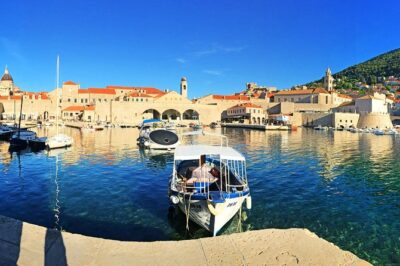
Browse the lists this tour appears in