
Reviewed · HISTORICAL TOURS
Split Walking Tour: History, Legends & Tales
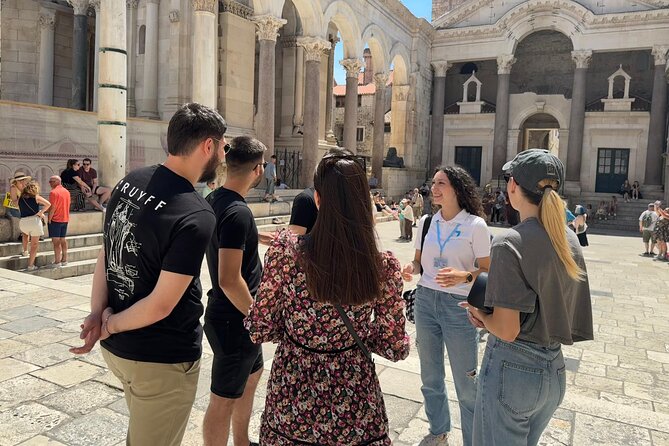
Split reveals its best stories on foot. This 90-minute walk links Diocletian’s Palace with the city squares and Riva Harbor, giving you a clear first look at Split’s Roman, medieval, Venetian, and modern layers. I especially like the small group limit of 12 and the guide’s local food recommendations, including pašticada and gelato. The tour costs $30.17, a fair price for a well-paced introduction.
I also like that the route stays outside paid attractions, so you do not spend extra on admission tickets. The tradeoff is that you will see the Palace Substructures and other sights without entering museums or ticketed rooms. If you want a detailed look inside every monument, this walk will feel like an introduction rather than a full archaeological visit.
In This Review
- Key points at a glance
- Why this short Split walk works so well
- Starting at Riva Harbor with Diocletian
- Beneath the Palace in the Substructures
- The Vestibule and Diocletian’s Southern Apartments
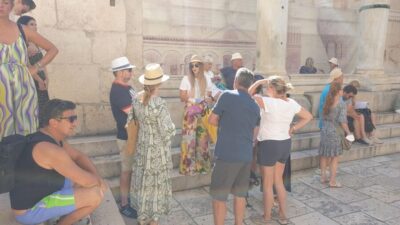
- The Peristyle, sphinx, and central drama
- The Golden Gate and Gregory of Nin
- People’s Square and the city beyond the walls
- Fruit’s Square and Venetian Split
- Ending back on Riva
- What the $30.17 price gets you
- Timing, weather, and who should book
- Should you book Split Walking Tour: History, Legends & Tales?
- FAQ
- Where does the tour start?
- Where does the tour end?
- How long does the walking tour last?
- What language is the tour offered in?
- How much does the tour cost?
- Are admission tickets included?
- How large is the tour group?
- Is a licensed guide included?
- Is the tour suitable for most people?
- What happens if the weather is poor?
Key points at a glance
- A 90-minute route from Riva and back: You begin and end beside Split’s main harbor promenade, which makes the walk easy to fit into a first day.
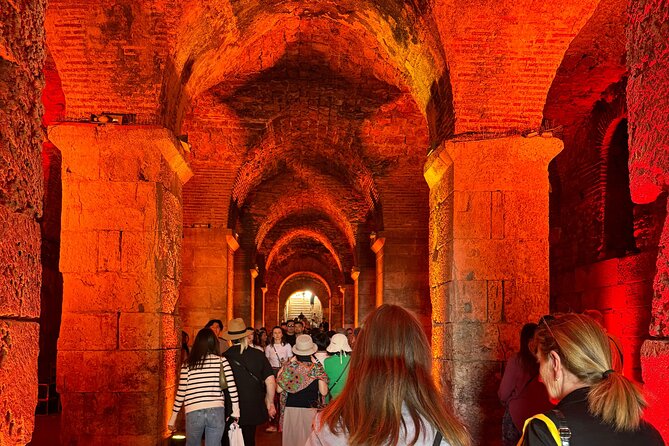
- The Palace Substructures reveal Roman engineering: You pass through the underground foundations and corridors, without entering a paid site.
- The Peristyle pairs Roman and Egyptian history: The square includes a well-preserved 3,500-year-old sphinx.
- Local legends keep the history lively: At Gregory of Nin’s statue, you can rub the large toe and make a wish.
- Lucija earns especially warm praise: Her friendly explanations, city stories, restaurant suggestions, and patience with children are repeated highlights.
- Small groups improve the experience: The maximum is 12 people, and some departures may be much smaller.
Why this short Split walk works so well
Split can be confusing at first. The old center is not a tidy museum district with one obvious entrance. It is a living city built into and around the remains of a Roman emperor’s retirement palace. Laundry hangs near ancient stone. Cafés occupy old walls. Residents cross spaces that once belonged to Diocletian.
That mixture is the real point of this experience. In 90 minutes, you get a simple map of the center and a story for the stones around you. The route moves from the waterfront through the Palace and then into the later city outside its walls.
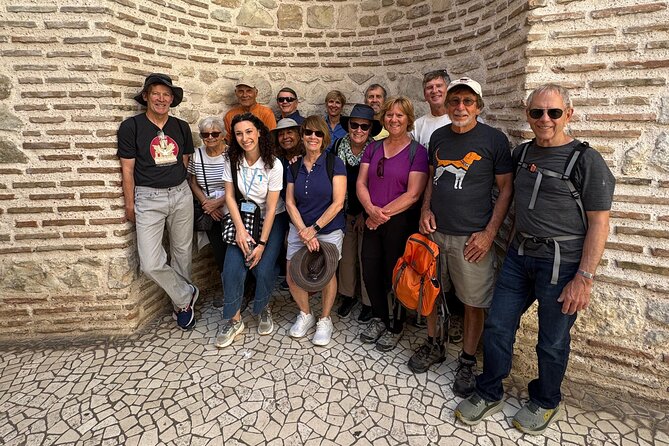
The group size matters. With a maximum of 12 people, you have a better chance of hearing the guide in narrow lanes and asking questions without holding up a large crowd. Several bookings have ended up with only two people, which can feel almost like a private walk, though you should not assume every departure will be that small.
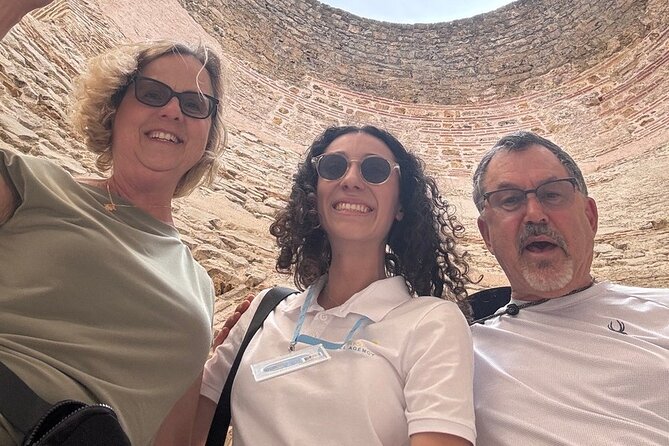
The guide is a major part of the appeal. Lucija is praised for an informal style, clear explanations, patience, and a strong affection for Split. She also gives practical suggestions for restaurants, bars, excursions, gelato, and local dishes. One particularly useful recommendation is pašticada, a Dalmatian beef dish that appears often in descriptions of her food advice.
More Historical Tours in Split
- Walking Tour of Split with a ‘Magister’ of History
★ 5.0 · 1,122 reviews - Split Walking Tour with Professor of History
★ 5.0 · 926 reviews - Split: History and Heritage Walking Tour
★ 4.9 · 650 reviews
Starting at Riva Harbor with Diocletian
The meeting point is Obala Hrvatskog narodnog preporoda 22, along Riva Harbor. This is Split’s main promenade, lined with palms, cafés, and views across the waterfront. The tour begins with a model of Split and an introduction to the city, Emperor Diocletian, and his palace.
This opening is useful because it gives you a mental picture before you enter the old center. The Palace is not simply one large building you walk into. Its surviving streets and structures form the core of modern Split, and the model helps explain how the pieces fit together.
You spend about 15 minutes here. That is enough time to set the scene without using up half the tour at the starting point. Riva is also a practical meeting place for cruise passengers and anyone arriving by public transportation. The end point is the same, so you finish in a familiar spot rather than being left in an unknown lane.
If you are arriving from a cruise ship, allow time to reach the meeting point and identify the exact address. The route is central, but the old town has many similar-looking streets and entrances.
Beneath the Palace in the Substructures
From Riva, the walk passes through the Substructures of Diocletian’s Palace. These underground corridors and rooms formed the foundation of the imperial residence above. They also show how carefully the Romans planned and supported the palace.
You spend roughly 10 minutes here. That is brief, but the guide can help you understand why the lower level matters. The rooms are not just atmospheric old stone. They mirror parts of the structure above and give you a sense of Roman building methods.
The description of this stop focuses on engineering, which is a good choice. It is easy to look at an ancient wall and see only age. Here, you begin to notice the practical work behind the palace: foundations, corridors, weight, and organization.
There is one important limitation. This experience does not include admission tickets, and it does not enter museums or paid sites. If access to a particular section of the Substructures requires payment on the day, you should expect to pass through the available public route rather than receive a full ticketed visit.
The Vestibule and Diocletian’s Southern Apartments
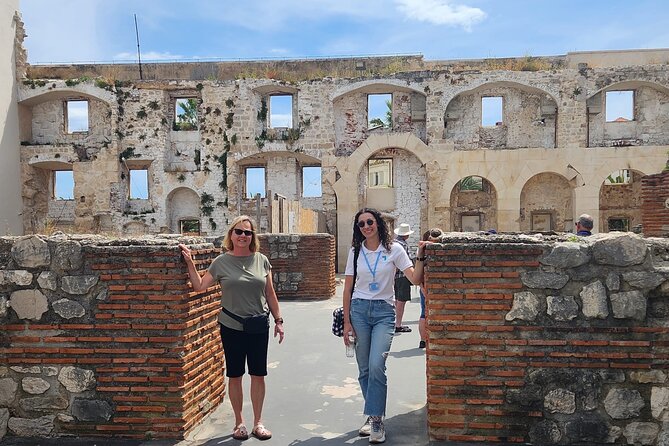
The next part leads through the southern portion of the Palace toward the Vestibule. This was the grand entrance hall to Diocletian’s apartments. Along the way, the guide points out the areas connected with the emperor’s private world, including the apartments, the Triklinium dining hall, and gardens.
This is where the Palace begins to feel less like a military or civic monument and more like a residence. Diocletian chose Split as a place to retire, and the southern section helps you imagine the palace as a home for an emperor, his household, and the people who served him.
The stop lasts about 10 minutes. You will not linger over every architectural detail, but the guide’s stories help tie the spaces together. Lucija’s style is especially suited to this kind of walk because the strongest praise centers on her ability to mix facts with funny stories and conversational explanations.
More Walking Tours in Split
- Split: Old Town and Diocletian Palace Walking Tour
★ 4.9 · 4,727 reviews - Walking Tour of Split and Diocletian’s Palace
★ 5.0 · 2,588 reviews - Krka Waterfalls tour with Trogir Walking tour and Krka panoramic boat cruise
★ 5.0 · 1,659 reviews - Split & Diocletian’s Palace Walking Tour
★ 5.0 · 1,125 reviews
The Peristyle, sphinx, and central drama
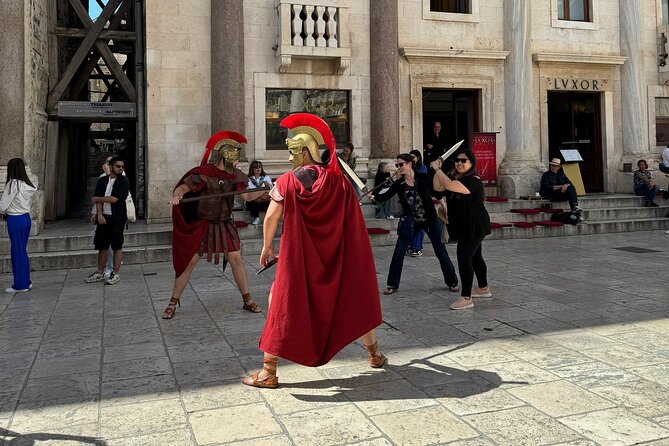
The Peristyle is the visual heart of the route. This ceremonial square once formed one of the most important public spaces in the Palace. Today, it remains one of the clearest places to feel the connection between ancient Rome and present-day Split.
You spend about 20 minutes here, the longest single stop. That extra time makes sense. The square contains several layers of meaning, and it deserves more than a quick photograph.
The Egyptian sphinx is the great surprise. It is described as 3,500 years old and remarkably well preserved, a reminder that Diocletian’s world drew on Egypt as well as Rome. Seeing the sphinx beside Roman architecture gives the square a wider story than a standard Roman ruin.
This is also a good place to pause and listen. The Peristyle is not a silent excavation site. It remains part of the city, and the contrast between ancient stone and daily life is central to understanding Split.
Because the tour stays outside ticketed attractions, the guide’s explanation is especially valuable here. You are not relying on museum labels or a long audio guide. The story comes from the person leading you, with room for questions.
The Golden Gate and Gregory of Nin
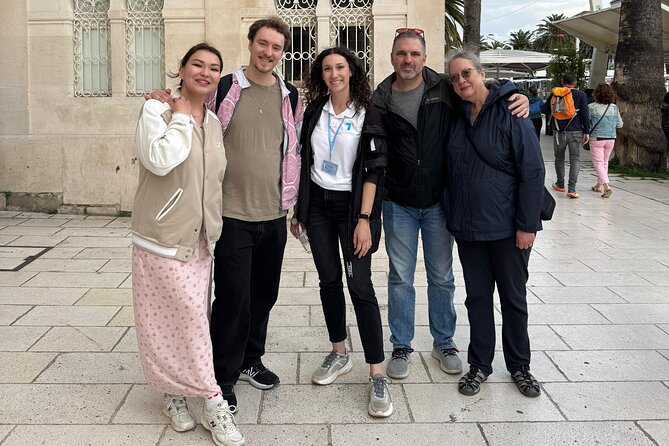
The route continues to the Golden Gate, one of the grand entrances into Diocletian’s Palace. This gateway gives you a strong sense of how the imperial complex was organized and how visitors once approached it.
The stop also includes the statue of Gregory of Nin. The local custom is simple: rub the statue’s large toe, make a wish, and move on with a little extra luck. It is a light moment after the more formal Roman architecture, and children usually appreciate having something hands-on to do.
You spend about 15 minutes in this area. The guide can connect the Palace to later Croatian religious and civic history, while the statue adds a bit of local folklore. That mix is exactly what the tour promises: history, legends, and tales rather than a strictly academic march through dates.
The Golden Gate is also a useful orientation point. Once you have seen how the Palace entrances relate to one another, the old town becomes easier to read on your own.
People’s Square and the city beyond the walls

After the Golden Gate, the walk leaves the Palace area and reaches Narodni Trg, commonly called Pjaca or People’s Square. This square sits beyond the western wall, near the Iron Gate. As Split’s population grew, the Palace became too small, and this area began developing outside the original walls in the 14th century.
That change is one of the most important ideas in the whole walk. Split did not remain frozen inside Diocletian’s plan. The city expanded, added new civic spaces, and continued to change around the old imperial core.
The former 15th-century city hall is one of the square’s key landmarks. Pjaca has served as a gathering place for centuries, and it still works as a pleasant place for coffee or an evening stroll.
You spend about 10 minutes here. The stop is not as visually dramatic as the Peristyle, but it gives you the story of a growing town. I like that the tour does not treat the Palace as the whole of Split. It shows you where the later city begins.
Fruit’s Square and Venetian Split
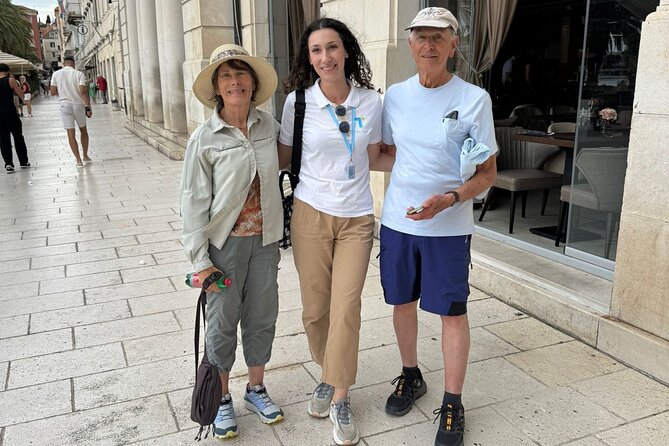
The final major stop is Fruit’s Square, officially Trg Braće Radić. It is a smaller square, but it carries several distinct pieces of Split’s later history. Bars, restaurants, shops, and occasional fairs give it an active city feel.
The octagonal Venetian tower is the main landmark. Built in the 15th century as part of the town’s defenses, it is a leftover from a period when Split was a smaller fortified settlement. Its shape makes it easy to recognize, and its position helps explain how defense shaped the square.
Across from the tower is the former Milesi family palace, built in the 17th century. Its Baroque façade is described as one of the finest examples of the style in Dalmatia. This is a useful contrast with the earlier stops: you move from Roman imperial design to Venetian fortifications and then to Baroque private wealth.
The visit here lasts about 10 minutes. It is enough to take in the square and understand its place in the city without turning the walk into an architecture lecture.
Ending back on Riva
The tour returns to Riva Harbor, completing the loop. Ending where you started is practical. You can continue along the promenade, stop for a drink, return to your ship, or use the walk as a launch point for exploring Split alone.
By this point, you have seen the main landmarks around Diocletian’s Palace and the first important squares beyond it. You also have a basic route in your head, which is often more useful than a long list of isolated facts.
The walk is especially good at the beginning of a stay. Several ratings describe it as an effective first introduction, and that makes sense. Once you know the Palace entrances, Peristyle, Golden Gate, Pjaca, Fruit’s Square, and Riva, later wandering becomes less random.
What the $30.17 price gets you
At $30.17 per person, this is not the cheapest way to look at Split’s old center, since you can walk through many streets without a guide. The value comes from the explanations, the route, and the chance to ask questions in a small group.
There are no admission tickets included. That keeps the advertised price clear, but it also means you should not expect entry into museums or paid Palace sites. The walk is best judged as a guided orientation, not as an all-access Palace visit.
For a first visit, I think the price is reasonable if you want context and local suggestions. It becomes better value when the group is small and the guide is as engaged as Lucija. Her advice about restaurants, bars, gelato, food, and other outings can also help shape the rest of your stay.
The tour is offered in English. Group discounts are available, and confirmation is provided at booking. The experience is listed as suitable for most people, allows service animals, and is near public transportation.
Timing, weather, and who should book
An early morning departure is a smart choice if available. One rating specifically points out that morning was cooler and less crowded. Split’s old center can feel very different in the heat, so a cooler start may make the 90-minute walk more comfortable.
The tour requires good weather. If poor weather cancels it, you can choose another date or receive a full refund. You can also cancel for a full refund up to 24 hours before the start time. Changes or cancellations within 24 hours are not accepted for a refund.
I would recommend this experience to:
- First-time visitors who want a clear introduction to Split
- Cruise passengers with limited time in port
- Families, since the guide has been praised for engaging with four children
- People who prefer stories and local context to a silent sightseeing route
- Anyone who wants restaurant and gelato suggestions from a local guide
- Visitors who prefer small groups over large city walks
I would look elsewhere if your main goal is extensive access to paid archaeological areas, museums, or a long specialist lecture. This walk gives you a strong overview, but it does not replace a full Palace admission or a dedicated archaeology tour.
Should you book Split Walking Tour: History, Legends & Tales?
Book it if you want a friendly, compact introduction to Split. The route covers the essential old-town sights, begins and ends at Riva, and adds useful details about food and local places. The Peristyle, sphinx, Golden Gate, and Palace foundations give you plenty of memorable landmarks in a short time.
Lucija is the clearest reason to choose this particular walk. Her warm manner, local pride, patience, and practical recommendations receive repeated praise. You should still remember that the experience depends heavily on the guide assigned to your departure, and that no paid entries are included.
For $30.17, I see this as a sensible first-day purchase, especially for cruise passengers, families, and anyone who wants to get oriented quickly. Take the walk early, listen closely at the Peristyle, make your wish at Gregory of Nin’s toe, and save room afterward for pašticada or gelato.
FAQ
Where does the tour start?
The tour starts at Obala Hrvatskog narodnog preporoda 22, 21000 Split, Croatia, along Riva Harbor.
Where does the tour end?
The experience ends back at the same meeting point at Riva Harbor.
How long does the walking tour last?
The tour lasts approximately 1 hour and 30 minutes.
What language is the tour offered in?
The tour is offered in English.
How much does the tour cost?
The listed price is $30.17 per person.
Are admission tickets included?
No. Admission tickets are not included, and the tour does not enter museums or paid sites.
How large is the tour group?
The tour has a maximum of 12 travelers.
Is a licensed guide included?
Yes. A licensed tour guide is included.
Is the tour suitable for most people?
Yes. Most people can participate, and service animals are allowed. The experience is also near public transportation.
What happens if the weather is poor?
The experience requires good weather. If it is canceled because of poor weather, you will be offered another date or a full refund.
Just added around Split
- Private VIP Blue Lagoon and 3 Islands Tour★ 4.5 · 9 reviews
- Split highlights – Evening walking tour★ 5.0 · 9 reviews
- Private boat transfer Split – Bol★ 5.0 · 9 reviews
- From Split: Trogir & Blue Lagoon Boat Tour with Snorkeling★ 4.6 · 9 reviews
- Private Photography Activity in Split★ 5.0 · 9 reviews
- Bike, Beer & Poljud Stadium Tour★ 5.0 · 9 reviews
- From Hvar: Blue cave group speedboat tour full day★ 5.0 · 9 reviews
- Split Walking Tour: History, Legends & Tales★ 5.0 · 9 reviews
Historical Tours, compared.


Walking Tour of Split with a ‘Magister’ of History
Read our review →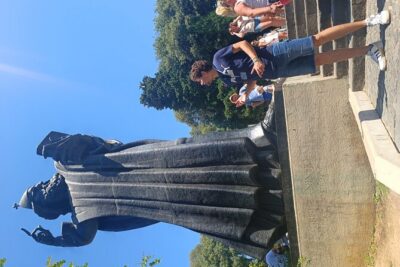


Split History and Gastro Small-Group Tour with Food and Drinks
Read our review →
PREMIUM Emperor’s Walking Tour for History Lovers + Museum
Read our review →Browse the lists this tour appears in