

Reviewed · HISTORICAL TOURS
Split: Private Walking Tour in the Historical Town Center
Split’s old town is history you can walk through. This private 105-minute tour links Diocletian’s Palace with the medieval streets that grew around it, then adds the city’s main squares and Riva promenade. I like the private format, which keeps the pace clear and makes it easy to ask questions. I also like the way the tour connects Roman, Venetian, French, Austro-Hungarian, and Yugoslav rule instead of treating Split as just a collection of old stones.
The main consideration is the price: $153 per group of up to 15 people is good value for a larger party, but expensive for one or two people. The Palace Substructures, also called the Basements, require a separate entrance fee, and the route is not suitable for wheelchair users.
In This Review
- Key points before you book
- Why this short private tour works well in Split
- Meeting the guide beside the bronze city model
- Diocletian’s Palace, where an imperial home became a city
- The Substructures reveal the Palace from below
- Peristil and the Cathedral of Saint Domnius
- Jupiter’s Temple and the Golden Gate
- Medieval Split beyond the Palace walls
- Pjaca and Fruit Square show the city’s public face
- Prokurative and the rule of different powers
- Riva gives the tour a natural finish
- How much value do you get for $153?
- What the guide adds to the experience
- Practical details to know before booking
- Who should book this Split walk?
- Should you book Sanja’s private Split tour?
- FAQ
- Where does the Split walking tour begin?
- Where does the tour end?
- How long does the tour last?
- What is the price of the private tour?
- Is the tour private?
- Which languages are available?
- Is entrance to the Palace Substructures included?
- Is Jupiter’s Temple visited inside?
- Is the tour suitable for wheelchair users?
- Can I cancel for a refund?
Key points before you book
- A private tour for up to 15 people: The fixed group price makes more sense for families or larger parties than for solo visitors.
- A strong first-day introduction: The route gives you useful context for exploring Split on your own afterward.
- Roman and medieval Split in one walk: You see Diocletian’s Palace, later neighborhoods, major squares, and Riva.
- A guide with language flexibility: Sanja leads tours in English, Italian, French, and Spanish.
- The Substructures add depth: The underground level requires a separate ticket but helps you understand the Palace above.
- A compact 105-minute route: You cover the key sights without giving up half a day.
Why this short private tour works well in Split
Split can feel confusing at first. Diocletian’s Palace is not a fenced-off ruin sitting apart from the modern city. It forms the core of the old town, with homes, cafés, shops, churches, and narrow lanes built into and around the Roman structure.
That is the central value of this walk. You are not simply moving from monument to monument. You are learning how one imperial residence became a medieval neighborhood, then part of a Venetian city, and later a town shaped by French, Austro-Hungarian, and Yugoslav rule.
I would schedule it early in your stay, ideally on your first full day. One Canadian couple specifically found that the tour helped them appreciate their time staying inside the old Palace walls. That is sound advice. Once you understand the basic layout and layers of Split, later wandering becomes much easier.
The tour lasts about 1 hour and 45 minutes. That is long enough for a proper orientation, but short enough to fit around lunch, a museum visit, or a ferry connection. A private group also means you do not have to match the pace of strangers, and you can hear the guide more easily in the tight streets.
More Historical Tours in Split
- Walking Tour of Split with a ‘Magister’ of History
★ 5.0 · 1,122 reviews - Split Walking Tour with Professor of History
★ 5.0 · 926 reviews - Split: History and Heritage Walking Tour
★ 4.9 · 650 reviews
Meeting the guide beside the bronze city model
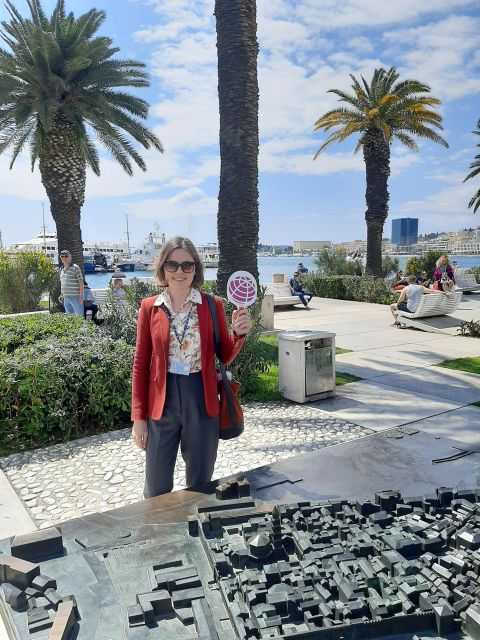
The meeting point is on Riva promenade, beside the bronze model of Split’s historical core. Look for it by the sea, in front of the south entrance to Diocletian’s Palace.
This is a smart starting place because the model gives you a quick map before you enter the old town. You can see the Palace walls, its position beside the water, and the way the later city developed around it. Split’s old center makes much more sense when you first see it from above, even in miniature.
The tour returns to this same area at the end. That makes the start and finish easy to remember, especially if you are meeting friends afterward or heading back toward the waterfront.
Diocletian’s Palace, where an imperial home became a city
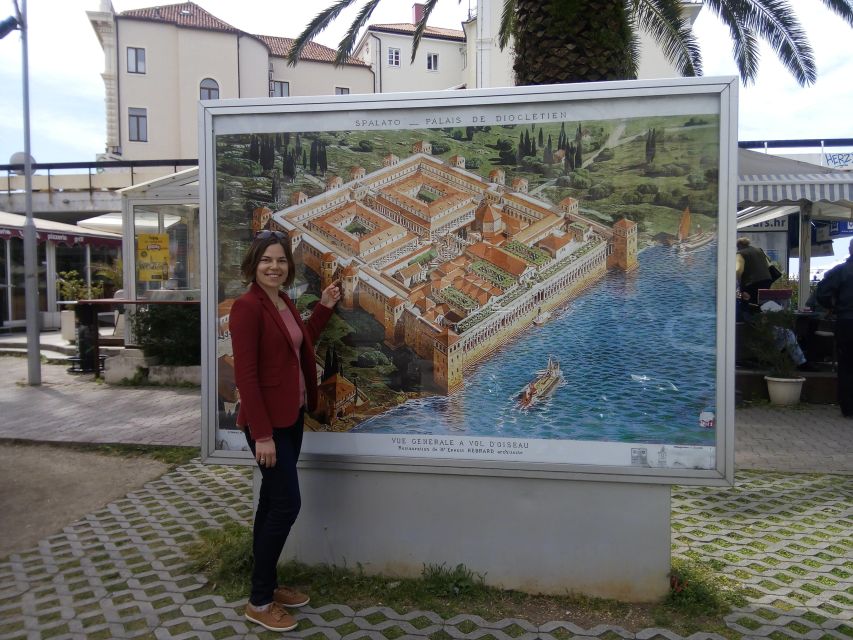
The first major section focuses on Diocletian’s Palace, built in the fourth century for the Roman emperor Diocletian. It is the oldest part of Split and the foundation for everything that follows.
You can expect a guided walk through the Palace streets and its surviving structure, with attention to the unusual mix of Roman remains and later buildings. Medieval homes occupy spaces that once served an imperial purpose, so the setting feels less like a single archaeological site and more like a working town built inside an ancient plan.
The Palace walls and four gates help you understand the original design. The gates mark the main entrances and show how the complex was organized. They are useful orientation points during your own later walks, since Split’s narrow lanes can quickly make you lose your sense of direction.
The Golden Gate receives its own stop on the route. It is one of the clearest reminders that this was once a carefully planned Roman residence, not merely a collection of old walls. Your guide can also explain how later residents adapted the Palace instead of preserving it as a frozen monument.
The Substructures reveal the Palace from below
The Palace Substructures, often called the Basements, are one of the most useful paid additions to this walk. The entrance fee is not included, so you should budget separately for admission.
The underground rooms help explain the shape of the imperial apartments above. They also show how much of the old plan survives below the present city. A guide can make this connection clear, which is harder to do when you visit the Basements alone and see only a series of stone rooms.
The route allows about 30 minutes for the Palace section, including the main complex. That is enough for an introduction, but not a slow archaeological study. If you are especially interested in Roman building methods, ask questions during the private tour and consider returning later for more time below ground.
More Walking Tours in Split
- Split: Old Town and Diocletian Palace Walking Tour
★ 4.9 · 4,727 reviews - Walking Tour of Split and Diocletian’s Palace
★ 5.0 · 2,588 reviews - Krka Waterfalls tour with Trogir Walking tour and Krka panoramic boat cruise
★ 5.0 · 1,659 reviews - Split & Diocletian’s Palace Walking Tour
★ 5.0 · 1,125 reviews
Peristil and the Cathedral of Saint Domnius
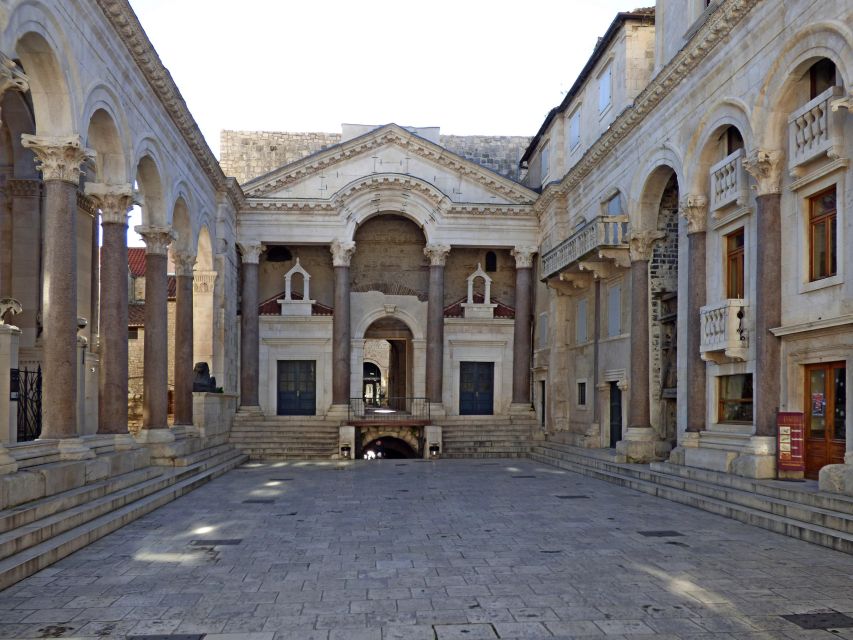
Peristil is the Palace’s central square and one of the most memorable spaces in Split. Tall stone columns frame the open area, and the surrounding buildings show several periods of construction in one glance.
The square is a good place to pause and let the original Roman plan sink in. It also helps explain the religious and political role of the Palace. Your guide can connect the formal Roman center with the later Christian buildings that occupy the same complex.
The Cathedral of Saint Domnius, also known as the former Mausoleum of Diocletian, adds one of Split’s most striking conversions. A structure built for an emperor later became a Christian cathedral. The tour includes a guided look and a pass by, but the information provided does not include a separate cathedral admission.
That distinction matters. This experience is designed as a city walk, not as a series of interior museum visits. If you want extended time inside the cathedral or access to additional paid areas, you may need to arrange those separately.
Jupiter’s Temple and the Golden Gate
Jupiter’s Temple is visited from the outside, with no entrance fee included or required for the external stop described here. Like the cathedral, it shows how the Roman Palace contained spaces tied to imperial religion and later Christian use.
The temple is a small stop, about 10 minutes, but it adds an important piece to the Palace story. The tour does not treat the site as an isolated photo stop. It places it within the original Roman layout and the later changes made by the people who lived here.
The Golden Gate follows as another key orientation point. Walking between these locations gives you a feel for the compact scale of the historic core. You are moving through real streets rather than crossing a large museum ground, so the tour feels efficient without being rushed.
Medieval Split beyond the Palace walls
The second half leaves the tightest Roman core and moves into the medieval neighborhood that developed outside the Palace. This is where the tour becomes especially useful for understanding Split as a city, not just as Diocletian’s former residence.
The streets and buildings here reflect later urban growth. Noble families built homes, public life shifted toward new squares, and the city took on the shape you see today. The guide also points out medieval houses connected with noble families, giving you a sense of how social power was displayed in the old town.
A particularly unusual detail is the small former Jewish ghetto and its still-active synagogue. This is a reminder that Split’s story includes minority communities and daily life, not only rulers and grand buildings. The stop gives the walk a human scale.
Because this is a private tour, you can ask for more explanation if this part interests you. Sanja has been praised for answering questions clearly and for presenting the city’s story in French as well as English. Her ability to explain Split through several cultural periods is one of the strongest reasons to choose this format.
Pjaca and Fruit Square show the city’s public face
People’s Square, commonly called Pjaca, is one of the main medieval-era squares on the route. It offers a useful contrast with Peristil. Peristil belongs to the Roman Palace; Pjaca reflects the later town that formed beyond it.
The tour spends about 15 minutes here, the longest stop among the listed squares. That gives your guide time to explain how public life changed as Split expanded beyond the imperial compound.
Fruit Square, or Voćni trg, adds another view of the city’s social and architectural development. Its name recalls the fruit sellers who once used the square, while the surrounding buildings show the way commerce and daily activity shaped the old center.
These squares are good places to return after the tour. You can use them as fixed points when exploring on your own, meeting someone, or finding your way back toward the waterfront. The guide’s practical tips are most useful here because they turn the old town from a maze into a set of recognizable landmarks.
Prokurative and the rule of different powers
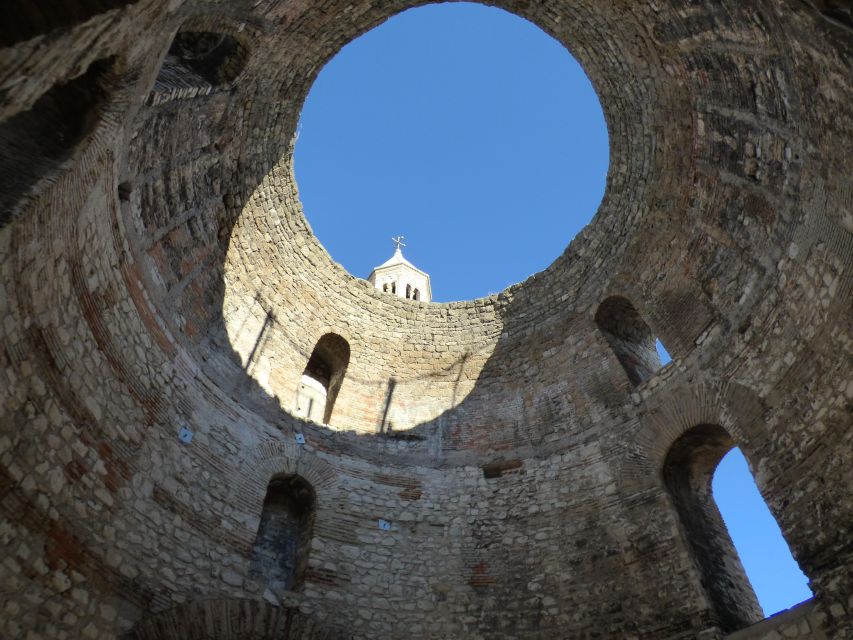
The route also includes Prokurative, a large square influenced by Venetian architectural ideas. It helps widen the story beyond Roman and medieval Split.
The tour explains how life changed under Venetian, French, Austro-Hungarian, and Yugoslav rule. That political timeline is valuable because Split’s buildings alone do not always explain who controlled the city or how those changes affected everyday life.
I appreciate this broader approach. A quick walk can easily become a list of emperors, dates, and stonework. Here, the historical periods are tied to the streets and squares around you, helping you see why the city looks the way it does.
You should not expect a full political history of Dalmatia in 105 minutes. The route gives you a clear framework, then leaves room for further reading or visits. That balance suits most people who want context without spending an entire day in a lecture.
Riva gives the tour a natural finish
The walk ends back on Riva promenade beside the sea. This is more than a convenient endpoint. Riva is one of Split’s main public spaces, and finishing there lets you shift from old stone lanes to the open waterfront.
The final 10 minutes provide time to connect the historic center with modern Split. From here, you can continue along the promenade, return to the Palace, or stop for a drink or meal nearby. The tour does not include transport, so the final location is useful if you plan to keep exploring on foot.
Because the route returns to the starting point, you do not have to worry about being left in an unfamiliar part of town. That is helpful after a compact but information-filled walk.
How much value do you get for $153?
The listed cost is $153 for a private group of up to 15 people. For a full party, the value is strong. Split’s old center contains enough layers and turns that a private guide can save you time, prevent confusion, and explain details you might otherwise pass without noticing.
For two people, the calculation is different. The same fixed price becomes a significant cost per person, especially since the Substructures require an additional entrance fee. A small group that prefers a personal pace may still find it worthwhile, but budget-minded couples should compare it with a shared walking tour.
For families and groups of friends, the price becomes easier to justify. You get one guide for the whole group, can ask questions without waiting behind a large crowd, and can hear the explanations clearly. The private setup also helps if your party wants the tour in French, Italian, Spanish, or English.
The strongest value comes when you use the tour as an orientation rather than a one-time sightseeing checklist. Book it near the beginning of your stay, take notes on the squares and gates, and use Sanja’s suggestions to plan the rest of your time.
What the guide adds to the experience
The guide is Sanja, a licensed local professional with a master’s degree. The strongest praise centers on her clear explanations, excellent French, strong English, and friendly response to questions.
Her presentation is especially useful for people who want the city’s history explained in a logical way. French-speaking visitors have found that she does more than translate facts. She also understands French culture, which can make comparisons and explanations feel more natural.
One Australian visitor valued Sanja’s ability to cover the city in every direction, from the Basements through the old town. A Canadian group of four appreciated the private arrangement because it was easy to hear and follow her. Those details point to the tour’s real advantage: personal communication, not simply access to a guide.
Still, the experience depends partly on your interests. If you want long, quiet time for photographs or detailed interior visits, the pace may feel brisk. If you want a clear introduction with plenty of historical connections, the format is a good fit.
Practical details to know before booking
The tour is available in English, Italian, French, and Spanish. It is a private group experience, and the maximum group size is 15 people.
The walk lasts 105 minutes and begins and ends beside the bronze model on Riva. Wear comfortable shoes, since the route uses city streets, Palace lanes, and historic squares. Wheelchair users should not book this activity because it is listed as unsuitable for wheelchair access.
The Substructures are not included in the price. The route describes an external visit to Jupiter’s Temple, so do not assume that every sight includes interior entry.
You can cancel up to 24 hours before the start for a full refund, and the reserve-now, pay-later option keeps your plans flexible. Starting times depend on availability, so check the schedule that suits your day.
Who should book this Split walk?
I would recommend it most strongly to first-time visitors, history fans, families, cruise passengers with limited time, and groups staying inside or near Diocletian’s Palace. It is also a smart choice if you want the tour in French, Italian, Spanish, or English and prefer direct access to your guide.
The tour works particularly well for anyone who wants to understand how Roman, medieval, and later European influences overlap in Split. You will leave with a clearer mental map and a better sense of which streets and squares deserve another look.
I would hesitate only if you are traveling alone or as a couple on a tight budget. The group price is much easier to defend when shared among several people. I would also choose another activity if you need a fully accessible route or want a slow, detailed visit inside every monument.
Should you book Sanja’s private Split tour?
Book it if you want a focused introduction to Split that combines Diocletian’s Palace, the Substructures, medieval neighborhoods, major squares, and political history in less than two hours.
The best plan is to take it early in your stay, pay the extra entrance fee for the Basements if they interest you, and use the guide’s landmarks to explore again afterward. At $153, it is not the cheapest way to see Split, but for a larger private group it offers a practical mix of orientation, local context, and personal attention.
FAQ
Where does the Split walking tour begin?
It begins beside the bronze model of Split’s historical core on Riva promenade by the sea, in front of the south entrance to Diocletian’s Palace.
Where does the tour end?
The tour ends back on Riva promenade by the sea, at the area of the starting point.
How long does the tour last?
The tour lasts 105 minutes, or about 1 hour and 45 minutes.
What is the price of the private tour?
The price is $153 per group of up to 15 people.
Is the tour private?
Yes. The activity is for a private group.
Which languages are available?
The live guide is available in English, Italian, French, and Spanish.
Is entrance to the Palace Substructures included?
No. Entrance to Diocletian’s Palace Substructures, also called the Basements, is not included and requires a separate entrance fee.
Is Jupiter’s Temple visited inside?
No. The tour includes an external visit to Jupiter’s Temple, with no entrance fee for that stop.
Is the tour suitable for wheelchair users?
No. The activity is listed as unsuitable for wheelchair users.
Can I cancel for a refund?
Yes. You can cancel up to 24 hours in advance for a full refund.
Just added around Split
- Private VIP Blue Lagoon and 3 Islands Tour★ 4.5 · 9 reviews
- Split highlights – Evening walking tour★ 5.0 · 9 reviews
- Private boat transfer Split – Bol★ 5.0 · 9 reviews
- From Split: Trogir & Blue Lagoon Boat Tour with Snorkeling★ 4.6 · 9 reviews
- Private Photography Activity in Split★ 5.0 · 9 reviews
- Bike, Beer & Poljud Stadium Tour★ 5.0 · 9 reviews
- From Hvar: Blue cave group speedboat tour full day★ 5.0 · 9 reviews
- Split Walking Tour: History, Legends & Tales★ 5.0 · 9 reviews
Historical Tours, compared.


Walking Tour of Split with a ‘Magister’ of History
Read our review →


Split History and Gastro Small-Group Tour with Food and Drinks
Read our review →
PREMIUM Emperor’s Walking Tour for History Lovers + Museum
Read our review →Browse the lists this tour appears in