
Reviewed · CITY WALLS & OLD TOWN TOURS
Split Old Town History Walking Tour
Roman ruins hide in plain sight here. This 90-minute walk is a smart introduction to Split because it brings you from the waterfront into Diocletian’s Palace, then out through old squares and city streets. I especially like the way the tour combines major sights with small local details, including the toe-rubbing tradition at the statue of Gregory of Nin. I also like the chance to hear practical tips about where to eat, drink, and continue exploring. The main consideration is pace: ten stops in an hour and a half leaves limited time for long historical explanations.
The tour costs $30.23 per person, includes a professional licensed local guide, and runs in English. Two departure times make it easier to fit around a ferry, cruise arrival, or hot afternoon. The tour has earned a 4.8 rating from 99 reviews, with 96 percent of customers recommending it, though two serious booking and cancellation problems show why it is wise to confirm the meeting details before setting out.
In This Review
- Key points to know before booking
- Starting on Split’s Riva waterfront
- Beneath Diocletian’s Palace in the cellars
- The Peristyle and Cathedral of Saint Domnius
- Acoustics in the Vestibule
- Temple of Jupiter and the palace’s religious changes
- Triklinij and imperial dining
- Leaving through the Golden Gate
- Pjaca and Split’s Venetian-era center
- Fruit’s Square and modern Split
- Back to the Riva after 90 minutes
- Guide quality, group size, and language
- Is $30.23 a fair price?
- What to wear and how to plan
- Who should book this Split walk?
- Should you book the Split Old Town History Walking Tour?
- FAQ
- How long is the Split Old Town History Walking Tour?
- What language is the tour offered in?
- How much does the tour cost?
- Where does the tour begin?
- Where does the tour finish?
- Is food or drink included?
- What happens if the weather is poor?
- Can I cancel for a full refund?
Key points to know before booking
- Roman Split in a short walk: Most of the time is spent around Diocletian’s Palace, the city’s essential sight.
- Local guides make the difference: Anita, Iva, Katarina, Petra, Toni, and Rocco are praised for clear explanations, warmth, humor, and local insight.
- Evening departures can be more comfortable: One guide-led walk was especially enjoyable later in the day, when the streets were cooler and quieter.
- Small groups are possible: The maximum is 20 people, but some departures have had only seven or ten.
- The route mixes famous sights and daily life: You see the Peristyle and cathedral, then Pjaca, Fruit’s Square, cafés, and the Riva.
- Plan for weather and uneven walking: The tour runs in all weather, needs comfortable non-slip shoes, and is not suitable for wheelchairs.
Starting on Split’s Riva waterfront
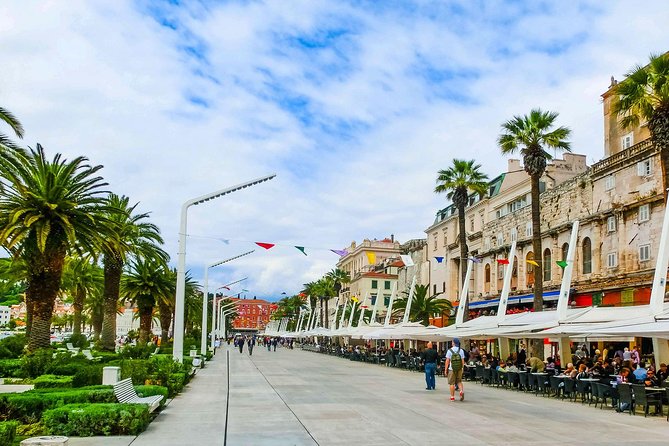
The tour begins at Obala Hrvatskog narodnog preporoda 21, on the Riva promenade. This is a useful meeting point because you start beside the sea rather than trying to find your guide inside the maze of Diocletian’s Palace.
Allow yourself enough time to locate the exact address. Split’s center is compact, but its old lanes can make a simple meeting point feel less simple when you are rushing. The guide uses the opening ten minutes to explain Split’s layout, culture, and broad story while you look across the waterfront.
That introduction matters. The Riva is not only a pretty place for a first photograph. It helps you understand how the modern city sits against the ancient palace. After the tour, you will recognize the waterfront as the edge of a much older urban core, not merely a promenade lined with cafés.
The Riva can be busy, particularly when several groups arrive at once. If you prefer a calmer start, choose the later departure when available. One experienced guide, Rocco, was praised for leading an evening walk that felt cooler and quieter than a midday outing.
More Historical Tours in Split
- Walking Tour of Split with a ‘Magister’ of History
★ 5.0 · 1,122 reviews - Split Walking Tour with Professor of History
★ 5.0 · 926 reviews - Split: History and Heritage Walking Tour
★ 4.9 · 650 reviews
Beneath Diocletian’s Palace in the cellars
From the waterfront, the route heads to the cellars beneath Diocletian’s Palace. These underground chambers are among the best places in Split to understand the palace above them.
The substructures supported the emperor’s residence and preserve the basic shape of the ancient complex. Your guide explains how these spaces related to the palace and what they suggest about Roman building methods and imperial life. You are not simply looking at old stone walls. You are seeing the hidden base of a residence built for an emperor.
The cellars are also a good change of mood after the open waterfront. The route moves from sea views and city noise into enclosed Roman spaces, then returns to the main palace level. Since the stop lasts about 15 minutes, expect a focused explanation rather than a long archaeological lecture.
There is a practical point here: the tour moves at a steady pace. If a particular column, arch, or chamber catches your eye, you may not have much time to study it alone. This is a first look that gives you a framework for returning later.
The Peristyle and Cathedral of Saint Domnius
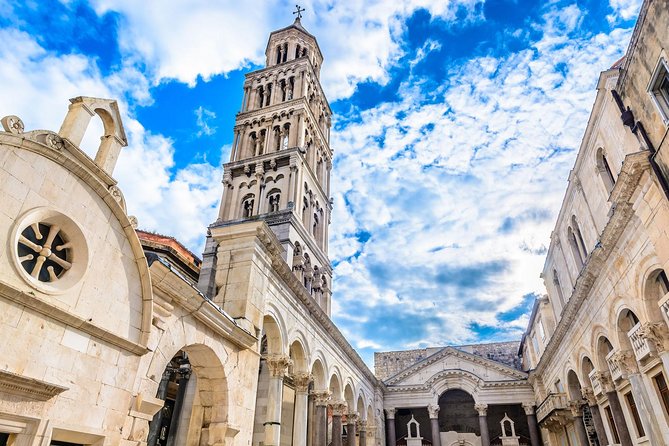
The Peristyle is the visual heart of the palace. Roman columns frame the open square, and the Cathedral of Saint Domnius rises from a building that began as Diocletian’s mausoleum.
This is where the layers of Split become especially clear. A Roman emperor created the palace. Later generations adapted its buildings for Christian worship and city life. The cathedral’s presence inside the old palace makes the site more than a preserved Roman monument. It is a working piece of the city’s long development.
The guide spends about ten minutes here, pointing out the columns, the square, and the unusual relationship between the cathedral and the former mausoleum. You should listen closely, since the Peristyle can be noisy and crowded. Small groups are a real advantage. Several departures have had fewer than ten people, and one group of seven found it easy to hear the guide.
The short stop is enough to orient you, but not enough for every detail. If you want extended time inside the cathedral or a close look at every carved feature, plan to return on your own.
Acoustics in the Vestibule
The Vestibule takes only about five minutes, but it adds a memorable sensory moment. You stand beneath a round, open dome where voices carry in an unusual way.
The guide may explain the room’s original role and its place within the palace. If you are lucky, you might hear klapa singers, performers of traditional Croatian multipart singing. The acoustics make this one of the most distinctive stops on the route, even though it is brief.
Do not count on a live performance. The possibility depends on timing and chance. Still, the Vestibule is worth seeing because it gives you a direct sense of the palace’s design. This is a place where architecture affects what you hear, not just what you see.
More Old Town Walks in Split
- Split: Old Town and Diocletian Palace Walking Tour
★ 4.9 · 4,727 reviews - Split: Diocletian Palace & Old Town Guided Walking Tour
★ 4.7 · 882 reviews - Diocletian’s Palace and Old Town SMALL GROUP Walking Tour
★ 5.0 · 502 reviews - SPLIT-PRIVATE Walking Tour of Diocletian’s Palace & Old Town
★ 5.0 · 467 reviews
Temple of Jupiter and the palace’s religious changes
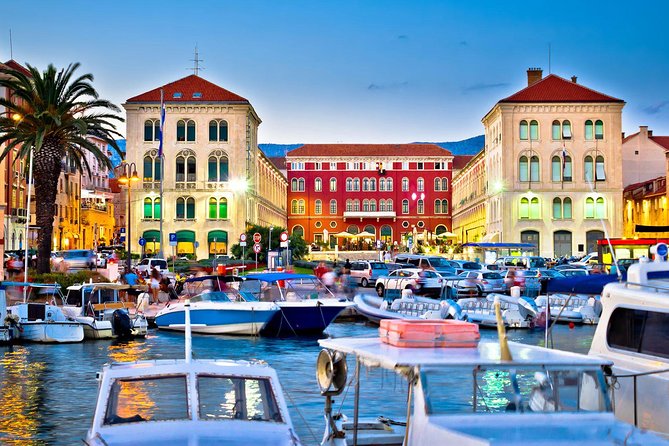
The former Temple of Jupiter is now a baptistery. In five minutes, the guide points out the ancient sculptures and preserved sarcophagus, then explains how the space changed purpose over time.
This stop is a compact lesson in reuse. Split’s old buildings were not frozen in the Roman period. They were adapted, altered, and given new meanings. The contrast between a Roman temple and a Christian baptistery helps you read the entire palace as a living center rather than a single-era museum.
The stop is short, so take advantage of the guide’s explanation and ask questions while you can. The tour is designed to show you the main story. It is not designed for a slow inspection of every object.
Triklinij and imperial dining
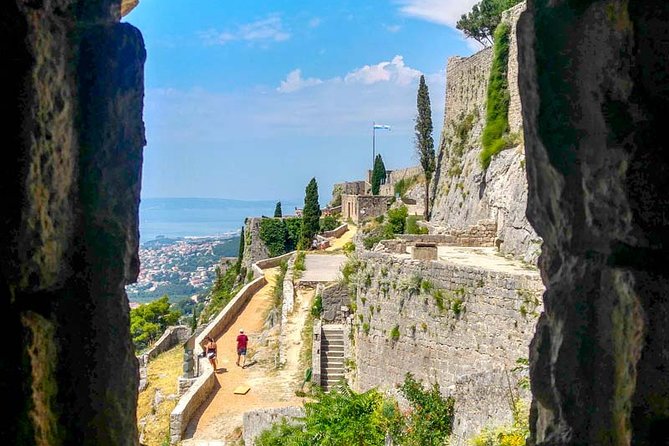
At Triklinij, you see where Diocletian hosted large banquets. The guide connects the room to Roman dining customs and the emperor’s lavish lifestyle.
This is a useful stop because it makes the palace feel inhabited. Columns and walls can seem abstract until you imagine meals, guests, servants, ceremony, and status within the same rooms. The five-minute visit does not recreate a banquet, but it gives the imperial residence a human scale.
If you enjoy social history, this may be one of the stops where a good guide earns the tour price. Guides such as Petra and Toni received praise for making historical material lively and easy to follow, while adding local stories and humor. The quality of the explanation depends on the individual guide, but the route gives them several good subjects to work with.
Leaving through the Golden Gate
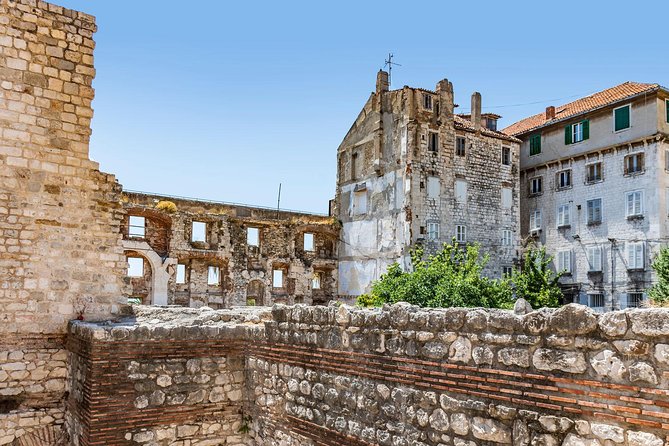
The Golden Gate is the grandest of the palace’s four gates. The route leads you outside, where you stop beside the tall statue of Gregory of Nin.
Rubbing the statue’s toe is a local good-luck custom. It is a small, playful detail, but it gives the walk a break from formal history. You get a tradition you can take part in, a quick photograph, and a clear sense of how the palace connects to the wider old town.
The Golden Gate also helps you understand the palace as an urban plan. You are not visiting an isolated ruin. You are moving through entrances, streets, squares, and buildings that still shape Split’s center.
The statue area can attract plenty of people. If you want a quiet photograph, you may need to wait your turn. The guide keeps the group moving, so this is another place to return later if you want more time.
Pjaca and Split’s Venetian-era center
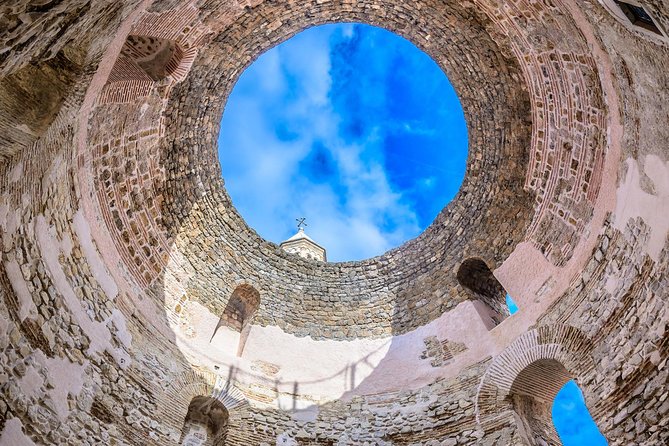
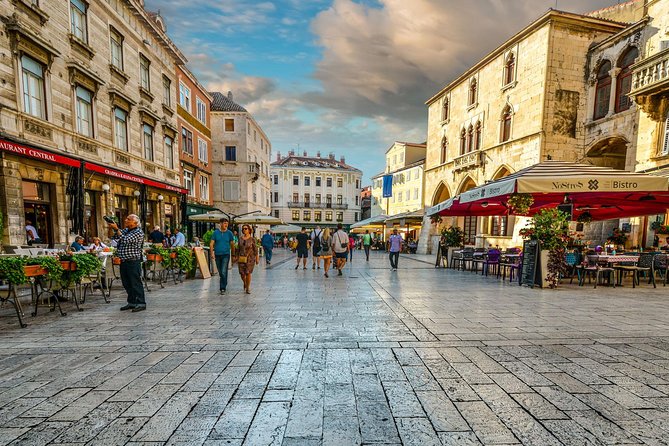
Narodni trg, commonly called Pjaca, shifts the mood from Roman imperial architecture to later city life. The square is surrounded by Venetian-era buildings and includes an old city clock. Cafés give the space an everyday, social feel.
This is where local advice can be especially helpful. The tour promises tips on places to eat, drink, and explore, and this setting gives those recommendations a practical context. You can ask your guide where to return for a meal or which nearby streets are worth a second walk.
The ten-minute stop is long enough to take in the square without turning the tour into a café break. Food and drinks are not included, so you should not expect a tasting or sit-down stop. That keeps the price focused on guiding, but you may want to plan a meal nearby afterward.
Fruit’s Square and modern Split
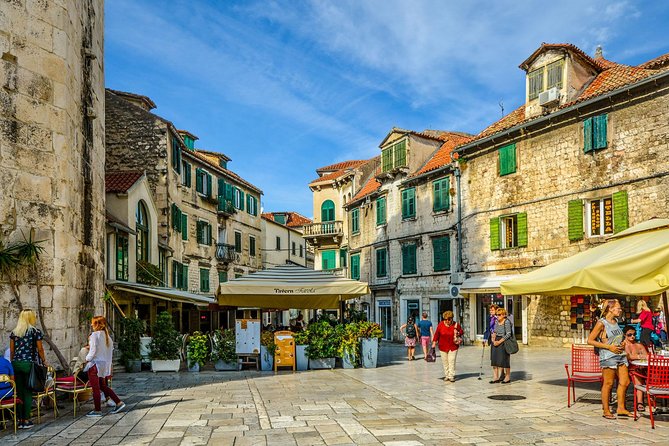
Fruit’s Square, or Trg Brace Radic, takes its name from the fruit market once held there. Today, baroque palaces and daily city activity surround the square.
This is a good final old-town stop because it shows how Split changed beyond the palace walls. Roman remains, Venetian buildings, market traditions, cafés, and modern routines all sit close together. You begin to see the city as a place where history is part of the street plan, not something separated behind museum doors.
The stop lasts around five minutes. That is enough for the basic story, but you will have to make your own return visit if you want to linger over the architecture or sit at a café. The guide’s local recommendations can help you decide what deserves more of your time.
Back to the Riva after 90 minutes
The route finishes where it began, on the Riva. This makes the tour easy to pair with other plans because you do not need to arrange transport back from a different neighborhood.
At the end, you have covered the main palace sights and several important public squares. You also have a clearer mental map of Split, which is one of the most useful results of a short city walk. The route is not a full historical study, but it gives you enough background to explore on your own with better eyes.
The pace is generally described as comfortable and manageable. One guide did not stick rigidly to the 90-minute limit, giving the group more than expected. That is a pleasant bonus, but you should still allow extra time if you have a ferry, meal reservation, or other fixed appointment.
Guide quality, group size, and language
The tour is offered in English and is led by a professional licensed local guide. The strongest comments focus on guides who combine facts with personality.
Anita is praised for her passion for Croatia and her ability to answer questions. Iva is described as efficient, friendly, and well informed. Katarina is credited with strong English and a full grasp of Diocletian’s Palace and Split’s past. Petra is praised for clear explanations and a willingness to handle many questions.
Toni’s style is more personal and humorous. He made the walk feel like an outing with a local friend, though clearer speech and a sharper separation between jokes and historical facts would help some listeners. Rocco was valued for local tips, good English, and a sense of humor.
That range is worth noting. A walking tour depends heavily on the person holding the guidebook, and no two guides will tell the stories in precisely the same way. The overall response is strongly positive, but one detailed comment wished for more historical detail and precision. If you want an academic lecture, this may feel light. If you want a friendly orientation with history attached, it should fit well.
The group limit is 20 people. Some departures are much smaller, which makes it easier to hear in the Peristyle and ask questions. You may want to choose a departure time with lower demand if your schedule allows, though group size cannot be guaranteed.
Is $30.23 a fair price?
At $30.23, I consider this a fair price for a 90-minute guided introduction to Split, particularly if this is your first visit. You are paying for a licensed local guide, a route through the palace, and useful orientation in a city that can be confusing at first.
The value is strongest when your guide adds personal insight. Specific guides have been praised for local recommendations, humor, passion, and practical answers. Those details can save you time later and help you choose where to spend the rest of your day.
The value is weaker if you want admission to every attraction or an extended palace tour. Food and drinks are not included, and the listed stops are brief. You should think of this as a guided overview, not a full museum visit.
The tour is especially good on your first day in Split. It can help you identify the cathedral, palace cellars, gates, and squares before you explore alone. An evening departure may offer better comfort during hot weather, and you still get the same core route.
What to wear and how to plan
Wear comfortable shoes with good grip. One direct comment specifically noted the need for non-slip footwear, and old-town surfaces can be hard on thin soles. Dress for the forecast because the walk operates in all weather.
The tour is near public transportation, begins and ends at the same waterfront address, and suits most people who can walk through the old town. Children must be accompanied by an adult. Pets are not allowed, and the experience is not suitable for wheelchair users.
You receive confirmation at booking. Because two customers reported major problems involving a canceled or unrecognized reservation, I would keep the confirmation accessible on your phone and check the operator’s instructions before leaving for the meeting point. The standard cancellation rule allows a full refund if you cancel at least 24 hours before the start time. Weather or minimum group requirements can also lead to a changed date or full refund.
Who should book this Split walk?
I would choose this tour if you want a short, friendly introduction to the city rather than a full-day history course. It suits first-time visitors, cruise passengers with limited time, couples, families with older children, and anyone who prefers to learn the basic story before wandering alone.
It is also a good fit if you like asking questions. The best guides on this route welcome them and add local suggestions beyond the formal stops.
I would think twice if you need step-free access, dislike walking on old surfaces, or want long periods for photography. I would also avoid booking it as your only historical experience if Diocletian’s Palace is your main reason for visiting Split. In that case, use this walk as an orientation, then return to the places that deserve more time.
Should you book the Split Old Town History Walking Tour?
Yes, for most visitors, this is a good-value first look at Split. The route covers the palace cellars, Peristyle, cathedral, Vestibule, Temple of Jupiter, Triklinij, Golden Gate, Pjaca, Fruit’s Square, and the Riva without taking up a whole morning or afternoon.
Book it for the guide’s local perspective and the easy overview, not for lengthy time inside each monument. If you can choose, consider an evening departure for cooler streets and a calmer feel. Keep your confirmation handy, wear grippy shoes, and leave room afterward for a meal or a return visit to the palace. With those expectations, this walk gives you a useful map, a handful of memorable Roman and Croatian stories, and a pleasant start in Split.
FAQ
How long is the Split Old Town History Walking Tour?
The tour lasts approximately 1 hour and 30 minutes.
What language is the tour offered in?
The tour is offered in English.
How much does the tour cost?
The listed price is $30.23 per person.
Where does the tour begin?
The meeting point is Obala Hrvatskog narodnog preporoda 21, 21000, Split, Croatia, on the Riva promenade.
Where does the tour finish?
The tour ends back at the meeting point on the Riva.
Is food or drink included?
No. Food and drinks are not included in the tour price.
What happens if the weather is poor?
The experience requires good weather. If the operator cancels because of poor weather, you will be offered another date or a full refund.
Can I cancel for a full refund?
Yes, if you cancel at least 24 hours before the experience start time. Cancellations or changes made less than 24 hours before the start time are not refunded or accepted.
More Walking Tours in Split
- Walking Tour of Split and Diocletian’s Palace
★ 5.0 · 2,588 reviews - Krka Waterfalls tour with Trogir Walking tour and Krka panoramic boat cruise
★ 5.0 · 1,659 reviews - Split & Diocletian’s Palace Walking Tour
★ 5.0 · 1,125 reviews - From Split: Krka Waterfalls Cruise & Trogir Walking Tour
★ 4.7 · 681 reviews
Just added around Split
- Private VIP Blue Lagoon and 3 Islands Tour★ 4.5 · 9 reviews
- Split highlights – Evening walking tour★ 5.0 · 9 reviews
- Private boat transfer Split – Bol★ 5.0 · 9 reviews
- Private Photography Activity in Split★ 5.0 · 9 reviews
- From Split: Trogir & Blue Lagoon Boat Tour with Snorkeling★ 4.6 · 9 reviews
- Bike, Beer & Poljud Stadium Tour★ 5.0 · 9 reviews
- From Hvar: Blue cave group speedboat tour full day★ 5.0 · 9 reviews
- Split Walking Tour: History, Legends & Tales★ 5.0 · 9 reviews
City Walls & Old Town Tours, compared.





City Walls Early Morning or Sunset Walking Tour
Read our review →
Plitvice Lakes with Boat Ride and Zadar Old Town Tour
Read our review →

Plitvice Lakes with Boat Ride & Zadar Old town tour
Read our review →Browse the lists this tour appears in