
Reviewed · HISTORICAL TOURS
Private History Split Walking Tour in English
Split’s old center is built into a Roman palace. This private 90-minute walk makes that unusual setting easier to understand, taking you from the Peristyle through the Vestibule, palace cellars, Golden Gate, Riva harbor, Fruit’s Square, and the old synagogue area. I like the one-group format, which lets your guide adjust the pace and answer your questions. I also like the clear route through both famous sights and smaller historical corners, including the story of Marko Marulić and Split’s Jewish community.
The main consideration is time. One hour and 30 minutes goes quickly in a city with this much to explain, so the walk gives you a strong introduction rather than a full visit to every site. The palace substructures museum is not included, and visitors with trouble on high steps should take care.
In This Review
- Key points before you book
- Why Split’s palace needs a guide
- Peristyle: starting in Diocletian’s center
- The Vestibule and a hint of Dalmatian sound
- Palace substructures: the practical side of Roman building
- Golden Gate and Gregory of Nin
- Riva Harbor: the palace meets the sea
- Fruit’s Square and Marko Marulić
- Split Synagogue and the city’s Jewish past
- How much value do you get for $66.54?
- What the guide style seems to do best
- Timing, walking comfort, and practical details
- Who should book this Split walk?
- Should you book the Private History Split Walking Tour?
- FAQ
- Where does the tour begin?
- Where does the tour end?
- How long does the walking tour last?
- Is the tour private?
- What language is the tour offered in?
- Is admission to Diocletian’s Palace included?
- Is the Split Synagogue admission included?
- Is the tour suitable for people with mobility concerns?
- Can I cancel for a full refund?
Key points before you book
- Private attention: Only your group takes part, so you can ask questions without a large crowd setting the pace.
- Seven central stops: The route covers the Peristyle, Vestibule, palace substructures, Golden Gate, Riva, Fruit’s Square, and Split Synagogue.
- Roman and later Split: You get both Diocletian’s Roman palace and later Venetian, Croatian, and Jewish history.
- A useful 90-minute introduction: The walk is short enough to fit into a busy day, but detailed enough to give you a working map of the Old Town.
- English-speaking guide: The tour is offered in English and led by a guide with strong local knowledge of the palace and nearby sights.
- Good booking flexibility: You can cancel for a full refund up to 24 hours before the start time.
Why Split’s palace needs a guide
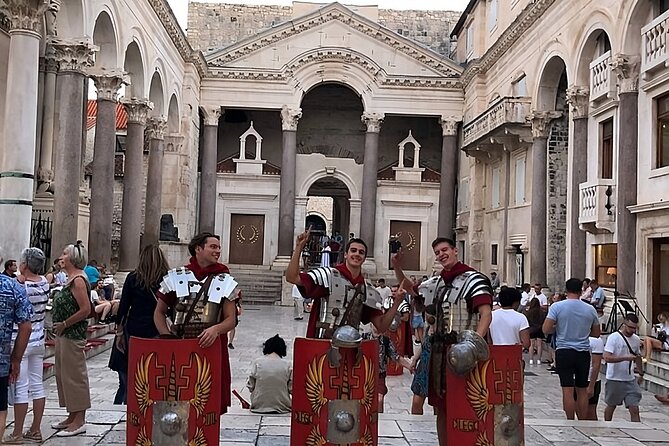
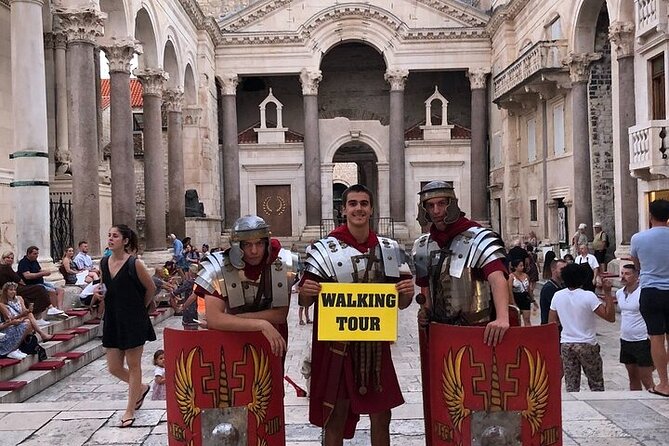
Split’s Old Town is not simply a collection of old buildings. Much of it sits inside the remains of Diocletian’s Palace, a Roman complex that still functions as part of the modern city. Homes, shops, lanes, squares, and cafés occupy spaces once planned for an emperor.
That can be confusing at first. A doorway may look medieval, while the stone beneath it belongs to a Roman structure. A narrow lane may follow an ancient palace corridor. The private format helps connect these pieces instead of leaving you to guess what you are seeing.
The meeting point is on Peristil ulica, at the Peristyle, the palace’s central square. This is a sensible starting place because routes lead from here toward many of the complex’s most important areas. You finish back at the same meeting point, which keeps the walk simple for the rest of your day.
I would book this early in your Split stay. The experience is often reserved about nine days ahead, and a first-day walk can help you understand the Old Town before you explore it on your own. With a 5 out of 5 rating from 159 reviews and 99 percent recommendation, the strongest pattern is clear: the guide’s historical explanations are the heart of the experience.
More Historical Tours in Split
- Walking Tour of Split with a ‘Magister’ of History
★ 5.0 · 1,122 reviews - Split Walking Tour with Professor of History
★ 5.0 · 926 reviews - Split: History and Heritage Walking Tour
★ 4.9 · 650 reviews
Peristyle: starting in Diocletian’s center
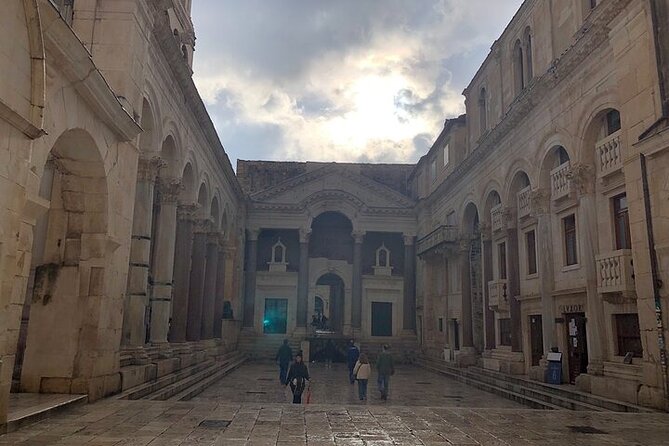
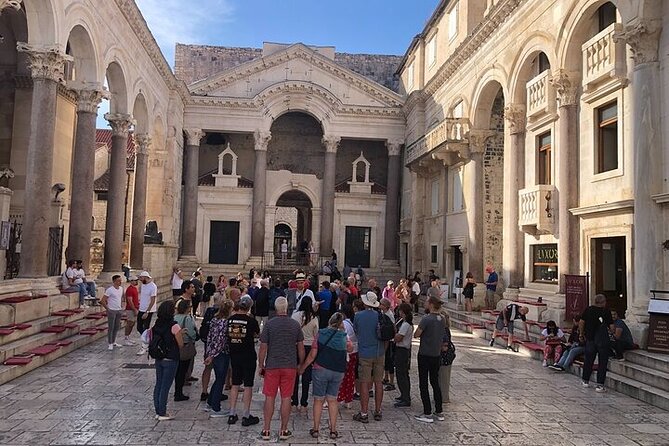
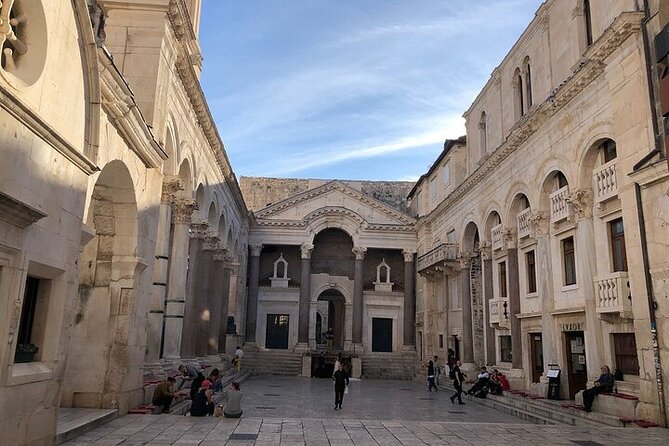
The Peristyle receives about 15 minutes, making it the longest single stop. That is appropriate. This is the main square of Diocletian’s Palace and the point from which you can reach many other parts of the complex.
Here, the guide can give you the basic plan of the palace and explain how its different sections fit together. That first orientation matters. Without it, the palace can feel like a maze of stone alleys. With it, you can begin to recognize the relationship between the central square, the entrances, the ceremonial areas, and the lower structures.
The Peristyle is also a good place to consider the city’s layers. The square was designed for imperial use, but Split’s Old Town continues to operate as a living neighborhood. I like this kind of setting because the past is not separated behind a fence. You see ancient architecture beside ordinary daily life.
Since admission to this stop is free, the guide’s interpretation provides the main value. Listen for the explanation of how the palace was planned and how the emperor’s residence differed from a normal Roman town. The stop is not just a photo opportunity, though you will have plenty of striking stonework around you.
The Vestibule and a hint of Dalmatian sound
The next stop is the Vestibule, where you spend about five minutes. This was part of the emperor’s palace and once served as an entry space. The short visit works as a continuation of the Peristyle rather than a separate attraction.
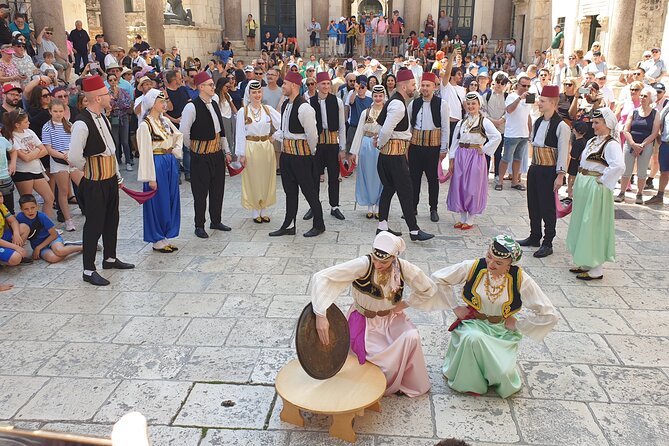
You may also hear traditional Dalmatian singing here. The information says this is a possibility, not a guaranteed performance, so you should treat it as a pleasant extra rather than a promised part of the tour. Still, the chance to hear local singing in an ancient architectural space gives this brief stop a distinctly Split character.
The Vestibule is free to visit. Its value comes from the guide’s explanation and from seeing how a ceremonial passage worked within the wider palace. If you enjoy architecture, pay attention to the shape of the space and how the guide places it within Diocletian’s original plan.
Palace substructures: the practical side of Roman building
The palace substructures receive about 10 minutes. You go through the lower parts of Diocletian’s Palace and learn how they were built and how their purpose changed over the centuries.
This is one of the most useful parts of the walk because the lower structures help explain what you see above ground. They show the practical side of the palace, including the way Roman builders supported and organized the imperial complex. The guide also explains later uses, so this is not only a lesson about ancient construction.
There is an important limit here. The museum section of the substructures is not included in the walking tour. You can visit that part afterward, but you would need to do so separately, and admission is not included in the tour price.
That arrangement suits you if you want a quick introduction before deciding how much more time to spend below ground. If you prefer a longer archaeological visit, plan extra time after the walk. The 90-minute schedule does not allow the substructures to become a full museum tour.
More Walking Tours in Split
- Split: Old Town and Diocletian Palace Walking Tour
★ 4.9 · 4,727 reviews - Walking Tour of Split and Diocletian’s Palace
★ 5.0 · 2,588 reviews - Krka Waterfalls tour with Trogir Walking tour and Krka panoramic boat cruise
★ 5.0 · 1,659 reviews - Split & Diocletian’s Palace Walking Tour
★ 5.0 · 1,125 reviews
Golden Gate and Gregory of Nin
At the Golden Gate, you spend about 10 minutes examining the main entrance to Diocletian’s Palace. This is one of the essential points on the route, since it shows how the palace connected to the outside world.
The stop also includes the statue of Gregory of Nin. Your guide explains his importance to Croatian history and language, giving you a link between the Roman setting and Croatia’s later cultural story. That shift is valuable. Split is not only about Diocletian, and the city’s identity cannot be understood through Roman monuments alone.
The Golden Gate is free to see, so again, the guide’s context is what turns the stop into more than a quick photograph. I would pay close attention here if you want to understand how national history and language fit into the city’s public spaces.
This part of the walk also gives you a useful change of scale. The Peristyle feels ceremonial and enclosed. The Golden Gate shows the palace as a fortified complex with controlled entrances. In a short time, the guide helps you see both sides of the Roman design.
Riva Harbor: the palace meets the sea
The route then reaches Riva Harbor for about 15 minutes. Riva is Split’s famous waterfront promenade, and this stop helps place the palace beside the sea rather than treating it as an isolated ruin.
You see a bronze model of Diocletian’s Palace, which can be especially helpful after walking through the complex itself. A model gives you the broad picture that narrow streets cannot. You can better understand the palace’s overall form, position, and relationship to the harbor.
The guide also explains the history of Riva. This adds a later urban layer to the tour and shows how Split grew around the old palace. I like this stop because it changes the rhythm of the walk. After enclosed stone spaces, the harbor offers a wider view and a chance to connect the ancient center with the modern waterfront.
There is no admission charge for Riva or the bronze model. The stop is also a useful moment to ask for suggestions about places to explore afterward. One of the recurring strengths of the guiding style is practical advice about what to see and where to go next, not just dates and names.
Fruit’s Square and Marko Marulić
Fruit’s Square, or Trg Braće Radić, receives about 10 minutes. Here, the guide points out a 15th-century Venetian citadel and explains the importance of Marko Marulić, often described as the father of Croatian literature.
This is a good reminder that Split’s past did not end with Rome. Venetian influence, local culture, and Croatian literary history all appear within a compact part of the Old Town. The square gives you a different architectural mood from the palace’s Roman core, while still remaining close to it.
The stop is free. Its main benefit is the connection between a visible building and a larger story about Split’s place in Croatian culture. If you are interested in literature or national history, this may be one of the most rewarding stops because it introduces a major local figure without requiring a separate museum visit.
The square also helps make the route feel balanced. You see an imperial center, a palace entrance, the waterfront, and a later civic space. That mix is more useful than a walk focused only on Roman stones.
Split Synagogue and the city’s Jewish past
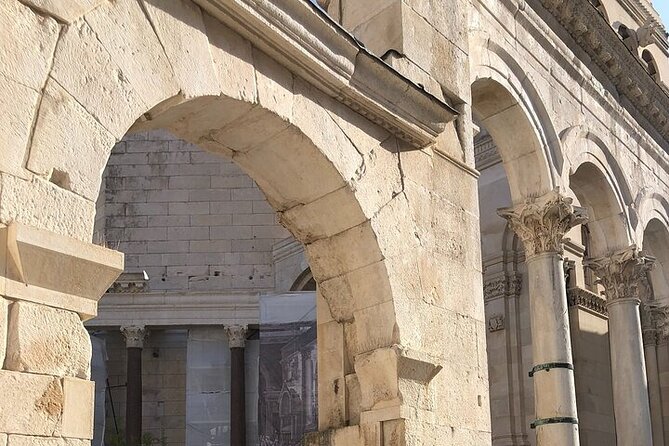
The final listed stop is Split Synagogue, where you spend about 10 minutes passing by the 16th-century synagogue and learning about the Jewish people of Split.
The synagogue admission is not included, and the information describes this part as passing by the site rather than visiting the interior. You should therefore expect an exterior history lesson, not a full synagogue tour.
I value the inclusion of this stop because it widens the story of the city. Ancient emperors and Venetian fortifications are important, but so are the communities that shaped Split over time. A brief explanation of Jewish life adds social history to the architectural route.
The stop also shows why a private guide can be useful. You might walk past the synagogue without noticing its age or significance. With explanation, an ordinary-looking passage becomes part of the city’s larger record.
How much value do you get for $66.54?
The listed price is $66.54 per person. That is not the cheapest way to see Split, especially if you are traveling alone. But this is a private experience, so the price needs to be considered in relation to the size of your group. Group discounts are available, and the cost may make more sense for two or more people who want a guide dedicated to them.
You are paying mainly for time with an educated English-speaking guide, not for admission tickets. Most stops are free. The substructures museum and synagogue admission are not included, so add those costs only if you choose to visit them separately.
I think the price is fair for you if you want history explained clearly and prefer to ask questions as you go. It is less appealing if you only want a quick orientation or plan to read about the palace on your own. The high rating, strong recommendation rate, and repeated praise for clear historical detail suggest that the guiding is where the experience earns its fee.
The walk also saves planning time. You do not need to work out how the palace, harbor, Venetian citadel, literature, and synagogue fit together. In a city where the old center can be confusing, that structure has real value.
What the guide style seems to do best
The strongest praise centers on explanation. The guide is repeatedly described as thoughtful, entertaining, and able to bring the palace to life. One guide, Antonella, is singled out for making the history easy to follow and giving the feeling of stepping into Split’s past.
The best part of that style is the link between facts and places. You are not simply given a list of dates. You hear about architecture at the palace, language at the Golden Gate, Croatian literature at Fruit’s Square, and Jewish history near the synagogue.
The guides also appear to offer useful recommendations for further exploration. That matters because the walk ends where it starts, leaving you in the middle of the Old Town with the rest of the day ahead.
Still, the experience depends heavily on the individual guide. A private walk gives you personal attention, but it does not guarantee that every guide will present the material in exactly the same way. The available feedback is very strong, yet you should choose this tour because you want a history-led walk, not because you expect a scripted entertainment show.
Timing, walking comfort, and practical details
The duration is about 90 minutes. The route stays around Split’s central Old Town and returns to the Peristyle meeting point. It is near public transportation, and most people can participate.
High steps are the main physical warning. If you have trouble with them, contact the provider before booking or consider a different way to see the palace. Service animals are allowed.
Wear comfortable walking shoes and expect uneven historic surfaces, though the supplied information does not give a precise distance or step count. Since the tour is private, you can ask your guide to explain anything you have missed or to clarify the route.
Confirmation arrives when you book. Free cancellation is available until 24 hours before the local start time. Cancellations or changes inside that window are not refunded or accepted. The experience also requires a minimum number of people, so if the provider cancels for that reason, you receive a different date or experience, or a full refund.
Who should book this Split walk?
I would recommend it to couples, families, and small groups who want a focused introduction to the city. It is especially useful if Roman architecture interests you but you also want later Croatian, Venetian, literary, and Jewish history.
It suits people who enjoy asking questions. The private setup is also helpful if your group has a specific interest in architecture, language, local culture, or the story of Diocletian.
I would be more cautious if you want extended museum time. The palace substructures museum is not part of the tour, and the synagogue is viewed from outside. You should also think twice if high steps are difficult for you.
Should you book the Private History Split Walking Tour?
Book it if you want clear historical explanations, a private guide, and a compact route through Split’s most important central sights. The strongest value comes from seeing how Roman, Venetian, Croatian, literary, waterfront, and Jewish stories connect within a small area.
Skip it if you only want admission to museums or prefer to wander without a guide. For most first visits, though, $66.54 per person is a reasonable price for a private English walk, especially when group discounts apply and the guide can shape the experience around your questions.
The tour will not show every part of Split. It will give you something more useful for a first afternoon: a mental map, a historical framework, and enough local context to make your own wandering far more rewarding.
FAQ
Where does the tour begin?
It begins on Peristil ulica at the Peristyle in Split, Croatia.
Where does the tour end?
The tour ends back at the meeting point.
How long does the walking tour last?
It lasts approximately 1 hour and 30 minutes.
Is the tour private?
Yes. Only your group participates in the activity.
What language is the tour offered in?
The tour is offered in English.
Is admission to Diocletian’s Palace included?
The listed stops at the Peristyle, Vestibule, Golden Gate, Riva Harbor, and Fruit’s Square have no admission charge. Admission to the museum section of the palace substructures is not included.
Is the Split Synagogue admission included?
No. Admission to the Split Synagogue is not included.
Is the tour suitable for people with mobility concerns?
Most people can participate, but the tour is not recommended for people who have issues with high steps.
Can I cancel for a full refund?
Yes. You can cancel at least 24 hours before the experience’s local start time for a full refund. Changes or cancellations made less than 24 hours before the start are not accepted or refunded.
Just added around Split
- Private VIP Blue Lagoon and 3 Islands Tour★ 4.5 · 9 reviews
- Split highlights – Evening walking tour★ 5.0 · 9 reviews
- Private boat transfer Split – Bol★ 5.0 · 9 reviews
- From Split: Trogir & Blue Lagoon Boat Tour with Snorkeling★ 4.6 · 9 reviews
- Private Photography Activity in Split★ 5.0 · 9 reviews
- Bike, Beer & Poljud Stadium Tour★ 5.0 · 9 reviews
- From Hvar: Blue cave group speedboat tour full day★ 5.0 · 9 reviews
- Split Walking Tour: History, Legends & Tales★ 5.0 · 9 reviews
Historical Tours, compared.


Walking Tour of Split with a ‘Magister’ of History
Read our review →


Split History and Gastro Small-Group Tour with Food and Drinks
Read our review →
PREMIUM Emperor’s Walking Tour for History Lovers + Museum
Read our review →Browse the lists this tour appears in