
Reviewed · HISTORICAL TOURS
Private History and Trivia Walking Tour by a Local Guide
History hides in Split’s narrow streets. This private walking tour packs the city’s main sights into about 1 hour and 45 minutes, with a local guide explaining how Roman, medieval, and modern Split fit together. I especially like the route’s strong focus on Diocletian’s Palace and the chance to ask questions as you go. I also like that it reaches streets and squares a bus cannot.
The main consideration is pace. You cover many stops in less than two hours, so this is a smart introduction rather than a slow architectural study. The advertised price is $53.95 per person, and group discounts may improve the value, but personal expenses are not included.
In This Review
- Key points to know before you book
- Why this Split walking tour works well for a first visit
- Riva Harbor: begin with Split’s setting
- The Bronze Gate and palace substructures
- Peristyle Square and the Cathedral of Saint Domnius
- Temple of Jupiter and the stone passageways
- Fruit’s Square and Marko Marulić
- Narodni Trg, the main town square
- Zeljezna Vrata and Split’s old entrances
- City Museum and the Papalić Palace
- The Golden Gate and Grgur Ninski
- St. Arnir and the final stretch on Marmontova
- What the $53.95 price gets you
- Who should book this private walk
- Should you book the Split history and trivia tour?
- FAQ
- How long does the walking tour last?
- Where does the tour begin?
- Where does the tour end?
- How much does the tour cost?
- Is this a private tour?
- Which languages are available?
- Does the price include attraction admission?
- Is the tour suitable for children?
- Is the tour accessible by public transportation?
- Can I cancel for a refund?
Key points to know before you book
- The route covers 13 named stops, from Riva Harbor to Marmontova Ulica.
- Diocletian’s Palace takes center stage, including its substructures, Peristyle, Cathedral, Temple of Jupiter, and Golden Gate.
- The tour is private, so only your group participates, with a maximum group size of 15.
- Ivan is a highly praised guide, noted for humor, patience, strong historical knowledge, and fluency in several languages.
- The tour works well for families, with positive feedback from parents traveling with children as young as 5.
- All listed stops have free admission, though any personal spending is your responsibility.
Why this Split walking tour works well for a first visit
Split is not a city you understand from a quick look at the waterfront. Its center grew inside and around the palace built for Roman Emperor Diocletian, and the old walls now contain homes, shops, churches, squares, and working streets.
That makes a guide useful. Without context, a column may look like decoration, an old doorway may seem ordinary, and a medieval palace may blend into the stone around it. This tour gives each place a story and keeps the route moving.
I see this as a good choice if you have a short stay, a cruise stop, or only one free morning. The route touches the main sights without sending you across the wider city. You also get a local contact who can answer questions about customs, food, neighborhoods, and what to see after the walk.
The private format matters. Your group can ask about Roman building methods, Croatian history, Game of Thrones filming locations, or practical city tips without waiting for a large crowd. The published group limit is 15, but the activity is private, so only your own party takes part.
The strongest praise centers on Ivan. He is described as friendly, funny, patient, and fluent in English, French, German, Spanish, and Italian. The feedback also points to his ability to keep children interested, answer questions at length, and add unusual details rather than simply reciting dates.
More Historical Tours in Split
- Walking Tour of Split with a ‘Magister’ of History
★ 5.0 · 1,122 reviews - Split Walking Tour with Professor of History
★ 5.0 · 926 reviews - Split: History and Heritage Walking Tour
★ 4.9 · 650 reviews
Riva Harbor: begin with Split’s setting
The meeting point is at Obala Hrvatskog narodnog preporoda 22, on the Riva promenade. This is a sensible place to start because you can immediately see the southern wall of Diocletian’s Palace, Split Harbor, and the promenades along the eastern and western coast.
The opening 10 minutes provide a useful orientation. You are not yet in the palace itself, but you are looking at the structure from outside and seeing how closely the ancient complex sits beside the water.
I like this beginning because it gives you a map in your head. The palace is not an isolated ruin. It is part of the city’s daily life, and the harbor helps explain why this location mattered.
The Bronze Gate and palace substructures
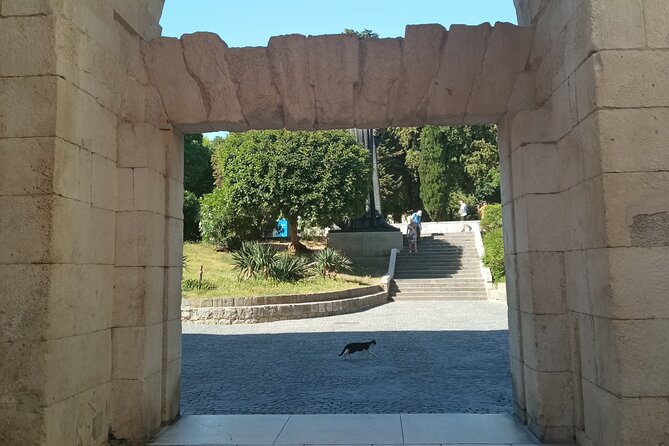
The group then enters the palace substructures through the Bronze Gate. The scheduled visit here is brief, about eight minutes, but it introduces one of the most important ideas on the tour: the lower level helped preserve the shape of the upper palace.
The guide explains how these spaces were used at different points in history. You will pass through the main corridor and hear why the substructures mattered beyond their original Roman purpose.
This stop is especially helpful if you find ancient sites hard to picture. Looking at the lower rooms gives you a clearer sense of the palace plan above. Since admission is listed as free for the stop, you can see this part without adding an entrance charge to the tour price.
Peristyle Square and the Cathedral of Saint Domnius
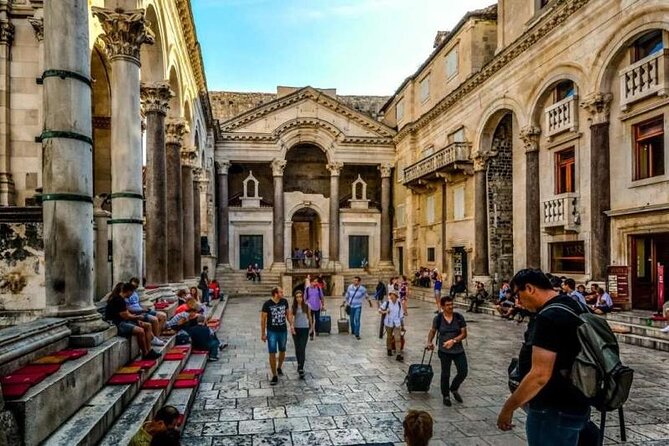
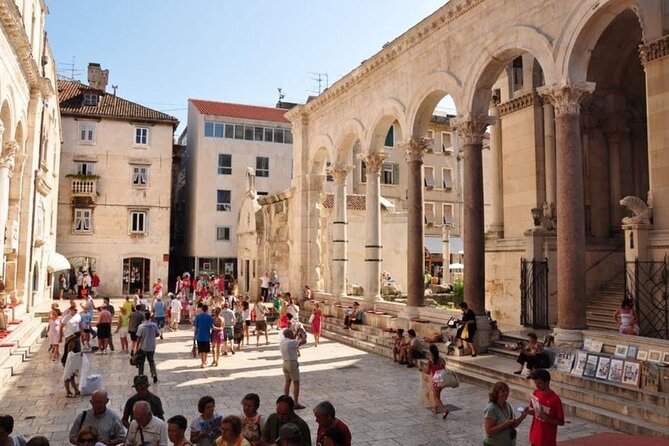
The Peristyle is the central ancient square of the palace, and the tour allows about 10 minutes here. This is where the Roman design becomes easiest to read: the open ceremonial space, surrounding stone, and surviving columns make the imperial setting feel more immediate.
Your guide explains the cultural and historical role of the square, not just its appearance. This is a good place to ask questions because later parts of the walk depend on understanding how Roman power shaped the old center.
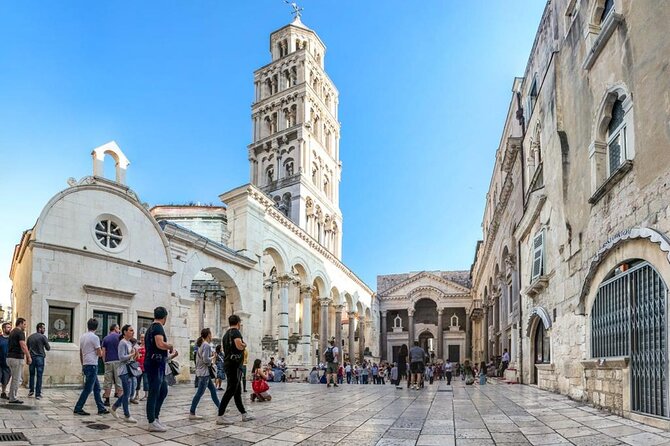
The next stop is the Cathedral of Saint Domnius, with about five minutes devoted to it. The building began as Diocletian’s mausoleum and later became a cathedral. That change tells you a great deal about how the palace continued to serve the city after the emperor’s era.
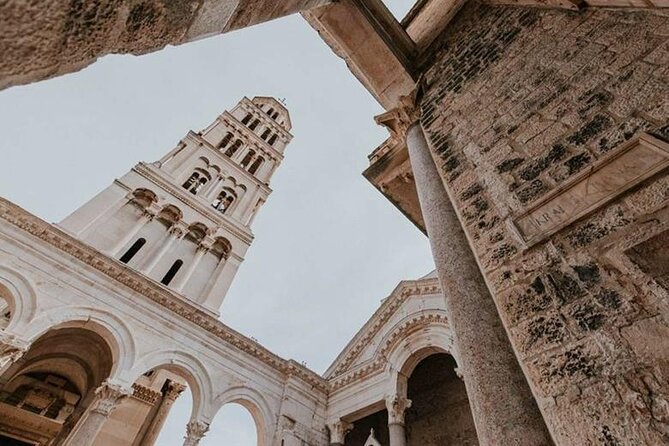
The guide also discusses the cathedral’s construction style and the adjacent bell tower. The short time here means you should not expect a full interior visit or a detailed climb. The value comes from seeing the building in its Roman setting and understanding how its purpose changed.
More Walking Tours in Split
- Split: Old Town and Diocletian Palace Walking Tour
★ 4.9 · 4,727 reviews - Walking Tour of Split and Diocletian’s Palace
★ 5.0 · 2,588 reviews - Krka Waterfalls tour with Trogir Walking tour and Krka panoramic boat cruise
★ 5.0 · 1,659 reviews - Split & Diocletian’s Palace Walking Tour
★ 5.0 · 1,125 reviews
Temple of Jupiter and the stone passageways
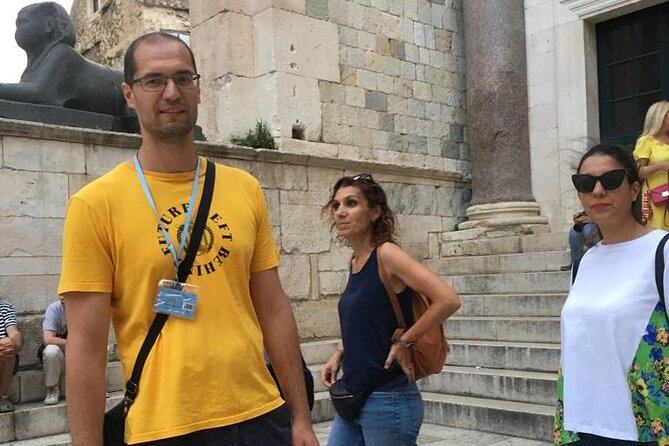
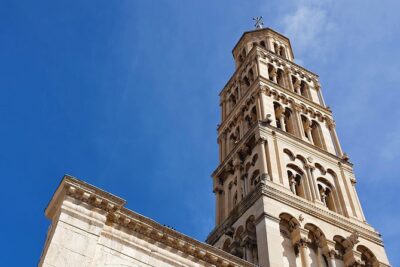
The Temple of Jupiter receives another five-minute explanation. As Christianity spread inside the palace, the temple became a baptistery. The sphinx in front adds a memorable visual detail and links this corner of Split to the wider world of ancient Egypt and Rome.
The stop is compact, but it helps you see that the palace was altered rather than frozen in time. Roman temples, Christian buildings, medieval homes, and modern businesses now share the same tight center.
From here, the walk uses narrow streets, including the famously tight passage called Pusti me Proć. The name roughly suggests letting me pass, which is an amusingly practical label for such a cramped route.
These lanes are where a walking tour earns its keep. A bus cannot enter them, and a self-guided visit may take you past without explanation. You get a close look at how Split’s old center functions at street level.
Fruit’s Square and Marko Marulić
Fruit’s Square, or Trg Braće Radić, is the next major pause, lasting about seven minutes. Here, the guide explains how Split developed and why the town’s growth was limited during certain periods.
The square also gives you several smaller details that are easy to miss. You pass the statue of Marko Marulić, often called the father of Croatian literature, and the 17th-century Milesi family palace behind it.
This is one of the tour’s better transitions. The focus moves from imperial Rome to the families, writers, and civic life that shaped later Split. The palace is no longer just an ancient monument. It becomes a living town with local personalities and competing eras layered together.
Narodni Trg, the main town square
Narodni Trg, also known as Piazza, receives about 10 minutes. The guide explains how it developed into Split’s main square as the town expanded beyond the original palace walls.
You pass several noble family palaces around the square, including a recently renovated palace at the western end, the old City Hall, and another palace associated with a family from Korčula at the eastern end. These stops help you compare the Roman core with later civic and aristocratic architecture.
I would pay close attention here if you enjoy urban history. The square shows how power shifted from an emperor to local families and public institutions. The buildings are not simply attractive facades. They mark the changing social structure of Split.
Because the tour moves quickly, you will hear the key background rather than receive a room-by-room architectural reading. If one palace catches your eye, make a note of it and ask the guide for more information.
Zeljezna Vrata and Split’s old entrances
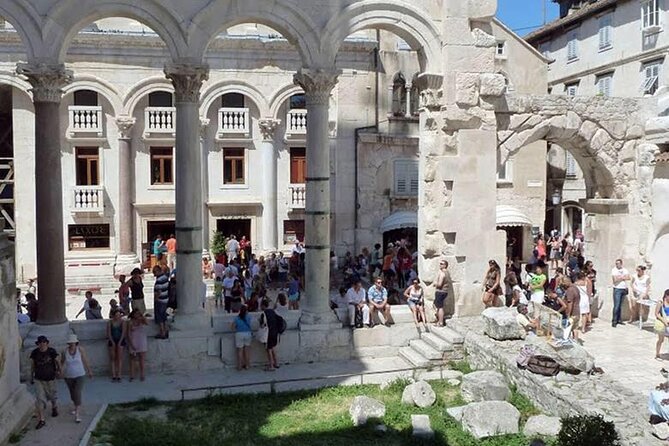
The route continues to Zeljezna Vrata, the Iron Gate, for about seven minutes. This was one of the palace entrances, and the guide explains the different activities associated with it over time.
You also pass a palace built by the wealthy Cindro family in the 17th century and a 15th-century palace linked to the Italian Augubio family. This stretch is a reminder that the old city was repeatedly adapted by people who lived and worked inside it.
The description of the route places this portion as the walk moves eastward, although the Iron Gate is also identified as the western gate of the palace. If the exact direction matters to you, confirm the route with the guide at the start. The important point is that you will see another historic entrance and several later palaces close together.
City Museum and the Papalić Palace
The City Museum of Split is housed in Papalić Palace. The scheduled explanation lasts only about three minutes, so this is a brief exterior-oriented stop rather than a museum visit with time to examine collections.
Papalić Palace still matters even in a short stop because of its architecture and its place in the city’s history. It also has a connection for Game of Thrones fans, with a notable and bloody scene filmed in front of the palace.
That reference is handled as an added detail, not the main purpose of the tour. I like that balance. You can enjoy the filming connection, but the walk remains centered on Split itself.
If you want to visit the City Museum inside, plan separate time and expenses. The tour information does not include a museum admission or a dedicated museum visit.
The Golden Gate and Grgur Ninski
The Golden Gate is the northern entrance to Diocletian’s Palace and one of the most decorated parts of the complex. The guide spends about seven minutes explaining its design and the skill required to build it in the Roman period.
This is one of the clearest places to appreciate the palace as a planned imperial residence. The scale and decoration are easy to read from outside, and the gate makes a strong contrast with the narrower medieval streets you have just walked.
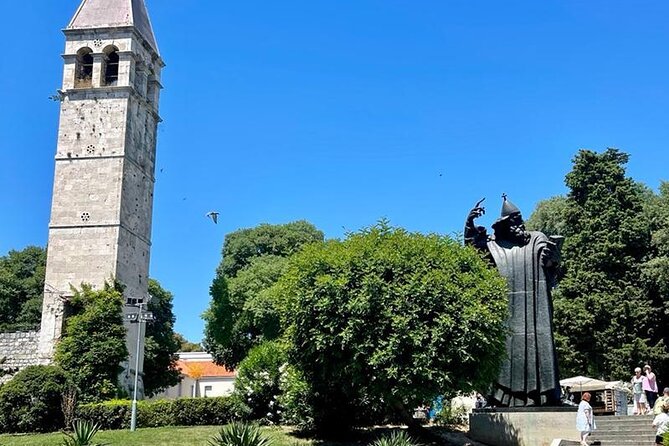
Opposite the gate is the statue of Grgur Ninski, the Bishop of Nin, created by Croatian sculptor Ivan Meštrović. The guide explains why Grgur is important and adds context to the monument.
The statue is a popular photo stop, but the explanation gives it more purpose. You learn that the public art around Split can carry national and religious meaning, not just visual appeal.
St. Arnir and the final stretch on Marmontova
Near the Grgur Ninski statue, you see the Bell Tower of St. Arnir, the chapel of St. Arnir, and remains of an early Christian church. The scheduled discussion is about five minutes, enough to connect the surviving structures with the city’s early Christian period.
The final stop is at the top of Marmontova Ulica, with about eight minutes focused on the street’s history. From here, you overlook the Croatian National Theater and the Monastery and Church of Our Lady of Health.
The guide also covers the short-lived period connected with Marmont. This gives the tour a closing chapter outside the palace itself and shows how Split continued to change under later political powers.
There is a small practical detail to check before booking. The route description says the walk finishes at the top of Marmontova, while the meeting information says the activity ends back at the meeting point. Ask for clarification if you need to return to the Riva promptly.
What the $53.95 price gets you
At $53.95 per person, this is not the cheapest way to see Split. But price alone does not tell the whole story because the tour is private and includes a licensed local guide.
The value is strongest for a small group that wants a shared introduction without joining strangers. You can divide the cost across your party, and group discounts may apply. A private guide also means you can ask for clarification, request more detail about a favorite building, or get advice for the rest of your visit.
The listed stops have free admission, so you are mainly paying for the guide’s time, planning, language ability, and local explanations. Personal expenses are not included. That matters if you decide to buy food, drinks, souvenirs, or tickets to attractions after the walk.
The tour is also a practical time purchase. In 105 minutes, you cover the palace’s key points and several later city squares. If you tried to build the same route alone, you could easily spend more time finding entrances and working out what you are looking at.
Who should book this private walk
I would recommend it to you if:
- You have only a morning in Split.
- You want the main palace sights explained in person.
- You prefer a private group to a large scheduled walk.
- You like history but still want room for questions and local tips.
- You are traveling with children who need a lively guide.
- You want help sorting Roman, medieval, Christian, and modern layers of the city.
The feedback is particularly strong for families. Ivan kept children aged 5, 7, and 12 interested, which is not a minor achievement on a history walk. His humor and friendly manner also appear repeatedly in the praise, along with his ability to speak French and Italian fluently in addition to the other listed languages.
You may want something else if you prefer long visits inside museums, detailed archaeological lectures, or a relaxed pace with plenty of time for photographs. The schedule gives most stops between three and 10 minutes, so the experience is clearly designed as a brisk city overview.
The tour operates Monday through Friday during the listed hours of 8:00 a.m. to 1:30 p.m. The activity is offered in English, French, German, Spanish, and Italian. Confirmation is provided at booking, service animals are allowed, and the route is near public transportation.
Free cancellation is available up to 24 hours before the start time for a full refund. Cancellations or changes made within 24 hours are not refunded or accepted, so keep the local cut-off time in mind.
Should you book the Split history and trivia tour?
Book it if you want a fast, personal introduction to Split rather than a full-day cultural program. The route covers the right essentials: the Riva, palace substructures, Peristyle, Cathedral, Temple of Jupiter, old gates, noble palaces, the City Museum exterior, Grgur Ninski, and Marmontova.
The best reason to choose it is the guide-led context. Ivan’s humor, language skills, and patient answers can turn a compact walk into a useful foundation for the rest of your stay.
Skip it if you already know Diocletian’s Palace well or plan to spend several hours exploring every interior on your own. For a first visit, a short stay, or a family group that wants history without a dry lecture, the tour offers a sensible blend of major sights, local detail, and personal attention.
FAQ
How long does the walking tour last?
The tour lasts approximately 1 hour and 45 minutes.
Where does the tour begin?
It begins at Obala Hrvatskog narodnog preporoda 22, 21000, Split, Croatia, on the Riva promenade.
Where does the tour end?
The route description says it finishes at the top of Marmontova Ulica. The meeting information says the activity ends back at the meeting point, so confirm the final drop-off point with the provider.
How much does the tour cost?
The listed price is $53.95 per person. Group discounts may be available.
Is this a private tour?
Yes. Only your group participates, and the published maximum is 15 people.
Which languages are available?
The licensed guide can lead the tour in English, French, German, Spanish, or Italian.
Does the price include attraction admission?
The listed stops show free admission. Personal expenses are not included.
Is the tour suitable for children?
Yes. Most people can participate, and the available feedback specifically describes children aged 5, 7, and 12 enjoying the experience.
Is the tour accessible by public transportation?
The meeting area is near public transportation.
Can I cancel for a refund?
Yes. You can cancel at least 24 hours before the start time for a full refund. Cancellations within 24 hours are not refunded.
Just added around Split
- Private VIP Blue Lagoon and 3 Islands Tour★ 4.5 · 9 reviews
- Split highlights – Evening walking tour★ 5.0 · 9 reviews
- Private boat transfer Split – Bol★ 5.0 · 9 reviews
- From Split: Trogir & Blue Lagoon Boat Tour with Snorkeling★ 4.6 · 9 reviews
- Private Photography Activity in Split★ 5.0 · 9 reviews
- Bike, Beer & Poljud Stadium Tour★ 5.0 · 9 reviews
- From Hvar: Blue cave group speedboat tour full day★ 5.0 · 9 reviews
- Split Walking Tour: History, Legends & Tales★ 5.0 · 9 reviews
Historical Tours, compared.

Walking Tour of Split with a ‘Magister’ of History
Read our review →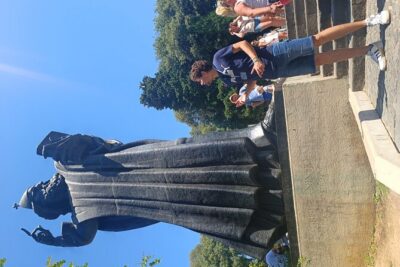


Split History and Gastro Small-Group Tour with Food and Drinks
Read our review →
PREMIUM Emperor’s Walking Tour for History Lovers + Museum
Read our review →Browse the lists this tour appears in