
Reviewed · HISTORICAL TOURS
History Split Walking Tour in French -Small group
Split’s old center is a palace you can walk through. This French-language tour brings Diocletian’s Palace to life with clear historical storytelling and a route that reaches the Peristyle, cellars, Golden Gate, Riva, and several lesser-known corners. I especially like the focus on the palace’s changing purpose over time, and the chance to hear about Croatian figures such as Gregory of Nin and Marko Marulić. The main drawback is that the advertised 90 minutes may not tell the whole story: the walk can run beyond two hours, and high steps may be difficult for some people.
The group can include up to 30 people, so this is small enough for a more personal approach but not an intimate private tour. The strongest feature is the French-speaking guiding, praised for fluent language skills, humor, patience, and the ability to answer detailed questions. At $69.14 per person, it is not the cheapest way to see Split, but it offers a useful historical framework before you explore the old city on your own.
In This Review
- Key points at a glance
- Why Diocletian’s Palace works best with a guide
- Peristyle: the palace’s grand central stage
- The Vestibule and the sound of Dalmatia
- The palace substructures and a key practical detail
- The Golden Gate and Gregory of Nin
- Riva Harbor: Split’s waterfront in context
- Fruit’s Square and Marko Marulić
- Split Synagogue and the city’s Jewish story
- French-language guiding is the main selling point
- Price, group size, and actual value
- Who should book this Split walk?
- Cancellation and planning advice
- Should you book it?
- FAQ
- Where does the French-language Split walking tour begin?
- Where does the tour end?
- How long does the tour last?
- Is the museum section of Diocletian’s Palace substructures included?
- Is the tour suitable for people with mobility issues?
- What is the cancellation policy?
Key points at a glance

- Diocletian’s Palace is still part of everyday Split, not a sealed museum, and the tour helps you understand that unusual layout.
- French is the working language, with guides praised for fluent, engaging explanations.
- Seven central sights fit into the route, including the Peristyle, Vestibule, substructures, Golden Gate, Riva, Fruit’s Square, and Split Synagogue.
- The tour may last longer than 90 minutes, so avoid booking it too close to another fixed appointment.
- The substructures are included as a historical space, but the museum section is not part of the visit.
- High steps are the main physical concern, while most travelers can take part and service animals are allowed.
Why Diocletian’s Palace works best with a guide
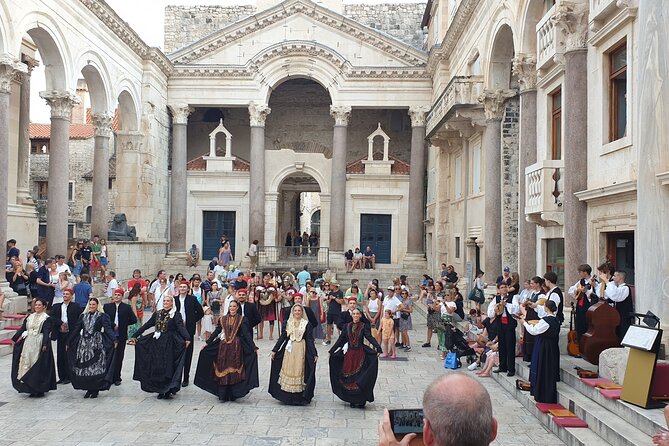
Split’s old center can seem confusing at first. Roman walls, medieval houses, cafés, shops, church buildings, and apartment entrances all share the same streets. You are not simply walking around an ancient ruin. You are moving through a living neighborhood built inside and around a Roman emperor’s retirement residence.
That is why a guide can add real value here. Without context, the Peristyle is a handsome stone square and the Golden Gate is an impressive entrance. With a strong explanation, you begin to see how the palace was planned, how people reused its spaces, and how Split grew around it.
The tour also gives you a useful starting point for the city’s wider story. You will hear about Diocletian’s rise from an obscure beginning to the most powerful man in the Roman world, then follow the palace through later periods shaped by Croatian, Venetian, Jewish, and local Dalmatian life.
I would not expect an academic lecture. The best feedback points to guides who mix facts with anecdotes, humor, and a friendly manner. Antonela is praised for being both engaging and well informed, while Irene is remembered for making the visit enjoyable for families with children. Other accounts describe guides with diplomatic and scholarly backgrounds, so the experience may vary by departure, but French fluency is a repeated strength.
More Historical Tours in Split
- Walking Tour of Split with a ‘Magister’ of History
★ 5.0 · 1,122 reviews - Split Walking Tour with Professor of History
★ 5.0 · 926 reviews - Split: History and Heritage Walking Tour
★ 4.9 · 650 reviews
Peristyle: the palace’s grand central stage
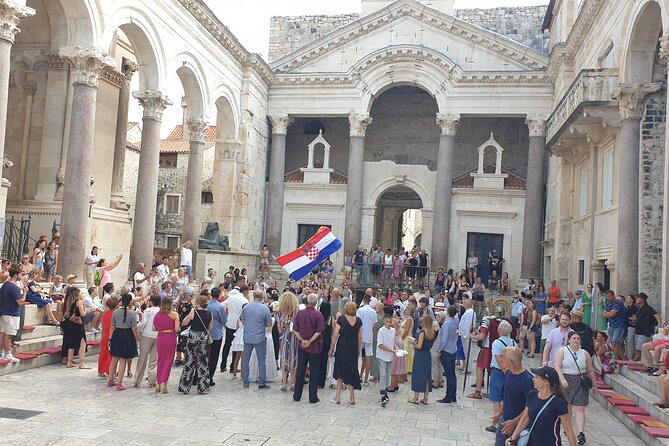
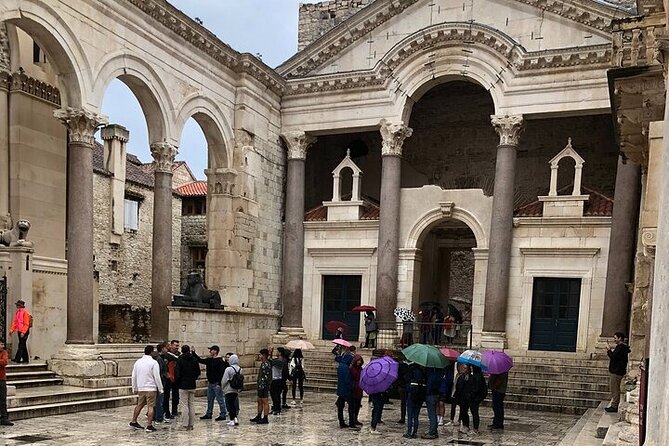
The tour begins at the Peristyle, the main square of Diocletian’s Palace. This is the natural place to start because several routes branch from it, and it helps you understand the palace’s basic plan.
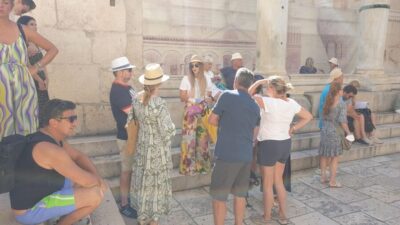
Expect to spend about 15 minutes here. The guide can explain how the square worked as a ceremonial space and how its surviving columns and stonework fit into the emperor’s complex. The Peristyle is also one of Split’s busiest public spaces, so a guide helps you focus on the details instead of simply taking photographs and moving on.
I like this opening because it establishes scale. Diocletian did not build a small country retreat. He created a fortified palace complex with ceremonial areas, living quarters, service spaces, entrances, and a waterfront connection. Once you understand the Peristyle, the rest of the walk becomes easier to follow.
The square can be crowded, and groups may need to pause at the edge rather than occupy the center. That is normal for a major public site. If you want quiet photographs, return early in the morning or later in the day after the tour.
The Vestibule and the sound of Dalmatia
A short walk leads to the Vestibule, an important entrance space associated with the emperor. The stop is brief, about five minutes, but it adds a different mood after the open Peristyle.
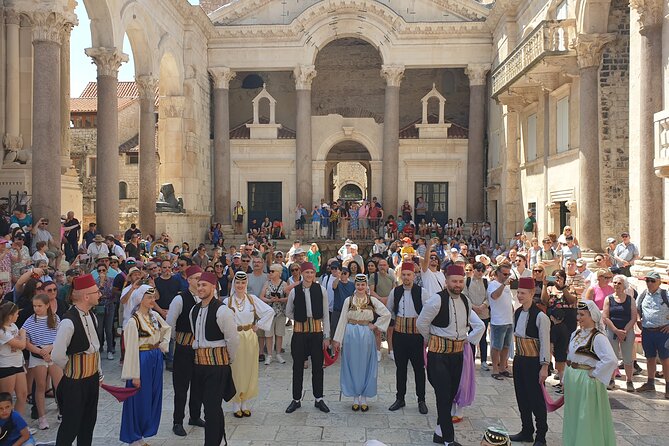
The building’s round form and unusual acoustics make it one of the most memorable spaces in the palace. There is also a chance you may hear traditional Dalmatian singing here. The information does not promise a performance every time, so treat it as a possible bonus rather than a guaranteed part of the tour.
This stop works well because the guide does not present the palace only as stone and dates. Local singing connects the old structure with living culture. It also gives you a small taste of the region’s traditions without requiring a separate cultural activity.
Since the stop is short, you may want to ask questions promptly. French-speaking guides are praised for taking time with unusual questions, but the pace still needs to keep the group moving.
The palace substructures and a key practical detail
The substructures receive around 10 minutes. These lower rooms are valuable because they show how the palace was built and how its spaces were used over the centuries.
They also help you understand the relationship between the palace above and the structure below. In places such as Split, old foundations are not just background scenery. They explain why the streets and buildings have the shape they do.
One important detail: this visit does not include the museum section of the substructures. You can visit that area after the walking tour, but any admission connected with it is not included. If you want a longer look at the underground spaces, allow extra time and check the separate museum arrangements.
The substructures may involve uneven surfaces or steps. The general guidance says most people can participate, but the tour is not recommended for anyone who has trouble with high steps. Sensible shoes will make the walk easier, even though no special equipment is required.
More Walking Tours in Split
- Split: Old Town and Diocletian Palace Walking Tour
★ 4.9 · 4,727 reviews - Walking Tour of Split and Diocletian’s Palace
★ 5.0 · 2,588 reviews - Krka Waterfalls tour with Trogir Walking tour and Krka panoramic boat cruise
★ 5.0 · 1,659 reviews - Split & Diocletian’s Palace Walking Tour
★ 5.0 · 1,125 reviews
The Golden Gate and Gregory of Nin
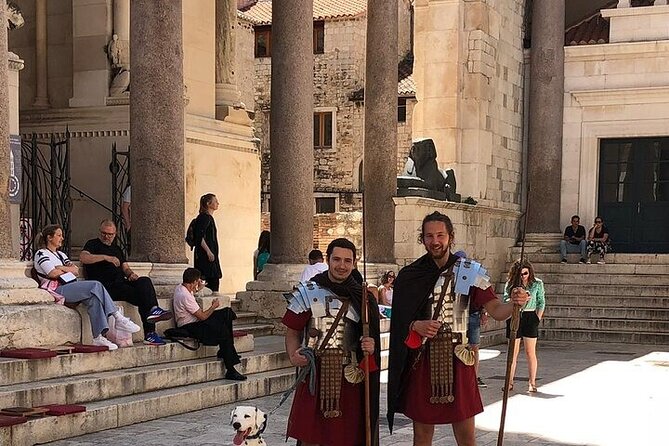
The Golden Gate is the palace’s main entrance and one of the clearest points for discussing how people entered the imperial complex. The stop lasts about 10 minutes.
Here you will also see the statue of Gregory of Nin, a major figure in Croatian culture and language. The guide explains why he matters, which gives the stop more meaning than a quick photograph beside a large statue.
This is one of the tour’s best transitions. You move from the Roman emperor and his palace to later Croatian identity, language, and public memory. Split’s story is not frozen in the fourth century. It has continued to change, and the Golden Gate area makes that easy to see.
The entrance can be crowded and busy with ordinary foot traffic. Listen closely when the guide gathers the group, since the space is not always ideal for a long explanation. A French-speaking guide who can project clearly will make a real difference here.
Riva Harbor: Split’s waterfront in context
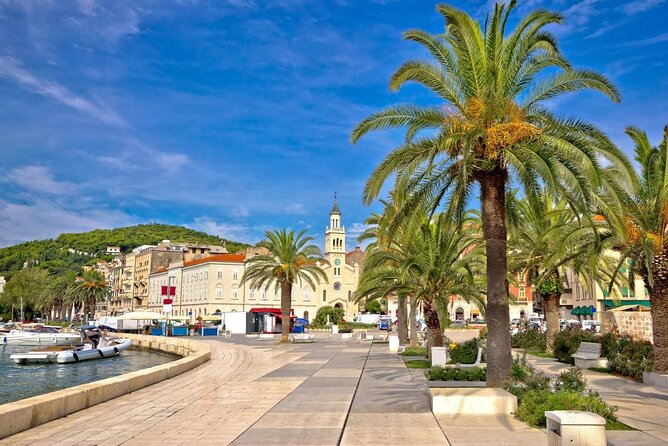
The walk continues to Riva Harbor, where you can see a bronze model of Diocletian’s Palace. This stop takes about 15 minutes and offers a useful change of viewpoint.
The model helps you picture the palace as a complete complex rather than a collection of disconnected streets. From the waterfront, the connection between the imperial residence and the sea becomes easier to grasp.
The guide also explains the history of the Riva promenade. Today it is one of Split’s most recognizable public spaces, but a good historical explanation helps you see how the waterfront has served different roles over time.
This section is also practical for orientation. If you are staying in Split, the Riva is an easy place to find again after the tour. You might want to return for a slow walk, a drink, or a view toward the harbor, but keep expectations sensible: the tour provides history and orientation rather than a dedicated waterfront break.
Fruit’s Square and Marko Marulić
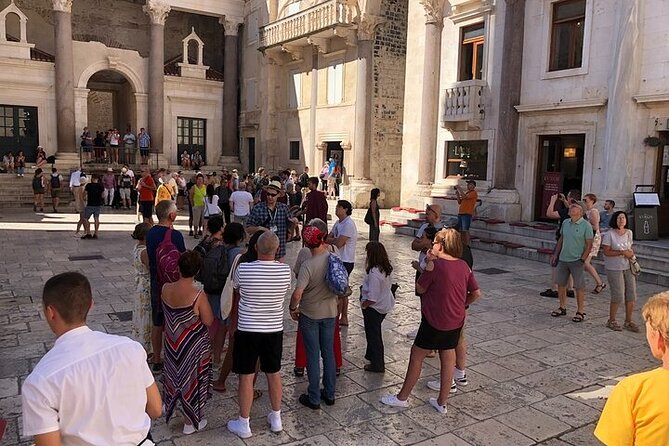
Fruit’s Square, or Trg Braće Radić, receives about 10 minutes. Its name comes from the former fruit market, and the square has a more intimate feel than the Peristyle.
The guide points out a 15th-century Venetian citadel and discusses Marko Marulić, often called the father of Croatian literature. This is a worthwhile stop because it broadens the visit beyond military and imperial history.
You are introduced to the Venetian period, local urban life, and Croatian literary culture in one compact space. That variety is one reason I like the route. It does not treat Split as only a Roman attraction.
The stop is short, so you will not receive a full literary lesson. Still, it gives you names and themes to investigate later. If Marulić interests you, note the name and ask the guide for a little extra context while the group is there.
Split Synagogue and the city’s Jewish story
The final listed stop is the Split Synagogue, a 16th-century site connected with the city’s Jewish community. The tour passes by it and explains the history of Jewish life in Split.
This is an important inclusion. Many short old-town walks focus only on emperors, churches, fortifications, and famous squares. A brief look at Jewish heritage gives you a broader sense of the people who helped shape the city.
The synagogue is not presented as a separate admission visit. The stop is about seeing the location from outside and learning its historical context. That makes it a compact but meaningful ending to the route.
Afterward, the activity returns to the meeting point at Peristil ulica. Since the tour ends where it starts, you can easily continue exploring the palace, revisit a stop, or find the museum section of the substructures independently.
French-language guiding is the main selling point
The feedback is unusually consistent about the language quality. Guides are described as speaking French perfectly or remarkably well, explaining carefully, and handling questions with confidence.
That matters in a place filled with dates, names, architectural terms, and overlapping periods. A tour translated word by word can feel stiff. The comments about passionate, funny, friendly, and engaging guides suggest a more natural style.
Antonela is specifically praised for her warmth and ability to make the palace’s story interesting. Irene is singled out for making the visit work well for children. You should not assume one particular guide will lead your departure, but these examples show the standard the operator aims for.
The tour is also a good fit if your group includes different ages. Families praised the amount of detail, while adults appreciated the guide’s historical depth. Children may enjoy the palace’s scale and unusual rooms, though the walk is still built around explanation rather than games or entertainment.
Price, group size, and actual value
The listed price is $69.14 per person. That is a substantial amount for a 90-minute city walk, especially because the main stops do not require admission tickets.
The value comes from the guide, not from paid entry. You are paying for a French-speaking specialist to connect the buildings, explain the palace’s construction, and place Split within a larger story. If you would otherwise read a guidebook or explore without much context, the tour can justify its price.
The group maximum is 30 people. That is smaller than a large coach-style outing, but it is not the same as a private walk. A group of this size may need to pause in wider spaces, and questions may be harder to manage when the group is full.
There are group discounts, which could improve the cost for families or larger parties. Mobile tickets are available, and confirmation is sent within 48 hours of booking, subject to availability. Plan ahead if your schedule is tight.
The official duration is about 1 hour 30 minutes, but several accounts describe the walk lasting more than two hours. I see that as a benefit if you want detail, but a problem if you have a reservation, ferry, or shore excursion immediately afterward. Leave a comfortable buffer.
Who should book this Split walk?
I would choose this tour if you want to understand Split rather than simply photograph it. It is especially useful for French-speaking visitors who prefer a live explanation in their own language and for families who want a guide able to keep children interested.
It also suits first-time visitors arriving in Split with limited time. The route covers the major palace landmarks and adds Riva, Venetian history, Croatian literature, and Jewish heritage. You get a useful framework for later independent exploring.
I would think twice if you dislike group walks, need a private pace, or want extensive access to the palace substructures museum. The museum section is not included, and a full group can never stop as freely as a private guide and your own party.
The walk is generally suitable for most people, but high steps are a stated concern. If stairs are difficult, ask for precise details before booking. Service animals are allowed, and the meeting point is near public transportation.
Cancellation and planning advice
Free cancellation is available if you cancel at least 24 hours before the local start time. Changes or cancellations made inside that window are not accepted for a refund.
The tour requires a minimum number of participants. If that minimum is not reached and the activity is canceled, you will be offered another date or experience, or a full refund.
Meet at Peristil ulica in Split, and expect to finish at the same point. Since the route is outdoors and passes through active public areas, arrive ready to walk and keep your phone available for the mobile ticket.
Should you book it?
Book this tour if French-language history, strong guiding, and a broad old-town route matter more to you than admission tickets or a private experience. The repeated praise for fluent, passionate guides is the strongest reason to choose it, and the route covers far more than the palace’s most famous square.
At $69.14, I would call it good value for someone who wants depth and clear orientation, but expensive for a casual stroll. Leave at least two hours free, expect steps, and plan to visit the substructures museum separately if that interests you. For French-speaking families and first-time visitors, this is a well-focused introduction to Split.
FAQ
Where does the French-language Split walking tour begin?
The tour begins at Peristil ulica, Peristil ul., 21000 Split, Croatia.
Where does the tour end?
The activity ends back at the meeting point.
How long does the tour last?
The stated duration is approximately 1 hour 30 minutes. It may last more than two hours, so leave extra time in your schedule.
Is the museum section of Diocletian’s Palace substructures included?
No. The tour visits the substructures and explains their construction and changing function, but the museum section is not included. You can visit it after the tour.
Is the tour suitable for people with mobility issues?
Most people can participate, but the experience is not recommended for anyone who has trouble with high steps.
What is the cancellation policy?
You can cancel at least 24 hours before the local start time for a full refund. Cancellations or changes made less than 24 hours before the start are not refunded or accepted.
Just added around Split
- Private VIP Blue Lagoon and 3 Islands Tour★ 4.5 · 9 reviews
- Split highlights – Evening walking tour★ 5.0 · 9 reviews
- Private boat transfer Split – Bol★ 5.0 · 9 reviews
- From Split: Trogir & Blue Lagoon Boat Tour with Snorkeling★ 4.6 · 9 reviews
- Private Photography Activity in Split★ 5.0 · 9 reviews
- Bike, Beer & Poljud Stadium Tour★ 5.0 · 9 reviews
- From Hvar: Blue cave group speedboat tour full day★ 5.0 · 9 reviews
- Split Walking Tour: History, Legends & Tales★ 5.0 · 9 reviews
Historical Tours, compared.

Walking Tour of Split with a ‘Magister’ of History
Read our review →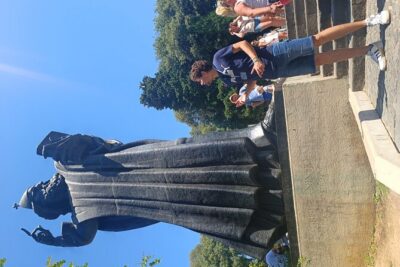


Split History and Gastro Small-Group Tour with Food and Drinks
Read our review →
PREMIUM Emperor’s Walking Tour for History Lovers + Museum
Read our review →Browse the lists this tour appears in