
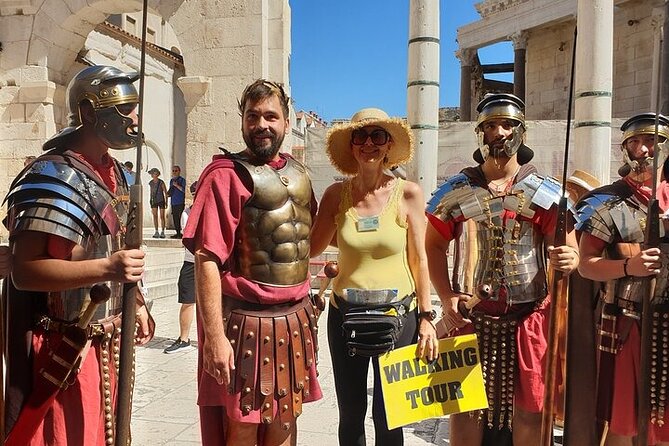
Reviewed · DIOCLETIAN PALACE TOURS
Split & Diocletian Palace Historical Walking Tour
Roman ruins still serve coffee here. This 90-minute walking tour gives you a useful first look at Diocletian’s Palace, from the grand Peristyle to the narrow route around the former imperial quarters. I like the choice between a regular group of up to 20 people and a small group limited to five. I also like the morning and afternoon departures, which make it easier to fit the walk around ferries, meals, and other Split plans.
The main caution is the price: $156.17 per person is a serious outlay for a short tour, especially since the museum section of the palace substructures is not included. The experience also depends heavily on the guide’s voice and presentation. One poor experience involved a guide who spoke too softly and often faced away from the group, while another praised an evening walk filled with useful facts and stories.
In This Review
- Five things to know before you book
- Starting at the Peristyle, Split’s Roman stage
- What the substructures reveal about the palace
- Following the south wall to Riva Harbor
- Fruit’s Square and Split’s Venetian chapter
- The ancient temple, Vestibulum, and Triklinij
- The mausoleum that became Split’s cathedral
- Grgur Ninski and the Golden Gate
- Why the short format can work
- Group size and the guide’s role
- Is $156.17 a fair price?
- Practical details before you go
- Who should book this Split walk?
- Should you book the Diocletian Palace walking tour?
- FAQ
- Where does the tour begin?
- Where does the tour end?
- How long does the walking tour last?
- What language is the tour offered in?
- How many people can join the regular tour?
- How many people can join the small group tour?
- Does the tour include the museum section of the palace substructures?
- Are morning and afternoon departures available?
- Is admission included at every stop?
- Can I cancel for a full refund?
Five things to know before you book
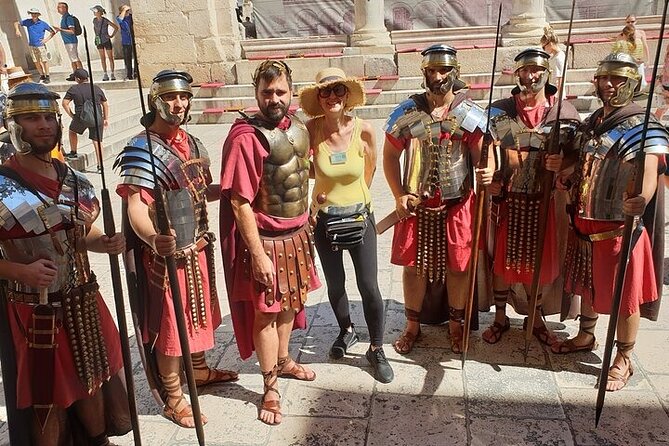
- The tour begins at the Peristyle, the central square and natural starting point for understanding the palace.
- The small-group option has a maximum of five people, giving you the best chance to hear the guide and ask questions.
- You visit the palace substructures but not the museum section, which you can see separately after the walk.
- The route covers both Roman and later Split, including the Riva waterfront, Fruit’s Square, Venetian buildings, medieval churches, and Meštrović’s Grgur Ninski statue.
- Morning and afternoon departures are available, and the activity ends back at the meeting point.
- Free cancellation is available up to 24 hours before the start time, subject to the stated minimum group requirement.
Starting at the Peristyle, Split’s Roman stage
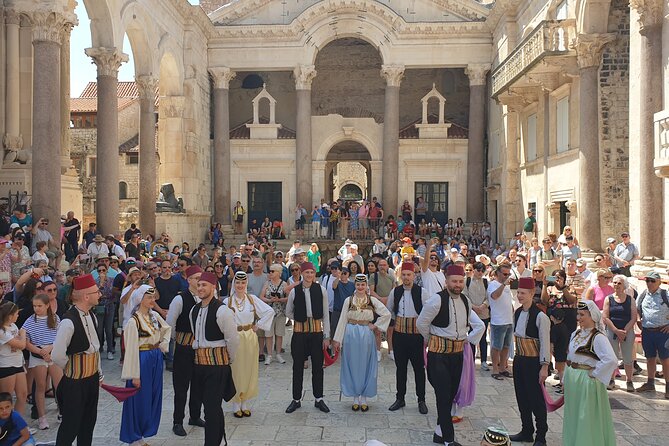
The tour starts on Peristil ulica at the Peristyle, the central square of Diocletian’s Palace. This is the right place to begin because almost every major part of the palace connects to this open space.
Allow yourself a little time to take in the setting. The square links the emperor’s former residence with the ceremonial heart of the palace, and it remains one of Split’s most memorable public spaces. You will be able to take close photographs of the palace rather than simply viewing it from a passing street.
The scheduled stop here lasts about 15 minutes. That is enough for orientation and an introduction to the palace, though not enough for a long architectural lecture. I would arrive ready to listen from the start. On a short walking tour, the opening explanation often gives you the framework that makes every later doorway and wall easier to understand.
More Historical Tours in Split
- Walking Tour of Split with a ‘Magister’ of History
★ 5.0 · 1,122 reviews - Split Walking Tour with Professor of History
★ 5.0 · 926 reviews - Split: History and Heritage Walking Tour
★ 4.9 · 650 reviews
What the substructures reveal about the palace
The next stop goes into the substructures of Diocletian’s Palace. The guide explains how the foundations were built and how these lower rooms served different purposes through the centuries.
This is one of the most useful parts of the walk because the lower level shows how the palace was supported and arranged. You are not only looking at an old stone room. You are seeing the structural plan beneath the imperial apartments and learning how the palace functioned as a built complex.
The visit lasts about 10 minutes. A key point is that this tour does not include the museum part of the substructures. You can visit that area after the guided walk, but you should not assume that your tour fee covers every underground room.
That limitation matters when you assess the price. The guided explanation may help you understand the foundations, but anyone hoping for a longer underground visit will need extra time and possibly a separate admission.
Following the south wall to Riva Harbor
From the palace, the route reaches Riva Harbor and the waterfront side of the complex. Here, you learn about the south wall of Diocletian’s Palace and Split’s broad promenade.
The Riva stop helps connect the Roman palace to modern city life. Instead of treating Diocletian’s Palace as an isolated archaeological site, the guide shows you how its walls meet the harbor and how the waterfront became part of Split’s daily rhythm.
The listed stop lasts about 10 minutes in one part of the route and about 15 minutes later. That suggests Riva may be used twice, with the second visit offering a closer look at the promenade and a bronze model of the palace.
You can use this section for photographs, but listen for the city’s physical layout. The waterfront gives you a better sense of the palace’s size and position than the tight lanes inside its walls.
Fruit’s Square and Split’s Venetian chapter
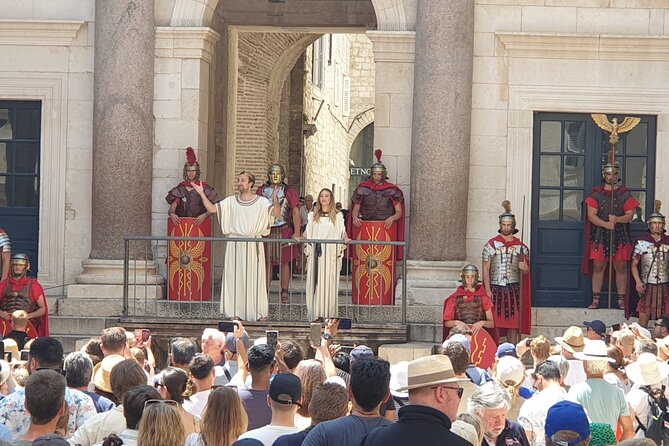
Fruit’s Square, known locally as Trg Braće Radić, brings a later period of Split’s story into the walk. The stop includes an old Venetian citadel and the sculpture of Marko Marulić.
The scheduled visit is only about five minutes, so expect a quick explanation rather than a long pause. Still, this is an important contrast with the Roman sections. Split is not only Diocletian’s palace. The city grew, changed, and added Venetian and medieval layers around the old imperial core.
The tour also passes a 15th-century Venetian palace that now houses the City Museum. The available details do not assign a separate duration to this stop, and it is not described as an included museum visit. Think of it as an exterior landmark and a chance to understand how later buildings occupied the old city center.
I like this mix of periods. You get a more honest picture of Split when Roman stone, Venetian architecture, church buildings, and modern cafés appear in the same short walk.
More Walking Tours in Split
- Split: Old Town and Diocletian Palace Walking Tour
★ 4.9 · 4,727 reviews - Walking Tour of Split and Diocletian’s Palace
★ 5.0 · 2,588 reviews - Krka Waterfalls tour with Trogir Walking tour and Krka panoramic boat cruise
★ 5.0 · 1,659 reviews - Split & Diocletian’s Palace Walking Tour
★ 5.0 · 1,125 reviews
The ancient temple, Vestibulum, and Triklinij
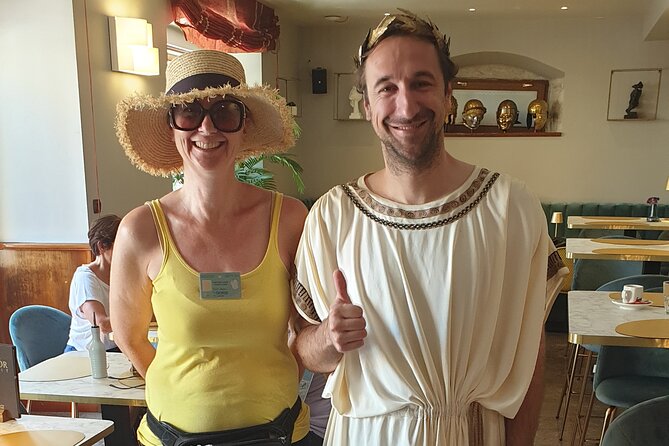
Another stop covers the last remaining ancient Roman temple within the palace. The information provided does not name the temple or give it a separate duration, so the guide’s treatment may be brief.
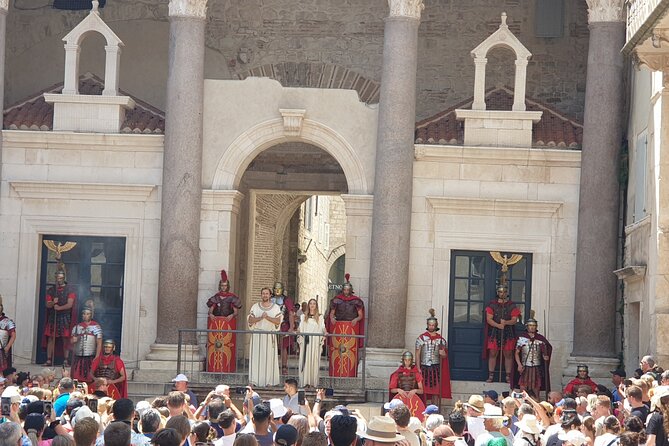
The Vestibulum follows as a look at the entrance hall to Diocletian’s personal quarters. This round or domed entrance space is tied directly to the emperor’s private area, making it one of the route’s most personal palace stops. The scheduled time is about five minutes.
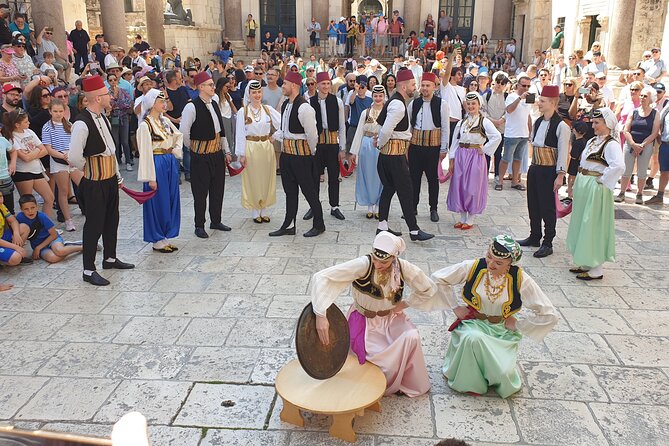
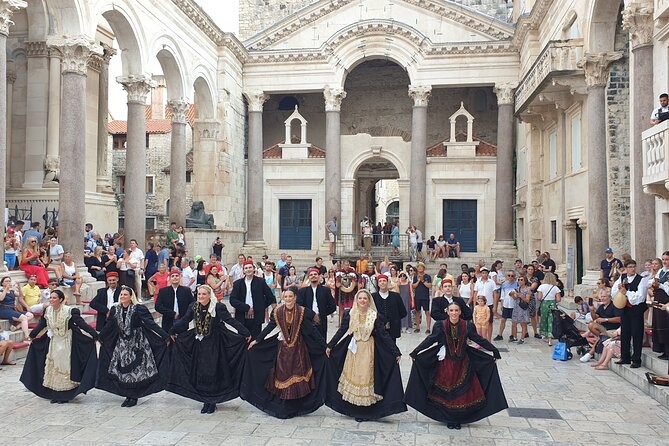
You might also hear traditional Dalmatian singing here. That detail can add a local touch, but it is described as something that may happen, not a guaranteed performance. I would treat it as a pleasant possibility rather than a promised part of the tour.
The Triklinij includes remains and a partial reconstruction of Diocletian’s personal walkway and dining hall. Again, the stop is short, about five minutes. The value comes from seeing how the palace worked as a residence, not just as a defensive compound.
These brief stops require a guide who can make a point quickly. If the explanation is clear, you receive a compact picture of imperial daily life. If the guide speaks too softly or faces away from the group, the experience loses much of its value.
The mausoleum that became Split’s cathedral
The route also includes Split’s cathedral, located inside the mausoleum of Emperor Diocletian. This is one of the clearest examples of the city’s changing identity.
A building created for an emperor’s burial later became a Christian cathedral. That single fact tells you much about how the palace was reused instead of abandoned. The stop is not described with a separate duration or admission detail, so confirm with the guide what portion you will see during the walk and what may require a separate ticket.
This is also an area where a short introduction can be enough to orient you, but not enough for every architectural detail. If the cathedral is high on your list, ask the guide whether you should return independently after the tour.
Grgur Ninski and the Golden Gate
The statue of Grgur Ninski, created by Croatian sculptor Ivan Meštrović, receives a substantial 15-minute stop. It stands in front of the north gate of Diocletian’s Palace and depicts Grgur of Nin, an important figure in Croatian language and church history.
This is a good place to ask questions. The tour specifically connects the statue with the importance of the Croatian language, so the guide can help explain why this figure matters beyond the sculpture itself.
The Golden Gate is the palace’s main entrance. You learn about its design, its place in the palace plan, and the nearby statue of Gregory of Nin. The listed duration is about 10 minutes, and the admission note says a ticket is not included.
The route description appears to give the statue some attention both before and near the Golden Gate. That is not necessarily a problem. The two stops work together: first, you meet the figure and his cultural importance, then you see the principal northern entrance and its setting.
The north gate is also a useful point for understanding how people entered the palace. Look at the scale of the walls and the relationship between the gate, the streets, and the interior lanes. You get a better sense of the palace as a living urban center rather than a freestanding ruin.
Why the short format can work
At about one hour and 30 minutes, this is a compact introduction. I see that as both a strength and a limit.
You can use it on your first morning in Split to get your bearings fast. Afterward, you will know which parts deserve a longer return visit, such as the substructures museum, cathedral, or any interior space not fully covered during the walk.
The pace may feel brisk because the route contains many stops. Several have only five or 10 minutes assigned to them, while a few stops have no stated duration. The overall schedule is therefore approximate, and you should not expect a slow archaeological study of every site.
An evening departure can be especially appealing. One five-star assessment praised an evening walk as a good way to become familiar with the area, with many facts and stories included. Morning departures may be better if you want to spend the rest of the day exploring on your own. Afternoon walks give you another practical option when your arrival schedule is uncertain.
Group size and the guide’s role
You can choose a regular tour with up to 20 people or a small group limited to five. I would strongly consider the small group if the price difference is manageable.
The smaller format should make it easier to hear the explanation in crowded squares, stay close to the guide, and ask about places you want to revisit. It is particularly useful at the Peristyle, Riva, and Golden Gate, where open spaces and city noise can spread a group out.
The regular option may suit you if you mainly want orientation and a lower group size is not important. Still, the maximum of 20 is large enough that you should remain alert when the group moves between stops.
The guide’s delivery is not a minor detail here. One three-star account described a presentation that was hard to hear because the guide spoke quietly and repeatedly turned away. Another account praised the guide for offering many interesting facts and stories. Those contrasting experiences suggest that the tour can be excellent when the guide projects clearly and keeps the group engaged, but uneven delivery can spoil an otherwise strong route.
If you struggle to hear, move close to the guide and ask politely for the explanation to be repeated. In the small group, that should be simple. In a group of 20, it may be less comfortable.
Is $156.17 a fair price?
At $156.17 per person, this tour costs more than a basic city orientation walk. The value depends on what you want from a guide.
You are paying for a focused route through the main palace areas, a guide, the choice of small-group service, and a return to the original meeting point. You are not paying for a full museum program, and the substructures museum is specifically outside the tour.
For me, the small group is the only version that could make this price feel reasonable, especially if you care about questions and clear communication. A group of five offers a more personal format and may help protect you from the hearing problem described in one poor account.
The regular group can still be useful, but at this price I would compare it carefully with other guided options in Split. The high satisfaction rate of 93 percent and a 4.9 rating from 29 ratings suggest that the experience is usually well received, but the sample is small and the direct feedback shows that guide quality matters.
If the price includes no separate admissions, budget for any paid interior visits you decide to make after the walk. The tour’s value is strongest as a concise introduction, not as an all-inclusive palace admission.
Practical details before you go
The meeting point is Peristil ulica, Peristil ul., 21000 Split, Croatia. The activity ends back at the same meeting point, which makes it easy to continue exploring from the palace center.
The tour is offered in English. Confirmation arrives when you book, and service animals are allowed. The activity is near public transportation, and most people can take part according to the supplied information.
You can cancel for a full refund if you do so at least 24 hours before the local start time. Changes or cancellations inside that window are not accepted for a refund. The tour also requires a minimum number of participants. If that minimum is not met and the activity is canceled, you will be offered another date or experience, or a full refund.
I would wear comfortable shoes and arrive at the meeting point early enough to locate the guide. That is practical advice for any walking route through a historic center, especially one that shifts between squares, waterfront paths, and palace passages.
Who should book this Split walk?
I would recommend it most strongly to you if:
- You are visiting Split for the first time and want a quick orientation.
- You want to understand the palace’s main layout before exploring alone.
- You prefer a guide to connect Roman, Venetian, medieval, and modern Split.
- You can choose the small group of five.
- You want morning or afternoon scheduling flexibility.
- You value stories and context more than a long museum visit.
I would be more cautious if you want extensive time inside the substructures, a detailed cathedral visit, or a slow architectural tour. The route covers a lot, but several stops are short and some interior attractions are not fully included.
Should you book the Diocletian Palace walking tour?
Book it if you want a compact, English-language introduction to Split and can select the small group. The route hits the Peristyle, palace foundations, Riva, Fruit’s Square, Vestibulum, Triklinij, cathedral area, Grgur Ninski, and Golden Gate, giving you a useful framework for independent exploring afterward.
I would skip it at this price if your main goal is museum access or a detailed look at every interior. For the best value, use the tour to learn the city’s shape and stories, then return on your own to the palace spaces that deserve more time.
FAQ
Where does the tour begin?
The tour begins at Peristil ulica, Peristil ul., 21000 Split, Croatia.
Where does the tour end?
The activity ends back at the meeting point.
How long does the walking tour last?
The tour lasts approximately one hour and 30 minutes.
What language is the tour offered in?
The tour is offered in English.
How many people can join the regular tour?
The regular tour can have a maximum of 20 people.
How many people can join the small group tour?
The small group option has a maximum of five people.
Does the tour include the museum section of the palace substructures?
No. The museum part of the substructures is not visited during the tour, though you can visit it afterward.
Are morning and afternoon departures available?
Yes. You can choose between morning and afternoon tour times.
Is admission included at every stop?
No. Some stops are listed with no admission charge, while admission is not included for the Golden Gate and Riva Harbor portions. The substructures museum is also outside the tour.
Can I cancel for a full refund?
Yes, if you cancel at least 24 hours before the experience start time. Cancellations or changes made less than 24 hours before the start are not refunded.
More Diocletian Palace Tours
- Split: Diocletian Palace & Old Town Guided Walking Tour
★ 4.7 · 882 reviews - Split: Game of Thrones Tour with Diocletian’s Palace Cellar
★ 4.8 · 545 reviews - Diocletian’s Palace and Old Town SMALL GROUP Walking Tour
★ 5.0 · 502 reviews - SPLIT-PRIVATE Walking Tour of Diocletian’s Palace & Old Town
★ 5.0 · 467 reviews
Just added around Split
- Private VIP Blue Lagoon and 3 Islands Tour★ 4.5 · 9 reviews
- Split highlights – Evening walking tour★ 5.0 · 9 reviews
- Private boat transfer Split – Bol★ 5.0 · 9 reviews
- From Split: Trogir & Blue Lagoon Boat Tour with Snorkeling★ 4.6 · 9 reviews
- Private Photography Activity in Split★ 5.0 · 9 reviews
- Bike, Beer & Poljud Stadium Tour★ 5.0 · 9 reviews
- From Hvar: Blue cave group speedboat tour full day★ 5.0 · 9 reviews
- Split Walking Tour: History, Legends & Tales★ 5.0 · 9 reviews
Diocletian Palace Tours, compared.


Walking Tour of Split and Diocletian’s Palace
Read our review →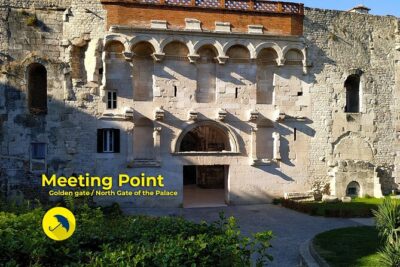

Diocletian Palace & Old Town Guided Walking Tour
Read our review →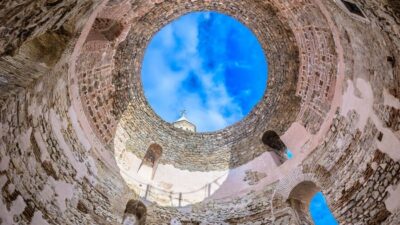
Game of Thrones Tour with Diocletian’s Palace Cellar
Read our review →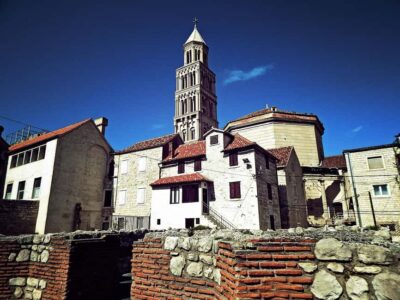
Diocletian’s Palace and Old Town SMALL GROUP Walking Tour
Read our review →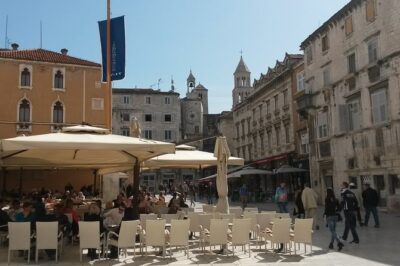
PRIVATE Walking Tour of Diocletian’s Palace & Old Town
Read our review →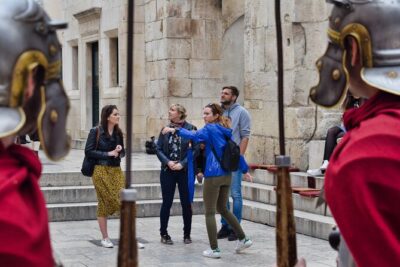
Browse the lists this tour appears in