
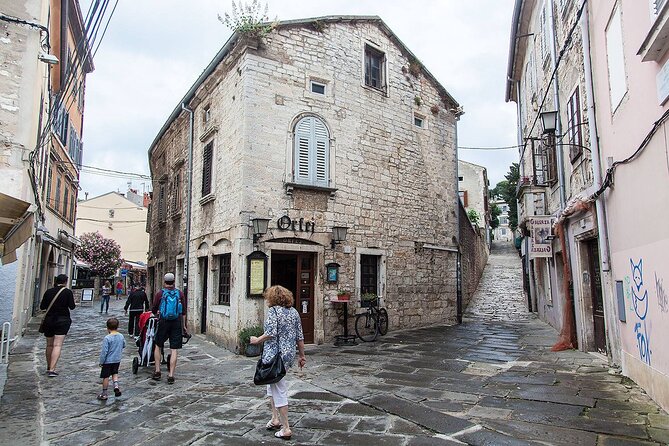
Reviewed · WALKING TOURS
Pula Essentials Walking Tour
Pula’s past is packed into a short walk. This 90-minute tour links the Roman Arena, medieval gates, Venetian streets, Austrian traces, the Forum, and the waterfront with a local guide who explains how the city changed over time. I especially like the clear historical sweep, from before Roman rule to modern Croatia, and the practical advice on places to eat, go out, and spend free time.
The price is $34 per person, which feels fair if you are new to Pula and want a useful orientation before exploring alone. I also like that the walk ends near either Tito’s Park or the Forum, two handy spots for continuing your day. The main consideration is that the Pula Arena is viewed only from outside, so you will need a separate ticket if you want to enter.
The tour is offered in English and needs at least two participants to run. Most of the feedback is glowing, with a 4.8 rating from 64 reviews. Stefano receives repeated praise for his friendly explanations and ability to handle questions, while Ana is also described as warm and well informed. One less positive account noted repeated explanations and a guide who seemed to have had too much wine before the walk, so the experience may depend somewhat on who leads your departure.
In This Review
- Key points at a glance
- Why this is a smart first look at Pula
- Meeting at Tito’s Park
- The Arena: Pula’s great Roman introduction
- Twin Gate and Gate of Hercules
- Giardini and the Arch of the Sergii
- Ulica Sergijevaca and the Forum
- Temple of Augustus and Pula Cathedral
- Riva and the waterfront finish
- What the guides add to the walk
- Is $34 good value?
- Who will enjoy this Pula walk?
- Should you book the Pula Essentials Walking Tour?
- FAQ
- Where does the Pula Essentials Walking Tour begin?
- How long does the walking tour last?
- What language is the tour offered in?
- Is the Pula Arena included inside the tour?
- Where does the tour finish?
- Is the tour wheelchair accessible?
- Can one person book the tour?
Key points at a glance
- Roman Pula in one focused walk: See the Arena, Twin Gate, Gate of Hercules, Arch of the Sergii, Forum, and Temple of Augustus.
- A useful first-day activity: The guide gives suggestions for dining, nightlife, nearby activities, and ways to use your spare time.
- Strong guide feedback: Stefano is often praised for clear storytelling, patience, humor, and practical local advice. Ana also receives warm comments.
- Short, central route: The walk begins at Tito’s Park and finishes at either Tito’s Park or the Forum.
- Outdoor sightseeing only: Admission to attractions is not included, and the Arena is seen from outside.
- Good booking flexibility: You can cancel up to 24 hours before departure for a full refund and reserve without paying immediately.
Why this is a smart first look at Pula
Pula can seem like several cities layered on top of one another. Roman monuments sit beside later gates and streets, while the harbor and central squares point to Austrian, Italian, Yugoslav, and Croatian chapters. A guide helps connect those pieces instead of leaving you with a collection of impressive stones and unfamiliar names.
This walk is not designed as a long museum visit. It is a compact introduction delivered outdoors, with time to ask questions and get suggestions for the rest of your stay. That makes it especially useful if you have just arrived, are staying near the old town, or want context before visiting the Arena on your own.
The guide also discusses food, nightlife, and other activities in Pula and the wider Istria area. That practical layer adds real value. You are not only learning what happened here, but also getting help deciding what to do next.
The timing deserves a small note. The advertised duration is 90 minutes, while the listed stop estimates add up to longer than that. I would treat those times as rough guidelines. The actual pace may change with questions, crowding, and the guide’s storytelling style.
More Walking Tours in Pula
- Pula: Historic Walking Tour with Local Guide & City Views
★ 4.8 · 143 reviews - Pula walking tour
★ 5.0 · 96 reviews - Pula: Historic Sites Guided Walking Tour
★ 4.8 · 78 reviews
Meeting at Tito’s Park
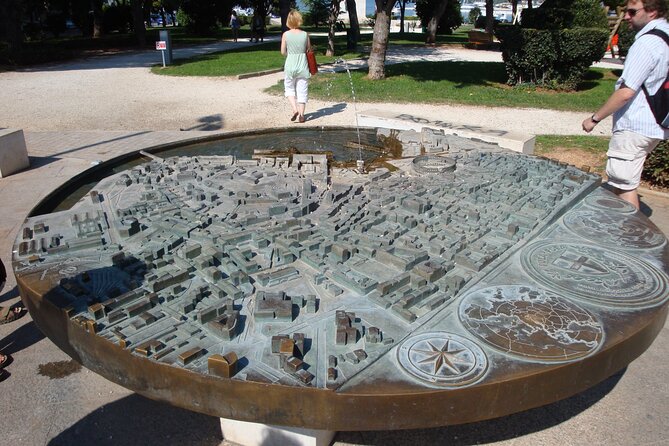
The walk begins at the top of Tito’s Park, across the street from the large Anchor. Look for a cast model of the city with a tiny fountain. This is a specific meeting point, but it is worth allowing a few extra minutes to find it, especially if you are arriving from an unfamiliar part of town.
The park provides a useful starting frame. You are outside the oldest core, yet close enough to move quickly toward the major Roman remains. The first sightseeing stop takes about 10 minutes, giving the guide a chance to place Pula within the larger story of Istria.
Because this is a public group walk, the atmosphere may be social or quiet depending on the booking. A private group option is available if you want more control over the pace and conversation.
The Arena: Pula’s great Roman introduction
The Pula Arena is the star of the route. At roughly 2,000 years old, it gives you an immediate sense of the city’s importance under Roman rule. You see the exterior and hear about its place in Pula’s past, but entrance is not included.
That outside view still has value. The Arena is large enough to dominate the approach, and a guide can help you understand what you are looking at rather than leaving you to admire the arches without context. The scheduled stop is about 20 minutes, making it the longest single visit on the route.
If entering the Arena matters to you, plan a separate visit. This tour does not include an interior tour or admission ticket. That is the chief limitation for anyone hoping for a full archaeological visit.
The Roman focus is one of the tour’s strongest features. Several people who praised the experience singled out the Roman period and said the walk helped explain how Pula became the city it is today. If ancient monuments are your main reason for visiting, this section gives you a useful start, but it will not replace dedicated time inside the Arena.
Twin Gate and Gate of Hercules
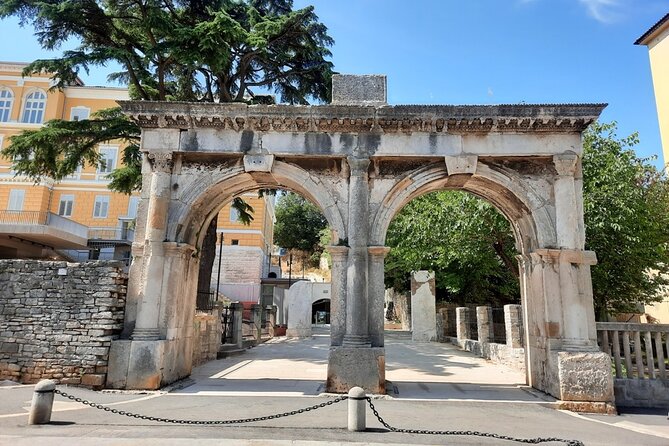
From the Arena, the route moves through two smaller but important reminders of Pula’s old defenses. Twin Gate is a compact stop, while the Gate of Hercules offers another look at the city’s Roman remains.
These sites are easy to pass without a guide. Their scale is modest compared with the Arena, so the explanation matters more than the photograph. You get a sense of how entrances, walls, and routes shaped movement through the old city.
The Gate of Hercules also shows how Pula’s ancient past is woven into ordinary streets. This is part of the appeal of a walking tour: the monuments do not appear as isolated stops reached by transport. They arrive one after another, connected by the same urban fabric.
Something different for another day:
- Pula: Arena Entrance Ticket
★ 4.3 · 2,590 reviews - Medulin -Kamenjak 5h boat trip with lunch & drinks on Sandra Boat
★ 5.0 · 1,621 reviews - Full-Day Boat Tour of the Medulin Archipelago from Medulin
★ 5.0 · 1,389 reviews - 3hours all inclusive Sunset&Dolphin Tour from Medulin on Sandra
★ 5.0 · 1,130 reviews
Giardini and the Arch of the Sergii
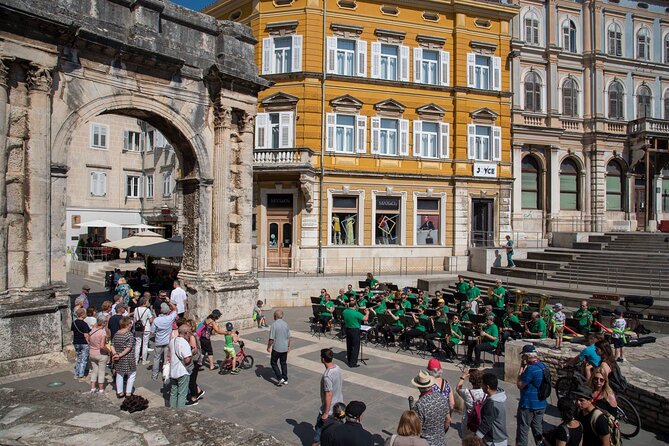
The walk continues through Giardini for about 10 minutes. This is less about stopping at one major monument and more about seeing how central Pula works as a living city. The guide can point out where to eat, have a drink, or return later when you are exploring independently.
Next comes the Arch of the Sergii, another major Roman landmark. It gives the route a strong visual centerpiece after the Arena and helps show the reach of Roman civic life beyond the amphitheater.
The guide’s role is important here. One of the most praised parts of the tour is the ability to answer questions that move beyond the standard Roman story. Past questions have ranged from the history of shipbuilding in the harbor to native Istrian dog breeds. That suggests the walk can become a broader conversation about local life, not just a memorized list of dates.
If you enjoy asking questions, this is a good place to do it. The walk is short, and a curious group can make the experience feel more personal.
Ulica Sergijevaca and the Forum
Ulica Sergijevaca brings you farther into the pedestrian heart of Pula. The 10-minute walk is a chance to notice the relationship between the old street plan and today’s shops, restaurants, and daily activity.
The route then reaches the Forum, one of the city’s central gathering places. This is where the story of Pula’s public life becomes easier to picture. The Forum also makes a practical end point because you can continue into the old town, stop for food, or use the guide’s recommendations while the information is fresh.
The guide discusses more than the Roman period here. Pula’s past includes medieval, Venetian, Austrian, Italian, Yugoslav, and modern Croatian chapters. That sequence is one reason the tour can feel more useful than a monument-only walk. You are shown how different political eras affected the city’s identity and appearance.
Several strong reviews describe the tour as a good way to understand how Pula became the place you see today. That is the right expectation. You will not receive an academic course in 90 minutes, but you should come away with a clear outline and enough detail to make later sightseeing more meaningful.
Temple of Augustus and Pula Cathedral
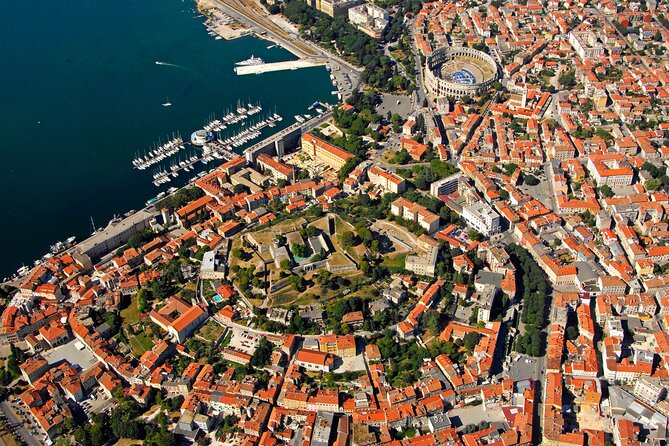
The Temple of Augustus receives a shorter stop of about five minutes. Its position near the Forum makes it easy to include, and the guide can explain its place within the Roman center.
Do not expect a long interior visit here. The value is in seeing the temple as part of the Forum rather than as a separate attraction. It helps complete the picture of Roman public architecture in central Pula.
Pula Cathedral follows later in the route. This shift in subject is useful because it shows the city beyond its ancient monuments. You move from Roman civic religion toward the Christian and later eras that shaped the old town.
The cathedral stop is listed at about 10 minutes. As with the other locations, the emphasis is on outdoor sightseeing and explanation. If you want extended time inside any attraction, you will need to arrange that separately.
Riva and the waterfront finish
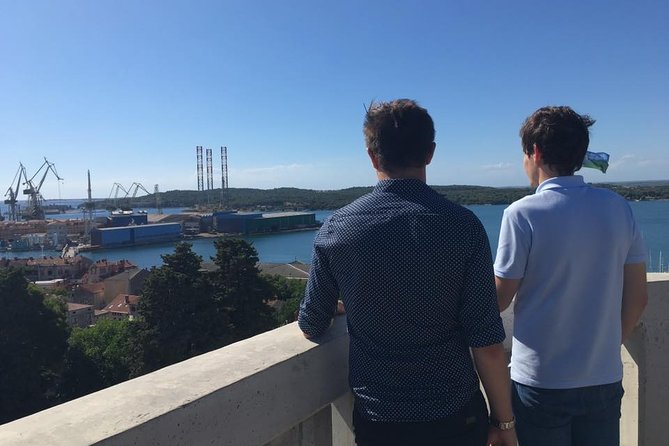
The final walk follows Riva, with sunset noted as part of the stop. The waterfront gives the tour a change of mood after the concentrated old-town monuments. It also connects the city’s history with its harbor and maritime life.
This is where the conversation about shipbuilding and the wider area may be especially useful. The harbor is not just a scenic ending. It helps explain why Pula mattered in different periods and why its identity cannot be reduced to Roman ruins.
The tour returns to Tito’s Park or finishes at the Forum. Both are practical drop-off points. You can stay in the center for dinner, continue to another sight, or use the guide’s recommendations for the evening.
A late departure may make the waterfront especially pleasant, but timing depends on the available start slots. Check the schedule before booking if sunset is important to you.
What the guides add to the walk
The strongest pattern in the feedback is praise for the guides, especially Stefano. He is repeatedly described as friendly, clear, patient, and able to make historical events understandable. One particularly positive account said he explained Pula while also taking photos when asked, and another praised his professional but relaxed manner.
That combination matters. Pula’s history includes many changes of rule and identity, and a rushed or overly technical presentation could become hard work. The best guide style here appears to be conversational, with room for questions and practical advice.
Ana also receives strong praise. She is described as especially pleasant and well informed, with useful suggestions for making the most of Pula and the surrounding area.
There is one caution. A four-star account described a friendly guide who repeated points several times and appeared to have been drinking before the walk. This is a single negative experience among largely excellent feedback, but it is fair to note that the quality of a small walking tour can vary with the individual guide and departure.
Is $34 good value?
At $34 per person, this is a reasonable price for a 90-minute guided introduction, particularly if you use the advice to shape the rest of your visit. You are paying for a certified guide, local recommendations, and a route that covers many of Pula’s key central sights without requiring transport.
The value is strongest when you book early in your stay. Information about restaurants, nightlife, nearby activities, and the wider Istria area can influence several later decisions. The tour is less valuable if you already know Pula well or plan to spend your time only inside paid attractions.
Remember that entrance tickets are not included. The Arena is seen from outside, and no admission is bundled into the $34 cost. If you want to enter the Arena or another attraction, add that expense and time to your plans.
The free cancellation option also reduces the risk. You can cancel up to 24 hours before the tour for a full refund, and reserve now while paying later. The minimum of two participants is more important for solo bookers: if you remain the only person booked one hour before departure, the tour will not run and you will be refunded.
Who will enjoy this Pula walk?
I would recommend it most strongly to first-time visitors, cruise passengers with limited time, couples, and anyone who wants a clear introduction before exploring alone. It also suits people who like history but prefer a short outdoor walk to a long museum session.
Families may appreciate the 90-minute length, though the historical content will suit older children better than very young ones. The route is wheelchair accessible, which makes it a practical choice for many visitors, though the exact ease of each street can still depend on local conditions.
Solo bookers should check the booking status because of the two-person minimum. If you want a more personal pace, a private group can be arranged.
This is not the best choice if you require an interior visit to the Arena, want a long archaeological lecture, or prefer a tour in a language other than English. It is also not a tour built around food tastings or nightlife stops. You receive suggestions, not included meals or drinks.
Should you book the Pula Essentials Walking Tour?
Book it if you want a friendly, compact orientation to Pula with Roman monuments, later historical layers, and useful local advice. The route covers a lot, the price is sensible, and the repeated praise for Stefano and Ana suggests a strong chance of an engaging guide.
Book it near the start of your stay so you can act on the dining and activity suggestions. Give yourself extra time to find the Anchor and city model at Tito’s Park, and remember that the Arena is viewed from outside.
Skip it if you already have a firm understanding of Pula or want a dedicated interior visit to the amphitheater. For most first-time visitors, though, this is a practical way to get oriented quickly and see why Pula is more than one famous Roman building.
FAQ
Where does the Pula Essentials Walking Tour begin?
It begins at the top of Tito’s Park, across the street from the large Anchor. Look for a cast model of the city with a small fountain.
How long does the walking tour last?
The advertised duration is 90 minutes. Start times vary, so check availability for the date you want.
What language is the tour offered in?
The tour is offered only in English and includes a live English-speaking guide.
Is the Pula Arena included inside the tour?
No. The Pula Arena is seen from outside, and entrance tickets to sights are not included.
Where does the tour finish?
The tour has two possible drop-off locations: Tito’s Park and the Forum.
Is the tour wheelchair accessible?
Yes. The activity is listed as wheelchair accessible.
Can one person book the tour?
The tour requires at least two participants to run. If an individual booking remains the only reservation one hour before departure, that person will be refunded.
Just added around Pula
- Istria: Private Boat Tour with Skipper★ 5.0 · 9 reviews
- 3 Hours Private Wine and Sunset Tour★ 5.0 · 9 reviews
- Pula: Sunset/Night-time Illuminated Transparent Kayak Tour★ 4.0 · 9 reviews
- Electric Off-Road Scooter Tour in Pula★ 5.0 · 10 reviews
- Pula: Your Custom Full-Day Private Sail – Explore Istria’s Gems★ 5.0 · 10 reviews
- Pula Private 2-Hour Guided Walking Tour★ 5.0 · 10 reviews
- Pula: Private Brijuni Tour With Swimming, Dinner & Drinks★ 4.3 · 10 reviews
- Stop on Island & National Park Day Cruise with Lunch Drinks★ 5.0 · 10 reviews
Walking Tours, compared.




Walking Tour of Split and Diocletian’s Palace
Read our review →


Krka Waterfalls tour with Trogir Walking tour and Krka panoramic boat cruise
Read our review →
City Walls Early Morning or Sunset Walking Tour
Read our review →Browse the lists this tour appears in