
Reviewed · DIOCLETIAN PALACE TOURS
Jewish Heritage & Diocletian’s Palace Private Split Tour
History has more than one doorway. This private Split tour uses Diocletian’s Palace as its Roman starting point, then follows the Jewish story through the Old Town, synagogue, former Jewish quarter, squares, harbor, and local streets. I like the way it connects grand imperial history with the lives of ordinary communities. I also like that the synagogue visit may include a conversation with a member of Split’s Jewish community, including Albert, who has welcomed many groups.
The tour lasts about two and a half hours and costs $187.05 per person. That is a serious price for a walking tour, even with a private guide, so it makes the most sense for families or small groups who want personal attention. The main thing to keep in mind is that the Jewish cemetery is listed among the highlights, but the detailed route provided focuses on the synagogue and Jewish quarter rather than naming a separate cemetery stop.
In This Review
- What makes this Split tour worth considering
- Why pair Jewish history with Diocletian’s Palace?
- Starting below the palace in the substructures
- The Vestibule and Peristyle: Rome in full view
- Grgur Ninski and the human scale of Split
- Entering Split’s synagogue and former Jewish quarter
- Narodni Trg and Split’s Venetian face
- Fruit’s Square and the literary side of the city
- Riva, Prokurative, and the city today
- Marmontova Street and the fish market option
- How the private format changes the experience
- Price, timing, and pickup details
- Who should book this tour?
- Should you book the Jewish Heritage and Diocletian’s Palace tour?
- FAQ
- How long is the Jewish Heritage and Diocletian’s Palace tour?
- What language is the tour offered in?
- Is this a private tour?
- What is included in the price?
- Is the synagogue visit included?
- Is the Jewish cemetery included?
- Where does the tour begin?
- Is pickup available for cruise ship passengers?
- Can the tour start at a requested time?
- What is the cancellation policy?
What makes this Split tour worth considering
- Menorah carvings in the palace basements connect Jewish life in Split with the Roman world of the fourth-century emperor.
- A private guide adjusts the pace and focus, which has helped groups with mobility concerns and families with very different interests.
- The synagogue visit is the emotional center, especially when a local community member is available to explain its past and present.
- The route covers more than palace ruins, including the Jewish ghetto, Venetian squares, Riva, Prokurative, and Marmontova Street.
- Cruise ship pickup is available at the port, while Old Town apartment pickup can be arranged directly.
- The tour is offered in English, with guides such as Jelena, Emil, Vinka, and Pero praised for warmth, humor, and clear storytelling.
Why pair Jewish history with Diocletian’s Palace?
Many first-time walks through Split stay inside the Roman palace. That is understandable. The Peristyle, Vestibule, cathedral area, stone lanes, and underground chambers are the city’s great visual prizes.
But Split is not a museum sealed in the year 305. People have lived inside and around these Roman walls for centuries. This tour helps you see the palace as a working city, shaped by Roman rule, medieval life, Venetian influence, Croatian culture, war, and the persistence of its Jewish community.
The Jewish story begins before Split itself took its present form. Archaeological finds from Salona, the nearby Roman city, show Jewish life there between roughly the second and third centuries AD. When attacks by invading groups forced Salona’s residents to flee, many moved into the shelter of Diocletian’s Palace. Jewish residents shared that upheaval and began a new chapter in Split.
That long timeline gives the tour its purpose. You are not simply looking at an old synagogue after seeing old Roman stones. You are tracing how communities survived, adapted, traded, worshiped, and made a home in the same compact urban space.
More Historical Tours in Split
- Walking Tour of Split with a ‘Magister’ of History
★ 5.0 · 1,122 reviews - Split Walking Tour with Professor of History
★ 5.0 · 926 reviews - Split: History and Heritage Walking Tour
★ 4.9 · 650 reviews
Starting below the palace in the substructures
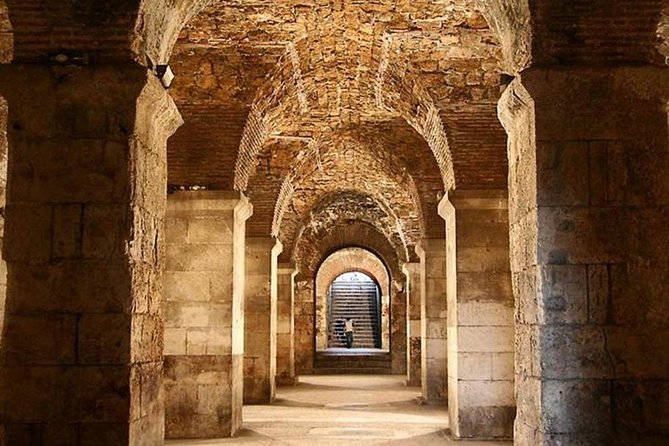
The tour begins at the substructures of Diocletian’s Palace, with admission included. Allow about 45 minutes here.
The underground chambers are among the best places in Split to understand the original palace plan. Their walls and corridors supported the imperial rooms above, and the layout gives you a physical sense of how large and carefully planned Diocletian’s retirement residence was.
The Jewish connection is especially valuable. Menorah carvings in the basement provide evidence used to discuss Jewish presence in Split during the early centuries. These are not grand monuments. They are small, easily missed details, which is exactly why a guide helps. Without someone pointing them out, you could walk past and see only another worn stone.
I would pay close attention to the guide’s stories here rather than rushing toward the next photo. The substructures can feel abstract if you only hear dates and building terms. A good explanation turns them into part of a lived setting, where staff, residents, and later generations used and altered the ancient structure.
The underground stop also makes practical sense if the weather is poor. One group began in heavy rain, and the guide adjusted the timing so the palace interior came first. That sort of flexibility is one of the clearest benefits of booking privately.
The Vestibule and Peristyle: Rome in full view
The Vestibule takes about 10 minutes. It was once a foyer of the palace, and its round form helps you picture how visitors approached the imperial apartments.
Next comes the Peristyle, the palace’s main ceremonial square. You will hear about its original Roman purpose and its later use as one of Split’s central public spaces. The columns were brought from different parts of the Roman Empire when the palace was built in AD 305, a useful reminder that Diocletian’s project depended on materials and labor gathered across a vast territory.
This is one of the busiest-looking parts of the route in visual terms, even though the tour itself is private. The Peristyle rewards a guide who can separate what is ancient from what belongs to later centuries. I would expect a short stop rather than a long lecture, since the itinerary allows about 10 minutes.
That brevity is both a strength and a limitation. You get a solid orientation without spending the whole morning on one square. If Roman architecture is your main passion, you may want extra time in the palace after the tour ends.
Grgur Ninski and the human scale of Split
The statue of Grgur Ninski, created by Ivan Meštrović, adds a Croatian cultural note to the Roman and Jewish themes.
Grgur Ninski was a medieval bishop and an important figure in Croatian history. The stop lasts about 10 minutes, enough to introduce the bishop and the sculptor without turning the walk into a separate art tour.
The statue is also a useful reminder that Split’s identity is layered. Roman emperors matter here, but so do medieval church leaders, Croatian writers, Venetian builders, local markets, and modern residents drinking coffee along the harbor.
More ways to see Diocletian's Palace:
- Split: Old Town and Diocletian Palace Walking Tour
★ 4.9 · 4,727 reviews - Walking Tour of Split and Diocletian’s Palace
★ 5.0 · 2,588 reviews - Split & Diocletian’s Palace Walking Tour
★ 5.0 · 1,125 reviews - Split: Diocletian Palace & Old Town Guided Walking Tour
★ 4.7 · 882 reviews
Entering Split’s synagogue and former Jewish quarter
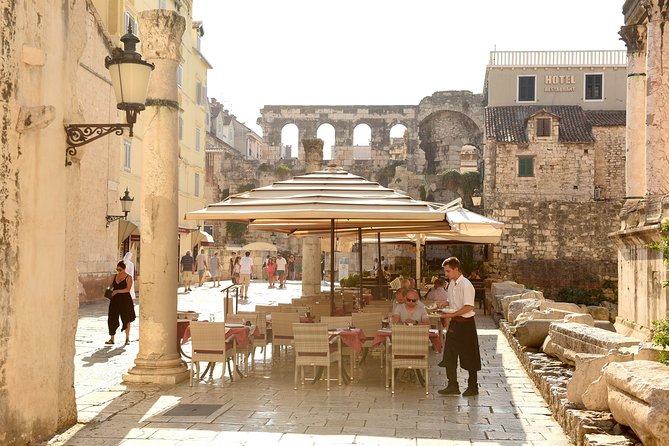
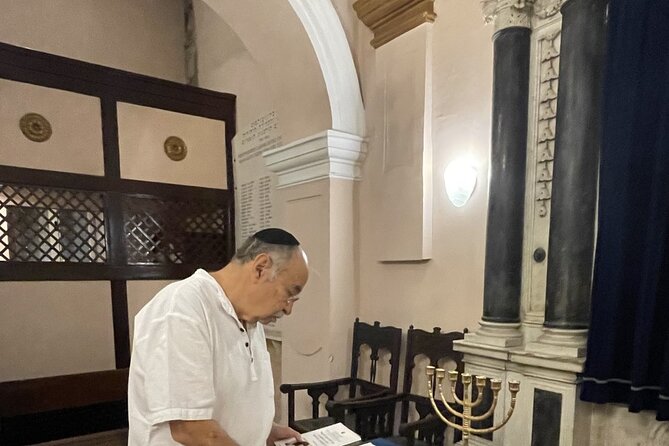
The synagogue stop lasts about 30 minutes and is likely to be the most distinctive part of the tour.
You walk through the former Jewish quarter and hear how Jewish residents lived and worked in Split. The community is described as one of Europe’s oldest, with roots connected to the Roman-era population of Salona and later centuries of Jewish life in the city. The tour also addresses the community’s role in Split’s economic and civic development.
The synagogue is still in use, and the visit may include a member of the local Jewish community. Albert is specifically praised for sharing personal and community stories. That human contact changes the tone of the afternoon. Instead of hearing only about a vanished population, you encounter a living community working to preserve memory and educate people who come through the door.
Access needs to be handled with care. The provider has arranged for the synagogue to be opened for private visits, but you should make sure the visit is confirmed when booking. A synagogue is an active religious place, not simply an attraction with guaranteed open hours.
The synagogue’s history also includes a painful wartime chapter. In 1942, precious synagogue objects and archives were destroyed on June 12. At Narodni Trg, a bronze plaque commemorates that destruction. This is a short stop, but it gives the Jewish story a direct connection to persecution, loss, and remembrance.
A useful point of balance: the tour offers a meaningful introduction, not an academic study of Jewish life in Croatia. If you have a specialist interest, use the guide’s time to ask focused questions about Salona, Split’s Jewish quarter, the synagogue’s survival, and the wartime archive loss.
Narodni Trg and Split’s Venetian face
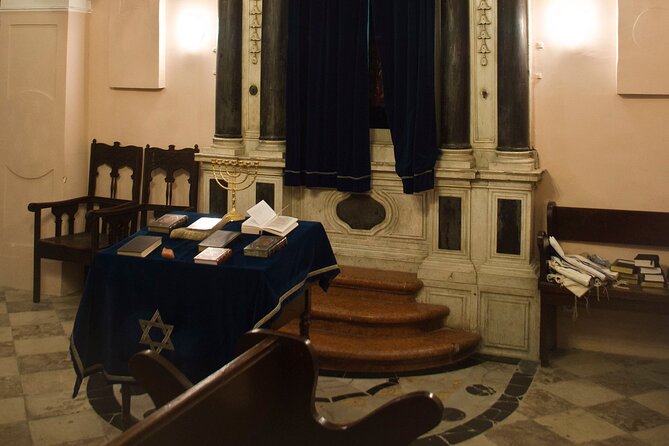
Narodni Trg, or People’s Square, takes about 10 minutes. Its Venetian architecture gives you a sharp visual change from the Roman palace.
The bronze plaque related to the 1942 destruction is the main Jewish-history reason for stopping here. The surrounding square also shows how Split developed beyond the palace walls, with civic buildings and later architectural styles shaping the city’s public life.
I like this stop because it prevents the Jewish story from being isolated inside the synagogue. The community’s history belongs to the entire city, and the square places that history in a public setting.
Fruit’s Square and the literary side of the city
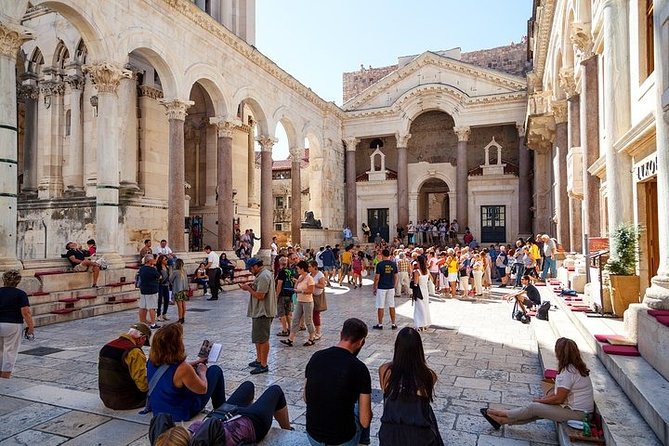
Fruit’s Square, officially Trg Braće Radić, is a five-minute stop just outside the palace.
The square is associated with Marko Marulić, often called the father of Croatian literature. His statue occupies the center, giving the guide a chance to move from religious and political history toward language and culture.
This is a quick orientation stop, not a full literary lesson. Still, it adds variety to the route and helps you understand that Split’s appeal is not only its Roman stones. The city has produced writers, artists, church leaders, merchants, and public figures who shaped Croatian culture.
Riva, Prokurative, and the city today
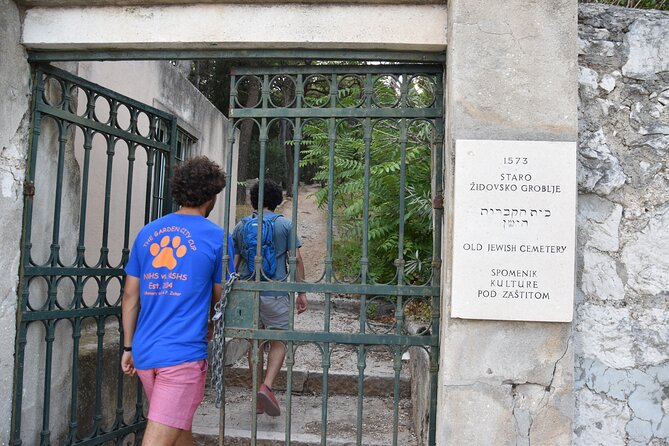
The route then reaches Riva, Split’s waterfront promenade. Locals call it their living room, and that nickname tells you how to read the place.
Riva is lined with cafés and restaurants and serves as a daily meeting place. The guide uses it to explain contemporary Split, including how local people use the harbor and what gives the city its social rhythm.
I consider this an important part of the tour. A palace-only walk can leave you with a beautiful but frozen picture of Split. Riva shows you the city in its current form, where the old center remains part of ordinary life.
About 10 minutes farther along, Prokurative, officially Republic Square, offers a strong Venetian and neo-Renaissance contrast. The buildings on three sides recall St. Mark’s Square in Venice, while the open southern side looks toward the harbor and Riva.
The stop is brief, but it gives you a good architectural comparison. Split’s history is not one clean style. Roman, medieval, Venetian, Austro-Hungarian, Croatian, and modern influences sit close together.
Marmontova Street and the fish market option
The final listed stop is Marmontova Ulica, another popular pedestrian promenade. The street is also close to Split’s fish market.
You can stop to see where locals buy fresh Adriatic fish. The information provided does not promise a formal market tour, so think of this as an optional look rather than a scheduled tasting or food activity. Meals and drinks are not included.
This is a pleasant way to finish because it returns the tour to everyday Split. After emperors, bishops, archives, and centuries of community history, you see a practical side of the city: shopping, seafood, promenades, coffee, and local routines.
How the private format changes the experience
The tour is private, so only your group participates. That matters more here than it would on a simple sightseeing loop.
The route includes several sensitive and detailed subjects. You may want to ask about the Jewish community, wartime destruction, or the connection between Salona and Split. A private guide can slow down for those questions instead of following a fixed script.
The guides associated with this experience include Jelena Vrancic, Emil, Vinka, and Pero. Jelena is repeatedly praised for clear English, humor, warmth, and a calm way of explaining complicated subjects. She has also adjusted routes for people with mobility problems, helped keep a large group together, and changed the order of stops during bad weather.
That does not mean every departure will feel identical. You may be led by Jelena or another guide from her team, and the personality of the guide will shape the morning. The consistent qualities to look for are an adaptable pace, strong local knowledge, and willingness to answer questions.
Most people can participate, but this is still a walking tour through an old city. You should expect uneven historic surfaces and frequent standing, even though the guide can make adjustments. Children must be accompanied by an adult, and service animals are allowed.
Price, timing, and pickup details
At $187.05 per person, this is not a bargain-priced introduction to Split. The value improves when you divide the cost among a private group, especially if you care about the synagogue visit and want time for questions.
The price includes a licensed private guide, the synagogue and former Jewish quarter visit, and admission to the palace substructures. It does not include food, drinks, or taxis.
The tour takes approximately two hours and 30 minutes. That is enough time for a well-paced overview, but not enough for lengthy visits at every site. If you want a slower look at the palace, plan to return afterward on your own.
The start time is arranged by request. The usual meeting point is near the bronze city map at 23 Obala Hrvatskog narodnog preporoda on Riva. Old Town apartment pickup is available. If you stay outside the Old Town, you generally meet at Riva.
Cruise ship passengers are met at the port. After leaving the ship, walk toward the customs gate, where the guide will be waiting with your name on a sign. Send the ship name, docking time, disembarkation time, and departure time as soon as possible so the timing can be arranged properly.
The provider lists operating hours from Monday through Saturday, 8:00 AM to 5:30 PM, for the stated booking period. Free cancellation is available up to 24 hours before the start time. Changes or cancellations inside that window are not accepted for a refund.
Who should book this tour?
I would choose this tour if you want more than a standard Roman monument walk. It suits:
- Families with mixed ages and interests
- Cruise ship passengers needing port pickup
- People with a strong interest in Jewish history
- Small private groups who value conversation
- First-time visitors who want a city overview in one morning
- Anyone who prefers a guide who can adjust pace and route
It may be less suitable if you want a long, specialist study of Roman architecture, a food tour, or a visit centered mainly on the Jewish cemetery. The published route gives the synagogue and Jewish quarter the clearest attention, while the cemetery is not separately detailed.
Should you book the Jewish Heritage and Diocletian’s Palace tour?
Book it if the chance to enter Split’s synagogue and speak with a local community member matters to you. That personal connection, along with the menorah carvings in the palace substructures, gives the tour a focus that ordinary Old Town walks often miss.
The $187.05 price is easiest to justify for a private family or group booking. Solo visitors and couples should compare the cost with a standard palace tour, then decide how much the Jewish-history element is worth.
My practical advice is to confirm synagogue access, share any mobility needs, and provide cruise details early. If you want a thoughtful introduction to Split that links Roman power with living community history, this is one of the more distinctive private walks available.
FAQ
How long is the Jewish Heritage and Diocletian’s Palace tour?
The tour lasts approximately two hours and 30 minutes.
What language is the tour offered in?
The tour is offered in English.
Is this a private tour?
Yes. Only your group participates in the activity.
What is included in the price?
The price includes a private guided tour with a licensed guide, the visit to the synagogue and Jewish quarter, and admission to the substructures of Diocletian’s Palace.
Is the synagogue visit included?
Yes. The synagogue visit is included, and the tour may include meeting a member of Split’s Jewish community.
Is the Jewish cemetery included?
The cemetery is listed among the tour’s highlights, but the detailed route provided does not identify a separate cemetery stop. Confirm this point with the provider when booking.
Where does the tour begin?
The usual meeting point is at 23 Obala Hrvatskog narodnog preporoda in Split, near the bronze city map on Riva.
Is pickup available for cruise ship passengers?
Yes. Cruise ship passengers are met at the port near the customs gate after disembarkation. You must provide the ship and timing details in advance.
Can the tour start at a requested time?
Yes. Since this is a private tour, the start time is arranged by request.
What is the cancellation policy?
You can cancel up to 24 hours before the start time for a full refund. Cancellations and changes made less than 24 hours before the start time are not accepted.
Just added around Split
- Private VIP Blue Lagoon and 3 Islands Tour★ 4.5 · 9 reviews
- Split highlights – Evening walking tour★ 5.0 · 9 reviews
- Private boat transfer Split – Bol★ 5.0 · 9 reviews
- From Split: Trogir & Blue Lagoon Boat Tour with Snorkeling★ 4.6 · 9 reviews
- Private Photography Activity in Split★ 5.0 · 9 reviews
- Bike, Beer & Poljud Stadium Tour★ 5.0 · 9 reviews
- From Hvar: Blue cave group speedboat tour full day★ 5.0 · 9 reviews
- Split Walking Tour: History, Legends & Tales★ 5.0 · 9 reviews
Diocletian Palace Tours, compared.


Walking Tour of Split and Diocletian’s Palace
Read our review →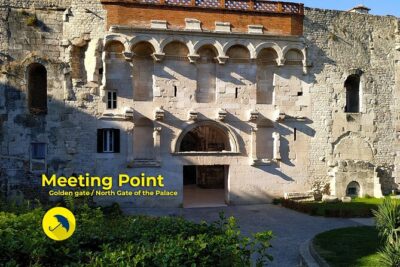

Diocletian Palace & Old Town Guided Walking Tour
Read our review →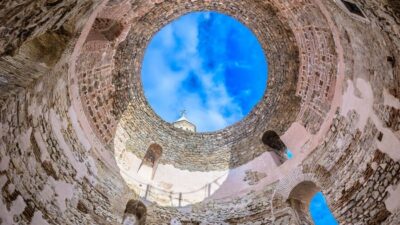
Game of Thrones Tour with Diocletian’s Palace Cellar
Read our review →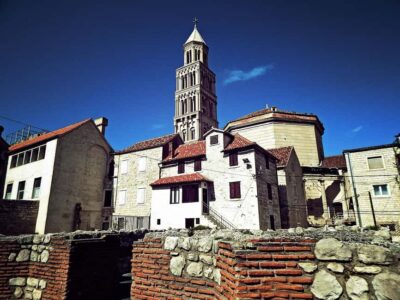
Diocletian’s Palace and Old Town SMALL GROUP Walking Tour
Read our review →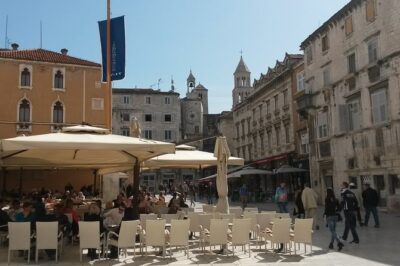
PRIVATE Walking Tour of Diocletian’s Palace & Old Town
Read our review →
Browse the lists this tour appears in