
Reviewed · DIOCLETIAN PALACE TOURS
History & Cultural Walking Tour of Split and Diocletian’s Palace
Split’s past is built into its streets. I like this small-group walking tour because it turns Diocletian’s Palace from a maze of old stone into a readable story, and I like its sensible 90-minute length, long enough for context without taking over your day. The main consideration is that high steps can be difficult, and the tour does not include the museum section of the palace substructures.
You meet at the Peristyle, the palace’s grand central square, then move through the Vestibule, underground substructures, Golden Gate, Riva Harbor, Fruit’s Square, and the old synagogue area. Guides such as Darko, Ivana, Ante, and Anthony have been praised for clear English, humor, strong local knowledge, and an easy way with questions. At $22.98 per person, the tour is a good-value orientation, especially if Split is your first stop in Croatia.
In This Review
- Key points to know before you book
- Why this 90-minute walk works well in Split
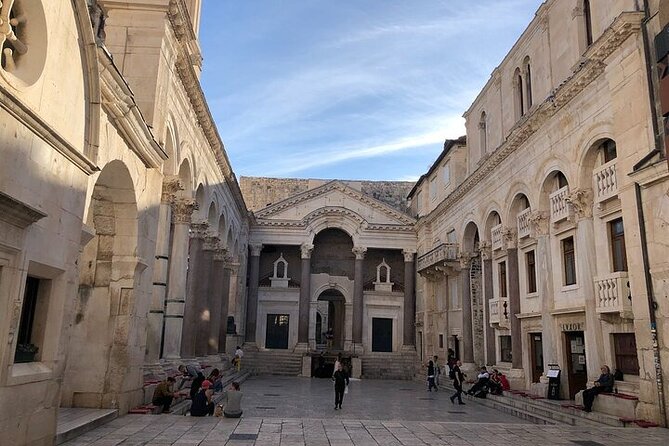
- Starting at the Peristyle, Split’s great Roman stage
- The Vestibule and the sound of Dalmatia
- Beneath the palace in the substructures
- The Golden Gate and Gregory of Nin
- Riva Harbor and the city’s public face
- Fruit’s Square, Venetian power, and Croatian literature
- A brief look at Split’s Jewish heritage
- What the guides add to the experience
- Price, timing, and practical value
- Who should choose this Split walking tour?
- Should you book it?
- FAQ
- How long does the History and Cultural Walking Tour last?
- Where does the tour begin?
- Where does the tour end?
- Is the tour offered in English?
- What is included in the price?
- Does the tour include the museum section of the palace substructures?
- How many people can join the tour?
- Can I cancel for a full refund?
Key points to know before you book
- The Peristyle gives you an immediate sense of scale: This central court is the natural starting point for understanding how the palace works.
- Traditional klapa singing may add a memorable local touch: The Vestibule is sometimes used for Dalmatian singing.
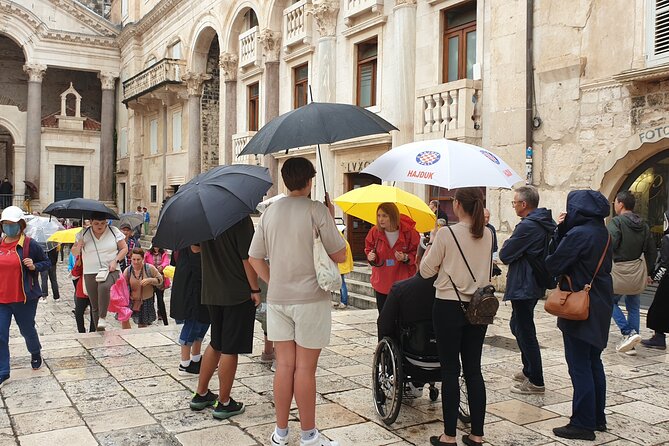
- The group is capped at 15 people: Smaller groups can mean better answers and fewer missed details.
- The tour focuses on context rather than paid entry: The listed stops are included, but the museum portion of the substructures is not.
- Early morning can be a smart choice: A 9 AM departure may mean cooler conditions and fewer people around the palace.
- The route covers more than Roman remains: You also hear about Croatian literature, Jewish life, Venetian influence, and Split’s waterfront.
Why this 90-minute walk works well in Split
Split can confuse you at first. Diocletian’s Palace is not an isolated ruin behind a fence. It is part of the living center, with homes, cafés, shops, lanes, church buildings, and daily city life fitted into Roman walls. Without a guide, you may admire the stone but miss the connections.
This tour gives you a useful framework. You learn where the palace began, how later generations adapted it, and why modern Split grew around and inside the Roman complex. I like that the route does not stay in one historical period. It moves from Emperor Diocletian to medieval and Venetian Split, then into Croatian cultural and Jewish history.
The 90-minute schedule is also practical. You get a strong first look without committing to a half-day program. If you have only a short stay, it leaves time for the cathedral, museums, lunch, or a second walk along the waterfront.
The group limit of 15 is important. A very large group can make a narrow old street feel even tighter, and questions become harder to ask. Here, you should have a better chance of hearing the guide and getting help with the details that interest you most.
More Historical Tours in Split
- Walking Tour of Split with a ‘Magister’ of History
★ 5.0 · 1,122 reviews - Split Walking Tour with Professor of History
★ 5.0 · 926 reviews - Split: History and Heritage Walking Tour
★ 4.9 · 650 reviews
Starting at the Peristyle, Split’s great Roman stage
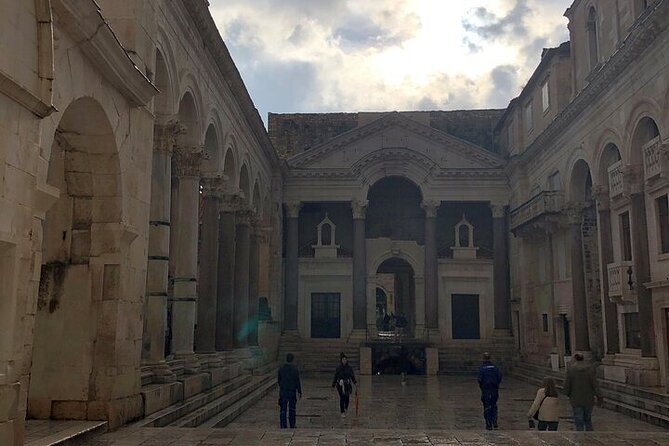
The tour begins on Peristil ulica at the Peristyle, the main square of Diocletian’s Palace. This is the right place to start because almost every part of the palace connects to it.
You spend about 15 minutes here. That may sound brief, but the Peristyle is dense with clues. Your guide explains its role in the palace and helps you understand its position as a central meeting and ceremonial area. From here, you can see how routes lead toward other parts of the complex.
I find this opening especially useful for first-time visitors. Instead of treating the palace as a collection of unrelated stone walls, you begin with a mental map. Pay attention to the layout, because the rest of the walk makes more sense once you know this square is the core.
The Peristyle is also one of the places where the present and the past sit side by side. You are not simply looking at an archaeological site. You are in a public city space still used and crossed every day.
The Vestibule and the sound of Dalmatia
A short stop at the Vestibule follows. This former entrance space of Emperor Diocletian’s palace receives about five minutes, but its shape and acoustics can make it memorable.
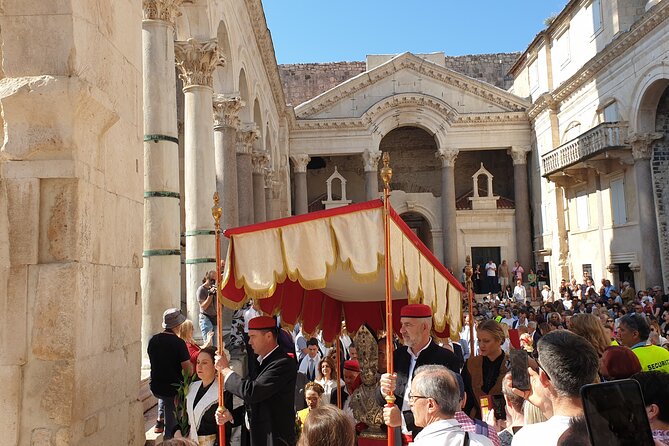
The guide explains the building’s past and may point out how the space functioned within the imperial complex. There is also a chance of hearing traditional Dalmatian klapa singing. That is a valuable touch because it connects the architecture with a living local tradition rather than leaving you with dates and names alone.
The singing is presented as a possibility, not a guaranteed performance, so you should not book the tour solely for it. Still, the chance adds character to the stop. History feels less distant when a local musical tradition fills an ancient space.
This is one area where the guide’s delivery matters. The strongest guides on this tour appear to use humor, questions, and storytelling rather than giving a dry lecture. Ivana, in particular, has been praised for bringing the past to life and using questions to help the group remember what they have learned.
Beneath the palace in the substructures
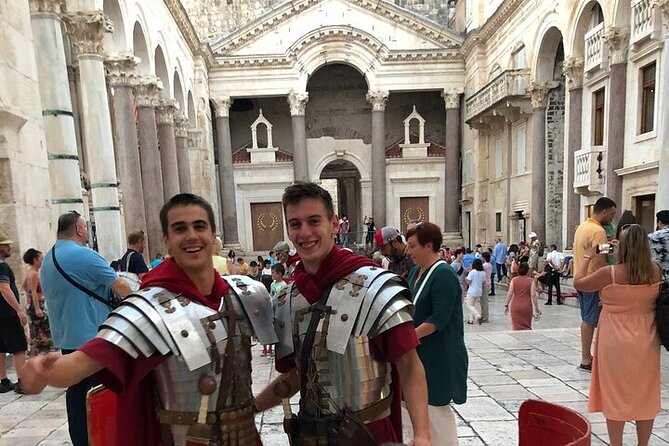
The route continues into the substructures of Diocletian’s Palace for about 10 minutes. These lower passages help explain how the palace was built and how the spaces were used over time.
You should note an important limit: this walk does not include the museum section of the substructures. You can visit that separately after the tour, but admission is not part of this experience. That makes the stop more of an introduction than a full underground museum visit.
Even so, the substructures are valuable because they reveal the practical side of the palace. Aboveground rooms can look grand and polished, while the lower levels help you picture the engineering and support system beneath them. Your guide explains their construction and later functions, giving you a better sense of how the complex changed across the centuries.
If you want to spend serious time examining the underground remains, plan an additional visit. The tour gives you orientation, not an exhaustive museum session. I see that as a fair trade for the broader route through Split’s center.
More Walking Tours in Split
- Split: Old Town and Diocletian Palace Walking Tour
★ 4.9 · 4,727 reviews - Walking Tour of Split and Diocletian’s Palace
★ 5.0 · 2,588 reviews - Krka Waterfalls tour with Trogir Walking tour and Krka panoramic boat cruise
★ 5.0 · 1,659 reviews - Split & Diocletian’s Palace Walking Tour
★ 5.0 · 1,125 reviews
The Golden Gate and Gregory of Nin
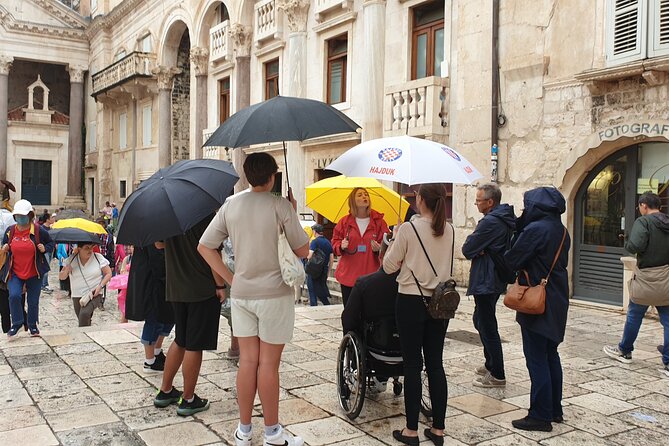
The Golden Gate is the main entrance to the palace and receives about 10 minutes. It is one of the clearest places to understand the palace as a fortified imperial residence.
Your guide explains the gate and points out the statue of Gregory of Nin. You also learn why Gregory matters to Croatian history and language. This adds a national story to the Roman setting, showing how Split’s identity extends far beyond Diocletian.
This is where a good guide can make a familiar monument more meaningful. You may already know that the gate is impressive, but the story surrounding Gregory gives the nearby statue a stronger purpose. It is not simply something to photograph on the way to another street.
The Golden Gate also works as a transition. The tour moves from the inner Roman palace toward the wider city, and the guide continues connecting architecture with Croatian culture. Guides who speak excellent English are particularly helpful here, since names and historical terms can be difficult to follow when rushed.
Riva Harbor and the city’s public face
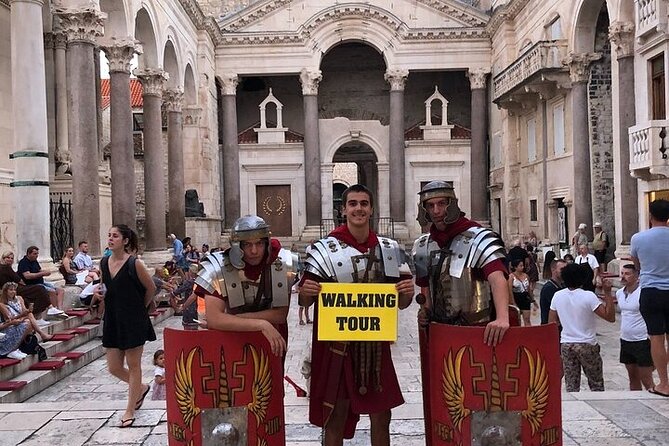
The walk then reaches Riva Harbor for about 15 minutes. Split’s waterfront is a different setting from the enclosed palace lanes, and it helps you see how the city presents itself today.
You see a bronze model of Diocletian’s Palace and learn about the history of the Riva promenade. The model is especially useful after walking through the palace because it lets you view the complex as a whole. Details that seemed disconnected in the lanes begin to fit together.
I like the change of pace here. The Riva gives you room to pause, look outward, and connect the old center with the modern city. It also makes this tour useful for practical orientation. After the walk, you will know where the waterfront sits in relation to the palace and may feel more comfortable exploring on your own.
The Riva stop lasts about 15 minutes, so it is not just a quick photo break. You have time to hear the story of the promenade and take in the contrast between the Roman core and Split’s open harbor setting.
Fruit’s Square, Venetian power, and Croatian literature
Fruit’s Square, officially Trg Brace Radic, receives about 10 minutes. Here, the focus shifts toward later Split, including a 15th-century Venetian citadel.
This stop adds a useful layer to the walk. If the first half centers on imperial Rome, Fruit’s Square shows how outside powers and later city life shaped Split. The Venetian presence is part of the city’s story, and the square gives you a setting in which to consider that change.
You also learn about Marko Marulic, often called the father of Croatian literature. That detail makes the stop more than an architectural aside. It introduces a major figure in Croatian culture and helps explain why Split matters not only for its Roman remains, but also for language and literature.
I appreciate this kind of range. You do not need to be a specialist in history to enjoy it, and the guide can place each person or building in a clear sequence. A participant with an academic background in history found the information thoughtful and relevant, which suggests the tour can satisfy curious readers as well as casual sightseers.
A brief look at Split’s Jewish heritage
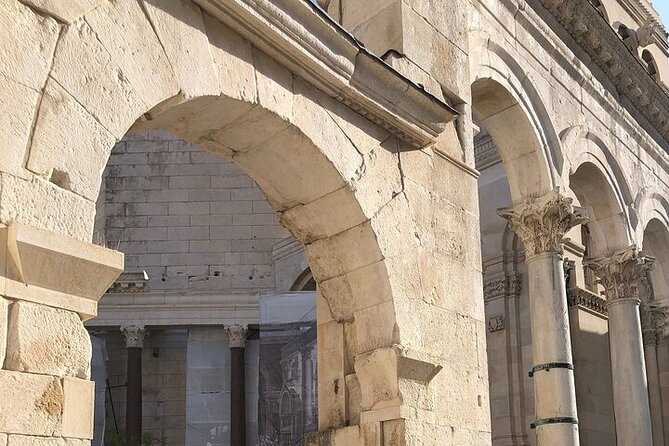
The last listed stop is the Split Synagogue, where you pass by a 16th-century synagogue and learn about the city’s Jewish community. The stop takes about 10 minutes.
This is not presented as a museum visit, and admission is not included. Instead, the guide provides historical context while you pass the site. That makes it a compact but meaningful part of the walk, especially if you want a broader view of Split’s communities and faith traditions.
I value the inclusion because many short city walks focus only on emperors, palaces, and grand public buildings. This stop widens the story. It reminds you that Split’s identity was shaped by many groups over time.
The tour ends back at the meeting point. That is convenient because you finish in the same central area where you began, with the palace still close by for independent exploring.
What the guides add to the experience
The guide is the main reason to choose a walking tour instead of using a guidebook alone. The strongest feedback centers on friendly, engaging instruction and a talent for making history easy to follow.
Darko has been praised for his enthusiasm and for sharing stories about his city. Ivana is noted for clear explanations, group questions, and useful suggestions for places to explore afterward. Ante, also called Anthony in English, has been described as welcoming and willing to show less obvious historical details.
The guide names can change, so you should not assume one particular person will lead your departure. Still, the pattern is clear: the experience depends heavily on a guide who can connect facts with place, answer questions, and adjust the level of detail.
That flexibility matters. One group of four chose an early start and appreciated seeing the palace with fewer crowds. Another small group of three received nearly three hours of explanation instead of the advertised 90 minutes. You should not expect an extended tour every time, but these examples suggest that a small group can sometimes allow a guide to linger when everyone is interested.
The tour is offered in English. Guides have been praised for speaking clearly, which is important when you are learning unfamiliar Croatian names and historical terms.
Price, timing, and practical value
At $22.98 per person, this is a modest price for a guided introduction to Split’s central sights. You are not paying for museum entry or a long excursion. You are paying for structure, interpretation, and the chance to ask questions while walking through the city.
That price makes the tour especially useful on your first day. I would use it to get oriented, then return to the places that caught my attention. The palace substructure museum, for example, can be visited afterward if you want more time underground.
The early start deserves serious thought. A 9 AM departure has two likely advantages: you may encounter fewer people in the tight palace lanes, and you can use the rest of the day for other sights. The schedule is not stated for every departure, so check your selected time before booking.
The experience has a maximum of 15 participants and is often reserved well ahead, with an average booking lead time of about 80 days. That does not mean you must reserve that far out, but it is a useful sign to plan ahead during busy periods.
You receive confirmation when booking, and mobile tickets are supported. The tour is near public transportation, service animals are allowed, and most people can participate. High steps may be uncomfortable, so think honestly about your mobility before choosing this route.
Free cancellation is available up to 24 hours before the local start time. Cancellations or changes inside that window are not eligible for a refund, and the experience requires a minimum number of participants.
Who should choose this Split walking tour?
I would recommend it most strongly to first-time visitors, history fans, cruise passengers with limited time, and anyone who wants a clear introduction before exploring alone. It also suits people who prefer a personal guide to a large group with a microphone.
The tour is a good match if you enjoy Roman architecture but also want to hear about Croatian language, literature, Jewish heritage, Venetian influence, and local music. That range gives you more than a palace lecture.
It may be less suitable if you want extensive museum time, a private tour, or a slow photography walk. The route covers seven areas in about 90 minutes, so the pace must keep moving. People with problems on high steps should also consider the physical demands.
Should you book it?
Yes, if you want a reasonably priced first look at Split with a small group and an English-speaking guide. The combination of the Peristyle, substructures, Golden Gate, Riva, Fruit’s Square, and synagogue area gives you a useful map of the city and a clear sense of how Roman, Venetian, Croatian, and local traditions meet here.
Book it early if your dates are fixed, and choose an early departure if available. If you prefer a longer archaeological visit, add the substructure museum afterward. For most visitors, this is a strong orientation walk that helps the rest of Split make sense.
FAQ
How long does the History and Cultural Walking Tour last?
The tour lasts approximately 1 hour and 30 minutes.
Where does the tour begin?
It begins at Peristil ulica, Peristil ul., 21000 Split, Croatia, at the Peristyle of Diocletian’s Palace.
Where does the tour end?
The activity ends back at the meeting point.
Is the tour offered in English?
Yes. The tour is offered in English.
What is included in the price?
The tour includes an educated guide with strong knowledge of the locations around Diocletian’s Palace. Gratuities are not included.
Does the tour include the museum section of the palace substructures?
No. The tour visits the palace substructures but does not include the museum part. You can visit that section separately after the walk.
How many people can join the tour?
The maximum group size is 15 people. Group discounts are available.
Can I cancel for a full refund?
Yes, if you cancel at least 24 hours before the experience start time. Cancellations or changes made less than 24 hours before the start time are not refunded.
More Diocletian Palace Tours
- Split: Diocletian Palace & Old Town Guided Walking Tour
★ 4.7 · 882 reviews - Split: Game of Thrones Tour with Diocletian’s Palace Cellar
★ 4.8 · 545 reviews - Diocletian’s Palace and Old Town SMALL GROUP Walking Tour
★ 5.0 · 502 reviews - SPLIT-PRIVATE Walking Tour of Diocletian’s Palace & Old Town
★ 5.0 · 467 reviews
Just added around Split
- Private VIP Blue Lagoon and 3 Islands Tour★ 4.5 · 9 reviews
- Split highlights – Evening walking tour★ 5.0 · 9 reviews
- Private boat transfer Split – Bol★ 5.0 · 9 reviews
- Private Photography Activity in Split★ 5.0 · 9 reviews
- From Split: Trogir & Blue Lagoon Boat Tour with Snorkeling★ 4.6 · 9 reviews
- Bike, Beer & Poljud Stadium Tour★ 5.0 · 9 reviews
- From Hvar: Blue cave group speedboat tour full day★ 5.0 · 9 reviews
- Split Walking Tour: History, Legends & Tales★ 5.0 · 9 reviews
Diocletian Palace Tours, compared.


Walking Tour of Split and Diocletian’s Palace
Read our review →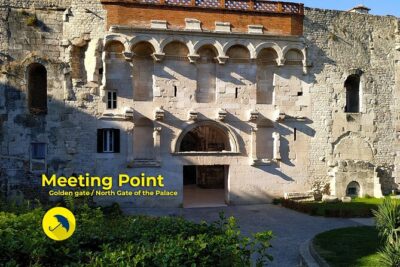

Diocletian Palace & Old Town Guided Walking Tour
Read our review →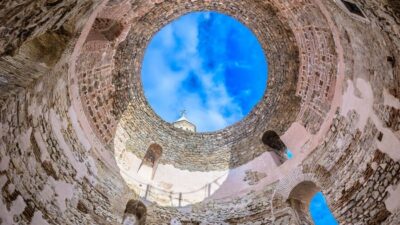
Game of Thrones Tour with Diocletian’s Palace Cellar
Read our review →
Diocletian’s Palace and Old Town SMALL GROUP Walking Tour
Read our review →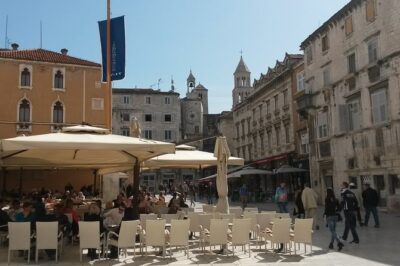
PRIVATE Walking Tour of Diocletian’s Palace & Old Town
Read our review →
Browse the lists this tour appears in