
Reviewed · CITY WALLS & OLD TOWN TOURS
Split Palace & Old Town -Private walking tour- Entrance included
Split’s Roman heart is still part of daily life. This private 2.5-hour walk combines Diocletian’s Palace with medieval squares, a fish market, and French-era streets, so you see more than a single monument. I especially like the included entry to the palace cellars, Temple of Jupiter, and Cathedral of Saint Domnius, plus the chance to ask your guide questions without sharing the group with strangers.
I also like the route’s tidy ending at Prokurative, where cafes and restaurants make it easy to continue your afternoon. Guides Dana and Jana receive especially warm praise for clear explanations, helpful suggestions, and directions. The main consideration is the price: at $203.95 per person, this is a serious spend for a 2.5-hour walk, even with private guiding and admission fees included.
In This Review
- Key points at a glance
- Why this Split walking tour works
- Starting on the Riva waterfront
- Entering Diocletian’s Palace through the southern side
- The Peristyle and the power of Emperor Diocletian
- Temple of Jupiter and the former imperial mausoleum
- The Vestibule and the Golden Gate
- Medieval Split around People’s Square
- Split’s fish market and the French-built Marmontova
- Finishing at Prokurative
- What the $203.95 price buys you
- Timing, access, and possible changes
- Who should book this private Split walk?
- Should you book Split Palace and Old Town?
- FAQ
- Where does the tour start?
- Where does the tour end?
- How long does the tour last?
- What language is the tour offered in?
- Is this a private tour?
- Which admission fees are included?
- Can the tour visit every listed sight?
- Can the tour be adapted for special needs?
- Are service animals allowed?
- What happens if bad weather cancels the tour?
Key points at a glance
- More than a palace tour: The route covers the Riva, Roman ruins, medieval squares, the fish market, Marmontova Street, and Prokurative.
- Three paid sights included: Entry is included for the palace cellars, Temple of Jupiter, and Cathedral of Saint Domnius.
- Private group format: Your group takes part alone, making it easier to ask questions and adjust the pace or focus.
- Guides Dana and Jana earn strong praise: Both are singled out for their command of Split’s past and for practical help after the walk.
- A useful two-part view of Split: You see the Roman palace first, then the later city that grew around it.
- Potential closures matter: Worship services and public events can prevent entry to some sights, requiring a small change to the route.
Why this Split walking tour works
Split is easiest to understand when you see the city in layers. Diocletian’s Palace gives you the Roman foundation, while the streets west of it show how later generations built homes, markets, churches, and public squares into and around the old complex.
That is the strength of this route. You are not left with a collection of grand names and dates. You move from the waterfront to the palace, through the north gate, and into the medieval and French sections of town. The walk gives you a basic map of central Split, which is useful if you have only a short stay.
The private format also changes the feel of the outing. You can ask why the palace survived, how a mausoleum became a cathedral, or where to go after the tour. Dana and Jana are praised for doing more than reciting facts. They also offer ideas for further sightseeing and help with directions, a small but valuable service in a dense old town.
Still, you should weigh the price carefully. The tour costs $203.95 per person, and the duration is approximately two hours and 30 minutes. The admissions and private guide add value, but a solo visitor or couple on a tight budget may find a shared walk easier to justify.
More Old Town Walks in Split
- Split: Old Town and Diocletian Palace Walking Tour
★ 4.9 · 4,727 reviews - Split: Diocletian Palace & Old Town Guided Walking Tour
★ 4.7 · 882 reviews - Diocletian’s Palace and Old Town SMALL GROUP Walking Tour
★ 5.0 · 502 reviews
Starting on the Riva waterfront
The meeting point is by the model of Split’s historical core at Obala Hrvatskog narodnog preporoda 23, along the Riva. This is a sensible place to begin because the waterfront gives you an immediate orientation to the city.
The opening stop lasts about 10 minutes and has no admission fee. Your guide provides general information about Split and explains the plan before leading you toward the palace.
I like this short introduction because it helps you picture the city before entering the tight streets. The Riva is also the natural place to settle your bearings. If you arrive early, check the meeting location in advance and allow enough time to find the model of the historic center.
The tour ends at Republic Square, also called Prokurative, rather than returning you to the Riva. That matters if you have a restaurant booking, onward plans, or a meeting point elsewhere. Prokurative is central and easy to use as a second base for exploring.
Entering Diocletian’s Palace through the southern side
The palace is not an isolated ruin behind a gate. It forms much of the center of Split, with streets, businesses, religious buildings, and homes occupying the old Roman footprint. The tour introduces the complex before moving into its best-preserved underground spaces.
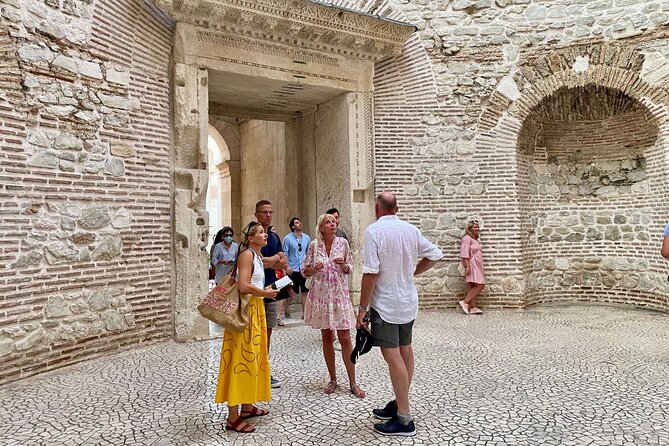
Through the South Gate, you enter Diocletian’s Cellars. These were built more than 1,700 years ago and remain unusually well preserved. The cellars help you understand the palace’s scale because the rooms and structural lines make the footprint easier to read than it is from the busy streets above.
The visit lasts about 15 minutes, with admission included. This is one of the clearest value points in the tour. If you looked at the palace only from street level, you could miss how massive the imperial residence once was.
The cellars can also give you a stronger sense of the palace as a working structure rather than a decorative monument. Your guide can connect the lower rooms to the layout above, helping you see why this section matters.
The Peristyle and the power of Emperor Diocletian
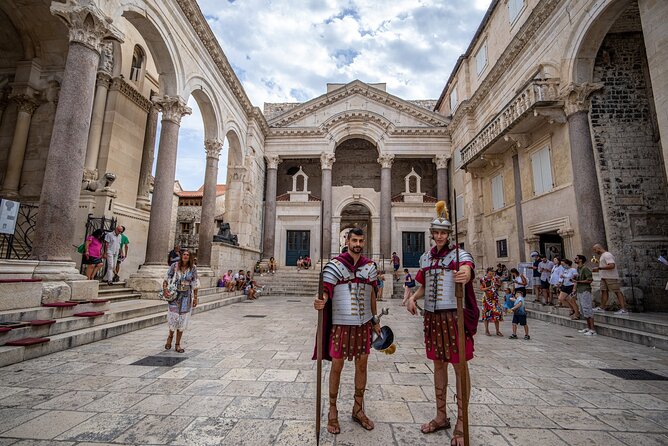
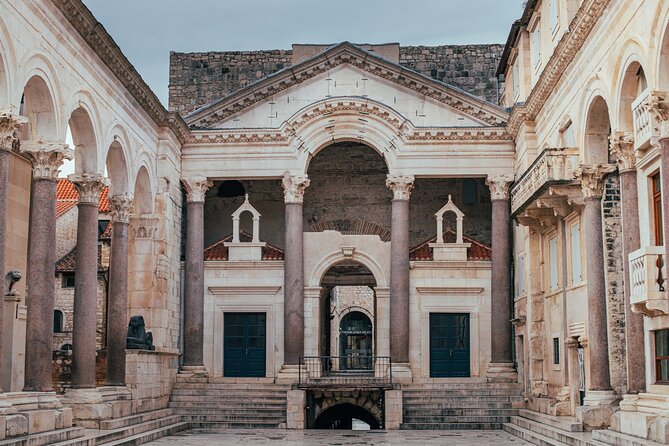
The Peristyle was the palace’s ceremonial and religious meeting place. It was where Diocletian presented himself to his subjects and encouraged worship of him as the son of Jupiter.
The stop takes about 10 minutes and is free. Its importance is not just visual. The open court shows how Roman authority used architecture to control movement and create ceremony. You are looking at a space designed for imperial display, not merely a pretty square.
This is also where the Roman and later Christian layers begin to meet. The palace did not remain frozen after Diocletian’s time. Its buildings were reused, altered, and absorbed into Split’s later life.
Because the Peristyle is part of an active city center, events or services can affect access to nearby sights. The guide may need to adjust the order or explain the spaces from outside.
More Walking Tours in Split
- Walking Tour of Split and Diocletian’s Palace
★ 5.0 · 2,588 reviews - Krka Waterfalls tour with Trogir Walking tour and Krka panoramic boat cruise
★ 5.0 · 1,659 reviews - Split & Diocletian’s Palace Walking Tour
★ 5.0 · 1,125 reviews - Walking Tour of Split with a ‘Magister’ of History
★ 5.0 · 1,122 reviews
Temple of Jupiter and the former imperial mausoleum
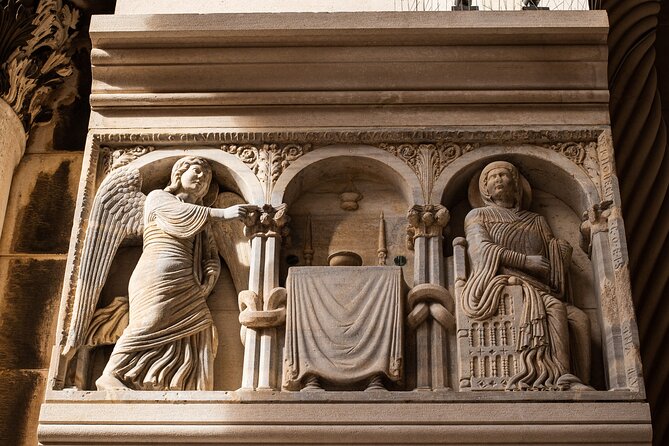
The Temple of Jupiter now serves as a baptistery. It has a notable casket ceiling, a design later used as an influence by Renaissance architects in Dalmatia.
The visit lasts about 10 minutes, and admission is included. This is a compact stop, but it gives you a useful lesson in reuse. A Roman religious building became part of a Christian city, and its original purpose is still visible beneath the later role.
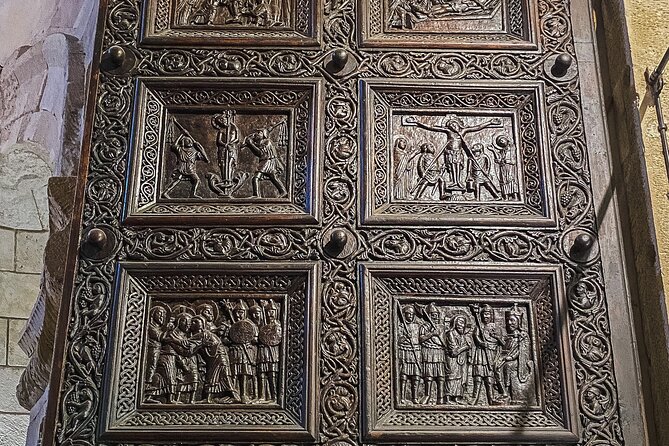
The Cathedral of Saint Domnius provides an even stronger example. It began as Diocletian’s mausoleum. During the Christianization of the city, the emperor’s coffin and remains disappeared, while the pagan mausoleum became a Christian cathedral.
The cathedral visit takes about 15 minutes, with entry included. I would pay close attention to the guide’s explanation here, because the building tells a complicated story without needing a large footprint. The change from imperial tomb to church is one of the most memorable pieces of context in Split.
The itinerary notes that the interior may be unavailable during worship or an event. That is not a flaw in the guide’s planning, but it is a real possibility. If the cathedral is closed, expect the program to change slightly.
The Vestibule and the Golden Gate
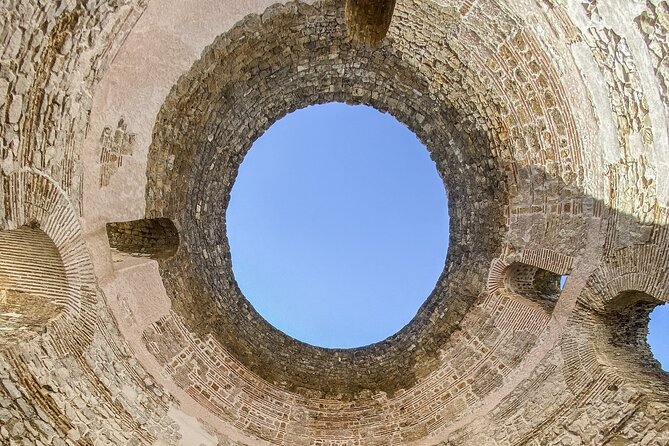
The Vestibule was the entrance area to Diocletian’s private chambers. The stop lasts about 10 minutes and is free.
This part helps separate the public and private sides of palace life. The Peristyle represented ceremony and imperial display, while the Vestibule led toward the emperor’s personal rooms. Together, the two stops show how the complex managed access and status.
The route then moves to the Golden Gate, the palace’s north entrance. It was the most important gate in Roman times, and the road from it led toward Salona, the capital of the Roman province.
You spend about 10 minutes here, without an admission charge. The gate is a useful transition point. From this side of the palace, the tour begins to leave the imperial complex and follow Split’s later growth.
If you enjoy Roman planning, this section will be particularly useful. The gate is not just a photo stop. It explains how the palace connected to the wider provincial road system.
Medieval Split around People’s Square
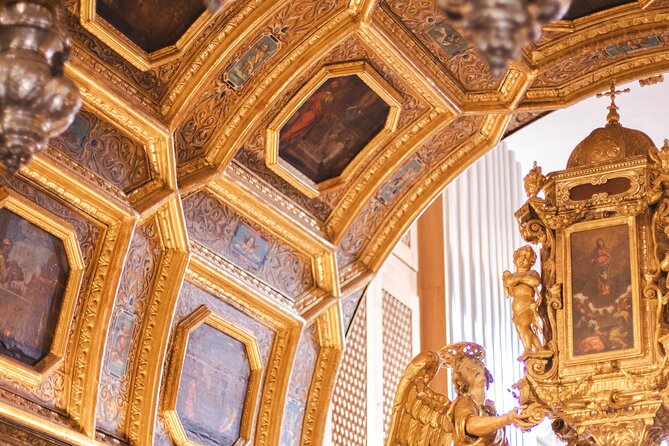
From the Golden Gate, the route follows the palace walls toward Narodni Trg, or People’s Square. This is where the actual medieval center of the old town developed west of the palace.
People’s Square has served as a city center since the Middle Ages. Its old Venetian palaces and neo-Gothic city hall show how Split changed after the Roman period. The stop is short, about five minutes, but it puts the palace into a wider urban story.
The tour then continues to Fruit’s Square, known as Voćni Trg or Trg Braće Radić. It was once a fruit market and now includes a monument to Marko Marulić, one of Split’s important Renaissance writers.
This stop lasts about 10 minutes and is free. I like the shift from imperial architecture to ordinary city functions. Markets and squares often explain a town better than monuments alone. Here, you see where trade and public life took place after the palace ceased to be an imperial residence.
The route gives you a useful contrast: Roman authority at the Peristyle, medieval civic life at People’s Square, and market activity at Fruit’s Square.
Split’s fish market and the French-built Marmontova
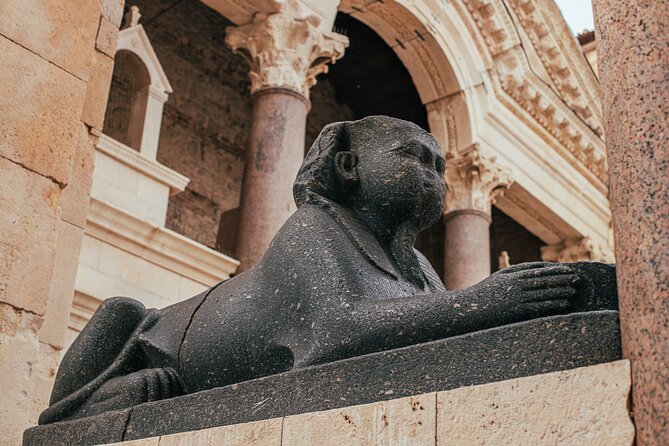
The Split Fish Market is one of the more unusual stops because it remains part of the city’s everyday character. It sits beside sulfur baths, which were known even to Diocletian as a source of relief for rheumatism and other ailments.
The sulfur smell is also said to keep flies away from the fish market. The tour allows about 10 minutes here, with no admission fee.
This is a good reminder that Split is not only an archaeological site. The city’s food markets, smells, and practical traditions are part of what you experience on foot. The stop may appeal more to you if you prefer local urban life to a list of grand buildings.
Next comes Marmontova Street, a pedestrian shopping street built by the French during Napoleon’s rule in the early 19th century. The stop lasts about 10 minutes.
Marmontova adds another period to the tour. You have Roman, medieval, Venetian, Christian, and French layers in a single walk. That range is one reason the route feels broader than a palace-only visit.
Finishing at Prokurative
The tour ends at Prokurative, also called Republic Square, after about 10 minutes there. Its architecture recalls St. Mark’s Square in Venice, and cafes and restaurants line the space.
This is a practical finish. You are not dropped at an obscure side street. You can stop for a drink, arrange a meal, or continue exploring the old town on your own.
The endpoint also gives the walk a clear shape. You begin on the Riva, enter the Roman complex, pass through the medieval center, and finish in a later civic square. The route is not a simple loop, so plan your next activity from Prokurative rather than from the starting point.
What the $203.95 price buys you
At $203.95 per person, this is best viewed as a premium private orientation rather than a cheap sightseeing walk. You are paying for approximately 2.5 hours with only your own group, along with admission to the cellars, Temple of Jupiter, and Cathedral of Saint Domnius.
The private format is most valuable when you want to ask questions or need the walk adapted to your group. The operator says the tour can be adjusted for special needs if you provide notice in advance. Service animals are allowed, and the route is near public transportation.
The price makes less sense if you mainly want photographs of the palace exterior. Several stops are free, and the walk covers a lot of ground without charging separate entry at each location. Its value comes from explanation, structure, and access to the three included interiors.
I would also consider how many people are in your group. A private tour can become reasonable when the cost is spread across several participants, though the listed rate is per person. For a small group, compare the convenience of private guiding with the lower cost of a shared tour.
The experience has a five-star rating from 77 reviews, with 100 percent recommending it. The praise focuses especially on the guides’ historical command and practical help. Dana is called an amazing guide, while Jana is praised for explaining the palace and suggesting what to see afterward.
Timing, access, and possible changes
The tour is offered in English and uses a mobile ticket. Confirmation arrives at booking, which keeps the basic planning simple.
Most people can participate, and the tour is near public transportation. If you have specific access needs, contact the provider before the tour so the route can be adjusted where possible.
The experience requires good weather. If poor weather forces cancellation, you are offered another date or a full refund. For your own cancellation, you receive a full refund if you cancel at least 24 hours before the start time. Cancellations or changes within 24 hours are not refunded or accepted.
Church services and public events can close some sights. In that case, the guide changes the program slightly. You should see this as a reason to stay flexible, especially if entering the cathedral is a major priority.
Who should book this private Split walk?
I would choose this tour if you want a strong first look at Split and prefer a guide who can connect the Roman palace to the later city. It suits couples, families, and small groups who value private attention and want admission to the main interior sights handled as part of the experience.
It is also a good match if you have limited time. In 2.5 hours, you cover the Riva, palace cellars, Peristyle, Temple of Jupiter, cathedral, Golden Gate, medieval squares, fish market, Marmontova, and Prokurative.
I would think twice if your budget is tight, you are content with exterior views, or you want a long stop inside each monument. The schedule gives each location a purpose, but many stops last only 5 to 15 minutes. This is an orientation walk with focused visits, not a slow archaeological study.
Should you book Split Palace and Old Town?
Book it if you want private guiding, included entry to three key interiors, and a clear explanation of how Split grew from Roman palace to modern city. The strongest reason to choose it is the guide. Dana and Jana are praised for both historical detail and useful advice after the walk.
The $203.95 price is high, so the decision depends on how much personal attention matters to you. For a small group that wants context and an efficient route, it can be a worthwhile introduction. For independent visitors who enjoy reading plaques and wandering freely, a cheaper option may be enough.
FAQ
Where does the tour start?
It starts at the model of the historical core of Split, at Obala Hrvatskog narodnog preporoda 23, 21000 Split, Croatia.
Where does the tour end?
The tour ends at Republic Square, also called Prokurative, in Split.
How long does the tour last?
The tour lasts approximately 2 hours and 30 minutes.
What language is the tour offered in?
The tour is offered in English.
Is this a private tour?
Yes. Only your group participates in the private activity.
Which admission fees are included?
Admission is included for the palace cellars, the Temple of Jupiter, and the interior of the Cathedral of Saint Domnius, when those attractions are open.
Can the tour visit every listed sight?
The program may change if a church service or public event prevents access to a sight.
Can the tour be adapted for special needs?
Yes. The tour can be adapted to participants’ special needs if you inform the provider in advance.
Are service animals allowed?
Yes. Service animals are allowed.
What happens if bad weather cancels the tour?
You are offered a different date or a full refund if poor weather causes cancellation.
Just added around Split
- Private VIP Blue Lagoon and 3 Islands Tour★ 4.5 · 9 reviews
- Split highlights – Evening walking tour★ 5.0 · 9 reviews
- Private boat transfer Split – Bol★ 5.0 · 9 reviews
- From Split: Trogir & Blue Lagoon Boat Tour with Snorkeling★ 4.6 · 9 reviews
- Private Photography Activity in Split★ 5.0 · 9 reviews
- Bike, Beer & Poljud Stadium Tour★ 5.0 · 9 reviews
- From Hvar: Blue cave group speedboat tour full day★ 5.0 · 9 reviews
- Split Walking Tour: History, Legends & Tales★ 5.0 · 9 reviews
City Walls & Old Town Tours, compared.





City Walls Early Morning or Sunset Walking Tour
Read our review →
Plitvice Lakes with Boat Ride and Zadar Old Town Tour
Read our review →

Plitvice Lakes with Boat Ride & Zadar Old town tour
Read our review →Browse the lists this tour appears in