Reviewed · GUIDED
Salona & Amphitheater – Private guided tour – Admission incl.
Salona still feels like a city waiting to be read. This private tour takes you from Split to the Roman ruins of Salona, where basilicas, baths, gates, sarcophagi, and an amphitheater reveal the scale of an ancient capital. I like the private format, which keeps the pace and questions within your own group. I also like the focus on both Roman and early Christian sites, rather than only the most famous ruins.
The main point to check is the admission wording. The tour title says admission is included, but the itinerary says the open-air museum ticket costs about 10 euros for adults and is not included. At $203.50 per person, that matters. The tour lasts about two and a half hours, and guide Ivan has been praised as a pleasant, well-informed companion.
In This Review
- Key points to know before booking
- Why Salona deserves time beyond Split
- Starting at Salona’s main entrance
- Manastirine and the earliest Christian story
- Tusculum and Don Frane Bulić
- The bishop’s palace and two vanished cathedrals
- Baths, bridges, and the working side of Salona
- Porta Caesarea and the marks of Roman traffic
- The forum, temple, and theater at Hram
- Sarcophagi and cemeteries outside the walls
- The Salona amphitheater is the main event
- What the private format is worth at $203.50
- Who will get the most from this visit
- Booking, weather, and cancellation
- Should you book Salona and the amphitheater?
- FAQ
- Where does the tour begin?
- Where does the tour end?
- How long does the tour last?
- Is admission to Salona included?
- Is this a private tour?
- What happens if the weather is poor?
Key points to know before booking
- Salona was once a city of about 60,000 people, giving the scattered ruins a scale that is easy to miss without explanation.
- The private guide leads your group alone, so you can ask questions and avoid the fixed rhythm of a large tour.
- The amphitheater is the main payoff, with enough surviving structure to make its original purpose clear.
- The route includes early Christian cemeteries and basilicas, including sites linked to Saint Domnius and five martyrs.
- The tour begins and ends at Salona’s main entrance, not in central Split, at Ul. don Frane Bulića 58 in Solin.
- Confirm the ticket arrangement before paying, since the supplied details disagree about whether the roughly 10 euro entrance fee is included.
Why Salona deserves time beyond Split
Split is rightly famous for Diocletian’s Palace, but Salona gives you a different view of Roman Dalmatia. This was not simply a small outpost with a few broken columns. Salona was a major city, with a population said to have reached roughly 60,000 before it was destroyed by the Avars in the sixth century.
That figure helps you picture the place. The remains are spread across an open-air archaeological site, so you are not walking through one compact monument. You are moving between pieces of a former urban center, religious grounds, roads, gates, baths, and entertainment buildings.
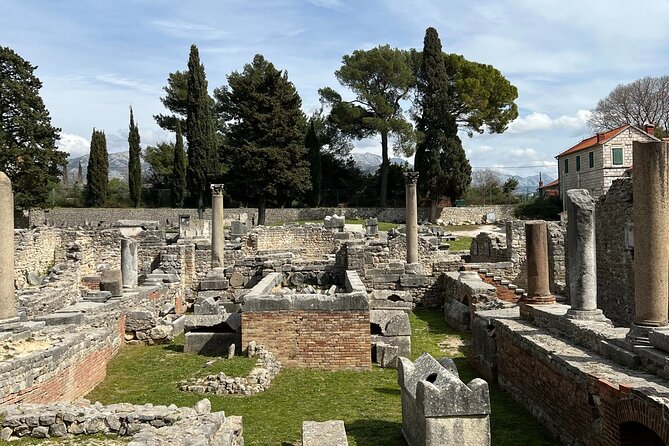
I find that setting valuable because it makes the past feel less polished and more real. You see foundations and partial walls rather than a fully rebuilt Roman town. A guide helps connect those fragments, especially when the site itself does not make the original layout obvious.
The tour is offered in English and lasts about 2 hours and 30 minutes. That is enough time to cover many points without turning the visit into an all-day archaeological expedition. Still, the itinerary includes eleven stops, so several are brief. You should expect a moving outdoor walk with focused explanations, not long periods at every ruin.
More Roman arena visits:
- Pula: Arena Entrance Ticket
★ 4.3 · 2,590 reviews - Pula Arena Amphitheater Admission Ticket
★ 4.0 · 68 reviews - Best of Istria: Amphitheater Pula + Rovinj + Hum Tour
★ 5.0 · 13 reviews
Starting at Salona’s main entrance
You meet at the main entrance on Ul. don Frane Bulića 58 in Solin, just outside Split. The experience ends at that same point, which makes the arrangement simple once you reach the site.
The guide begins with general information at the entrance before leading you through Salona. That opening matters here. The remains cover a broad area, and a short introduction gives you a basic map in your head before the individual stops begin.
The site is near public transportation, and most people can participate. Service animals are allowed. The information does not give a specific pickup service from a Split hotel, so you should plan on reaching the stated meeting point yourself unless the operator confirms something different.
Wear practical shoes and bring protection from the weather. The tour requires good weather, and poor conditions can lead to a new date or a full refund. Since the ruins are outdoors, the quality of your visit will depend partly on how comfortable you are walking and listening outside.
Manastirine and the earliest Christian story
The first major area is Manastirine, a place that began as a Roman necropolis and later became a Christian cemetery. This change gives the site much of its meaning. You are not looking only at graves. You are seeing how burial customs and religious life changed as Christianity gained a public place in the Roman world.
Saint Domnius, the martyr and patron of Split, was buried here. That connection gives Manastirine a direct link to the city you are visiting today. Split’s religious identity did not begin inside the later medieval center. It reaches back to places such as this.
The listed time here is about 15 minutes. That is enough for an explanation and a look around, but not for a slow independent study of every stone. If you want detailed time with inscriptions or individual tombs, ask your guide what can be examined during the stop.
Tusculum and Don Frane Bulić
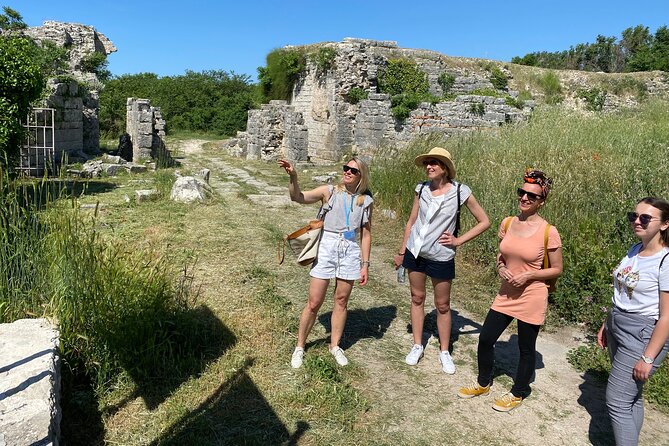
Tusculum adds a more recent layer to the visit. Don Frane Bulić, a prominent clergyman and archaeologist from Split, built it as an office and meeting place. Some rooms can be visited.
This is a useful reminder that archaeology is not only about ancient builders. Modern researchers shaped the way Salona was excavated, protected, and understood. Bulić’s connection to the site also appears in the street name used for the meeting point, Ul. don Frane Bulića.
The stop is scheduled for about 15 minutes. You will not have time for an extended museum-style visit, but the building helps explain the work behind the ruins. I like this part because it gives the ancient remains a human working history, not just a Roman one.
A few more tours and experiences worth a look
- SPLIT-PRIVATE Walking Tour of Diocletian’s Palace & Old Town
★ 5.0 · 467 reviews - Private Krka Waterfalls tour with 30min Boat Cruse
★ 4.0 · 458 reviews - Split by Private Electric Rickshaw – Palace & Hidden Gems
★ 5.0 · 412 reviews - Private Blue cave, Mamma Mia and Hvar, 5 islands tour from Split
★ 5.0 · 387 reviews
The bishop’s palace and two vanished cathedrals
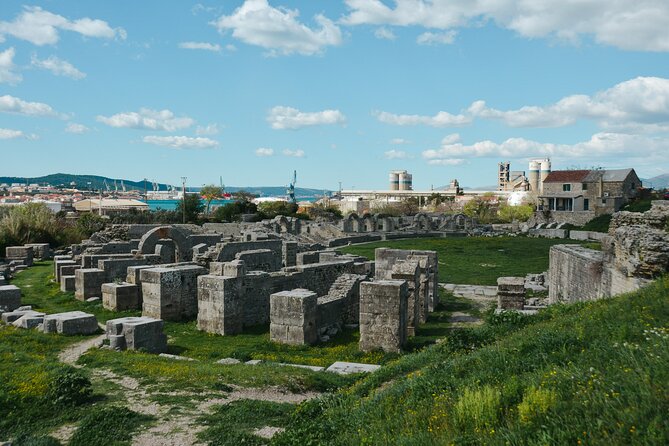
At the remains of the Biskupska palača, you see the foundation walls of a bishop’s palace and two cathedrals. These buildings belong to the period when Christians were allowed to practice their religion freely.
Only foundations remain, so this is a stop where the guide’s explanation carries much of the experience. Low stone walls can be hard to interpret on your own. With the right context, they begin to suggest the shape of a major religious center.
The itinerary allows about 15 minutes here. That pace suits the site. You can inspect the surviving outlines, ask how the buildings related to each other, and then continue before the ruins begin to blur together.
Baths, bridges, and the working side of Salona
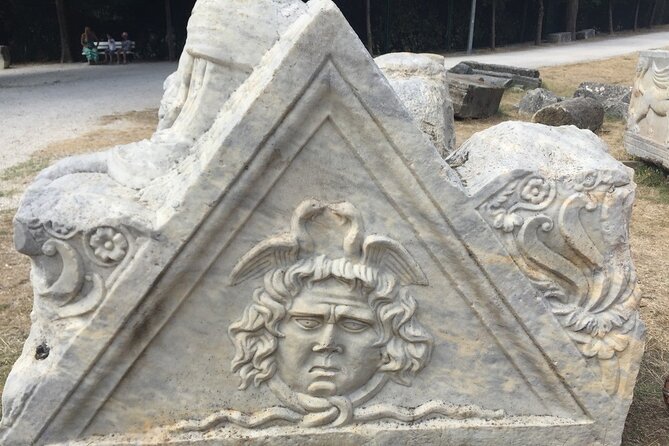
The large urban spa shows how Roman baths served as social and cultural centers for several hundred years. Roman baths were not merely places to wash. They were places to meet, talk, and spend time, and their size reflects the needs of a substantial city.
You get about 10 minutes at the baths. That is short, but the point is clear: Salona had the public infrastructure of a major urban center. The remains help balance the cemetery and church stops with evidence of everyday civic life.
At Pet Mostova, or the Five Bridges, the focus shifts to an industrial area outside the old city center. The name refers to five bridges that once belonged to this working zone. This stop may be less visually dramatic than the amphitheater, but it gives you a better sense of how the city operated beyond its ceremonial core.
Again, the planned time is about 10 minutes. I would treat it as a quick orientation stop rather than a major photo break.
Porta Caesarea and the marks of Roman traffic
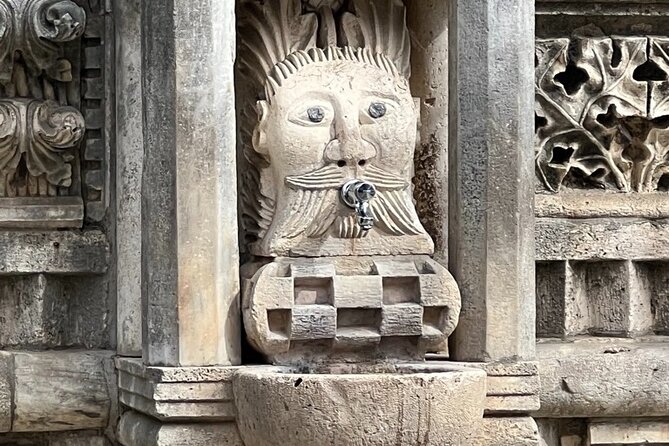
The Town Gate, known as Porta Caesarea, was the capital gate in Roman times. The most memorable detail is practical: ruts from Roman chariot wheels can still be seen in the stone.
Those grooves are small, but they make the site unusually easy to imagine. A wall foundation can feel abstract. Wheel tracks show repeated movement, pressure, and use. They connect the gate to daily traffic entering and leaving Salona.
The tour allows approximately 10 minutes. Look down as well as up. The most interesting evidence may be beneath your feet rather than in a dramatic surviving arch.
The forum, temple, and theater at Hram
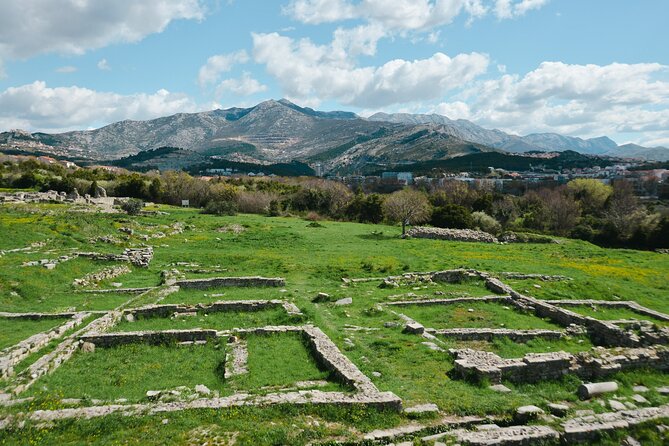
Hram lies in the oldest part of the city. Here you see the remains of the forum, a temple, and an ancient Roman theater.
This is one of the places where a guide can help you understand the plan of Salona. The forum formed part of the civic center, while the temple and theater show the religious and public functions that shaped Roman urban life. The remains are not presented as one complete monument, so you will need to use the surviving outlines and the explanation together.
The visit here is about 10 minutes. That makes the stop a concise lesson in how the city was organized. If you enjoy Roman archaeology, you may wish the schedule allowed longer, but the broad route gives you more variety than a single-site visit would.
Sarcophagi and cemeteries outside the walls
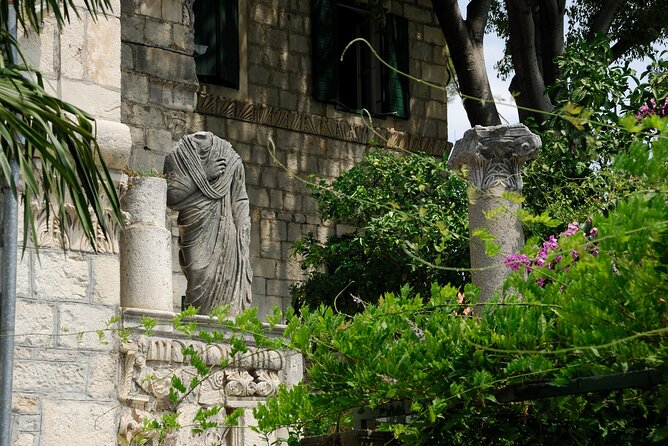
The Cemetery of the 16 Sarcophagi lies beside the road leading toward the amphitheater. Its position reflects a Roman practice: cemeteries were placed outside city walls.
This is a strong example of how the tour connects separate remains. The sarcophagi are not an isolated display. Their location beside a road shows how burial grounds related to movement, entrances, and the limits of the city.
The stop lasts around 10 minutes. You can examine the arrangement and hear why the cemetery was placed there before continuing toward the amphitheater.
Kapljuc provides another view of Salona’s Christian past. It contains a basilica and necropolis, and five martyrs who died in the amphitheater were buried here. Their deaths occurred at the beginning of the fourth century during the persecution of Christians under Diocletian.
That connection gives the route an emotional and historical arc. You first see the amphitheater as a Roman public building, then encounter the burial place of people linked to its violent use. Kapljuc also receives about 10 minutes, so listen closely when the guide explains the relationship between the two sites.
The Salona amphitheater is the main event
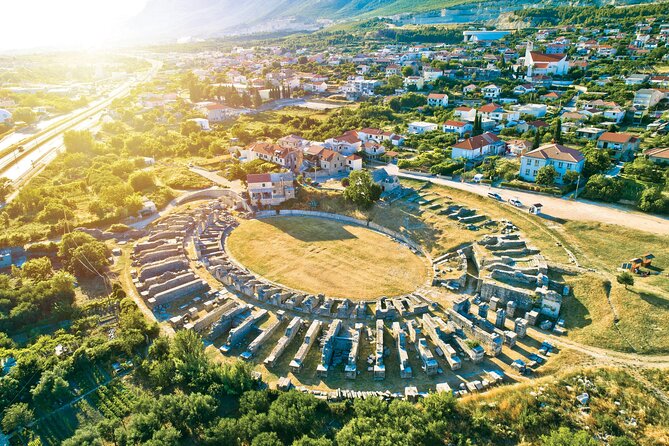
The amphitheater is the final and longest stop, with about 30 minutes planned. That is sensible. It is the clearest surviving building on the route and the place where the earlier pieces of Salona come together.
The structure is relatively well preserved, though much of its stone was removed by the Venetians for use in churches in Venice. That fact adds an uncomfortable but useful lesson. Ancient buildings were often treated as convenient quarries long after their original purpose disappeared.
Even in its damaged state, the amphitheater helps you understand the size and organization of Roman public entertainment. You can study the surviving form, hear how the building fit into Salona, and connect it with the martyrs remembered at Kapljuc.
I would save your best questions for this stop. Ask about the building’s capacity, its place in the city, and which parts remain. The supplied information does not promise a staged event or special access, so expect an archaeological visit rather than a performance or reenactment.
What the private format is worth at $203.50
At $203.50 per person, this is not a low-cost way to see Salona. The value depends on how much you want interpretation and personal attention. A private experience means only your group participates, which can make a difference at a site spread across many modest remains.
You are paying for a guide who can explain why a cemetery sits outside the walls, how the baths served public life, and what links the amphitheater to early Christian history. Without that help, you may see many stones but miss the larger story.
The price is easier to justify for a small group that would otherwise book several separate tickets or wants to ask plenty of questions. It is harder to justify if you mainly want a quick look at the amphitheater and are happy to read on your own.
Admission needs special attention. The tour title identifies admission as included, but the detailed stop information says the Salona open-air museum ticket is not included and costs about 10 euros for adults. Ask Split Guide to confirm the current arrangement before booking, since the difference affects the final cost.
The experience is booked, on average, 84 days ahead. That suggests you should not leave it until the last minute if your dates are fixed, especially since it is a private activity with limited guide availability.
Who will get the most from this visit
I would choose this tour if you want Roman ruins without the crowds and tight streets of central Split. It suits people who enjoy seeing how a city worked, not just photographing one famous monument.
It is also a good fit if early Christian history interests you. Manastirine, the bishop’s palace, Kapljuc, and the martyr burials give the visit a strong religious thread.
Families and small groups may appreciate the private setup because you can keep the conversation focused. The itinerary says most people can participate, but it does not provide detailed information about wheelchair access, terrain, or the exact walking distance. Ask for those specifics if mobility is a concern.
You should be comfortable with an outdoor archaeological walk and a fairly brisk schedule. Eleven stops in 150 minutes means some visits last only 10 minutes. If you prefer long, quiet periods at each ruin, this route may feel hurried.
The one named guide in the available feedback is Ivan, who was described as a pleasant companion and whose guidance made the tour worthwhile. That is encouraging, though guide assignments can change, so do not assume Ivan will lead every departure unless Split Guide confirms it.
Booking, weather, and cancellation
Confirmation is provided when you book. The tour is conducted in English, uses a mobile ticket, and begins and ends at the Salona main entrance.
You can cancel for a full refund up to 24 hours before the start time. Changes made less than 24 hours before the experience are not accepted, and cancellations inside that window are not refunded. The cut-off follows local time.
Good weather is required. If conditions force cancellation, you are offered another date or a full refund. That policy is useful for an outdoor site, but leave enough flexibility in your Split schedule if possible.
Should you book Salona and the amphitheater?
Book it if you want a private, guided look at Roman Salona and value explanation as much as the ruins themselves. The route gives you more than an amphitheater: you see cemeteries, basilicas, baths, city gates, a forum, a theater, and the remains of a bishop’s center.
At $203.50 per person, I would book only after confirming the admission fee. Once that point is clear, the decision comes down to your group size and interest. For a small group that wants a focused English tour, the personal format can make the price worthwhile. For a budget-minded visitor who wants only the main monument, a shorter or self-guided option may offer better value.
The best reason to go is the complete arc of the visit. Salona shows you a Roman city at work, a Christian community under pressure, and an amphitheater still tied to both public entertainment and martyrdom. That is a lot of history to find just beyond Split.
FAQ
Where does the tour begin?
It begins at the Salona main entrance, Ul. don Frane Bulića 58, 21210 Solin, Croatia.
Where does the tour end?
The activity ends back at the Salona main entrance, the same place where it starts.
How long does the tour last?
The tour lasts approximately 2 hours and 30 minutes.
Is admission to Salona included?
The tour title says admission is included, but the detailed information says the open-air museum ticket is not included and costs about 10 euros for adults. Confirm the current policy with Split Guide before booking.
Is this a private tour?
Yes. Only your group participates in the activity.
What happens if the weather is poor?
The experience requires good weather. If it is canceled because of poor weather, you are offered a different date or a full refund.
Just added around Split
- Private VIP Blue Lagoon and 3 Islands Tour★ 4.5 · 9 reviews
- Split highlights – Evening walking tour★ 5.0 · 9 reviews
- Private boat transfer Split – Bol★ 5.0 · 9 reviews
- From Split: Trogir & Blue Lagoon Boat Tour with Snorkeling★ 4.6 · 9 reviews
- Private Photography Activity in Split★ 5.0 · 9 reviews
- Bike, Beer & Poljud Stadium Tour★ 5.0 · 9 reviews
- From Hvar: Blue cave group speedboat tour full day★ 5.0 · 9 reviews
- Split Walking Tour: History, Legends & Tales★ 5.0 · 9 reviews
Guided, compared.
Plitvice & Rastoke Guided Day Trip with Ticket
Read our review →
Plitvice Lakes Guided Tour with Entry Tickets
Read our review →
Plitvice Lakes National Park Guided Day Tour from Split
Read our review →
Rastoke & Plitvice Lakes Guided Tour with Ticket
Read our review →