
Reviewed · WALKING TOURS
Walking tour of Split with an Art Historian
Split reveals itself one stone at a time. I like the way this small-group walk connects Roman, medieval, and modern Split, and I like that Josipa, an art historian, explains buildings as well as the people who used them. The main drawback is that the tour does not enter paid sites, including the cathedral and palace substructures.
This is a strong first activity in Split, especially if you want a clear sense of how Diocletian’s Palace became the city’s Old Town. Josipa’s easy pace, local recommendations, and willingness to answer unexpected questions add real value. You should be ready for steps, uneven surfaces, hot sun, and a fair amount of standing.
In This Review
- Key points to know before booking
- Why this tour makes sense as your Split introduction
- Starting at Strossmayer Park and the story of water
- Tower 2 and the less glamorous side of Diocletian’s Palace
- Gregory of Nin and a local good-luck custom
- Entering through the Golden Gate and following the Cardo
- The Iron Gate and why it mattered
- The Peristyle, Split’s great Roman stage
- The Silver Gate and the Cathedral of Saint Domnius
- The narrow Let Me Pass Street
- The Vestibule and the sound of klapa
- Descending toward the Riva through the palace substructures
- The Riva and the model of Split’s Old Town
- What Josipa adds as an art historian
- Price, timing, and practical comfort
- Who should book this Split walking tour?
- Should you book it?
- FAQ
- Where does the walking tour begin?
- Where does the tour end?
- How long does the tour last?
- What language is the tour offered in?
- Does the price include entry to the cathedral?
- Does the tour enter the palace substructures?
- How large is the group?
- Can I bring my dog?
Key points to know before booking
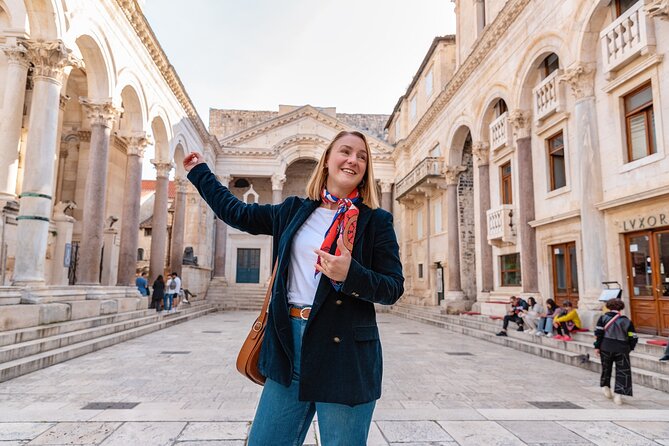
- Art historian guide: Josipa brings together architecture, archaeology, geography, folklore, and daily life.
- Small group of up to 10: You can hear the guide clearly and ask questions without shouting across a crowd.
- Roman palace turned living city: The route shows how ancient walls, medieval streets, homes, shops, and cafés share the same space.
- No paid admissions: You see and discuss major sites from outside, but entrance tickets are not included.
- Roughly two hours on foot: The walk covers a lot of ground, with several steps and some uneven sections.
- Smart morning choice: An early start can mean cooler weather and fewer large cruise groups around the main sights.
Why this tour makes sense as your Split introduction
Diocletian’s Palace is not a quiet archaeological park. It is the center of Split, with residents living among Roman columns and medieval lanes. That can make the city confusing at first. A palace gate may lead to a café, a Roman street may narrow into a passage, and an emperor’s mausoleum may now serve as a cathedral.
This tour gives you the basic map and the larger story. You begin in Strossmayer Park, outside the palace core, then enter through the Golden Gate. From there, the route follows ancient streets toward the Peristyle, the cathedral, the Vestibule, the palace substructures, and the Riva waterfront.
I especially value the way this route explains why Split looks the way it does. You are not simply shown a series of old stones. You learn how water supported the palace, how Roman planning shaped the center, how later residents adapted the imperial complex, and how local customs still connect people with the old city.
The group limit of 10 matters here. The palace has narrow lanes and crowded squares, so a small party is easier to manage than a large flag-following procession. Josipa has also been praised for adjusting the route around crowded areas and for making room for questions.
More Walking Tours in Split
- Split: Old Town and Diocletian Palace Walking Tour
★ 4.9 · 4,727 reviews - Walking Tour of Split and Diocletian’s Palace
★ 5.0 · 2,588 reviews - Krka Waterfalls tour with Trogir Walking tour and Krka panoramic boat cruise
★ 5.0 · 1,659 reviews
Starting at Strossmayer Park and the story of water
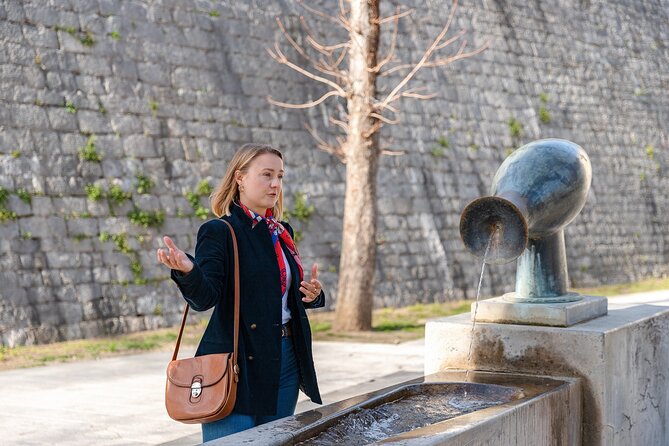
Meet Josipa beside the central fountain in Strossmayer Park, locally called Đardin. This is a useful starting point because it gives you a little breathing room before the tour enters the tight streets of the old center.
The opening story concerns water, which has supported life in and around the palace for more than 17 centuries. That may sound like a modest topic, but it is a good way to understand why Diocletian chose this place and how a large imperial residence could function.
You will spend about 10 minutes here. The fountain also makes the meeting point fairly easy to identify, though arriving early is wise. The guide waits no more than 10 minutes after the scheduled departure time.
Tower 2 and the less glamorous side of Diocletian’s Palace
The next stop is Tower 2 of Diocletian’s Palace. It is not presented as the prettiest sight on the route, and that is part of its usefulness. You get an early look at the palace as a fortified Roman complex rather than as a collection of postcard views.
This short stop helps explain what makes Split unusual. The palace is not only preserved ruins. It is an old structure that became the framework for a working city. You will start to see how modern Split grew inside and around the Roman plan.
Gregory of Nin and a local good-luck custom
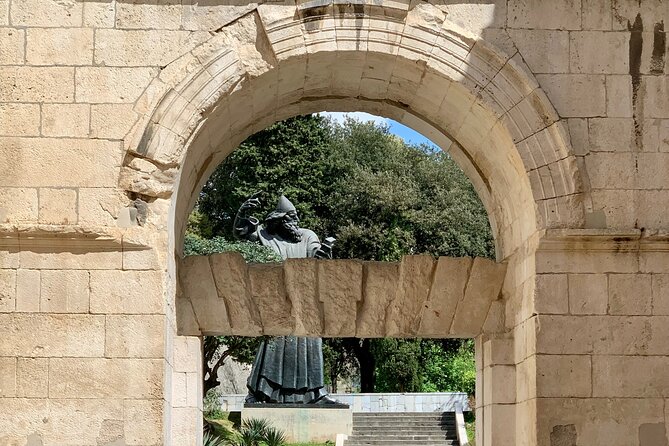
Before entering through the Golden Gate, you stop at the seven-meter bronze statue of Gregory of Nin. The Croatian sculptor Ivan Meštrović created this imposing figure, which has become part of Split’s everyday popular culture.
The familiar local custom is to rub the statue’s toe for good luck. Josipa adds context about the monument, so the stop is more than a quick photo opportunity. It is also a chance to see how a public artwork can become part of a city’s habits and identity.
Allow five minutes here. If you want a photograph, listen first and take your turn quickly, since the statue is a natural gathering point.
Something different for another day:
- Split: Krka Waterfalls Trip with Boat Cruise and Swimming
★ 4.8 · 10,519 reviews - From Split: Krka Waterfalls, Food & Wine Tasting Tour
★ 5.0 · 9,326 reviews - Blue cave, Mamma Mia and Hvar, 5 islands speedboat tour
★ 5.0 · 7,150 reviews - From Split: Krka Waterfalls, Food & Wine Tasting Tour
★ 4.9 · 6,598 reviews
Entering through the Golden Gate and following the Cardo
The Golden Gate was the palace’s northern entrance and one of four main entry points. It is an ideal place to discuss Roman planning because the gate leads into the Cardo Maximus, the principal north-south street.
You follow this ancient route toward the Peristyle. Today, the street is woven into the Old Town, so you will see the pleasing collision of Roman structure and later city life. The route is short, but the historical reach is enormous: you are walking along a line planned roughly 1,700 years ago.
A brief stop near Dioklecijanova takes you toward a small garden within the palace. This pause gives the group a break from the main flow of the street and shows how tucked-away spaces exist inside the dense center.
The Iron Gate and why it mattered
The Iron Gate lies in the palace’s northwestern corner. Here, Josipa explains why this entrance gained special importance over time and became known locally as the city’s platinum gate.
The value of this stop is the added layer of later history. Diocletian built the gates for a Roman palace, but their meaning changed as Split grew. You get a reminder that old buildings do not have only one story. Their importance can shift as a city changes around them.
The Peristyle, Split’s great Roman stage
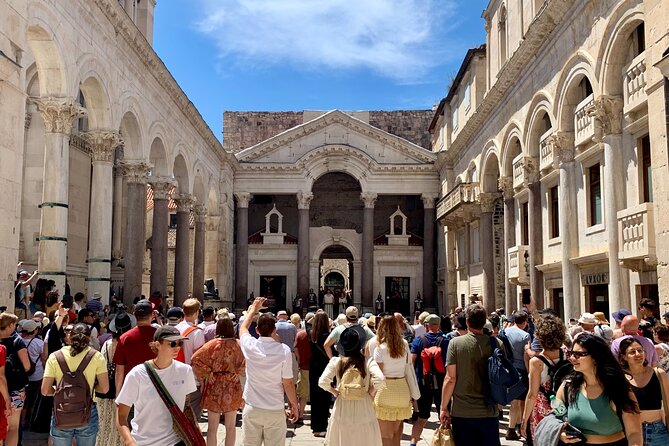
The Peristyle is the visual high point of the walk. You approach it along the Decumanus, the main east-west route, and the space opens into a monumental court framed by ancient architecture.
This is where the scale of Diocletian’s project becomes easiest to grasp. Josipa explains the court’s origin and purpose, then connects its Roman role with the ways later generations used the space. The stop lasts about 10 minutes, but you may want extra time here after the tour for your own photographs.
Crowds can gather at the Peristyle, particularly when cruise ships are in port. That is one reason I would choose a morning departure when possible. You may still find activity, but the main court can be easier to hear and appreciate before large groups arrive.
The Silver Gate and the Cathedral of Saint Domnius
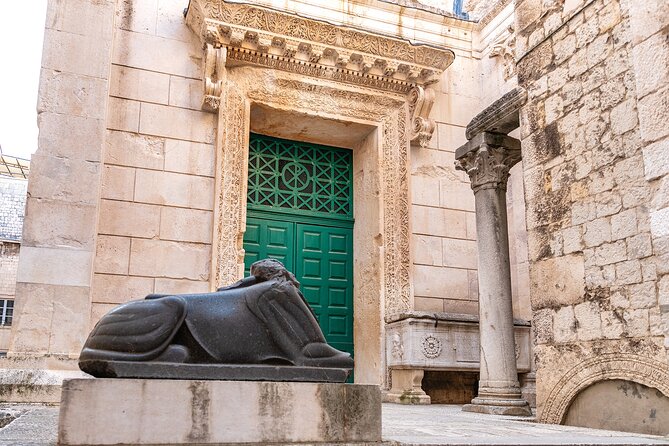
From the Peristyle, the route makes a short detour to the Eastern, or Silver, Gate. Josipa reveals the reason for this small but significant turn on site. It is a good example of the tour’s approach: short stops are used to connect the visible structure with the city’s larger story.
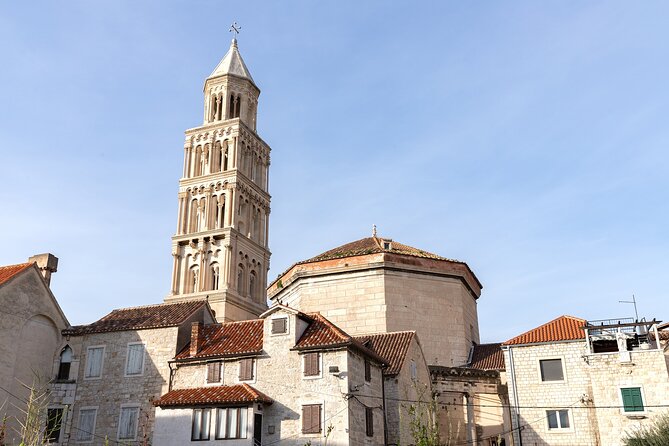
The Cathedral of Saint Domnius is especially important because the building began as a mausoleum for Emperor Diocletian and was later adapted into a Christian cathedral. That change captures the central theme of Split: Roman power, Christian tradition, and later city life occupy the same architectural setting.
You do not go inside the cathedral. Admission is not included, and the tour does not enter paid attractions or museums. That keeps the walk within its stated price, but you should budget extra time and money if you want to visit the interior on your own.
The narrow Let Me Pass Street
The lane called Let Me Pass, or Pusti me da prodjem, is less than 10 meters long and only 57 centimeters wide. It is one of the route’s lighter moments, but it also says something important about how people adapted to life within the palace walls.
The lane is tied to local memories and is honored by a public monument elsewhere in Split. You will probably stop for a quick photograph, but do not expect to stroll through it in a group. Its tiny width is the point.
This is a useful example of the tour’s balance. You get major architecture at the Peristyle, but you also get small details that help the city feel lived in rather than frozen in Roman times.
The Vestibule and the sound of klapa
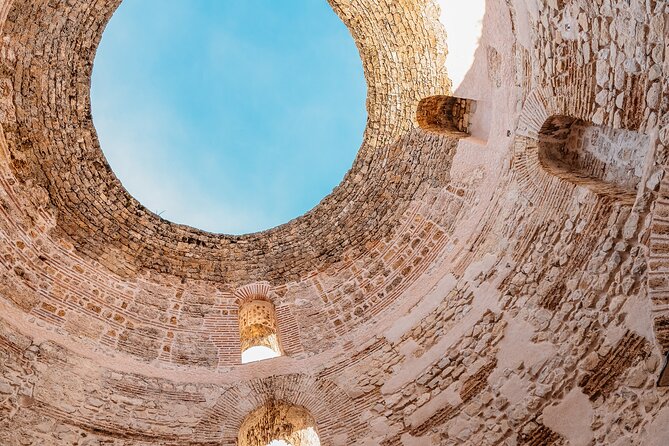
The Vestibule once served as the entrance to the emperor’s private quarters. Today, it is one of Split’s best-known open-air photo spots, with a striking circular form and strong acoustics.
You have around 10 minutes here to look around and take photographs. You might also hear traditional klapa singing, which is often performed in the space because of its natural sound.
The stop works well for both architecture lovers and casual sightseers. Josipa can explain the original function, while the possible music gives you a direct connection to a living local tradition. Since the Vestibule is popular, your experience may depend on how busy the area is during your visit.
Descending toward the Riva through the palace substructures
The route then heads through part of Diocletian’s Palace substructures. Locals use this passage as a shortcut to the waterfront, and it gives you a sharp change in atmosphere. The bright openness of the Peristyle gives way to darker, quieter stone corridors before you emerge near the sea.
You do not explore the full substructure complex. A separate admission fee applies, and the available tour time is limited. This is the clearest point where you need to manage expectations: you receive an introduction and pass through a section, but this is not a complete underground archaeology tour.
Even so, the stop is valuable because it helps you understand the palace’s physical structure. What you see above ground is only part of the complex. The substructures also show how the Roman plan shaped the later city.
The Riva and the model of Split’s Old Town
Once outside, you walk along part of the Riva, Split’s waterfront promenade, street, and public meeting place. The route is short, but it provides a welcome change after the narrow palace lanes.
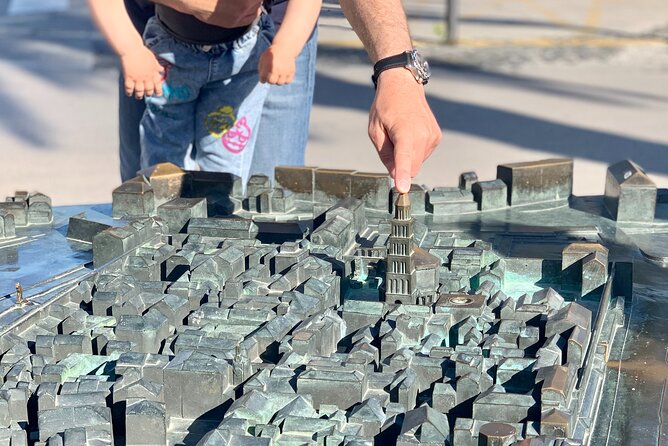
The final stop is usually the bronze model of Split’s historic core near the Riva. Josipa uses the model to review the city’s layout and topography, which helps fix the earlier route in your mind. You can see how the palace sits within the wider center and how the waterfront relates to the old streets.
If time remains, the walk may continue. If not, Josipa shares suggestions for exploring on your own, including places to eat and other local activities. Several people have valued these recommendations, especially for lunch and for planning the rest of a Split stay.
What Josipa adds as an art historian
The title of this experience matters. Josipa is not simply pointing out Roman remains. Her background in art history lets her discuss form, materials, architecture, and how buildings were reused across centuries.
Her explanations also reach beyond dates. She connects the palace to geography, local customs, and the way people lived in the old center. That wider frame is what turns a sightseeing walk into a useful orientation.
I also like the conversational approach. You can ask about architecture, archaeology, local life, food, or what to do next. Past bookings have included families with ages ranging from 29 to 77, and the pace was adjusted to suit the group.
If you prefer a guide who delivers a fixed speech without interruption, this may feel less structured than you want. If you enjoy asking questions and following an interesting detail for another minute, the format should suit you well.
Price, timing, and practical comfort
At $30.23 per person, the tour is fairly priced for a guided introduction lasting about 1 hour 40 minutes to two hours. You are paying for a small group, an art historian’s interpretation, and a route that covers the essential Roman center plus several less obvious details.
The value is strongest if you take the walk near the start of your Split visit. You will understand the layout sooner, avoid wasting time wandering past important sites, and have a chance to ask Josipa where to eat or what to see next.
The tour is offered in English and uses a mobile ticket. Confirmation arrives when you book, and free cancellation is available up to 24 hours before the start time. Changes or cancellations inside that 24-hour window are not accepted for a refund.
Wear comfortable shoes. The route is mostly manageable walking, but it includes unavoidable steps and some uneven ground. Most people can participate, yet anyone with walking difficulties should consider comfort and safety before booking.
Split can be hot, so carry water and use sun protection. The tour runs rain or shine. Service animals are allowed, and dogs may be possible if you contact Josipa before booking so she can check that the arrangement suits the group.
Who should book this Split walking tour?
I would choose this for a first visit, a short stay, or any day when you want the Roman center to make sense. It suits history and architecture fans, but the local customs, photo stops, and food suggestions give it enough variety for people who do not normally seek out formal history tours.
Families can benefit from the short stops and the chance to ask questions. Couples and solo visitors may appreciate the small group, particularly if a very small booking creates a more private conversation.
You should choose something else if your main goal is to enter the cathedral, tour every section of the substructures, or spend a long time inside museums. Those admissions are outside this experience. You may also prefer a different activity if steps, uneven streets, heat, or a rain-or-shine schedule would make nearly two hours on foot uncomfortable.
Should you book it?
Book this tour if you want Split explained, not just displayed. Josipa’s art history background, local perspective, flexible conversation, and small group size make the $30.23 fee good value for a first look at the city.
Choose a morning slot if available, especially during cruise season. You will have a better chance of hearing clearly at the Peristyle and taking in the palace before the biggest groups arrive. Just remember that the tour is an outdoor introduction, not a paid-entry tour of the cathedral or underground chambers.
FAQ
Where does the walking tour begin?
It begins beside the Strossmayer Fountain in Strossmayer Park, also called Đardin, at Ul. kralja Tomislava 12 in Split.
Where does the tour end?
The usual endpoint is the bronze model of Split’s Old Town on the Riva waterfront, at Obala Hrvatskog narodnog preporoda 23.
How long does the tour last?
The tour lasts approximately 1 hour 40 minutes to two hours.
What language is the tour offered in?
The tour is offered in English.
Does the price include entry to the cathedral?
No. The tour does not enter Saint Domnius Cathedral, and admission is not included.
Does the tour enter the palace substructures?
The route passes through part of the substructures as a shortcut to the Riva, but it does not explore the full complex. Additional admission fees apply for a deeper visit.
How large is the group?
The maximum group size is 10 people.
Can I bring my dog?
Dogs may be possible, but you should contact Josipa before booking so she can discuss the details and make sure the arrangement works for everyone.
Just added around Split
- Private VIP Blue Lagoon and 3 Islands Tour★ 4.5 · 9 reviews
- Split highlights – Evening walking tour★ 5.0 · 9 reviews
- Private boat transfer Split – Bol★ 5.0 · 9 reviews
- Private Photography Activity in Split★ 5.0 · 9 reviews
- From Split: Trogir & Blue Lagoon Boat Tour with Snorkeling★ 4.6 · 9 reviews
- Bike, Beer & Poljud Stadium Tour★ 5.0 · 9 reviews
- From Hvar: Blue cave group speedboat tour full day★ 5.0 · 9 reviews
- Split Walking Tour: History, Legends & Tales★ 5.0 · 9 reviews
Walking Tours, compared.




Walking Tour of Split and Diocletian’s Palace
Read our review →


Krka Waterfalls tour with Trogir Walking tour and Krka panoramic boat cruise
Read our review →
City Walls Early Morning or Sunset Walking Tour
Read our review →Browse the lists this tour appears in