
Reviewed · DIOCLETIAN PALACE TOURS
Split: Private Walking Tour with Diocletian’s Palace
Split’s old center is a palace you can walk through. I like the way this private walking tour links Roman ruins with medieval lanes, Gothic palaces, churches, markets, and the Riva waterfront. I also like the freedom to set the pace, ask questions, and shape the route around your interests. Guides including Slavko, Antonia, Vinka, and others have earned praise for their warmth, local insight, and strong storytelling.
The main consideration is that the tour can last anywhere from 90 minutes to five hours, so you need to confirm the exact duration and starting time when booking. Some streets and historic spaces may also be difficult for wheelchair users, and you will want comfortable shoes for the uneven walking route.
In This Review
- Key things to know before you book
- Why Diocletian’s Palace makes such a good walking tour
- Golden Gate and the palace’s northern entrance
- The Game of Thrones Museum and People’s Square
- Fruit Square and the everyday side of Split
- Riva Harbor and the city’s public face
- Diocletian’s Cellars and the Roman foundation
- Peristil, the palace’s grand central space
- Saint Domnius Cathedral and the unusual Roman reuse
- Vestibul and the return to the Golden Gate
- Private guiding, language, and pace
- What to wear and who should book
- Is the $117 price good value?
- Should you book this Split walking tour?
- FAQ
- Where does the tour start?
- Where does the tour end?
- How long does the tour last?
- Is this a private tour?
- What languages are available?
- What sights are included?
- Is the Cathedral of Saint Domnius included?
- Is transportation included?
- Is the tour suitable for wheelchair users?
- What should I bring?
- Can I cancel for a refund?
- Do I have to pay when I reserve?
Key things to know before you book
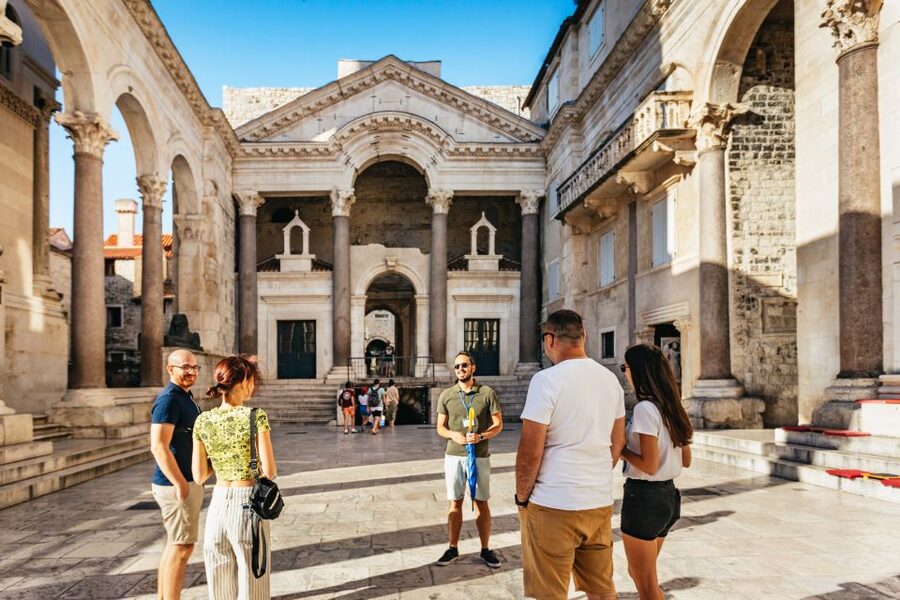
- The palace is still part of daily life: Diocletian’s Palace is not a fenced-off ruin. Homes, shops, cafés, museums, and streets occupy the ancient structure.
- Your guide can adjust the route: This is a private group experience for up to two people, with time and attention shaped around your interests.
- The 90-minute route covers major sights: Golden Gate, People’s Square, Fruit Square, Riva, the cellars, Peristil, Saint Domnius Cathedral, and Vestibul are all included.
- Local storytelling is a major strength: Slavko, who was born and raised in Split, has been praised for giving the city’s past a clear local perspective.
- It works well for families: A guide can explain the history in a way that suits adults, teenagers, or younger children.
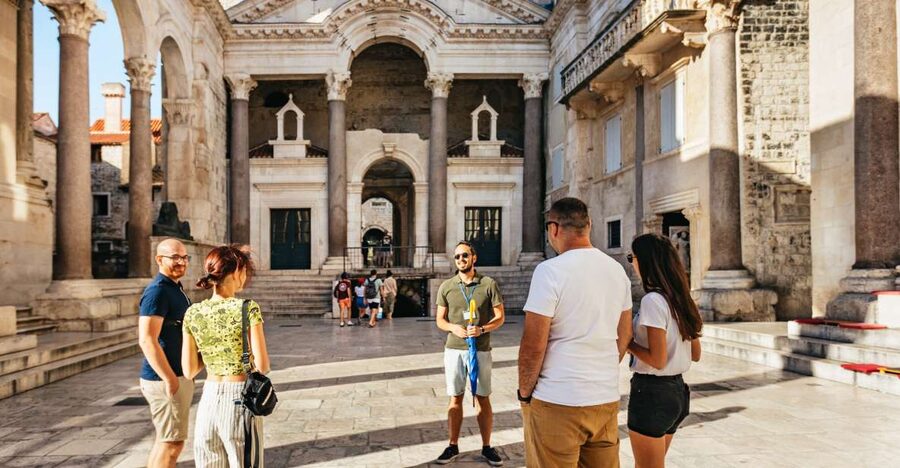
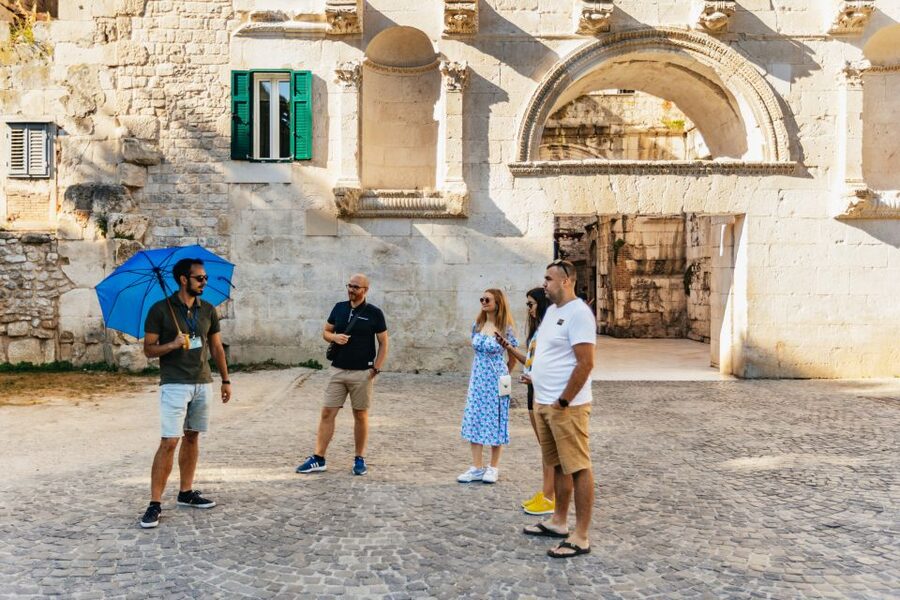
- The meeting point is easy to identify: Look for a guide carrying a blue umbrella at the Golden Gate, the palace’s North Gate.
Why Diocletian’s Palace makes such a good walking tour
Split’s central old town is unusual because the remains of a Roman emperor’s retirement palace are woven into the modern city. You are not simply looking at a monument from behind a barrier. You are walking through streets where people live and work, passing ancient stone beside later churches, palaces, cafés, and public squares.
That mixture is easier to understand with a guide. Without context, the old center can feel like a maze of pale stone alleys. With the right explanations, you begin to see the city in layers: Roman foundations, medieval changes, Renaissance and Baroque additions, and the busy life of present-day Split.
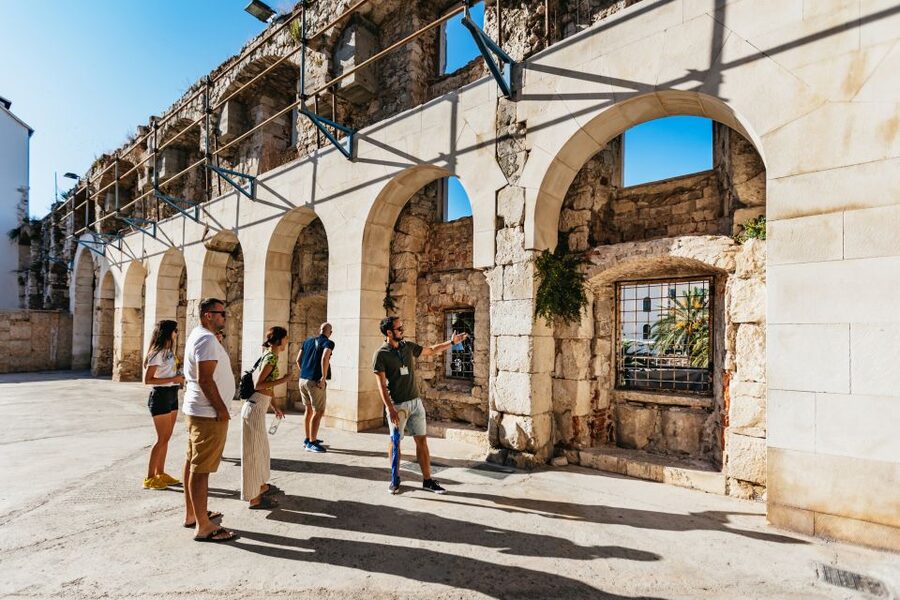
The tour begins at the Golden Gate, the main northern entrance to Diocletian’s Palace. From there, your guide can explain the palace layout and show how the old Roman plan still shapes the city. The route is private, so you can ask why a wall looks different in one section, how the palace changed after Roman rule, or where local life fits into the ancient structure.
I especially like this format for a first visit. A large group can give you facts, but a private guide can stop when you need a better explanation, skip what does not interest you, or spend more time on architecture, religion, local customs, or Roman history.
More Walking Tours in Split
- Split: Old Town and Diocletian Palace Walking Tour
★ 4.9 · 4,727 reviews - Walking Tour of Split and Diocletian’s Palace
★ 5.0 · 2,588 reviews - Krka Waterfalls tour with Trogir Walking tour and Krka panoramic boat cruise
★ 5.0 · 1,659 reviews
Golden Gate and the palace’s northern entrance
The Golden Gate is both the meeting point and the first major sight. Look for the guide with a blue umbrella at the North Gate of Diocletian’s Palace.
This entrance gives you an immediate sense of scale. It is not just a decorative arch. It was part of a fortified palace complex designed for the emperor Diocletian, who retired to the area in the early fourth century. The gate leads into the old core and helps you understand how the palace once functioned as a secure imperial residence.
Your guide will spend about 10 minutes here. That may sound brief, but the value comes from learning what to look for. The stonework, passageways, and surviving structure make more sense once you know that later generations built their own city into the Roman shell.
You will also see the statue of Gregory of Nin, a medieval Croatian bishop. Rubbing the statue’s toe is a popular local custom, though the supplied tour details do not promise a special ritual or stop beyond seeing the statue. Treat it as a point of interest, not a guaranteed feature of the route.
The Game of Thrones Museum and People’s Square
The brief stop near the Game of Thrones Museum lasts about five minutes. This is a small part of the tour, so you should not book the experience mainly for the museum. Instead, it offers a modern pop-culture link to Split and the wider Dalmatian setting used in the series.
After that, the route moves to People’s Square, known locally as Pjaca. The guided visit lasts about 10 minutes. This square helps show how Split developed beyond the original Roman palace. Medieval and later buildings frame the open space, giving you a clear look at the shift from imperial stronghold to a lived-in town.
The tour description highlights 12th and 13th-century Romanesque churches, 15th-century Gothic palaces, and Renaissance and Baroque buildings. People’s Square is one of the places where those later periods become easier to spot. I would ask your guide to point out the details that separate Romanesque, Gothic, Renaissance, and Baroque design. A private tour gives you the chance to turn a quick viewing stop into a useful architecture lesson.
Fruit Square and the everyday side of Split
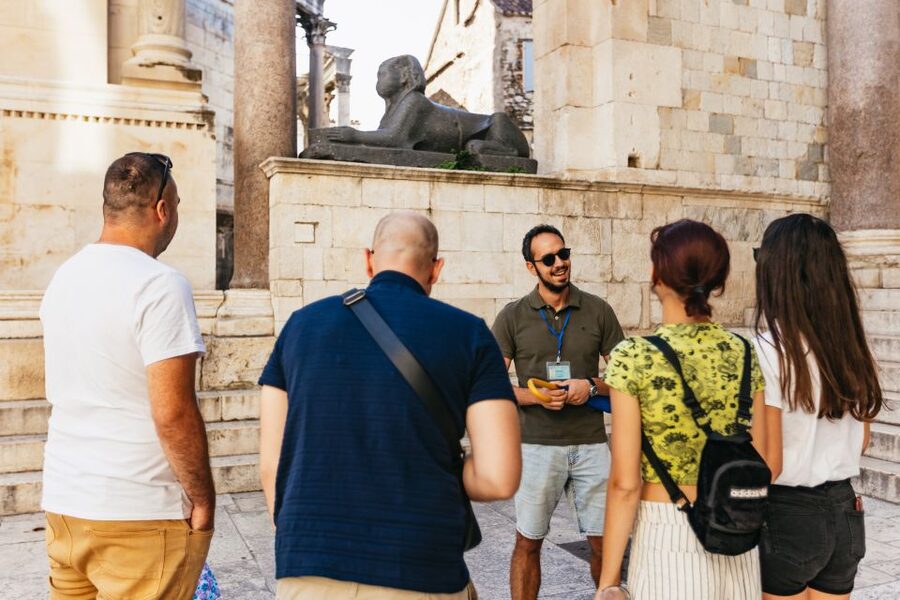
Fruit Square, or Voćni trg, offers a different feel from the palace gates and grand religious buildings. The stop lasts around 10 minutes and brings you into one of the old city’s social spaces.
This is a good place to notice how Split’s historic center functions today. The ancient setting is not isolated from ordinary life. Squares, shops, restaurants, and meeting places occupy the same compact area shaped by Roman construction.
The route also includes the Fish Market, described as a focal point of life in Split. The itinerary does not assign it a separate timed stop, so do not expect a long market visit. Still, your guide can help connect the market and the squares with the city’s daily rhythm, rather than treating Split as a collection of old stones.
If you enjoy local details more than dates, tell your guide early. The private format is best used for questions about food, neighborhoods, markets, and customs, as well as emperors and bishops.
More ways to see Diocletian's Palace:
- Split & Diocletian’s Palace Walking Tour
★ 5.0 · 1,125 reviews - Split: Diocletian Palace & Old Town Guided Walking Tour
★ 4.7 · 882 reviews - Split: Game of Thrones Tour with Diocletian’s Palace Cellar
★ 4.8 · 545 reviews - Diocletian’s Palace and Old Town SMALL GROUP Walking Tour
★ 5.0 · 502 reviews
Riva Harbor and the city’s public face
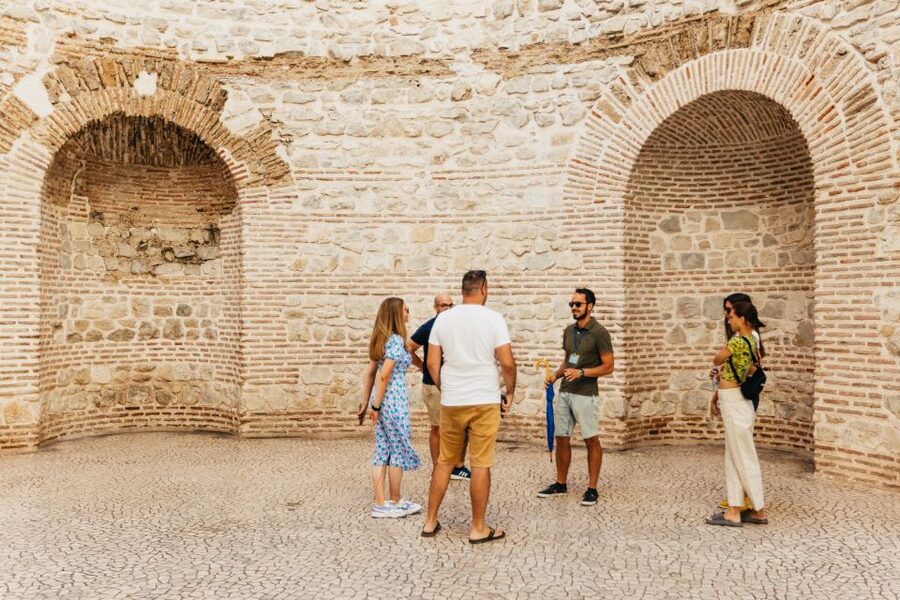
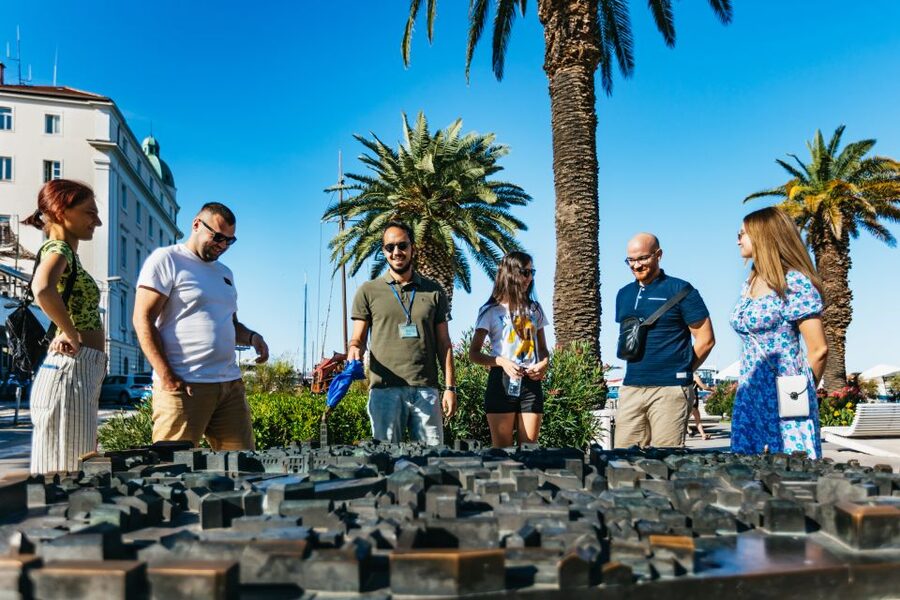
From the old squares, you continue to the Riva, Split’s waterfront promenade. The guided stop lasts approximately 10 minutes.
The Riva is a useful contrast to the enclosed lanes of Diocletian’s Palace. Here you can look out toward the harbor and see how the city opens toward the sea. The promenade is also a natural place to pause, take photographs, and understand why Split remains connected to maritime life.
The tour details describe the Riva as a beautiful promenade over Riva Harbor. That makes it a pleasant mid-route change of pace, but keep in mind that this is still a walking history tour. It is not a harbor cruise or a long waterfront leisure stop.
Your guide can share stories about the city’s past and offer local recommendations. Gudrun from Germany specifically praised the guide’s individual tips, while Antonia was praised for taking time to answer questions about the city, architecture, palace, and Split’s unusual place in history. Those comments point to the practical value of asking for advice while you are still in the center, when recommendations can help shape the rest of your visit.
Diocletian’s Cellars and the Roman foundation
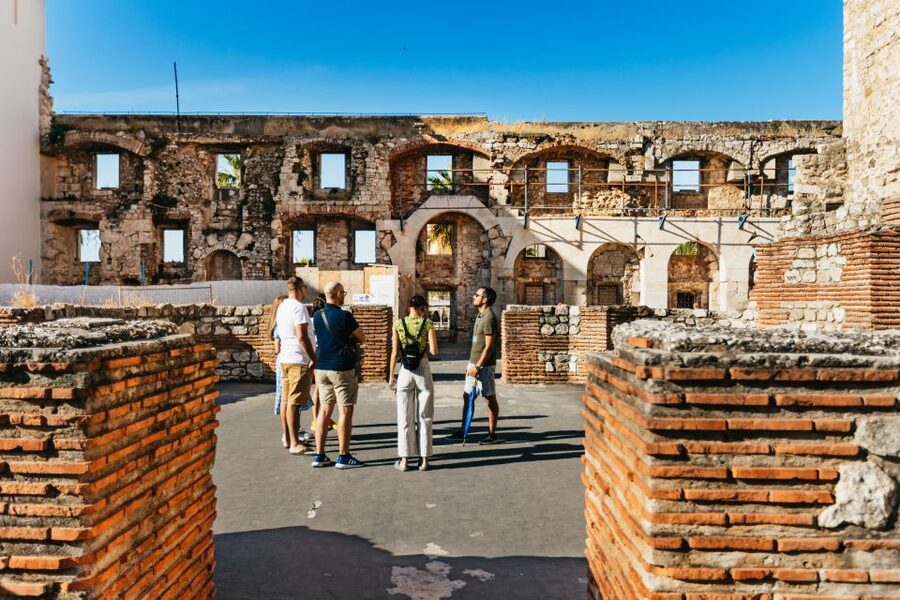
The Diocletian’s Cellars receive the longest single stop in the listed route, about 15 minutes. This is one of the most useful parts of the tour because the underground spaces help you understand the structure above.
The cellars supported the upper palace and preserved the shape of the Roman plan. Walking through them gives you a clearer idea of how the palace was organized than simply looking at scattered walls in the open air.
This is also where a guide’s explanation matters most. Ancient ruins can look repetitive if you do not know what each section did. Ask about storage, construction, the relationship between the cellars and the imperial rooms above, and how later use affected their preservation.
The listing includes a guided visit but does not specify separate admission details. If you are particularly interested in entering every paid interior, confirm what is covered when you book. The guide’s time and all taxes, fees, and handling charges are included, but the provided details do not spell out every possible site ticket.
Peristil, the palace’s grand central space
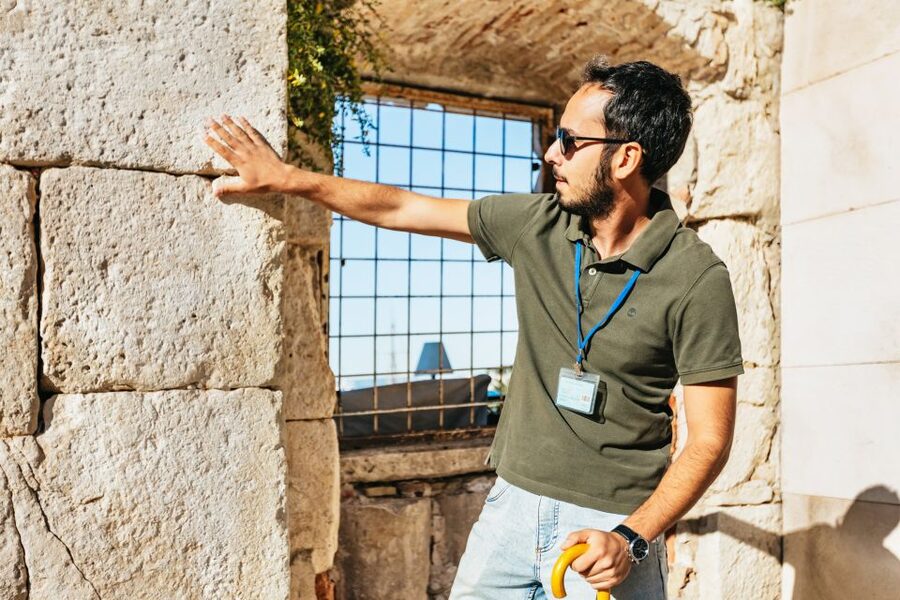
Peristil is the symbolic heart of Diocletian’s Palace and receives about 10 minutes on the route. This open stone square brings several parts of the story together: Roman imperial power, later Christian use, and modern Split.
Your guide can explain how the square related to the emperor’s ceremonial route and why the surrounding architecture matters. It is also one of the best places to see how old and new uses overlap. Visitors pass through, people pause, and historic buildings remain part of the city rather than a silent archaeological park.
This is a good stop for photographs, but the guide’s explanation gives it more value than a quick picture. Look up at the columns and surrounding façades, then compare the Roman elements with the later changes. Split’s interest lies in those alterations. The palace did not remain frozen in Diocletian’s time.
Large groups can gather around Peristil, especially at a major historic site. A private guide may help you avoid standing in the middle of a crowd, and Slavko was praised for steering around huge groups while keeping the experience personal. That is a practical benefit, especially during busy periods.
Saint Domnius Cathedral and the unusual Roman reuse

The Cathedral of Saint Domnius, or St Duje, is another 10-minute stop. It is one of the most remarkable buildings in Split because it began as Diocletian’s mausoleum and was later adapted for Christian worship.
Diocletian died in 311 AD and is associated with one of the last major persecutions of Christians in the Roman Empire. The building connected with his burial was later transformed into a cathedral. That change gives you a direct lesson in how political and religious power shifted over time.
The cathedral is described as one of the best-preserved ancient Roman buildings still standing. Your guide can help you see the difference between the original Roman structure and the later Christian additions, including the bell tower and surrounding elements.
Ten minutes is enough for an introduction, but not a long architectural study. If religion, Roman burial customs, or church design matters to you, use the private setting to ask for more detail. The flexible tour can be extended, with total duration ranging from 90 minutes to five hours, depending on the option and availability you choose.
Vestibul and the return to the Golden Gate
The final listed stop is Vestibul, with around 10 minutes of guided attention. This circular entrance space connected the palace’s ceremonial areas with the emperor’s apartments. Its shape and acoustics make it one of the more memorable sections of the route.
Vestibul also helps complete the palace story. You begin at the fortified northern entrance, see the city’s later squares and waterfront, then return to the Roman core. The route ends back at the Golden Gate, which is convenient if you want to continue exploring Split on your own.
Because the tour returns to its starting point, you can easily continue toward the nearby streets, squares, or Riva after saying goodbye to your guide. The experience does not include transportation, which is not a problem here. The main sights are close together, and the point of the tour is seeing them on foot.
Private guiding, language, and pace
The group is private and limited to your party, with the listed price of $117 for up to two people. That works out to $58.50 per person for two, before considering the value of the guide’s time and personalization. For one person, the cost is less attractive, but the privacy remains useful if you want to ask many questions or move at your own speed.
The strongest praise has gone to the guides’ personal approach. Slavko was described as animated, professional, and able to give a local view because he was born and raised in Split. Antonia was praised for her command of the city’s history, architecture, and unusual place in the past, as well as her patience with questions. Vinka has also received a direct recommendation for being excellent and professional.
The guides speak English, German, Spanish, and French. That language choice can make a real difference when discussing complicated changes in religion, government, architecture, and urban life.
The duration range is unusually broad. A 90-minute version suits you if you want orientation and the major sights. A longer option, up to five hours, is better if you want extended explanations, more questions, and a slower route. Check the available starting times and duration carefully instead of assuming every booking follows the same schedule.
What to wear and who should book
Wear comfortable shoes. The route includes old streets, stone surfaces, and extended walking through the center. Sunglasses and a sun hat are also sensible, particularly because parts of the route are outdoors and Dalmatian sunlight can be strong.
This tour suits first-time visitors who want to understand Split quickly without being pushed through a large group. It is also a good choice for couples, families, and parents with teenagers. One guide has been praised for adapting the explanations to teenagers, which suggests the private format can keep younger members involved better than a fixed lecture.
You should think twice if you need step-free access. The experience is not suitable for wheelchair users, and the supplied information does not promise accessible routes or facilities.
Free cancellation is available up to 24 hours before the tour for a full refund. You can also reserve and pay later, which helps if your Dalmatian schedule may change. The tour operates with live guides, not an audio app, so the quality of your experience depends partly on the guide assigned that day.
Is the $117 price good value?
I think the price is reasonable for two people who want a private introduction to Split. You are paying for direct access to a local professional guide, a flexible pace, and a route that joins the major parts of the old center in one walk.
The value is strongest when you use the private format actively. Ask questions. Request more time at the cathedral or cellars. Tell the guide if you care more about Roman engineering, medieval churches, local life, architecture, or filming locations. A private tour is not automatically better than a group tour, but it becomes better value when the route reflects your interests.
The price may feel high if you only want a quick orientation and do not plan to ask questions. In that case, the 90-minute option makes more sense than choosing a longer version. Also confirm the handling of any interior admission fees, since the provided inclusions list the guide, private sightseeing, taxes, fees, and handling charges but does not give a full ticket breakdown.
Should you book this Split walking tour?
Book it if you want the old center explained by a local guide rather than simply photographed. The tour is especially useful for understanding how a Roman palace became a medieval town and then a modern Croatian city.
I would choose the shorter version for a first orientation, and a longer option if you care deeply about architecture, Roman history, or local stories. The praise for Slavko, Antonia, Vinka, and the other guides suggests that the human side of the experience is its strongest feature.
Skip it if you need wheelchair access, dislike walking on old stone streets, or prefer exploring alone with no fixed meeting point. For most couples and families, though, this is a smart way to make sense of Split’s dense historic center in a short time.
FAQ
Where does the tour start?
It starts at the Golden Gate, the North Gate of Diocletian’s Palace in Split. Look for a guide carrying a blue umbrella.
Where does the tour end?
The route returns to the Golden Gate.
How long does the tour last?
The available duration ranges from 90 minutes to five hours. You should check the available option and starting time when booking.
Is this a private tour?
Yes. It is a private sightseeing tour for your own group, with the listed price covering up to two people.
What languages are available?
Live tour guides are available in English, German, Spanish, and French.
What sights are included?
The route includes the Golden Gate, Game of Thrones Museum area, People’s Square, Fruit Square, Riva, Diocletian’s Cellars, Peristil, Saint Domnius Cathedral, and Vestibul.
Is the Cathedral of Saint Domnius included?
Yes. The route includes a guided stop of about 10 minutes at the Cathedral of Saint Domnius.
Is transportation included?
No transportation is listed. This is a walking tour that begins and ends in central Split.
Is the tour suitable for wheelchair users?
No. The activity is listed as unsuitable for wheelchair users.
What should I bring?
Bring comfortable shoes, sunglasses, and a sun hat.
Can I cancel for a refund?
Yes. You can cancel up to 24 hours in advance for a full refund.
Do I have to pay when I reserve?
No. The reserve-now, pay-later option lets you book without paying immediately.
Just added around Split
- Private VIP Blue Lagoon and 3 Islands Tour★ 4.5 · 9 reviews
- Split highlights – Evening walking tour★ 5.0 · 9 reviews
- Private boat transfer Split – Bol★ 5.0 · 9 reviews
- Private Photography Activity in Split★ 5.0 · 9 reviews
- From Split: Trogir & Blue Lagoon Boat Tour with Snorkeling★ 4.6 · 9 reviews
- Bike, Beer & Poljud Stadium Tour★ 5.0 · 9 reviews
- From Hvar: Blue cave group speedboat tour full day★ 5.0 · 9 reviews
- Split Walking Tour: History, Legends & Tales★ 5.0 · 9 reviews
Diocletian Palace Tours, compared.


Walking Tour of Split and Diocletian’s Palace
Read our review →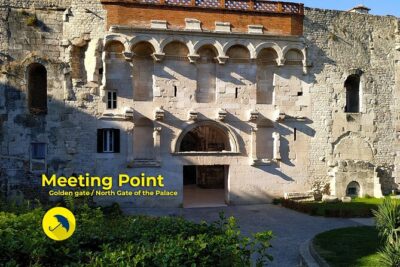

Diocletian Palace & Old Town Guided Walking Tour
Read our review →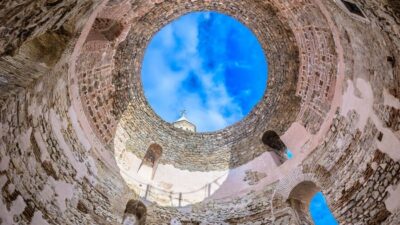
Game of Thrones Tour with Diocletian’s Palace Cellar
Read our review →
Diocletian’s Palace and Old Town SMALL GROUP Walking Tour
Read our review →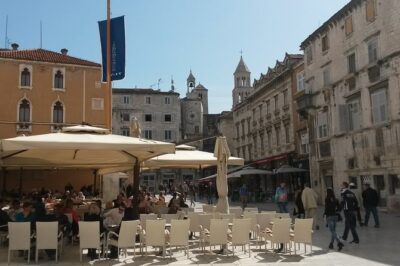
PRIVATE Walking Tour of Diocletian’s Palace & Old Town
Read our review →
Browse the lists this tour appears in