
Reviewed · WALKING TOURS
Split: Guided Walking Tour in English
Split reveals its story on foot. This 90-minute tour makes the old center easier to understand, especially the remarkable Diocletian’s Palace, where Roman walls, medieval buildings, shops, homes, and daily life all share the same space. I like the local perspective and the compact route, which gives you a useful first look at Split without taking up half your day. The main consideration is that entrance fees for churches and museums are not included, and the uneven stone streets are not suitable for wheelchair users.
I also like the chance to hear about local customs, food, and traditions rather than getting only a list of dates. Guides such as Petra and Gabrijela have been praised for answering questions and adding personal knowledge of the city. At $29 per person, the tour is a fair buy if you want historical context before exploring the palace on your own, though independent visitors who only want a quick stroll may find the price less appealing.
In This Review
- Key points to know before booking
- Starting beside Split’s waterfront
- Walking through a city built inside a palace
- Peristyle, the palace’s grand public court
- Roman remains and medieval additions
- Local customs, food, and everyday culture
- What the 90-minute itinerary feels like
- Is $29 a fair price?
- Who should take this Split walking tour?
- Practical advice for getting more from the walk
- Should you book it?
- FAQ
- Where does the Split walking tour begin?
- How long does the tour last?
- What language is the tour offered in?
- Is admission to churches and museums included?
- Is the tour wheelchair accessible?
- Can children join the tour?
- Can I cancel the booking?
Key points to know before booking

- Diocletian’s Palace is still part of everyday life: You will see a Roman complex that is not sealed off from the city, but woven into homes, streets, and local businesses.
- The 90-minute route is an efficient introduction: It covers Split’s central sights without demanding a full morning or afternoon.
- Peristyle is the architectural heart: This grand court once led toward the emperor’s private rooms and mausoleum.
- Local guides add more than dates: Petra and Gabrijela have been praised for clear explanations, friendly attitudes, and practical food and culture tips.
- Museum and church tickets cost extra: Your guide can explain where to buy them, but the tour price covers guiding only.
- The meeting point is easy to identify: Start at the Gray Line office at Obala Hrvatskog Narodnog Preporoda 21.
Starting beside Split’s waterfront

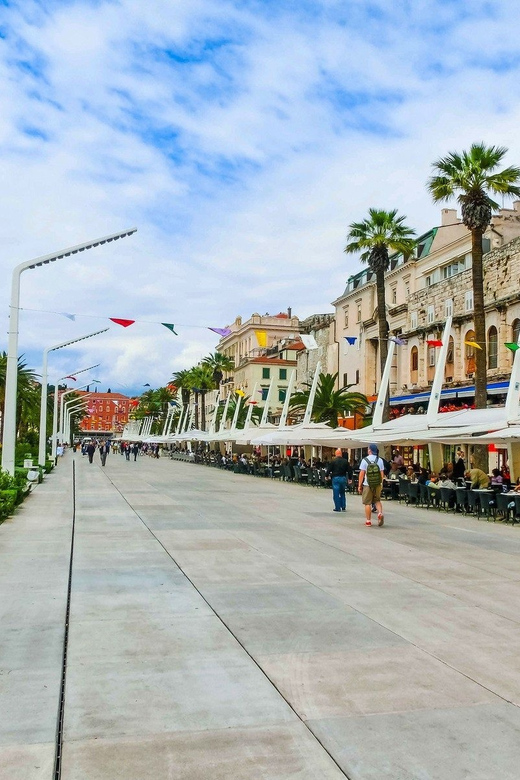
Your tour begins at the Gray Line office at Obala Hrvatskog Narodnog Preporoda 21. This address sits along Split’s waterfront promenade, a sensible place to meet before heading into the old center.
The location matters because Split’s historic core can feel confusing at first. Streets inside and around the palace are narrow, stone-paved, and arranged around an ancient plan rather than modern traffic. Meeting outside the old center gives you a clear starting point and lets the guide lead you into the maze.
The tour returns to the same address after 90 minutes. That makes it easy to continue with your own plans afterward. You can stop for lunch, visit a church or museum, or wander back through the palace with a better idea of what you are seeing.
The activity is offered in English with a live guide. Children are welcome, but they must stay with an adult. Pets are not allowed, and minors cannot attend without an accompanying adult.
More Walking Tours in Split
- Split: Old Town and Diocletian Palace Walking Tour
★ 4.9 · 4,727 reviews - Walking Tour of Split and Diocletian’s Palace
★ 5.0 · 2,588 reviews - Krka Waterfalls tour with Trogir Walking tour and Krka panoramic boat cruise
★ 5.0 · 1,659 reviews
Walking through a city built inside a palace
The unusual thing about Split is that Diocletian’s Palace is not simply an isolated monument. The city grew around it and, in many places, inside it.
Emperor Diocletian built the palace around 1,700 years ago. Over time, later residents adapted the Roman structure, added medieval buildings, and turned parts of the complex into ordinary city space. You may pass doorways, shops, stone walls, and occupied buildings while the guide explains how the old imperial residence became the core of modern Split.
That mix is the main reason I would choose a guided walk instead of simply circling the exterior. Without context, the stone streets can look like a jumble of old walls. With a guide, you can begin to separate Roman construction from medieval additions and understand how the palace shaped the city’s growth.
The walk is not presented as a museum visit. It is an outdoor tour through public streets and historic areas. That means you get a sense of how the old center functions today, but you should not expect a long stop inside every monument.
Peristyle, the palace’s grand public court
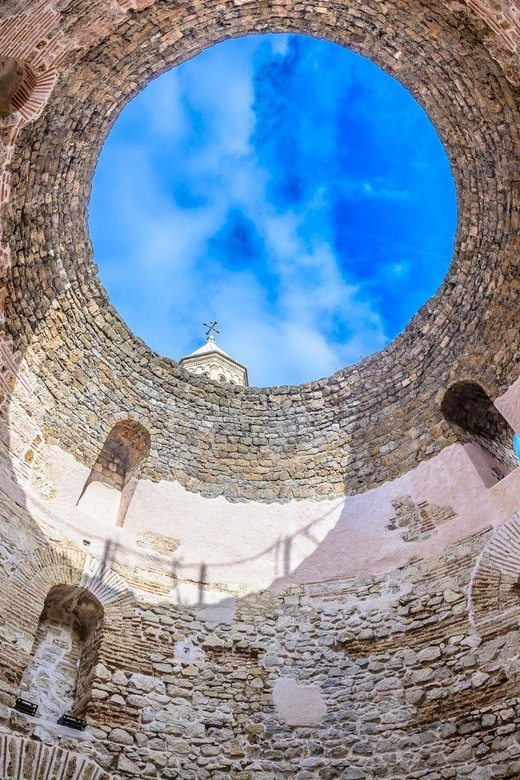
The Peristyle is one of the most important stops on the route. This monumental court once provided access to the emperor’s apartments and mausoleum, giving it a clear role in the palace’s original design.
Here, the guide can help you read the space as Roman architecture rather than just a photogenic square. The scale, stonework, and formal layout reflect the power of the emperor who commissioned the palace. The later layers of Split are also visible, showing how the area changed after the Roman period.
This is likely to be one of the most useful moments for first-time visitors. The Peristyle connects the palace’s political and religious functions in one place, and the guide’s explanation helps you understand why it mattered.
You will not receive entry tickets to churches or museums as part of the tour. If you want to go inside those sites, you can purchase tickets separately, either during your stay or after the walking tour. The guide can point out the relevant locations and explain the arrangements.
Roman remains and medieval additions
The tour focuses on the relationship between the ancient palace and the city that came after it. You will hear how Split developed around the Roman structure and how medieval construction altered the original site.
That long timeline is more useful than a simple list of famous buildings. Split is not only Roman, and it is not only medieval. The charm comes from seeing both periods pressed together in a small area.
As you move through narrow stone streets, the guide explains the age and purpose of different features. The walk can help you notice the contrast between monumental Roman planning and the more irregular medieval buildings that followed.
I would pay close attention to the guide’s explanations about how people still live within the palace walls. That detail changes the way you see the site. You are not walking through a dead archaeological zone. You are moving through a real neighborhood shaped by an ancient building.
The streets can be uneven, and there may be tight passages. For that reason, the activity is not suitable for wheelchair users. Anyone who has difficulty with steps or rough paving should consider this limitation before booking.
Something different for another day:
- Split: Krka Waterfalls Trip with Boat Cruise and Swimming
★ 4.8 · 10,519 reviews - From Split: Krka Waterfalls, Food & Wine Tasting Tour
★ 5.0 · 9,326 reviews - Blue cave, Mamma Mia and Hvar, 5 islands speedboat tour
★ 5.0 · 7,150 reviews - From Split: Krka Waterfalls, Food & Wine Tasting Tour
★ 4.9 · 6,598 reviews
Local customs, food, and everyday culture
The tour promises more than architecture. It also introduces local customs, traditions, and the way Split’s residents use the historic center.
That cultural layer is one of the strongest reasons to book a guide. A map can show you the palace, but it cannot easily explain how the old center fits into local life. A good guide can connect the buildings to the habits, food, and traditions of the people who live in and around them.
Gabrijela received especially strong praise for her English, local knowledge, and practical suggestions about food. Petra was also singled out for being friendly, informative, and willing to answer questions. Those details suggest that the experience can be conversational rather than rigid, although your exact guide and group size will depend on the date.
One earlier departure became a private tour for three people because nobody else had booked. You should not assume that will happen on your date, but it shows that group size can sometimes be small. A smaller group usually makes it easier to ask questions and hear the guide in narrow streets.
The clearest praise for the guides centers on their ability to explain the city in an engaging way. That is important here, because the palace rewards interpretation. You will get more from the walk if you ask about local food, customs, and what to see after the tour.
What the 90-minute itinerary feels like
The route starts at the waterfront meeting point and heads into central Split. The first part helps you move from the modern promenade into the historic center, where the palace and later city buildings overlap.
The middle of the tour is devoted to the palace and its main features. Expect explanations of the 1,700-year history, the Roman emperor who built the complex, and the later medieval growth that took place around it.
The Peristyle provides a major focal point. The guide explains its role as the entrance area for the imperial apartments and mausoleum, while also placing it within the wider story of Split.
The rest of the walk leads through narrow stone streets and past ancient monuments and medieval buildings. The exact order of stops may vary, but the purpose remains the same: help you understand how one Roman palace became the center of a living Croatian city.
The group then returns to Obala Hrvatskog Narodnog Preporoda 21. Since the tour lasts only 1.5 hours, it works well near the beginning of a stay. You can use what you learn to plan later visits instead of spending your first day trying to decode the old center alone.
Is $29 a fair price?
At $29 per person, the value depends on how much context you want. The price includes a 90-minute walking tour, an English-speaking guide, and all taxes and VAT. It does not include admission to churches or museums.
For a short introduction to one of Europe’s most unusual historic centers, I consider the price reasonable. You are paying for orientation and interpretation, not simply access to a monument. Diocletian’s Palace is free to walk through in many areas, but understanding the Roman plan, the medieval changes, and the modern homes inside the walls can make the visit far more rewarding.
The value is strongest if you are visiting Split for the first time, have limited time, or prefer asking questions as you walk. It is also useful if you plan to return to specific churches or museums afterward, since the guide can explain where to buy tickets and what you can see at your own pace.
The value is weaker if you want a self-guided walk and already know Roman and medieval architecture. You will still see the same streets, but much of the benefit comes from the guide’s explanations. Remember to budget separately for any paid interiors you decide to visit.
Who should take this Split walking tour?
I would recommend this tour to first-time visitors who want a clear introduction without committing to a long excursion. Ninety minutes is long enough to cover the essential story but short enough to leave room for lunch, shopping, a museum, or independent wandering.
It also suits cruise passengers and short-stay visitors. The start and finish point are the same, and the compact format gives you a practical way to see the center while keeping the rest of your day open.
Families can join, provided children remain with an adult. The stone streets and pace may be tiring for very young children, but the brief duration is more manageable than a longer city tour.
History fans should find plenty to appreciate, especially around the Peristyle and the palace’s Roman remains. Culture-focused visitors will also benefit from the discussion of local traditions and food.
I would be cautious if you need step-free access. The tour is not wheelchair accessible, and the narrow stone streets may be difficult for anyone who has trouble with uneven surfaces.
Practical advice for getting more from the walk
Book the tour near the start of your time in Split if possible. The guide’s explanation of the palace can give structure to everything you see later, including the parts you explore independently.
Bring comfortable shoes. This is a walking tour through narrow stone streets, not a smooth promenade stroll. The route is only 90 minutes, but uneven historic paving can still be hard on your feet.
Keep questions ready. Petra and Gabrijela were praised for handling questions easily, and the experience appears to benefit from conversation. Ask about local food, customs, later museum visits, or the parts of the palace where people still live.
Do not expect every interior to be included. Churches and museums require separate tickets. If you want to enter them, use the guide’s directions and visit after the tour, when you can take your time.
Finally, leave some unscheduled time after the walk. The guide returns you to the waterfront meeting point, but the real benefit is that you can now explore the palace with a basic map in your head.
Should you book it?
Book this tour if you want a short, friendly introduction to Split that combines Roman history with present-day local life. The strongest reasons are the central setting, the useful explanation of Diocletian’s Palace, and the chance to ask a local English-speaking guide about culture and food.
The 4.9 rating from 10 reviews reflects especially strong praise for guides such as Petra and Gabrijela, who were described as friendly, clear, and generous with local information. The tour is not the right choice for wheelchair users, and you should allow extra money for church and museum tickets.
For $29, I think it is a sensible first step into Split, particularly if you have never visited the palace before. Take the walk early, listen closely at the Peristyle, then return on your own to explore the interiors that interest you most.
FAQ
Where does the Split walking tour begin?
Meet at the Gray Line office at Obala Hrvatskog Narodnog Preporoda 21 in Split.
How long does the tour last?
The guided walking tour lasts 90 minutes, or 1.5 hours.
What language is the tour offered in?
The tour is conducted in English by a live English-speaking guide.
Is admission to churches and museums included?
No. Entrance fees are not included. The guide can help explain where to purchase tickets, and you can visit the sites afterward at your own pace.
Is the tour wheelchair accessible?
No. The tour is not suitable for wheelchair users.
Can children join the tour?
Yes, but children must be accompanied by an adult. Unaccompanied minors are not allowed.
Can I cancel the booking?
Yes. You can cancel up to 24 hours before the activity for a full refund. You can also reserve now and pay later.
Just added around Split
- Private VIP Blue Lagoon and 3 Islands Tour★ 4.5 · 9 reviews
- Split highlights – Evening walking tour★ 5.0 · 9 reviews
- Private boat transfer Split – Bol★ 5.0 · 9 reviews
- Private Photography Activity in Split★ 5.0 · 9 reviews
- From Split: Trogir & Blue Lagoon Boat Tour with Snorkeling★ 4.6 · 9 reviews
- Bike, Beer & Poljud Stadium Tour★ 5.0 · 9 reviews
- From Hvar: Blue cave group speedboat tour full day★ 5.0 · 9 reviews
- Split Walking Tour: History, Legends & Tales★ 5.0 · 9 reviews
Walking Tours, compared.




Walking Tour of Split and Diocletian’s Palace
Read our review →


Krka Waterfalls tour with Trogir Walking tour and Krka panoramic boat cruise
Read our review →
City Walls Early Morning or Sunset Walking Tour
Read our review →Browse the lists this tour appears in