
Reviewed · DIOCLETIAN PALACE TOURS
Split Diocletian Palace Highlights – Private walking tour
A Roman palace is still everyday Split. This 90-minute walk brings you through Diocletian’s Palace, where homes, shops, cafés, and ancient stone share the same streets. I like the small group design, with up to six people, and the way the route links famous monuments with ordinary local life.
I also like the guide’s personal touch. Dana earned special praise for filling the walk with history and stories, not just dates. The main tradeoff is that the cathedral and Temple of Jupiter are viewed from outside, so you will not see their interiors or climb any towers on this tour.
In This Review
- Key points to know before booking
- Why Split’s palace works so well as a walking tour
- Starting on the Riva with Split’s modern rhythm
- Inside Diocletian’s Palace, where ancient walls hold modern life
- The southern gate and the well-preserved cellars
- The Peristyle, the palace’s great public stage
- Saint Domnius Cathedral and the change from emperor to saint
- East, west, and north: reading the palace through its gates
- The Triclinium and the emperor’s private side
- The Vestibule and Temple of Jupiter
- Green Market, local food, and the walk back
- Is $137.80 per person good value?
- Who should choose this Split walk?
- My booking recommendation
- FAQ
- How long does the Split Diocletian Palace tour last?
- Where does the tour start?
- Where does the tour end?
- Are entrance fees included?
- How many people can join the tour?
- Can I cancel for a full refund?
Key points to know before booking
- A living Roman palace: Diocletian’s Palace is not a closed museum. People still live and work inside its ancient walls.
- A compact private walk: The route lasts about 1 hour and 30 minutes and is designed for a group of up to six participants.
- Roman history with local context: You will see the palace gates, Peristyle, Vestibule, Triclinium, cellars, and nearby markets.
- Mostly free-access sightseeing: The listed stops have no entrance fee, but the cathedral and Temple of Jupiter are viewed only from outside.
- Useful local advice: Restaurant, bar, and leisure recommendations are included, which can help after the walk.
- Simple cancellation terms: You can receive a full refund if you cancel at least 24 hours before the start time.
Why Split’s palace works so well as a walking tour
Split’s old center is unusual because Diocletian’s Palace is not preserved as a silent archaeological site. It is part Roman remains, part medieval town, and part modern neighborhood. You may pass a stone arch, a laundry line, a small shop, and a café within a few steps.
That mix gives the walk its appeal. You are not only looking at ruins. You are seeing how a large imperial complex was absorbed into the daily life of the city. The guide can explain why a Roman doorway still matters while pointing out what is happening around it now.
The route is also sensible for a short visit. It begins on the Riva, enters the palace through the southern side, moves through its ceremonial center and gates, then returns toward the waterfront. At a steady pace, the 90-minute length gives you an introduction without taking up half your day.
I would think of this as a strong first orientation to Split. It gives you the layout, the major Roman features, and several ideas for what to explore later. It is not designed as a long archaeological study or a ticketed museum visit.
More Walking Tours in Split
- Split: Old Town and Diocletian Palace Walking Tour
★ 4.9 · 4,727 reviews - Walking Tour of Split and Diocletian’s Palace
★ 5.0 · 2,588 reviews - Krka Waterfalls tour with Trogir Walking tour and Krka panoramic boat cruise
★ 5.0 · 1,659 reviews
Starting on the Riva with Split’s modern rhythm
The meeting point is by the model of Split’s historic center at Obala Hrvatskog narodnog preporoda 23. That places you on the Riva, the broad waterfront promenade and one of the easiest places in Split to get your bearings.
The Riva is a social space as much as a scenic one. Locals and visitors sit at cafés, meet friends, and watch the movement along the harbor. The tour allows about 10 minutes here at the start, enough for the guide to introduce the city’s setting before the Roman story begins.
This is a useful opening because the palace was built right beside the water. The waterfront helps you understand that Diocletian was not choosing an isolated inland retreat. His palace was tied to the sea, the nearby Roman province, and the road network leading toward Salona.
The route returns to the Riva at the end. The listed end point is Republic Square, also called Prokurative, so check the exact finishing instructions when you book. Either way, you finish near cafés and central streets rather than being left at a remote site.
Inside Diocletian’s Palace, where ancient walls hold modern life
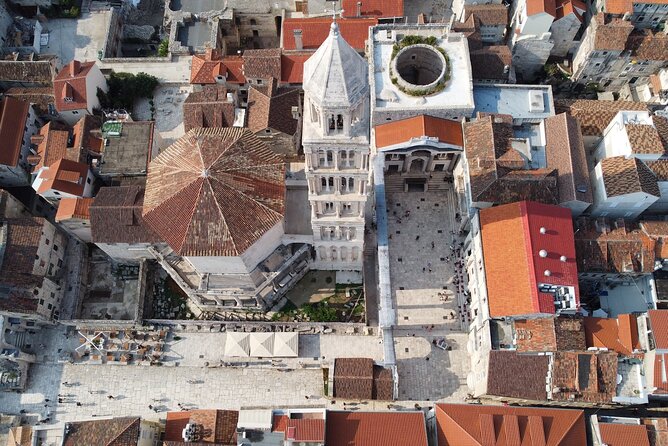
The palace was built more than 1,700 years ago for Emperor Diocletian, who used it as a residence and retirement complex. Its scale becomes easier to grasp once you remember that this was not just a villa. It included ceremonial areas, private rooms, religious buildings, gates, defensive structures, and service spaces.
The palace stop lasts about 15 minutes. That is enough for an overview, but the guide’s explanation matters here because the surviving stonework can seem confusing at first. The old complex has changed over time, and later buildings now occupy spaces that once served Roman purposes.
I like this part of the tour because it corrects a common expectation. You will not walk into a single preserved building with empty rooms and labels on every wall. Instead, the palace forms the framework of the old city. Shops and homes operate inside it, and the history is mixed into the streets.
This also means you should expect some noise and everyday activity. That is not a flaw. It is the reason Split feels like a city rather than a staged ruin.
The southern gate and the well-preserved cellars
Through the south gate, the route reaches Diocletian’s Cellars. The stop is scheduled for about five minutes, but it provides one of the clearest ways to picture the original palace.
The cellars are well preserved because they supported the structures above them. Their arrangement reflects the shape of the emperor’s private and ceremonial rooms on the upper level. As you walk through the lower spaces, you get a better sense of the palace’s size and planning.
The short time here is a limitation if you enjoy Roman architecture and want every detail explained. Still, the cellars make a good visual lesson. Aboveground walls have been altered by later building, while the lower level gives you a stronger impression of the original Roman plan.
The provided tour details describe the cellars as part of the no-fee route. Since the experience does not include paid entrance tickets, ask the guide if access conditions change on your date.
More ways to see Diocletian's Palace:
- Split & Diocletian’s Palace Walking Tour
★ 5.0 · 1,125 reviews - Split: Diocletian Palace & Old Town Guided Walking Tour
★ 4.7 · 882 reviews - Split: Game of Thrones Tour with Diocletian’s Palace Cellar
★ 4.8 · 545 reviews - Diocletian’s Palace and Old Town SMALL GROUP Walking Tour
★ 5.0 · 502 reviews
The Peristyle, the palace’s great public stage
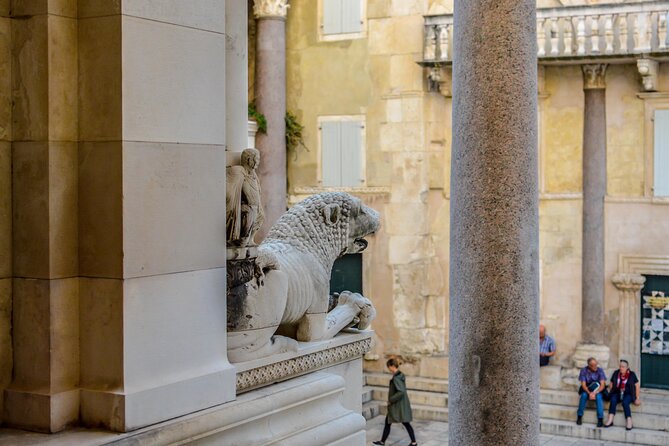
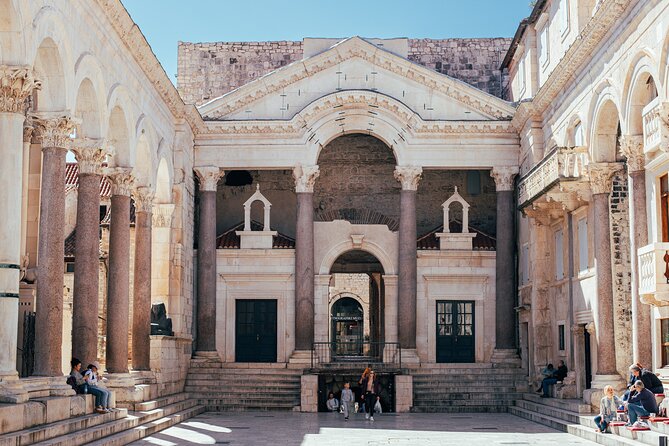
The Peristyle is the dramatic center of the visit. This was the palace’s ceremonial meeting place, where Diocletian presented himself to his subjects and associated himself with Jupiter, the chief Roman god.
You have about 10 minutes here. The space explains the political purpose of Roman architecture better than a list of dates can. The emperor was not simply living comfortably. He was creating a setting that made his authority visible.
Look up and around rather than focusing only on the paving stones. The proportions, columns, and surrounding structures show how the area was meant to guide attention toward the emperor and the sacred buildings. The guide can connect the space to the rest of the palace, including the nearby mausoleum and Temple of Jupiter.
This is likely to be one of the busiest points on the walk. The tour is short enough that you will not have much time to linger alone, but a private or small-group format gives you a better chance to ask questions than a large scheduled group.
Saint Domnius Cathedral and the change from emperor to saint
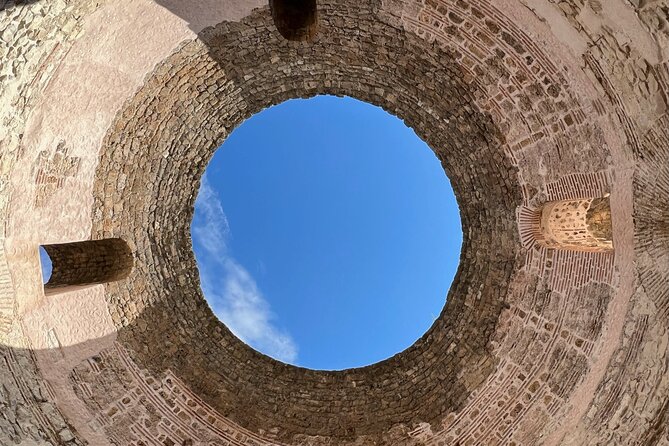
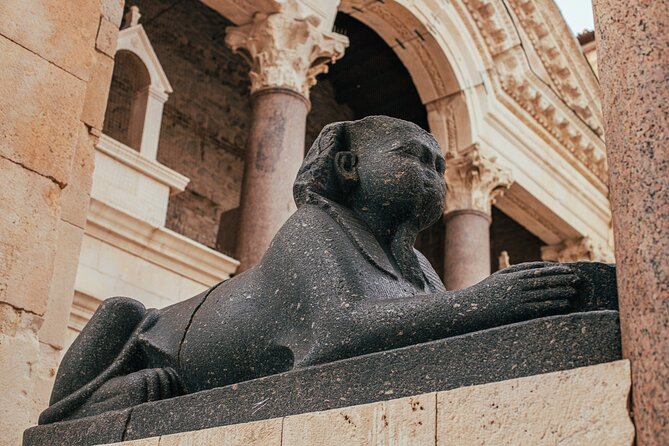
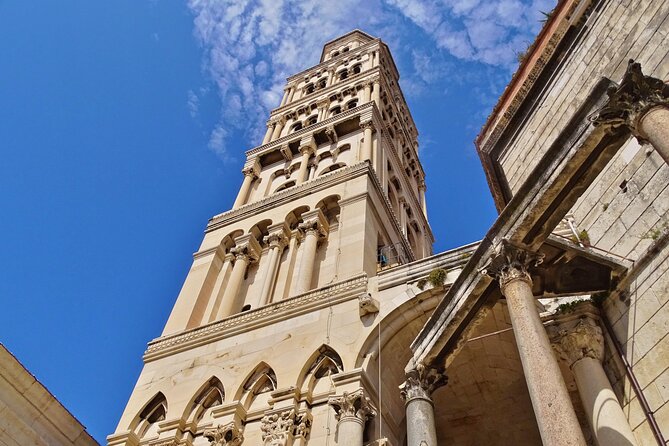
The Cathedral of Saint Domnius occupies what was once Diocletian’s mausoleum. That change tells one of Split’s most striking stories: a building created for the burial of a Roman emperor became a Christian cathedral after the city’s religious life changed.
The tour spends about five minutes here and views the cathedral from outside. No entrance fee is included because there is no interior visit. You will hear how the original coffin and Diocletian’s remains disappeared during the Christianization of the site.
This is an important distinction for planning. If you want to see the cathedral’s interior, treasury, or tower, you will need to arrange that separately. The walking tour gives you the story and the exterior setting, not the paid visit.
I consider the outside stop worthwhile, especially for a first orientation. Just do not book this experience expecting a full cathedral tour.
East, west, and north: reading the palace through its gates
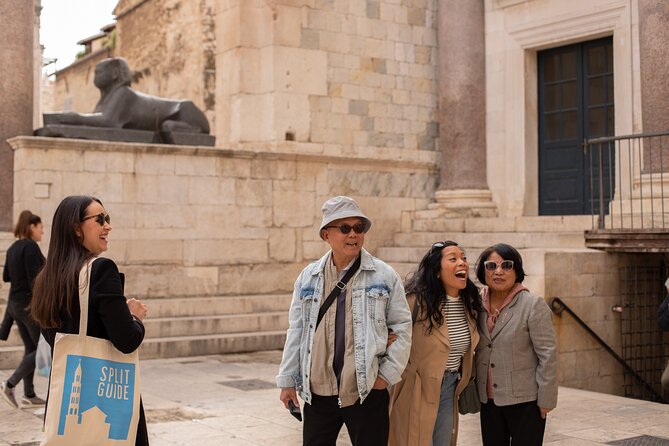
The route uses the gates to show how the palace connected to the wider Roman world and protected its residents. Each gate has a different role in the story.
The eastern gate leads toward the market area. The tour details call this the Silver Gate in its description, although the stop heading uses Iron Gate. It was walled up and reopened in the 1940s, and today it leads toward the market where local products are sold. This is a good example of Split’s old structure being used for present-day errands.
The western Iron Gate is more clearly tied to defense. Like the northern and eastern entrances, it was built as a double gate, known as a propugnaculum. The space between the gates could trap attackers, who might then be struck with stones, arrows, or hot oil. After passing through, you reach Pjaca, a handsome square outside the palace.
The Golden Gate on the north was the most important entrance in Roman times. The road from here led toward Salona, the capital of the Roman province. That detail gives the gate more meaning than its name alone. It was not simply a grand doorway. It connected the palace to the administrative center of the surrounding territory.
Each gate receives about five minutes. That is enough to understand its purpose, but not enough for a long stop at every architectural detail. The value comes from seeing the gates in sequence.
The Triclinium and the emperor’s private side
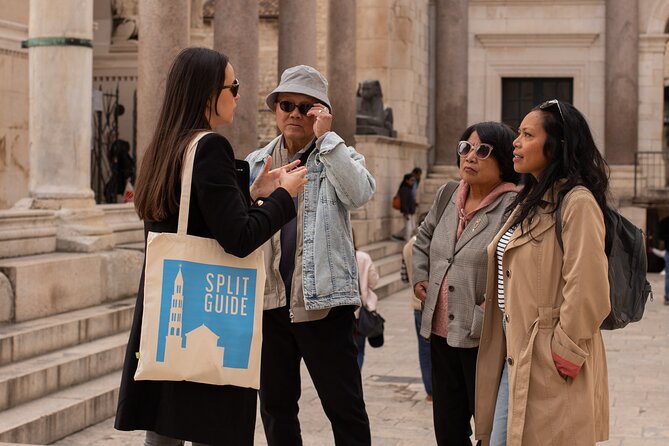
The Triclinium was a dining room where Diocletian entertained guests. The tour allows about 10 minutes here, making it one of the longer stops.
The name comes from the Latin word for dining room. Meals could include local wine, fish, honey, and as many as 20 courses in one evening. That information gives you a glimpse of imperial dining customs without turning the walk into a lecture about menus.
I like this stop because it shifts the focus from power and defense to routine and pleasure. The palace was a political setting, but it was also a home. Food, hospitality, and private ceremony were central to life inside it.
You should keep the scale in mind. The current remains do not recreate an imperial dinner, and the tour does not include a meal. Instead, the Triclinium helps you imagine how the private parts of the complex worked.
The Vestibule and Temple of Jupiter
The Vestibule was the entrance area to Diocletian’s private chambers. The stop lasts about five minutes and helps connect the public Peristyle with the emperor’s more private world.
The route then reaches the Temple of Jupiter, now used as a baptistery. As with the cathedral, the temple is viewed from outside and there is no interior entrance included. That makes this another stop where the guide’s explanation carries much of the value.
The change from a Roman temple to a Christian baptistery reflects the city’s long religious transition. You see the same pattern elsewhere in the palace, where Roman imperial spaces were adapted rather than simply abandoned.
These stops are brief, so I would note any questions you want to ask before the guide moves on. The experience is designed to show the relationship between sites, not to provide a long examination of each one.
Green Market, local food, and the walk back
Near the eastern side of the palace, the Green Market sells fresh fruit, vegetables, and traditional foods. The scheduled stop is about five minutes, but it adds a useful present-day contrast to the Roman monuments.
This is one of the more authentic touches in the route. You see where local shopping happens, rather than spending the entire walk among formal attractions. The market also makes the palace’s location feel practical. Ancient walls sit beside places where people buy food for the day.
The tour then follows the palace walls back toward the Riva. The route ends around Republic Square, or Prokurative, according to the stated end point. The included recommendations for restaurants, bars, and leisure activities are especially useful here, since you can ask the guide where to continue after the walk.
Is $137.80 per person good value?
At $137.80 per person, this is not a budget introduction to Split. The price makes the most sense if you value a private format, personal questions, and advice shaped around your interests.
You are paying for about 90 minutes of guiding rather than for entrance tickets. Since the cathedral and Temple of Jupiter are viewed from outside, and the listed sights carry no entrance fees, the cost is mainly for the guide’s time and the small-group setting.
For two people or a small family, that can be reasonable if you want a focused start to your stay. A group of up to six also spreads the cost across a manageable private party. If you are traveling alone, the price is harder to justify unless personal guiding is a high priority.
The strongest value comes from the route’s context. A map can show you the palace gates, but a guide can explain why the Golden Gate points toward Salona, how the cellars reveal the palace plan, and why a mausoleum became a cathedral.
Who should choose this Split walk?
I would recommend it to first-time visitors who want the old center explained in a clear, compact format. It also suits people who prefer questions and conversation over a large group following a flag.
It is a good fit if you want:
- A short introduction before exploring Split on your own
- Roman history linked to modern city life
- A small group, with the experience designed for up to six people
- Restaurant, bar, and activity suggestions after the walk
- A route that covers the palace’s major public and defensive points
I would look elsewhere if you specifically want interior visits, entrance tickets, the cathedral tower, or a long specialist lecture. This is an exterior-focused walking tour, not a full archaeological program.
The route can be adapted to special needs if you inform the provider in advance. Service animals are allowed, public transportation is nearby, and most people can participate. Since the walk depends on good weather, poor conditions may lead to a new date or a full refund.
My booking recommendation
I would book this tour if you have limited time in Split and want the palace to make sense quickly. Dana’s praised storytelling is a real plus, and the combination of Roman monuments, market streets, and waterfront life gives you more than a simple list of photo stops.
The main question is value. At $137.80 per person, you should want a personal guide and local suggestions, not just access to the sights. If that suits your travel style, this is a well-focused introduction with a strong five-star record, 35 ratings, and a listed recommendation from 100 percent of customers.
FAQ
How long does the Split Diocletian Palace tour last?
The walking tour lasts approximately 1 hour and 30 minutes.
Where does the tour start?
It starts at the model of Split’s historical core on Obala Hrvatskog narodnog preporoda 23, 21000 Split, Croatia.
Where does the tour end?
The stated end point is Republic Square, also known as Prokurative, in Split.
Are entrance fees included?
There are no entrance fees included because the sights are visited from the outside. The cathedral and Temple of Jupiter are specifically exterior visits.
How many people can join the tour?
The experience is designed for a group of up to six participants. Additional booking information lists a maximum of 10 travelers.
Can I cancel for a full refund?
Yes. You can cancel at least 24 hours before the experience start time for a full refund. If poor weather causes the provider to cancel, you will be offered another date or a full refund.
Just added around Split
- Private VIP Blue Lagoon and 3 Islands Tour★ 4.5 · 9 reviews
- Split highlights – Evening walking tour★ 5.0 · 9 reviews
- Private boat transfer Split – Bol★ 5.0 · 9 reviews
- From Split: Trogir & Blue Lagoon Boat Tour with Snorkeling★ 4.6 · 9 reviews
- Private Photography Activity in Split★ 5.0 · 9 reviews
- Bike, Beer & Poljud Stadium Tour★ 5.0 · 9 reviews
- From Hvar: Blue cave group speedboat tour full day★ 5.0 · 9 reviews
- Split Walking Tour: History, Legends & Tales★ 5.0 · 9 reviews
Diocletian Palace Tours, compared.


Walking Tour of Split and Diocletian’s Palace
Read our review →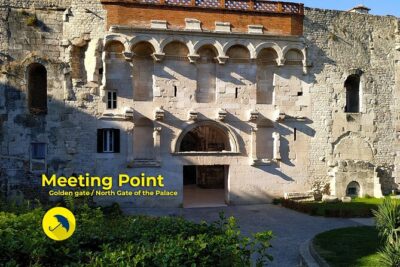

Diocletian Palace & Old Town Guided Walking Tour
Read our review →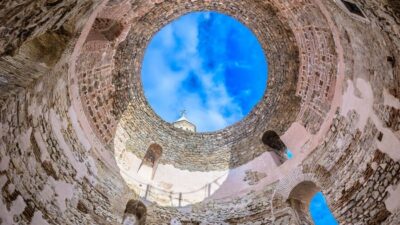
Game of Thrones Tour with Diocletian’s Palace Cellar
Read our review →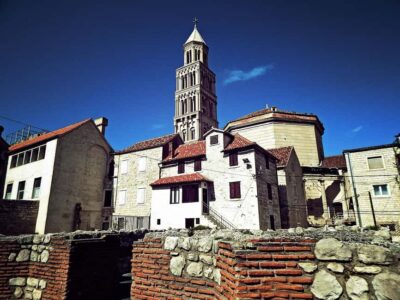
Diocletian’s Palace and Old Town SMALL GROUP Walking Tour
Read our review →
PRIVATE Walking Tour of Diocletian’s Palace & Old Town
Read our review →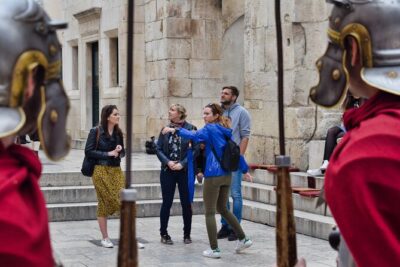
Browse the lists this tour appears in