
Reviewed · WALKING TOURS
Private Split Walking tour with a Photo session
Split rewards slow looking.
This private tour combines Diocletian’s Palace with a professional photo session, giving you both local context and a useful record of your time in the city. I like the easy Riva meeting point, and I like that your guide can adjust the pace for your own group. The main concern is the $300.73 per-person price, which is high for a 2.5-hour walk unless the private attention and photographs matter to you.
The route covers Split’s biggest sights without taking your whole day. You see the old center, hear stories about Roman and medieval Split, and still have the afternoon free for lunch, a museum, or the beach. Just confirm exactly what the photo package includes and whether cathedral admission is covered, since the supplied details are inconsistent on that point.
In This Review
- Key points to know before booking
- What you are paying for at $300.73 per person
- Starting on Split’s Riva promenade
- Reading Diocletian’s Palace as a Roman home and fortress
- Hearing the Vestibule sing
- Entering the Cathedral of Saint Domnius
- Rubbing Gregory of Nin’s toe
- People’s Square and the city beyond the palace
- Fruit’s Square, Venetian defenses, and Marko Marulić
- Prokurative and the Venetian-style finish
- The guide and photo session
- Who should book this Split experience?
- Should you book it?
- FAQ
- Where does the tour begin?
- Where does the tour end?
- How long does the tour last?
- Is the tour private?
- What language is offered?
- Is a photographer included?
- What is the cancellation policy?
Key points to know before booking
- A private walk through the heart of Split: Only your group participates, so the guide can adjust the pace and focus.
- A professional photographer joins the experience: Ivan Gudić is named as the lifestyle photographer.
- The meeting point is easy to find: The tour begins at the start of the Riva promenade, near a bronze model of Split.
- You see the Roman core and later city life: The route includes Diocletian’s Palace, the cathedral, People’s Square, Fruit’s Square, and Prokurative.
- The walk lasts about 2 hours 30 minutes: That leaves most of the day open for other plans.
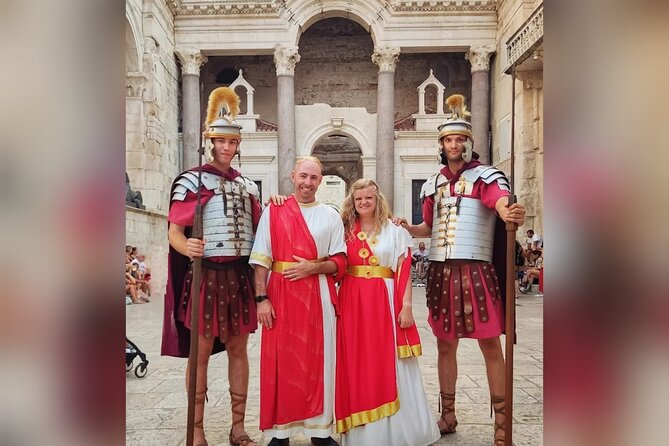
- Roman costumes may be part of the fun: One account describes Jelena offering a Roman-costume photo session as a surprise, though you should confirm whether this is included on your date.
What you are paying for at $300.73 per person
At this price, you are not simply buying a standard city walk. You are paying for a private guide, a lifestyle photographer, and the freedom to keep the tour centered on your group rather than a fixed crowd.
That can be good value for a couple, family, or small group that wants polished holiday photographs and a relaxed introduction to Split. A private guide can stop when you want, explain details that interest you, and avoid spending time on subjects that do not. The tour also ends after roughly two and a half hours, so it does not swallow your day.
Still, the cost deserves a clear-eyed look. The listed sights are mostly public spaces and exterior areas with no admission charge. The value comes from personal service and photography, not from expensive entry tickets. If your main goal is simply to learn about Split, a regular group walk is likely to cost less. If you also want someone to take carefully considered photographs while you explore, the calculation changes.
Before paying, ask how many finished photographs you receive, how they are delivered, and how long delivery takes. Those details are not supplied here. Also confirm whether Ivan Gudić will personally photograph your group, and whether the Roman-costume images are part of the standard service or an occasional extra.
More Walking Tours in Split
- Split: Old Town and Diocletian Palace Walking Tour
★ 4.9 · 4,727 reviews - Walking Tour of Split and Diocletian’s Palace
★ 5.0 · 2,588 reviews - Krka Waterfalls tour with Trogir Walking tour and Krka panoramic boat cruise
★ 5.0 · 1,659 reviews
Starting on Split’s Riva promenade
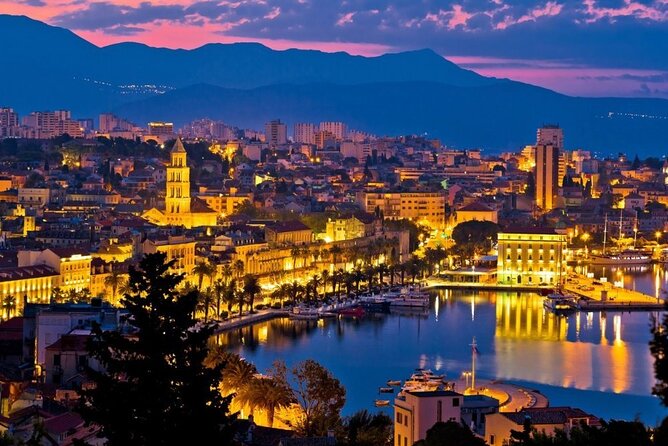
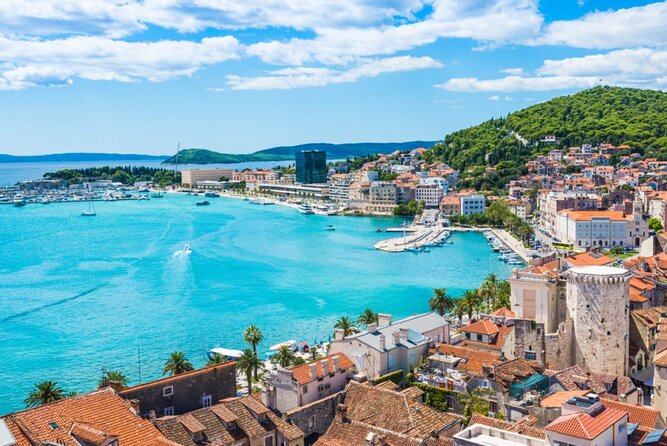
The tour starts on the Riva, Split’s broad waterfront promenade. The meeting point is at Obala Hrvatskog narodnog preporoda, near a bronze model of the city. This is a sensible place to begin because the Riva is easy to locate, close to public transportation, and central to the old town.
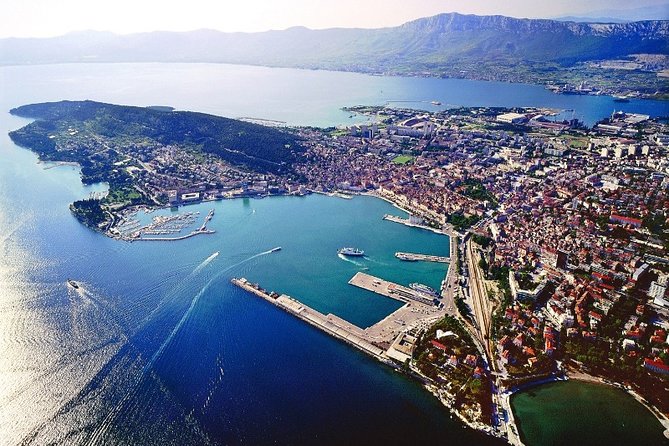
The Riva is more than a pretty strip beside the water. It is a social room for local life, lined with coffee shops and restaurants and used for concerts, festivals, holiday celebrations, and city events. The promenade is about 250 meters long and 55 meters wide, so you get an immediate sense of Split’s connection to the harbor.
Allow a little extra time to find the bronze model and gather your group. The stated meeting point is clear, but a busy waterfront can still be confusing, especially when cruise passengers are arriving. The walk begins with about 10 minutes here, enough for orientation and an explanation of why the Riva matters to people who live in Split.
For photography, the waterfront gives your session a natural opening. You are not starting in a cramped alley or inside a crowded monument. The sea, promenade, and historic center provide a simple backdrop while you get comfortable with the photographer.
Reading Diocletian’s Palace as a Roman home and fortress
From the Riva, you move to the Diocletian’s Palace area, the tour’s central subject. The palace is one of the best-preserved Roman architectural monuments in the world, but it is not a silent ruin set apart from modern life. Much of Split’s old center developed inside and around it.
The original complex mixed a luxury retirement residence with a military camp. Its rectangular plan measured roughly 215 by 180 meters, with four large corner towers, smaller towers along the walls, and four main gates. Two principal streets divided the palace into four sections.
Your guide can explain the basic Roman layout as you walk through it. The southern section held the emperor’s apartments and ceremonial rooms. The northern section served soldiers, servants, storage, and other practical needs. This division helps you picture the palace as a working imperial compound rather than a single grand hall.
The scheduled visit lasts about 30 minutes. That is enough for an introduction, though not enough to inspect every corner or every surviving wall. The private format helps here because you can ask questions as the structure reveals itself. If you are especially interested in Roman construction or archaeology, tell the guide early so the explanation can lean in that direction.
The palace is also where the tour’s photo element has the most potential. Stone walls, arches, and narrow passages offer varied settings, but the historic center can be busy. A private photographer may help you find better angles and avoid photographs that look like quick snapshots.
Hearing the Vestibule sing
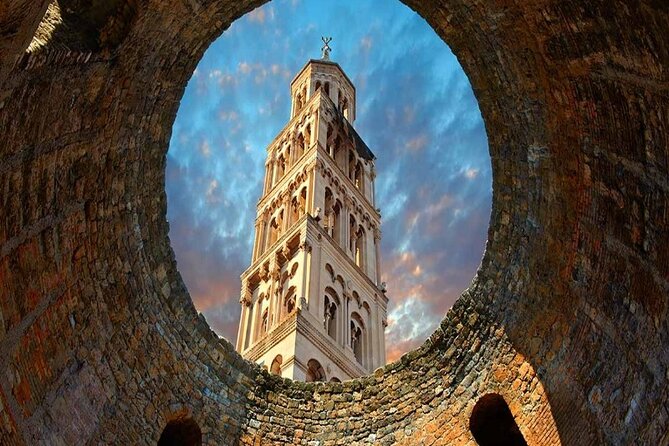
The Vestibule was once the entrance to the residential part of the palace. From the outside it is rectangular, while its interior follows a circular plan. That contrast gives the space a powerful shape, even after centuries of change.
The original interior had semicircular niches, statues, a large domed roof with colorful mosaic, and bright pale walls. The dome no longer appears as it did in the Roman period, but the room’s form remains easy to read.
The Vestibule has also had an ordinary, almost comic afterlife. Not so long ago, people lived there, kept poultry, and cultivated gardens. That detail brings the building down from imperial ceremony to daily neighborhood life.
Today, the room is valued for its acoustics. Groups singing traditional Dalmatian a cappella music sometimes use the space, and the sound can be memorable. You may find the 10-minute stop especially appealing if you like music and local customs, though a performance is not guaranteed by the tour details.
This is a good place to keep your camera ready, but it can be dark and crowded. The photographer’s work matters more here than simply having a phone in your hand. Ask whether the session includes interior photographs, since the available information does not specify the exact shooting locations.
A few more tours and experiences worth a look
- Private rafting on Cetina river with caving & cliff jumping,free photos & videos
★ 5.0 · 66 reviews - Private Vacation Photography Experience in Split, Croatia
★ 5.0 · 47 reviews - Split Private Tour with Professional Photos
★ 5.0 · 16 reviews - Split: Photographer for your holidays!
★ 4.8 · 14 reviews
Entering the Cathedral of Saint Domnius

The Cathedral of Saint Domnius occupies Diocletian’s former mausoleum, making it one of Europe’s most unusual cathedral settings. A Roman emperor who persecuted Christians was later associated with a building used for Christian worship. In the seventh century, the mausoleum became a cathedral, with relics of Saint Domnius and Saint Anastasius given an important place.
The walnut doors, carved by Andrija Buvina of Split, are a major feature. Inside, ancient Roman, medieval Christian, and modern religious traditions share the same structure. The cathedral remains an active place of worship, so respectful behavior and appropriate clothing are sensible.
The stop is listed at about 15 minutes. That is a short visit, but it can work well on a walking tour where the aim is orientation rather than a full religious-art study. The cathedral visit also includes access to the Temple of Jupiter and the Crypt of Saint Lucy, according to the supplied details.
There is a cost issue to clarify before booking. One part of the information says cathedral admission is included, while another says admission to the cathedral, Temple of Jupiter, and Crypt of Saint Lucy costs 25 Croatian kuna, or about 3.50 euros, and is not included. Since Croatia now uses the euro, ask the operator for the current price and confirm whether you will pay separately.
Rubbing Gregory of Nin’s toe

Outside the Golden Gate, one of the four main Roman entrances to the palace, you meet the statue of Gregory of Nin. This medieval bishop argued for the use of the Croatian language in church services instead of Latin, making religious words easier for local people to understand.
The large bronze figure was made by Ivan Meštrović in 1929. Meštrović is one of Croatia’s best-known sculptors, and his work appears in several places around Split.
The statue’s polished big toe comes with a local good-luck custom. Rub it and make a wish. It costs nothing, takes a moment, and gives your photo session a playful stop after the more serious Roman and religious sites.
The Golden Gate area can be crowded, particularly near the statue. If you want a clean photograph, listen to the photographer’s instructions and be patient. The 10-minute timing is brief, so this is more of a quick story and photo opportunity than a long discussion of medieval church politics.
People’s Square and the city beyond the palace
People’s Square, usually called Pjaca by locals, was the first part of Split to develop outside the palace walls. It is first recorded in the 13th century as Saint Lawrence’s Square and later became a center of civic life.
The old town hall, now used as an exhibition center, faces the square. Noble families once lived in the surrounding palaces, including the Cambi, Pavlović, Nakić, Ciprianis, and Karepić families. Today, bars, restaurants, and shops fill the same urban setting.
I like this stop because it shows how Split changed from an imperial residence into a lived-in medieval and modern city. The palace is not the whole story. Pjaca helps you see the city growing outward and creating its own public spaces.
The visit lasts about 15 minutes. That gives you time to look up at the facades and hear a few local stories, but not to explore the interiors. If you are interested in architecture, ask the guide to point out the oldest visible details.
Fruit’s Square, Venetian defenses, and Marko Marulić

Fruit’s Square, officially Trg Braće Radić, is smaller than People’s Square but packed with visual detail. Its name comes from the market once held there, while the surrounding buildings now house bars, restaurants, and shops.
The octagonal Venetian tower is the clearest reminder of the square’s defensive past. It was built in the 15th century, when the town was much smaller. Across from it, the Milesi family palace has a striking 17th-century Baroque facade.
A statue of Marko Marulić stands nearby. Marulić, a Split citizen, was a 15th-century writer, philosopher, and intellectual often called the father of Croatian literature. The statue was also made by Ivan Meštrović, linking this stop with Gregory of Nin.
The tour allows about 10 minutes here. That is enough to connect the tower, palace, and statue, but you will want to return later if you like the square’s cafes or want more photographs. The private format lets you flag a favorite setting for an extra image, though the exact number of photo stops is not stated.
Prokurative and the Venetian-style finish
The final stop is Prokurative, officially Republic Square, just west of the Riva. Its arcaded buildings recall Venice’s Saint Mark’s Square, reflecting the city’s Italian cultural and political influences in the 19th century.
Mayor Antonio Bajamonti began developing the square in the mid-1800s. The colonnades, window reliefs, and architectural decoration point toward Venetian, ancient, and Renaissance models. Bajamonti also built a theater here, though it was later destroyed by fire.
Prokurative has long served as a setting for cultural events and music festivals. Local bars and restaurants give it a more relaxed role today. The stop takes about 10 minutes and brings you back near the waterfront, where the tour ends at the original meeting point.
That circular route is practical. You are not left in an unfamiliar neighborhood, and you can easily continue to lunch or make your own plans along the Riva. The tour covers plenty of ground, but the stops are close enough to fit into one compact morning or afternoon.
The guide and photo session
The guide is as important as the route. Jelena receives particularly strong praise for being punctual, easy to contact through WhatsApp, clear in English, and helpful with wider suggestions for a stay in Split. If she is assigned to your booking, you can expect a friendly, informal style rather than a stiff lecture.
Her storytelling about Diocletian was especially well received. That matters because the palace can feel confusing when you first arrive. A guide who connects the emperor’s life, the building’s layout, and the city’s later development makes the stones easier to understand.
The supplied information names Ivan Gudić as the private professional lifestyle photographer. The service is offered in English, and the tour is private, so you do not need to pose in front of strangers from a large group.
One account describes a Roman-costume photo surprise offered at the end of the tour. That sounds like a fun way to connect the images with the story of Diocletian, but it should not be treated as guaranteed without confirmation. Ask about clothing, locations, the number of photos, and delivery arrangements before you book.
Who should book this Split experience?
This tour suits you best if you want a personal introduction to Split and care about having photographs taken during the walk. Couples celebrating a trip, families who want everyone in the picture, and small groups who dislike fixed group-tour pacing are the natural audience.
It also works well for a short stay or cruise visit. The meeting point is central, the route lasts about 2.5 hours, and the activity returns to where it began. You can then eat, shop, visit another attraction, or simply sit on the Riva.
It may not suit you if you want a long archaeological tour, extensive cathedral time, or a low-cost way to see the old town. The tour moves through many stops, and the price is difficult to justify if you do not value the private photographer.
The activity is offered in English, has a mobile ticket, and allows service animals. Most people can participate, and public transportation is nearby. Good weather is required, so a poor-weather cancellation may lead to another date or a full refund. Free cancellation is available up to 24 hours before the start time, while later cancellations are not refunded.
Should you book it?
Book this experience if you want Split explained at a comfortable pace and would otherwise struggle to get good photographs of your whole group. The route gives you the city’s essential sequence: harbor, Roman palace, cathedral, medieval gate, public squares, and a return to the Riva.
I would book only after confirming the photo deliverables, the guide’s name, the Roman-costume option, and the cathedral admission charge. At $300.73 per person, this is a special-occasion purchase, not a bargain city walk. For the right group, the private attention and lasting photographs can make the price worthwhile. For everyone else, Split’s compact old center is easy to explore independently.
FAQ
Where does the tour begin?
It begins at Obala Hrvatskog narodnog preporoda in Split, at the start of the Riva promenade near a bronze model of the city.
Where does the tour end?
The activity ends back at the meeting point on the Riva.
How long does the tour last?
The walking tour lasts approximately 2 hours and 30 minutes.
Is the tour private?
Yes. Only your group participates in the private tour.
What language is offered?
The tour is offered in English.
Is a photographer included?
Yes. A private professional lifestyle photographer named Ivan Gudić is included.
What is the cancellation policy?
You can cancel up to 24 hours before the experience for a full refund. Cancellations or changes made less than 24 hours before the start time are not accepted for a refund. If poor weather or an insufficient number of bookings causes the operator to cancel, you are offered another date or a full refund.
Just added around Split
- Private VIP Blue Lagoon and 3 Islands Tour★ 4.5 · 9 reviews
- Split highlights – Evening walking tour★ 5.0 · 9 reviews
- Private boat transfer Split – Bol★ 5.0 · 9 reviews
- From Split: Trogir & Blue Lagoon Boat Tour with Snorkeling★ 4.6 · 9 reviews
- Private Photography Activity in Split★ 5.0 · 9 reviews
- Bike, Beer & Poljud Stadium Tour★ 5.0 · 9 reviews
- From Hvar: Blue cave group speedboat tour full day★ 5.0 · 9 reviews
- Split Walking Tour: History, Legends & Tales★ 5.0 · 9 reviews
Walking Tours, compared.




Walking Tour of Split and Diocletian’s Palace
Read our review →


Krka Waterfalls tour with Trogir Walking tour and Krka panoramic boat cruise
Read our review →
City Walls Early Morning or Sunset Walking Tour
Read our review →Browse the lists this tour appears in