
Reviewed · DIOCLETIAN PALACE TOURS
Chill Private Walking Tour of Diocletian’s Palace
Ancient Split rewards a closer look. This private walk makes Diocletian’s Palace easier to read, with Mili’s clear storytelling and 3D images showing how the Roman complex may have looked 17 centuries ago. I like the relaxed pace and the fact that your group alone takes part. I also like the route from the Silver Gate to the Golden Gate, which gives you a useful sense of the palace as a living part of Split rather than a sealed museum. The main drawback is that several interiors cost extra, so the final price can rise if you want to enter the cathedral, Temple of Jupiter, or museum section of the substructures.
At $107.84 for up to 15 people, this is strongest value for a family or small group. I would book it for a first visit, especially if you have only one day in Split and want more than a quick circuit of old stones. Bring good walking shoes, and consider an evening time in hot weather.
In This Review
- Five things to know before you book
- Why a private walk helps at Diocletian’s Palace
- Beginning at the Peristyle, the palace’s grand center
- Going below ground in the palace substructures
- Seeing a Roman mausoleum become Saint Domnius Cathedral
- The Temple of Jupiter and the art of reuse
- Triklinij, where imperial life becomes easier to picture
- Papalićeva Street and the palace as a lived-in town
- Fruit’s Square and the story beyond Rome
- The Golden Gate and the palace’s defensive side
- Finishing with Grgur Ninski outside the north gate
- What the guide adds to the price
- Timing, tickets, and practical planning
- Who will get the most from this walk
- Should you book the Chill Private Walking Tour?
- FAQ
- Where does the tour start?
- Where does the tour end?
- How long does the tour last?
- Is this a private tour?
- What language is offered?
- Are interior entry fees included?
- Which interior visits are optional?
- Is the tour offered in all weather?
- Can I cancel for a full refund?
- Are service animals allowed?
Five things to know before you book
- The tour follows a full north-south route: You start at the Eastern, or Silver, Gate and finish outside the Golden Gate by the Grgur Ninski statue.
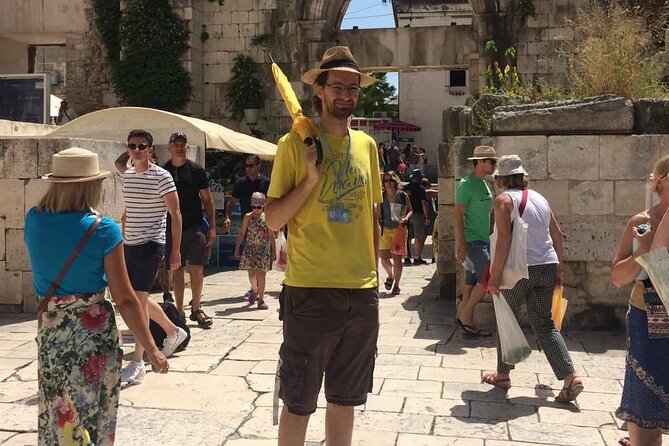
- Mili brings the ruins back to life: His 3D reconstructions help you picture the palace before centuries of change and new construction.
- The group is private: Only your party participates, with room to ask questions and adjust the pace.
- Optional entry tickets keep the base price lower: The free portions cover the main story, while interior visits can add time and cost.
- Expect history with humor: The tour covers Roman power, Christian reuse, Croatian history, and even Game of Thrones connections when useful.
- The route takes about 90 minutes to two hours: Optional interior visits can add roughly 20 minutes at the substructures and 10 minutes at the cathedral.
Why a private walk helps at Diocletian’s Palace
Diocletian’s Palace is not a single building with a neat entrance and exit. It is a large Roman complex folded into modern Split. Homes, cafés, lanes, churches, shops, and stone walls occupy spaces that once served an emperor and his court.
That layering is fascinating, but it can be hard to understand on your own. A column may belong to the Roman period, while the building attached to it is much later. A church may occupy an imperial mausoleum. A narrow lane may follow an ancient route even though its current walls have changed many times.
This tour gives you a guide through that puzzle. Mili’s approach combines dates and architecture with the less polished parts of imperial life, including the good, bad, and rather unpleasant details. His humor helps keep the history from turning into a list of names.
The private format matters. With only your group, you can stop to ask why a Roman structure survived, how it was reused, or what a particular reconstruction is showing. The guide also checks the pace and can respond to the interests of your party. That is especially useful if adults and teenagers want different amounts of detail.
More Walking Tours in Split
- Split: Old Town and Diocletian Palace Walking Tour
★ 4.9 · 4,727 reviews - Walking Tour of Split and Diocletian’s Palace
★ 5.0 · 2,588 reviews - Krka Waterfalls tour with Trogir Walking tour and Krka panoramic boat cruise
★ 5.0 · 1,659 reviews
Beginning at the Peristyle, the palace’s grand center
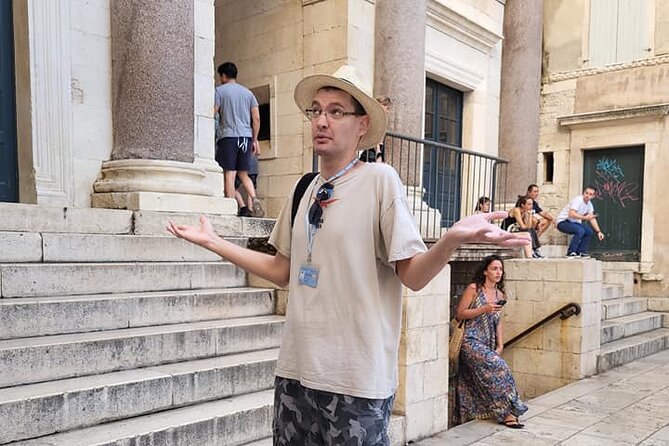
The walk begins at the Peristyle, the open ceremonial heart of the palace. Plan on about 20 minutes here.
This is the right place to begin because it introduces Diocletian, the Roman emperor who built the complex as a retirement residence and fortified palace. The Peristyle helps you see that this was not simply a private villa. It was also a formal setting for imperial power, with architecture designed to impress.
Your guide explains how the palace came together and how its original purpose shaped the layout. The most useful part is learning to connect the visible columns and stonework with the larger plan. Without that framework, the Peristyle can look like a handsome square surrounded by later buildings. With it, you begin to see the Roman design beneath modern Split.
The area is free to view, so there is no extra ticket at this first stop. It can be busy, especially during popular visiting hours, but the private group format gives you a better chance to pause without being tied to a large crowd’s pace.
Going below ground in the palace substructures
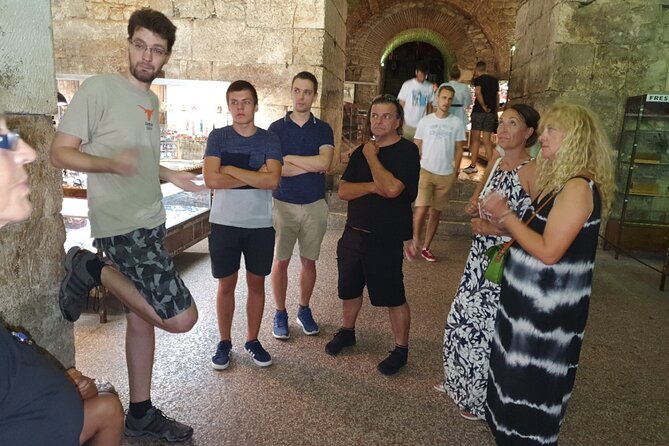
Next comes the free section of the Diocletian Palace substructures, planned for about 10 minutes. These lower rooms reveal how the palace was supported and arranged, and they help explain why some upper-level walls and spaces follow such a clear plan.
This stop is valuable for one simple reason: underground spaces make the palace’s construction easier to understand. You can see the practical side of the complex rather than only its ceremonial face. The guide connects the architecture below with what you have already seen above.
There is also an optional museum section. If you choose to buy that ticket, the visit adds about 20 minutes. I like that the tour does not force everyone to pay for the longer version. If your group wants a quick orientation, the free portion keeps the walk moving. If ancient construction is your main interest, the extra section gives you more time with the remains.
Ask about the optional ticket before the tour begins so your group knows how much time and money to allow. The advertised tour lasts about 90 minutes to two hours, but added interiors can push the visit beyond the shortest estimate.
Seeing a Roman mausoleum become Saint Domnius Cathedral
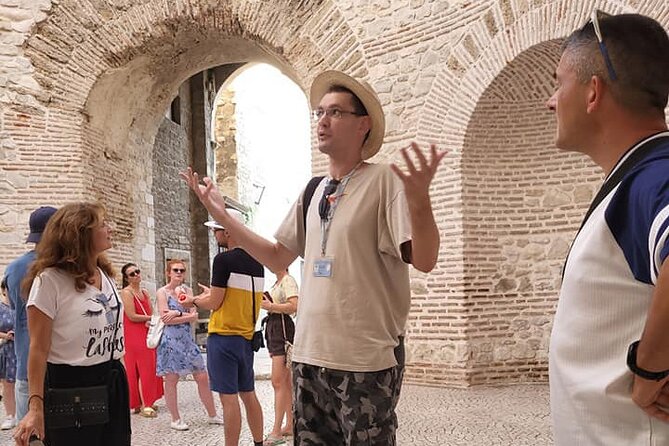
The Cathedral of Saint Domnius gets about 10 minutes in the main route. It began as part of Diocletian’s Palace and is one of the best-preserved Roman structures in the complex.
The key story here is the change in purpose. A building connected with the emperor’s burial became a Christian cathedral. That shift lets you see how Split did not simply preserve Roman ruins as empty monuments. People adapted them, worshiped in them, and built their own lives around them.
A cathedral ticket allows your group to go inside, adding about 10 minutes. Without one, the guide explains the important points from outside. This is another case where the base tour remains practical for a group with mixed interests. Some people may want every interior; others may prefer to spend the time walking through the streets.
The outside explanation still gives the cathedral a strong place in the story. You learn to look for the Roman core rather than treating the building as an isolated church.
More ways to see Diocletian's Palace:
- Split & Diocletian’s Palace Walking Tour
★ 5.0 · 1,125 reviews - Split: Diocletian Palace & Old Town Guided Walking Tour
★ 4.7 · 882 reviews - Split: Game of Thrones Tour with Diocletian’s Palace Cellar
★ 4.8 · 545 reviews - Diocletian’s Palace and Old Town SMALL GROUP Walking Tour
★ 5.0 · 502 reviews
The Temple of Jupiter and the art of reuse
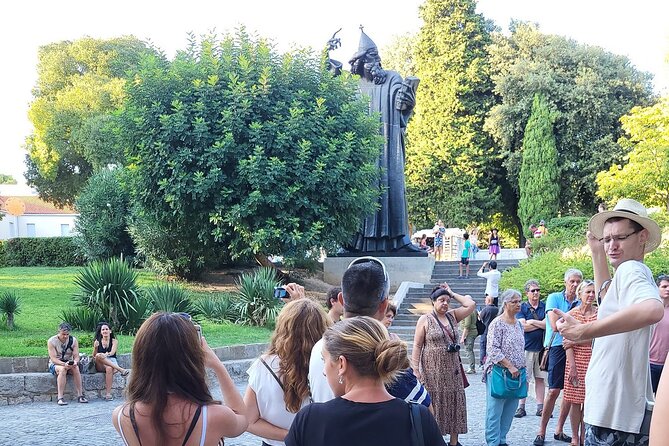
The Temple of Jupiter receives about 10 minutes. It was dedicated to Jupiter, the chief Roman deity, and later became part of the Christian story of the palace.
Its survival is a reminder that later generations often preserved ancient structures by giving them a new role. The church’s reuse of Roman buildings may not have been intended as careful conservation, but it helped keep important stonework intact.
A small interior ticket is optional. If you do not enter, the guide covers the essential information outside. I would decide based on your group’s interests and the day’s heat. The interior is not required to understand the broader point, but it adds another look at how Roman and Christian history overlap in Split.
This is also a good place to listen for the guide’s comparisons between the palace as it appears now and the palace as it may have looked in Roman times. The 3D reconstructions are especially useful because they turn fragments into a clearer picture.
Triklinij, where imperial life becomes easier to picture
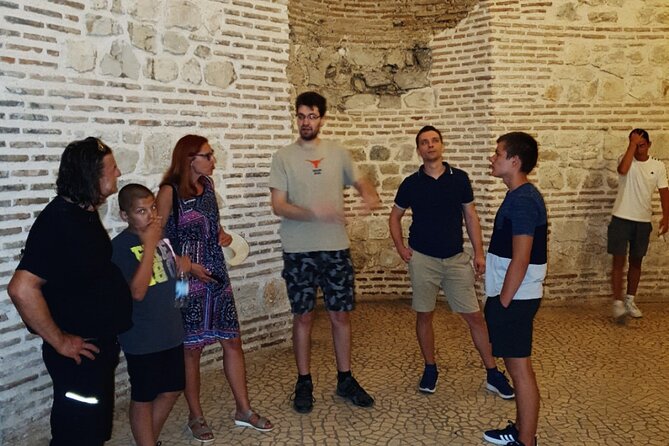
The southeastern corner of the palace suffered major damage, but the construction method allowed part of it to be reconstructed. The stop at Triklinij takes about 15 minutes.
Here, the focus shifts from public ceremony to the way Diocletian may have lived inside the palace. The partial reconstruction gives you a sense of rooms and use, even though the entire corner has not survived.
This is one of the tour’s most helpful transitions. The Peristyle shows imperial display. Triklinij gives you a more domestic impression. Together, the two stops make the palace feel less like a collection of ruins and more like a working residence with formal and private spaces.
The reconstruction should be treated as an informed visual aid, not a perfectly preserved original room. That distinction matters. The guide’s 3D comparisons help you separate what is still Roman from what has been rebuilt or altered.
Papalićeva Street and the palace as a lived-in town
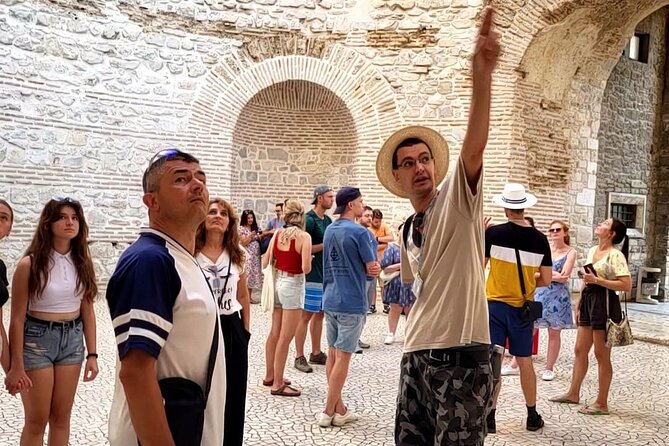
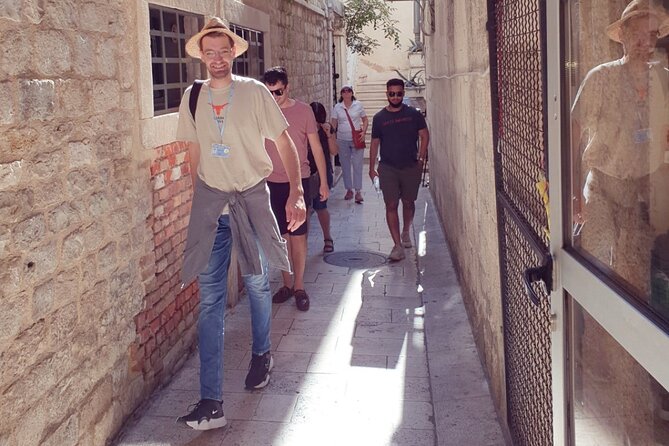
The walk through Papalićeva alleyway takes about 15 minutes. This is not a single grand monument. Its value comes from the small details and the way the route leads you through the northern half of the palace.
You get a better feel for Split here because the palace is still part of everyday city life. The Roman plan has not been kept behind a barrier. Later homes and streets occupy the old structure, and the result is uneven, compact, and full of surprises.
That can also be the challenge. If you want a clean archaeological site with open views and signs at every turn, Diocletian’s Palace may feel confusing. The private guide is most useful precisely because the place is layered and not always obvious.
Mili’s communication before the tour and his willingness to answer questions are practical strengths. You can use this section to ask about a detail that caught your eye earlier, rather than waiting for a formal stop.
Fruit’s Square and the story beyond Rome
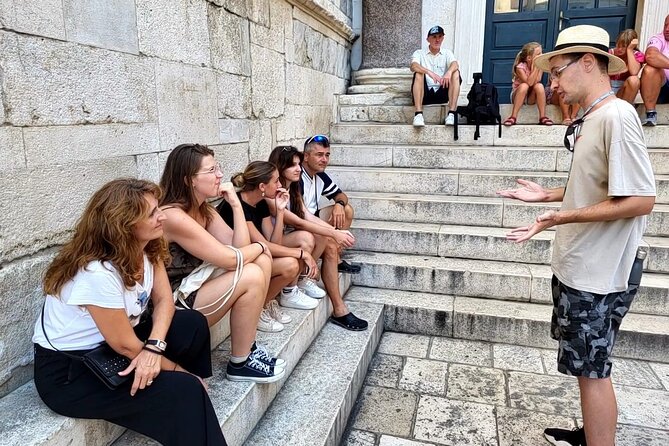
At Fruit’s Square, or Trg Braće Radić, the tour moves outside the palace for about 15 minutes. Here the emphasis broadens to an important period of Croatian history and to the way the palace has been absorbed into later buildings.
This stop prevents the tour from becoming Rome-only. Diocletian’s Palace is central to Split, but Split is not frozen in the fourth century. The surrounding square shows how the old complex continued to shape the town long after Roman rule ended.
I like this part because it helps you read the city as a mixture of periods. Roman walls, later buildings, and modern activity share the same space. The palace survived not because every later generation left it untouched, but because people kept adapting it.
The square also gives the walk a change of scale. After several close looks at individual structures, you can step back and see how the palace works within the city.
The Golden Gate and the palace’s defensive side
The route reaches the Golden Gate near the end, with about 10 minutes devoted to the northern entrance. This is where the palace’s military function gets more attention.
The gate helps explain the fortified character of Diocletian’s residence. Your guide discusses the original defenses and the changes made between Roman construction and the present day. That comparison is important because the gate you see now is not a frozen snapshot of the fourth century.
The northern entrance is also a useful orientation point. By this stage, you have crossed much of the palace, and the route from the Silver Gate to the Golden Gate gives you a clearer sense of its size and structure.
If your party includes Game of Thrones fans, this area may add an extra layer of interest. Mili has related information ready, but the tour does not depend on the show. People who have never watched it still get the Roman and Croatian history.
Finishing with Grgur Ninski outside the north gate
The final 15 minutes take place outside the Golden Gate beside the bronze statue of Grgur Ninski, an important bishop in Croatian history.
This is a useful ending because it brings the story forward from Roman construction into Croatian identity and later history. The guide uses the statue and the northern gate to tie together what you have seen, from the emperor’s palace to the city that grew within it.
Ending outside the gate also gives you a clear landmark for the rest of your day. You are not left inside a maze of lanes wondering where the tour finished. The endpoint is on Dioklecijanova 7, beside the statue.
What the guide adds to the price
The cost is $107.84 per group of up to 15 people, not per person. For one or two people, that is a serious expense. For a family or group of four to 15, the value improves quickly because the price is shared.
You are paying for a private route, an experienced guide, flexibility, and visual material that helps explain missing or altered buildings. The 3D reconstructions are not a small extra. At a site with so many rebuilt sections, they help you picture the original Roman plan.
The guide’s strongest qualities are clear communication, humor, punctuality, and care with the group’s pace. Mili has been praised for explaining difficult layers in a way that works for adults and teenagers alike. He also adjusts when conditions change. During one sudden thunderstorm, he waited for the rain to ease and changed the route to avoid flooding.
That flexibility is worth noting, though weather can still affect the experience. The tour requires good weather. If poor conditions cancel it, you can choose another date or receive a full refund.
Timing, tickets, and practical planning
The listed route takes approximately one hour and 30 minutes to two hours. The stop times add up to about two hours, so think of the schedule as flexible rather than a race from site to site.
The tour starts at the Eastern, or Silver, Gate at Poljana kraljice Jelene 5. It finishes at the Golden Gate, near Grgur Ninski. Since the start and finish differ, plan your next activity around the northern gate rather than returning to the meeting point.
Interior fees are not included. The free route covers the Peristyle, the free section of the substructures, the outside of Saint Domnius Cathedral, the outside of the Temple of Jupiter, Triklinij, Papalićeva Street, Fruit’s Square, the Golden Gate, and the Grgur Ninski statue.
You can add tickets for the museum section of the substructures, the cathedral interior, and the small interior of the Temple of Jupiter. These choices add roughly 30 minutes in total based on the stated timing. Ask about the options at the start so you can make a group decision.
The experience is offered in English and uses a mobile ticket. It is near public transportation, service animals are allowed, and most people can take part. The supplied hours show Monday availability from 8:00 a.m. to 6:00 p.m. between May 1 and October 31, 2026, so confirm your exact start time when booking.
Free cancellation is available up to 24 hours before the start time. Changes or cancellations inside that window are not accepted for a refund.
Who will get the most from this walk
I would choose this tour for a first visit to Split, a family group, or anyone who has only a short time in the city. It is also a good fit if you prefer asking questions instead of listening to a fixed speech.
History fans will appreciate the movement between Roman engineering, imperial life, Christian reuse, and Croatian history. Game of Thrones fans get extra context, but the tour is not built only around the show.
I would be more cautious if you are traveling alone and watching every euro. At $107.84, a self-guided visit costs less, although it will not give you the same private explanations or 3D comparisons.
You should also know that the main route includes walking through old urban spaces rather than a smooth museum circuit. The experience is designed around streets, gates, squares, and surviving structures. Comfortable shoes and a weather check make sense.
Should you book the Chill Private Walking Tour?
Book it if you want Diocletian’s Palace explained as a living city, not just photographed as a Roman monument. The private format, Mili’s approachable style, 3D reconstructions, and full route from Silver Gate to Golden Gate make the price reasonable for a group.
Skip it if you want to explore slowly on your own, do not care for guided history, or are unlikely to share the group price with several people. If you do book, choose an evening on a hot day when possible, decide in advance which optional interiors interest you, and leave room for the tour to run close to two hours.
FAQ
Where does the tour start?
It starts at the Eastern, or Silver, Gate at Poljana kraljice Jelene 5, 21000 Split, Croatia.
Where does the tour end?
It ends outside the Golden Gate at Dioklecijanova 7, near the bronze statue of Grgur Ninski.
How long does the tour last?
The experience lasts approximately one hour and 30 minutes to two hours. Optional interior visits can add extra time.
Is this a private tour?
Yes. Only your group participates, with a maximum of 15 people.
What language is offered?
The tour is offered in English.
Are interior entry fees included?
No. Fees for optional interiors are not included in the tour price.
Which interior visits are optional?
You may buy tickets for the museum section of the substructures, the interior of the Cathedral of Saint Domnius, and the small interior of the Temple of Jupiter.
Is the tour offered in all weather?
The experience requires good weather. If poor weather causes cancellation, you can receive a full refund or select another date.
Can I cancel for a full refund?
Yes. You can cancel at least 24 hours before the start time for a full refund.
Are service animals allowed?
Yes. Service animals are allowed, and the tour is near public transportation.
Just added around Split
- Private VIP Blue Lagoon and 3 Islands Tour★ 4.5 · 9 reviews
- Split highlights – Evening walking tour★ 5.0 · 9 reviews
- Private boat transfer Split – Bol★ 5.0 · 9 reviews
- From Split: Trogir & Blue Lagoon Boat Tour with Snorkeling★ 4.6 · 9 reviews
- Private Photography Activity in Split★ 5.0 · 9 reviews
- Bike, Beer & Poljud Stadium Tour★ 5.0 · 9 reviews
- From Hvar: Blue cave group speedboat tour full day★ 5.0 · 9 reviews
- Split Walking Tour: History, Legends & Tales★ 5.0 · 9 reviews
Diocletian Palace Tours, compared.


Walking Tour of Split and Diocletian’s Palace
Read our review →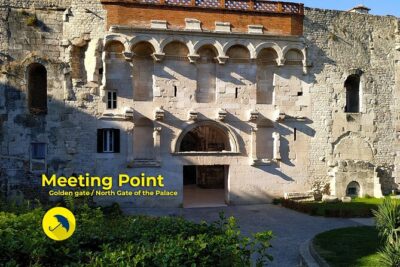

Diocletian Palace & Old Town Guided Walking Tour
Read our review →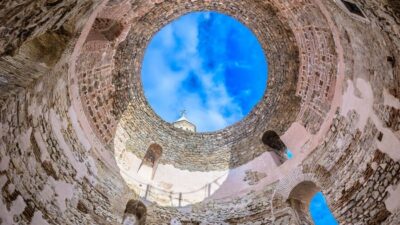
Game of Thrones Tour with Diocletian’s Palace Cellar
Read our review →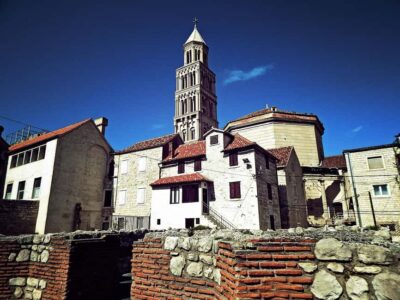
Diocletian’s Palace and Old Town SMALL GROUP Walking Tour
Read our review →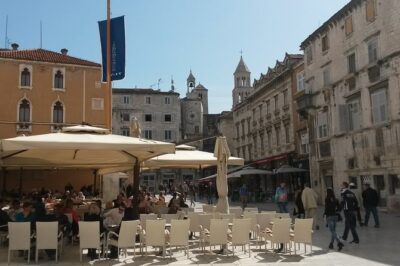
PRIVATE Walking Tour of Diocletian’s Palace & Old Town
Read our review →
Browse the lists this tour appears in