
Reviewed · CABLE CAR RIDES
Zagreb in a day including cable car to Medvednica Nature park
Zagreb gives you city and mountain in one day. This private tour pairs Zagreb’s compact historic center with a ride on the Sljeme cable car into Medvednica Nature Park, an unusual combination that lets you see both urban Croatia and its favorite nearby escape. I like the personal guiding, and I like that private transportation handles the longer stretches between the city center, Mamutica, Mirogoj, and the mountain.
The main drawback is pace. With 6 to 8 hours and a long list of stops, several visits last only five or ten minutes. The price of $300.35 per person also needs careful thought, although it becomes more reasonable when shared by a private group and when you value a flexible guide, hotel pickup, and included cable-car transport.
In This Review
- Key points at a glance
- Zagreb’s heart, from Zrinjevac to Dolac Market
- Medieval streets and Zagreb’s social side
- The funicular, Lotrščak Tower, and Upper Town
- Zagreb beyond the center: theatre, parks, and socialist architecture
- The Sljeme cable car into Medvednica Nature Park
- Guides, transport, timing, and value
- Who should book this Zagreb day tour?
- FAQ
- How long does the tour last?
- Where does the tour start?
- Where does the tour finish?
- Is hotel pickup available?
- Is this a private tour?
- What language is the tour offered in?
- Is transportation included?
- Is the Sljeme cable car included?
- Is food included?
- Is the tour suitable for all weather?
- Is admission to Lotrščak Tower included?
- What level of fitness is required?
- Is the tour refundable if I cancel?
- Final verdict
Key points at a glance
- City and mountain in one outing: See Zagreb’s medieval Upper Town, grand Lower Town squares, and Medvednica Nature Park on the same day.
- Private attention: Only your group takes part, so your guide can adjust the route to your interests and available time.
- A useful mix of walking and driving: Walk the central sights, then use an air-conditioned vehicle for Mirogoj, Mamutica, and the cable-car area.
- The Sljeme cable car is included: The modern ride takes about 20 minutes and leads to the mountain summit area.
- Guides add practical value: Bernarda, Alex, and Aleksandar are praised for adapting the tour, explaining Croatian history, and offering food and sightseeing tips.
- Plan for short visits: The itinerary covers many landmarks, but most central stops are quick looks rather than full museum or church visits.
Zagreb’s heart, from Zrinjevac to Dolac Market
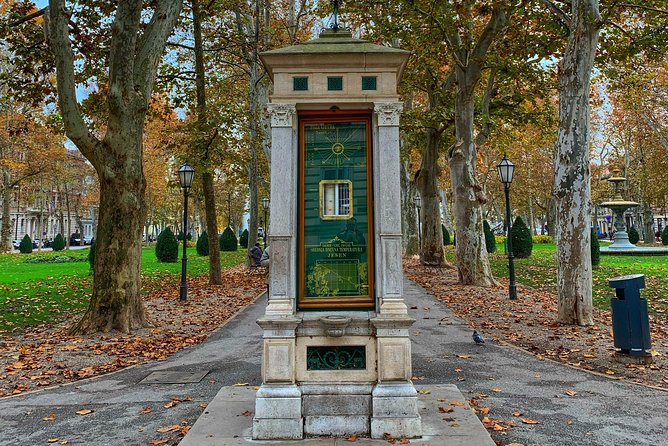
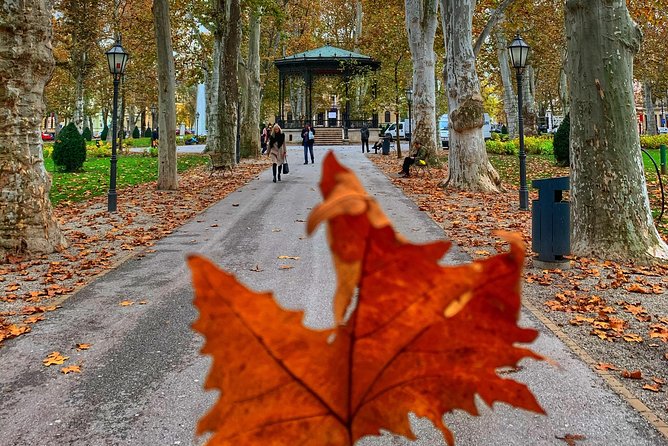
The tour begins at Zrinjevac, officially Nikola Šubić Zrinski Square, one of the prettiest pieces of Zagreb’s Green Horseshoe. This formal park is lined with plane trees, flowerbeds, fountains, and classical buildings. It is a good place to begin because you can get your bearings without fighting steep streets or heavy traffic.
Give your guide a moment here to explain how Zagreb’s Lower Town developed around a chain of parks and public squares. The 1884 meteorological post is a small but worthwhile detail. Its cast-iron column once displayed readings for temperature, air pressure, and humidity, showing how public science was part of city life in the 19th century.
From there, you reach Ban Josip Jelačić Square, Zagreb’s central meeting point. Trams cross the square, cafés line the edges, and the equestrian statue of Ban Josip Jelačić provides an easy reference point. The statue’s changing position and orientation reflect Croatia’s political shifts, including its return to the square in 1990 after being removed during the Yugoslav period.
This is a ten-minute stop, so expect an explanation and a look around rather than a long pause. I would use the time to note the mixture of classicist and Art Nouveau façades, then ask your guide how the square functions in daily city life.
Next comes Kaptol and Zagreb Cathedral. The twin-spired cathedral is one of the city’s defining sights and Croatia’s tallest building. Its story includes medieval beginnings, repeated rebuilding, and major damage from the 1880 earthquake. Inside, you may see Gothic and later additions, altars, stained glass, and the tombs of important Croatian figures, although the short schedule may limit how long you can stay.
Dolac Market is close by and gives the tour a more ordinary, local feel. Known as the belly of Zagreb, it has open-air stalls for fruit, vegetables, flowers, and seasonal produce, with meat, fish, and cheese sellers in the covered section below. The red umbrellas make the market easy to recognize.
A ten-minute stop works best for taking in the colors, smells, and layout. If food matters to you, tell your guide early. The tour does not include food or drinks, but the guide can point out places to eat. Alex is specifically praised for recommending good places for food and drinks during the walk and for suggesting stops elsewhere in Croatia.
More Cable Car Rides:
- Dubrovnik Cable Car Ride, Old Town Walking Tour plus City Walls
★ 4.5 · 685 reviews - Dubrovnik: Cable Car, Walking Tour and City Walls Combo
★ 4.6 · 322 reviews - Explore Dubrovnik by Cable Car (ticket included)
★ 4.5 · 109 reviews
Medieval streets and Zagreb’s social side
The Church of Saint Francis is a quieter pause in the Opatovina area. It belongs to a Franciscan monastery complex and reaches back to the 13th century. Its appearance reflects centuries of repairs, with Gothic and Baroque elements and changes made after the 1880 earthquake.
This is not a grand cathedral visit. Its appeal is the calm interior, religious artwork, stained glass, and modest scale. Five minutes is enough for a quick look and a short explanation, but not for a slow architectural study.
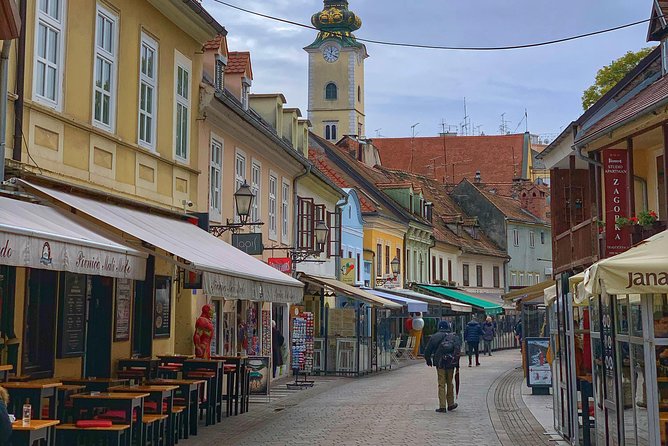
Tkalčićeva Street then changes the mood. Once the course of the Medveščak stream and a dividing line between Kaptol and Gradec, it is now a pedestrian street lined with cafés, bars, shops, murals, and sculptures. It is one of the best places on the route to see how old Zagreb and modern city life meet.
I would not rush this part if you care about atmosphere. The ten-minute scheduled stop is enough to understand the street, but you may want to ask your guide where to return later for coffee or an evening drink.
Nearby Krvavi Most, or Bloody Bridge, carries one of Zagreb’s memorable names. There is no bridge today. The name recalls violent medieval clashes between the rival settlements of Kaptol and Gradec, once separated by a stream. The small street now feels peaceful, but its name offers a neat way to understand Zagreb’s divided beginnings.
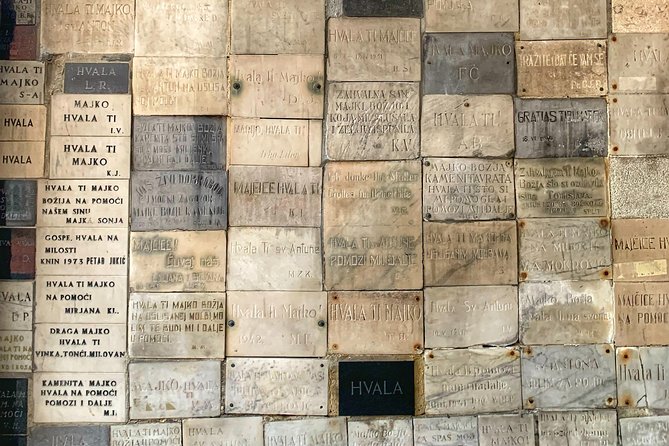
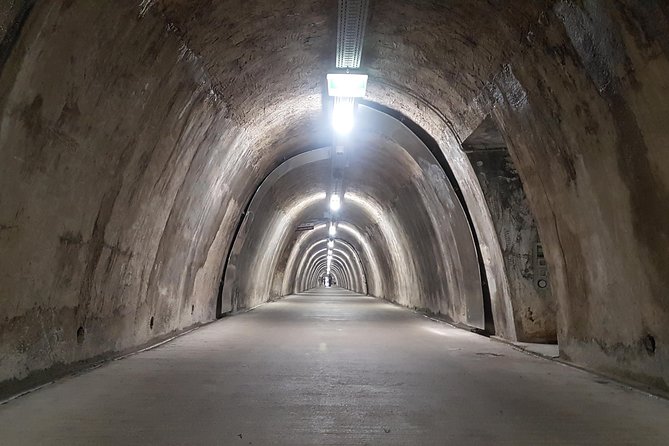
The Grič Tunnel adds a different kind of history. Built in 1943 during World War II, this 350-meter passage served as a bomb shelter and protected route during air raids. It later fell out of regular use before being reopened as a pedestrian passage and venue for exhibitions and art events.
The planned visit is only five minutes, so you will likely walk through a section rather than study every entrance. Still, the cool arched passage and wartime purpose make it more than a simple shortcut.
The funicular, Lotrščak Tower, and Upper Town
The Zagreb Funicular is one of the city’s most charming short rides. Operating since 1890, it travels only 66 meters and takes about a minute, connecting the Lower Town with Gornji Grad. The vintage cars and the steep little track give this otherwise brief journey real character.
The ride is included, which removes one small cost and makes the transfer easy. It is not a scenic mountain railway, so keep your expectations in proportion. Its value lies in the history and the connection between two parts of town.
At the upper station, Lotrščak Tower recalls Zagreb’s medieval defenses. Built in the 13th century near the old southern gate, it protected the settlement and later became associated with the Grič cannon. Since 1877, the cannon has fired at noon as a city time signal.
The tower admission is not included. The schedule allows five minutes, so this tour appears designed for an exterior explanation rather than a full tower visit. If entering Lotrščak is important to you, ask the guide whether there is enough time and confirm the extra admission cost.
The Upper Town, or Gornji Grad, is the central walking portion of the day. Narrow cobbled streets, old façades, political buildings, and medieval corners give it a slower feel than the tram-filled squares below. Gradec and Kaptol were once separate medieval settlements, and their later union helped create modern Zagreb.
You will pass the Old Town Hall on Ćirilometodska Street. Dating from the 15th century, it served as the seat of Zagreb’s city council and local government. Its exterior is more restrained than the cathedral, but that modesty suits the old administrative quarter.
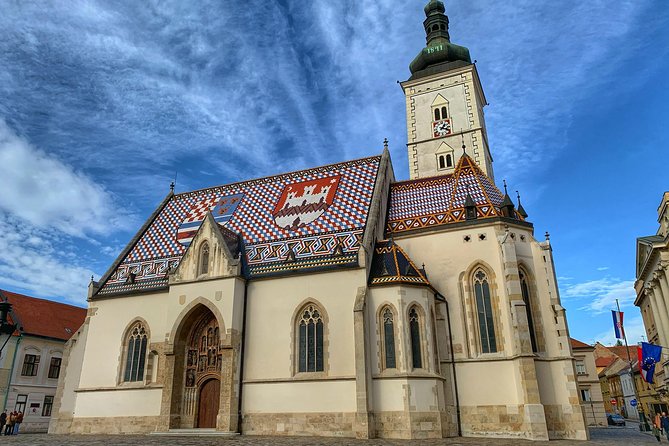
St. Mark’s Square is the visual high point of the Upper Town. St. Mark’s Church is famous for its tiled roof, which displays the coats of arms of Croatia, Dalmatia, Slavonia, and Zagreb. The Croatian Parliament and Banski Dvori, the seat of the government and official residence of the prime minister, surround the square.
This is also a place where your guide’s live commentary matters. A photograph of the roof takes a moment. Understanding why the square remains central to Croatian political life gives the stop more weight.
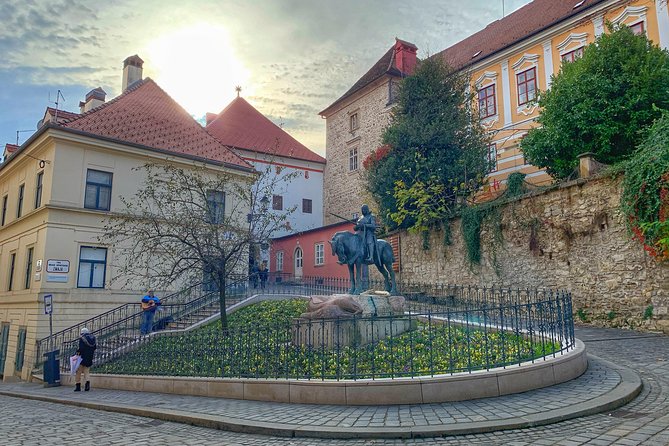
The Stone Gate is smaller but more intimate. It is the last surviving original city gate from Zagreb’s medieval fortifications. A painting of the Virgin Mary and Child survived a fire in 1731, and the passage became a chapel where people light candles and pray.
Radićeva Street connects the Stone Gate with Ban Jelačić Square. Its cobbles, older façades, shops, and restaurants make it a pleasant route downhill. Keep an eye out for courtyards and architectural details, but remember that the listed timing allows only a brief walk through this area.
Zagreb beyond the center: theatre, parks, and socialist architecture
The driving portion broadens the picture. The Croatian National Theatre sits on Republic of Croatia Square in a yellow Neo-Baroque building opened in 1895. Designed by Viennese architects Hermann Helmer and Ferdinand Fellner, it remains a major venue for opera, ballet, and drama.
The square also contains Ivan Meštrović’s Well of Life, along with the Academy of Dramatic Art and the University of Zagreb’s Rectorate. You may not enter the theatre during this tour, but seeing it from outside helps explain Zagreb’s long investment in the arts.
The Art Pavilion and King Tomislav Square continue the city’s cultural and architectural story. The pavilion was built for the 1898 Millennial Exhibition in Budapest, then taken apart and rebuilt in Zagreb. Its yellow façade and glass dome make it one of the city’s recognizable exhibition spaces.
The nearby Main Railway Station, opened in 1892, anchors the southern end of the Green Horseshoe. Designed by Ferenc Pfaff, it connects Zagreb’s park system with the wider European rail network. These stops are best treated as guided city views rather than museum visits.
Mamutica offers a sharp change in scale and style. This huge 1970s residential complex in New Zagreb contains more than 1,100 apartments and stretches for over 240 meters. Its concrete Brutalist design reflects the ambition of Yugoslav-era urban planning.
Mamutica is still a lived-in apartment building, not a preserved monument. That is exactly why it is interesting. Your guide can use it to explain how Zagreb expanded south of the Sava River and how socialist architecture shaped everyday housing.
Mirogoj Cemetery provides the most peaceful stop outside the center. Founded in 1876 and designed by Hermann Bollé, it is known for ivy-covered arcades, domes, sculptures, and carefully maintained paths. It also welcomes people of all faiths, giving the site a broad picture of Zagreb’s religious and cultural life.
I would allow yourself a little quiet here. The arcades and tombs of notable Croatian artists and political figures reward attention, and the cemetery feels more like a park than a conventional burial ground. The private vehicle makes this stop much easier than trying to combine it with the central walking route on your own.
Something different for another day:
- From Zagreb: Plitvice & Rastoke Guided Day Trip with Ticket
★ 4.9 · 2,955 reviews - Zagreb: Rastoke & Plitvice Lakes Guided Tour with Ticket
★ 4.9 · 1,897 reviews - Communism & Croatian Homeland War Tour
★ 5.0 · 1,355 reviews - Best of Zagreb with the WW2 Tunnels
★ 5.0 · 973 reviews
The Sljeme cable car into Medvednica Nature Park
The final major section leaves the city behind. The Sljeme cable car reopened in 2022 after extensive renovation and links Zagreb with the upper areas of Mount Medvednica. The ride takes about 20 minutes, while the scheduled stop is 30 minutes, including time to take in the views and orient yourself.
The cabins are spacious, and the trip offers a gradual change from city streets to wooded mountain country. On a clear day, you can look back toward Zagreb and across the surrounding area. The ride is included in the tour price, an important point when judging the overall value.
At Sljeme, the highest point of Medvednica reaches 1,033 meters. The protected nature park offers forest trails, mountain lodges, educational paths, and seasonal activities such as hiking, mountain biking, and winter skiing. This tour gives you about 30 minutes at the mountain, so expect a short taste rather than a serious hike.
You should wear shoes suitable for walking and bring clothing for changing conditions. The experience operates in all weather, but it can be canceled for poor weather. In that case, you are offered another date or a full refund.
The mountain segment is what separates this tour from a standard Zagreb city walk. It gives you a sense of how quickly the city gives way to open countryside. Still, if your main goal is hiking, the limited time at Sljeme may feel too brief.
Guides, transport, timing, and value
The private format is the strongest practical feature. Only your group participates, and the guide can adjust the route to your interests and time limits. Bernarda is praised for shaping the day around a group’s interests and schedule, while Alex and Aleksandar are praised for explaining Croatian and Zagreb history and offering useful advice for the rest of a stay.
That flexibility matters because the itinerary is ambitious. A guide can spend more time on the Upper Town for history lovers, point out food options near Dolac or Tkalčićeva, or keep the walking portion moving when weather turns bad. Alex also adjusted the timing in response to poor weather, which is useful on a day that combines streets, open squares, and a mountain ride.
The air-conditioned private vehicle handles the less walkable sections. You will not need to arrange separate transport to Mamutica, Mirogoj, or the cable-car area. Hotel pickup is offered, although the stated meeting point is Zrinjevac 2, and the tour ends back at the meeting point or at your designated pickup location.
At $300.35 per person, this is not a budget city tour. The value improves if several people share the private vehicle and guide, or if you have only one full day in Zagreb and want the mountain included. It is less compelling if you prefer slow museum visits, long café breaks, or independent public transport.
Food, drinks, personal expenses, and Lotrščak Tower admission are not included. The funicular and Sljeme cable car are included. Confirmation arrives at booking, and the tour requires a moderate level of physical fitness because you combine walking, cobbles, steps, and time outdoors.
The cancellation terms are strict: the booking is non-refundable and cannot be changed for personal reasons. Weather cancellation is the exception, with a new date or full refund offered if conditions make the tour impossible.
Who should book this Zagreb day tour?
I would choose this tour if you have one day in Zagreb, want a strong overview, and prefer having a guide connect the city’s separate chapters. It suits couples, families, and small groups who value private transport and do not want to organize the cable car, Mirogoj, and the historic center themselves.
It is also a good fit if you want local advice beyond sightseeing. The guides’ useful restaurant, drink, and Croatia-wide suggestions can save time during a short visit.
I would hesitate if you want a relaxed pace. Many stops are brief, and the mountain visit is an introduction rather than a full outdoor outing. For a slower day, ask before booking if the route can be trimmed to fewer sights.
FAQ
How long does the tour last?
The tour lasts approximately 6 to 8 hours.
Where does the tour start?
The stated meeting point is Zrinjevac 2, 10000 Zagreb, Croatia.
Where does the tour finish?
It ends back at the meeting point, or at your designated pickup location if that arrangement is made.
Is hotel pickup available?
Yes. Hotel pickup is offered, adding convenience for a full-day private outing.
Is this a private tour?
Yes. Only your group participates.
What language is the tour offered in?
The tour is offered in English.
Is transportation included?
Yes. The tour includes an air-conditioned vehicle and private transportation for the driving portion.
Is the Sljeme cable car included?
Yes. Cable-car transport to Medvednica is included.
Is food included?
No. Food and drinks are not included, and personal expenses are also separate.
Is the tour suitable for all weather?
It operates in all weather, so you should dress appropriately. If poor weather causes cancellation, you are offered another date or a full refund.
Is admission to Lotrščak Tower included?
No. Admission to Lotrščak Tower is not included.
What level of fitness is required?
A moderate level of physical fitness is recommended. The day includes city walking, cobbled streets, outdoor stops, and time around Medvednica.
Is the tour refundable if I cancel?
No. The experience is non-refundable and cannot be changed for personal reasons. Weather-related cancellation is handled separately.
Final verdict
Book this tour if you want Zagreb’s main historic sights, a look at modern and socialist-era city life, and the Sljeme cable car without managing the transport yourself. The private guide format gives the day its real value, especially when you request a route shaped around your interests.
Skip it if you want to linger at every stop or spend several hours hiking. For a first visit with limited time, though, the combination of Dolac, the Upper Town, Mirogoj, and Medvednica gives you a surprisingly broad picture of Zagreb in one well-filled day.
Just added around Zagreb
- Zagreb: VR 3D Immersive Film Experience – Voucher★ 4.6 · 9 reviews
- Zagreb GRAND Private Walking Tour★ 4.5 · 9 reviews
- Zagreb: Explore with an Art Historian – Private Walking Tour★ 4.9 · 9 reviews
- Croatian cuisine cooking class with Dolac market tour★ 5.0 · 9 reviews
- From Zagreb: Plitvice Lakes & Rastoke Private Tour★ 5.0 · 9 reviews
- Private Guided Tour of Ljubljana and Lake Bled from Zagreb★ 5.0 · 9 reviews
- Picturesque Samobor & Samobor Castle Half-day Tour★ 4.5 · 9 reviews
- Zagreb to Split Private Transfer via Plitvice Lakes National Park★ 5.0 · 9 reviews
Cable Car Rides, compared.
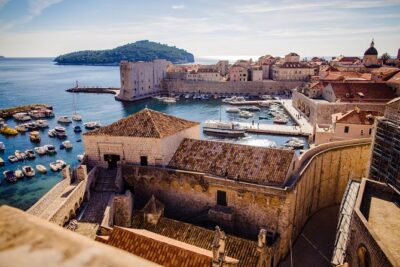
Dubrovnik Cable Car Ride, Old Town Walking Tour plus City Walls
Read our review →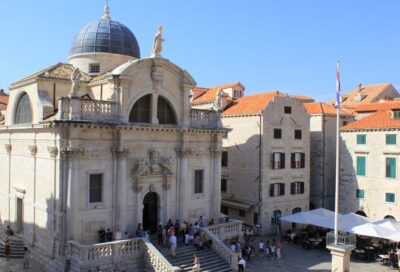
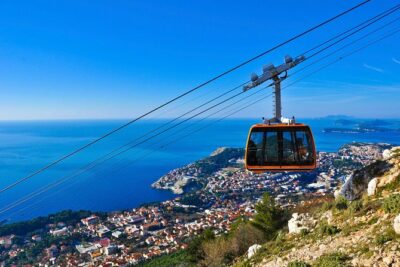
Explore Dubrovnik by Cable Car (ticket included)
Read our review →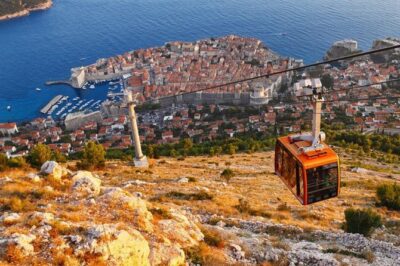
Dubrovnik Shore Excursion: Explore Dubrovnik by Cable Car (ticket included)
Read our review →
Private Dubrovnik panoramic sightseeing tour – cable car view
Read our review →Browse the lists this tour appears in