Reviewed · HALF-DAY
Split and Trogir Half Day Guided tour
Two Dalmatian towns, one well-planned outing. This five to six-hour tour links Split’s Roman palace with Trogir’s medieval streets, giving you a useful taste of the region without arranging transport yourself. I especially like the contrast between Diocletian’s Palace, still woven into modern Split, and compact Trogir, where Venetian-era buildings crowd around a handsome central square. I also like the local guides, including Antonia, Ivana, Ante, Mia, and others, who bring personal stories and Croatian perspective to the route.
The main caution is the pace. You will walk a lot, often over old stone surfaces, and the day can feel hot and crowded in summer. Trogir time may also shrink if the group starts late or must meet a strict return schedule.
In This Review
- Key points at a glance
- Why pairing Split with Trogir works
- Starting beneath Diocletian’s Palace
- The Vestibule, Golden Gate, and Riva Harbor
- Fruit Square and Split’s smaller details
- The short ride to Trogir
- Trogir’s central square and city hall
- Saint Lawrence’s Cathedral and St. Sebastian
- Kula Karmelengo and free time
- Walking, weather, and group pace
- What the $60.49 price really covers
- The guides make or break the day
- Should you book the Split and Trogir tour?
- FAQ
- Where does the tour start?
- Where does the tour end?
- How long does the tour last?
- Is transportation included?
- Are entrance tickets included?
- Can I cancel for a full refund?
Key points at a glance
- Two historic towns in five to six hours: See Split’s palace district and Trogir without booking separate transport.
- The palace is a living city: Homes, cafés, shops, squares, and churches fill the remains of Diocletian’s retirement residence.
- Trogir adds a strong contrast: Its compact island center feels quieter, more medieval, and more Venetian than Split.
- Guides are a major strength: Antonia, Ivana, Ante, Mia, Antoinette, Frane, and Slavico are praised for clear explanations, humor, and local feeling.
- Expect serious walking: The route is mostly level, but the stone paving and long day can tire anyone with limited mobility.
- Good value at $60.49: The price covers a guide, air-conditioned vehicle, both walking tours, and free time in Trogir, but monument tickets and food cost extra.
Why pairing Split with Trogir works
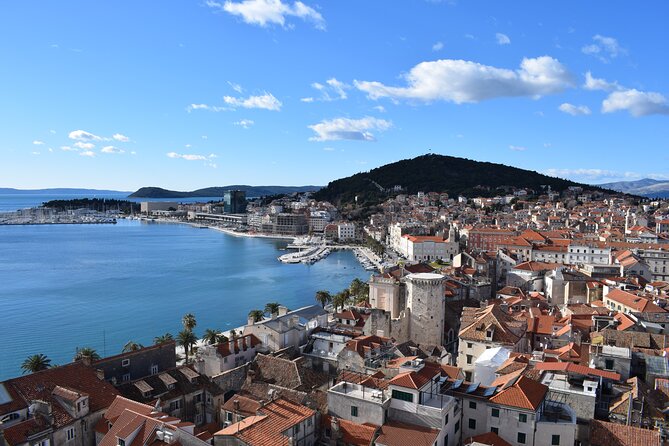
Split and Trogir are close enough to combine, yet different enough to keep the day interesting. Split is built around the remains of the Roman emperor Diocletian’s palace. Trogir is a smaller old town with medieval and Venetian layers packed into a compact center.
That contrast is the real reason to book this outing. A Split-only walk can explain the palace well, but Trogir gives you another way to read Dalmatian history. You move from a huge Roman complex absorbed into a living city to a smaller fortified town where the old core is easier to take in at a glance.
The tour lasts about five to six hours, including the vehicle ride and free time. That makes it a practical choice if you are in Split for a short stay or arriving by cruise ship. You get an introduction rather than an exhaustive study, but the route covers the key sights.
The advertised maximum is 50 people, though the walking portion may be divided into smaller groups. One outing used groups of about nine, while another had 11 in Split and additional people join for Trogir. Group size can therefore vary, so I would ask about the expected number if a quiet, intimate walk matters to you.
A few more tours and experiences worth a look
- Half-Day Rafting Experience on Cetina River with Cliff Jumping and more
★ 5.0 · 940 reviews - Split: Half-Day Blue Lagoon, Shipwreck, and Trogir Boat Tour
★ 4.2 · 673 reviews - Split: Half-Day Blue Lagoon, Čiovo and Trogir Boat Tour
★ 4.5 · 634 reviews
Starting beneath Diocletian’s Palace
Meet at the Golden Gate, at Dioklecijanova 7 in Split. This is a sensible starting point because the gate drops you directly into the old palace area, and it is easy to recognize once you reach the north side of the historic center.
The first stop is the palace substructure, often called the basements. These underground rooms supported the emperor’s residence above and are among the clearest places to understand the palace’s original plan. They were also used as a filming location for Game of Thrones, which adds a pop-culture detail without taking over the history.
The visit here is brief, about 10 minutes. That is enough for an introduction and a few photographs, but not a long architectural study. Admission to the listed stops is free, though some sites along the route may charge separately if you choose to enter them.
From below, you head up to the Peristyle, the palace’s ancient main square. Allow about 20 minutes here. This is the visual heart of the complex, with towering columns and later buildings pressed around the Roman framework.
The Peristyle makes the palace’s transformation easy to grasp. It was designed for imperial ceremony, but later generations reused and altered the space. The best guides point out how the Roman structure survives beneath the layers added by the people who made Split their home.
The Vestibule, Golden Gate, and Riva Harbor
The Vestibule was the ancient entrance to Diocletian’s private residence. It receives roughly 10 minutes on the route, which is enough to see its shape and hear how it connected the public palace spaces with the emperor’s quarters.
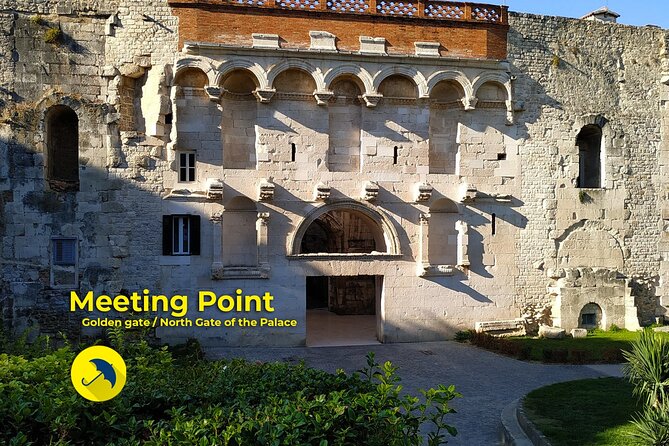
Next comes the Golden Gate, the north entrance. This is also the meeting point, so you may see it before the tour begins and return to it during the walk. The gate is a useful orientation marker, and the guide can explain how the palace was arranged around its four main entrances.
The tour then leaves the palace core for Riva Harbor. A 10-minute walk along the famous waterfront gives you a change of view. Instead of looking up at Roman stone, you look out toward the harbor and the busy edge of the modern city.
Riva is not a long sightseeing stop, but it helps connect the old town with everyday Split. Take a moment for photographs and notice how quickly the city shifts from ancient walls to a broad public promenade.
Fruit Square and Split’s smaller details
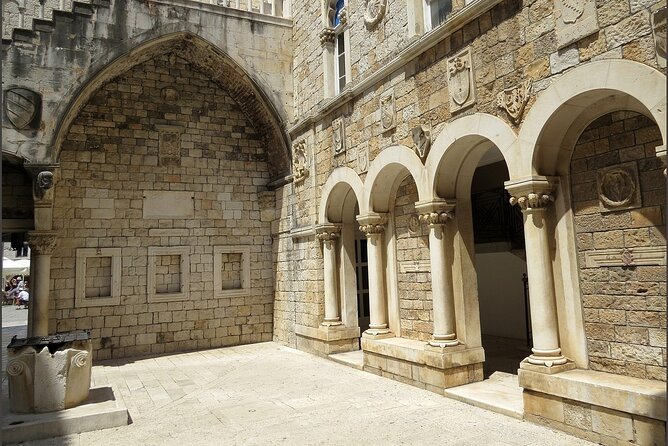
Fruit Square, officially Trg Braće Radić, receives about 20 minutes. It is one of Split’s more interesting squares, and it rewards attention to the smaller details that can be missed if you simply follow the main route through the palace.
This is where a good guide matters. Guides such as Antonia and Ivana are praised for linking architecture with local stories, while Frane is noted for adding personal Croatian views and opinions. Ante, described as a local history student, is also praised for making the walk clear and entertaining.
The strongest part of the tour is not simply being led from one monument to the next. It is learning why the buildings look the way they do and how Split changed over roughly 1,700 years. One guide was especially praised for drawing attention to the way the palace had been altered and reused over time.
You should still keep your expectations sensible. This is a group walk, not a private architectural seminar. The guide must keep moving, and crowded lanes or cruise-ship arrivals can make it harder to hear. Stay close, and ask questions when the group pauses.
Something different for another day:
- Split: Krka Waterfalls Trip with Boat Cruise and Swimming
★ 4.8 · 10,519 reviews - From Split: Krka Waterfalls, Food & Wine Tasting Tour
★ 5.0 · 9,326 reviews - Blue cave, Mamma Mia and Hvar, 5 islands speedboat tour
★ 5.0 · 7,150 reviews - From Split: Krka Waterfalls, Food & Wine Tasting Tour
★ 4.9 · 6,598 reviews
The short ride to Trogir
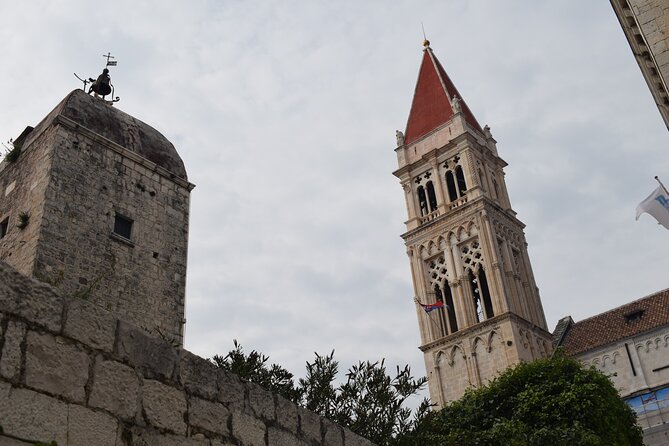
After Split, an air-conditioned vehicle takes you to Trogir. The transport is included, so you do not need to work out buses, taxis, or parking. That convenience is a large part of the tour’s value, especially in the summer heat.
The vehicle has been described as a small van on some departures. Comfort can depend on the number of people assigned to it. One outing felt cramped even with five passengers, so you should not assume every departure will feel spacious.
The route is designed to return you to the original meeting point at the Golden Gate. A guide or driver may be able to help with a cruise-port return, but confirm this before booking if your ship schedule is tight. One important practical lesson is to leave enough time for the return. A delayed start or a group member with an early ship departure can reduce the time available in Trogir.
Trogir’s central square and city hall
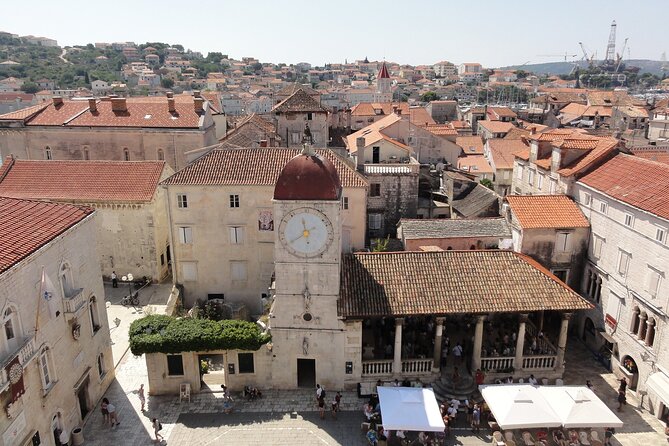
The Trogir portion begins at the town hall, referred to in the route as Ayuntamiento Trogir. The stop lasts about 10 minutes and introduces the town’s civic history.
You then move to Trogir’s central square for about 20 minutes. This is the town’s main gathering space and one of the best places to see several important buildings together. The compact layout makes Trogir easy to read, even during a short visit.
I like this part of the day because it feels different from Split. In Split, the old and new are tangled together across a large urban area. In Trogir, the old center is smaller and more concentrated, so you can get a clear sense of the town’s character without covering as much ground.
The route leaves time to look around on your own. Use it for photographs, a short drink, or a closer look at details the guide could not cover. One useful warning: people who wanted more time in Trogir felt the free period was too short, particularly when the return schedule was fixed.
Saint Lawrence’s Cathedral and St. Sebastian
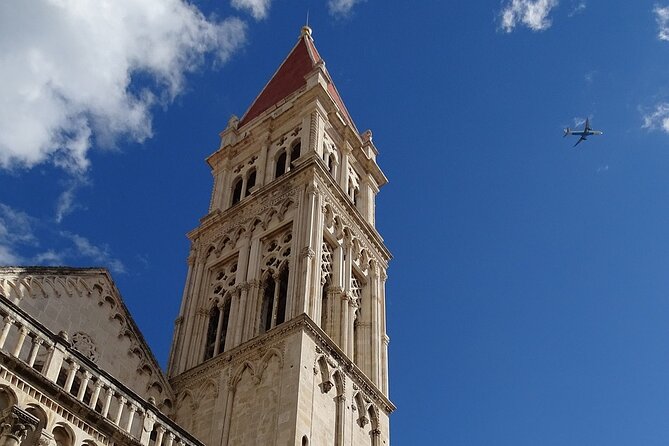
Saint Lawrence’s Cathedral is dedicated to Trogir’s patron saint and receives about 15 minutes. It is one of the most important sights in the town, but the entrance ticket is not included.
The tour price includes guided walks, not admission to every monument. Bring some extra Croatian currency or a payment method accepted at the site if you want to enter. If you prefer not to pay, you can still appreciate the cathedral’s exterior and the surrounding square.
St. Sebastian, once a church and now a memorial place, gets about 10 minutes. It is a shorter stop, but it adds another layer to Trogir’s story and shows how religious buildings can take on new civic roles.
The guide’s role is particularly useful in Trogir because the town’s buildings are close together and easy to blur into one sequence of stone façades. Antonia has been praised for explaining both the history and architecture of Split and Trogir, while Mia is praised for storytelling and for adjusting the tour when rain made outdoor stops difficult.
Kula Karmelengo and free time
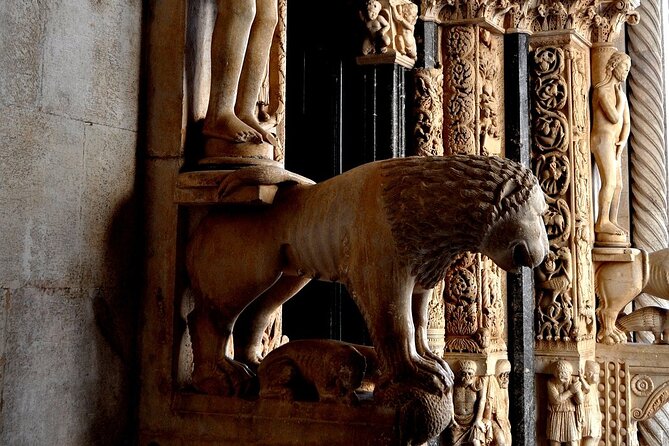
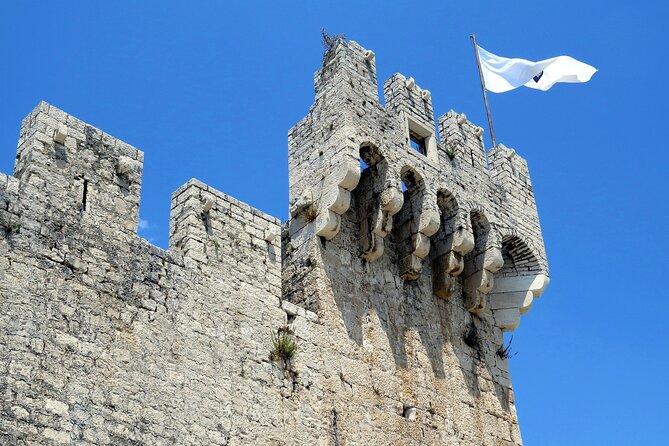
Kula Karmelengo is a Venetian fortress built to protect Trogir. The stop lasts about 10 minutes, and admission is not included.
Even if you do not enter, the fortress helps explain Trogir’s position and defensive past. If you do want to go inside, check the ticket cost and available time before committing. A short tour can make every minute count, and you do not want a monument visit to cut into your limited free time.
Free time in Trogir is one of the tour’s most useful features. You can choose how to spend it instead of remaining with the guide for every minute. I would use it for a relaxed walk through the old center, photographs, or a drink, while keeping a close eye on the agreed meeting time.
Trogir is described as photogenic and upscale, and it can feel calmer than Split. That does not mean it will always be quiet. Summer crowds, poor weather, and cruise schedules can change the mood from day to day.
Walking, weather, and group pace
There is a lot of walking. The route is described as mostly level rather than uphill, but old stone streets can still be hard on your feet. Wear shoes with good grip, and carry water, especially in summer.
The tour operates in all weather conditions, so dress for the forecast. Rain can force the guide to find sheltered places for explanations, as Mia did on one wet departure. Hot weather creates a different problem: crowded streets and direct sun can make a late start feel much worse.
The tour is offered in English. Most people can participate, but children must be accompanied by an adult. Service animals are allowed, and the meeting point is near public transportation.
A small-group feel is possible, but not guaranteed in every departure. The stated capacity is up to 50 people. If you want the most personal experience, book a private tour instead of expecting a large public departure to behave like one.
What the $60.49 price really covers
At $60.49 per person, the tour offers solid value if you want both guided interpretation and transport. The fee includes a professional guide, a guided walk through Split’s old town and Diocletian’s Palace, air-conditioned transport, a guided walk in Trogir, and free time there.
You are paying for more than a ride between two towns. The guide helps you understand the palace’s layers, points out details you might otherwise miss, and gives structure to a short visit. The vehicle also removes the hassle of arranging a separate trip to Trogir.
The extra costs are food, drinks, and admission tickets to historical monuments. Saint Lawrence’s Cathedral and Kula Karmelengo are specifically listed as paid entrances, so budget for those only if you want to go inside.
The value is strongest for first-time visitors, cruise passengers with a limited day, and anyone who wants an overview before exploring independently. It is weaker for people who already know Split well or who want a slow day with plenty of unscheduled time.
The 94 percent recommendation rate and 4.8 rating from 157 ratings point to a dependable experience, but the occasional problems are worth noting. A late start, changed group arrangements, tight van seating, or a shortened Trogir visit can affect the day. Much depends on timing, group coordination, and the guide assigned to you.
The guides make or break the day
The most consistent strength is the guiding. Antonia is praised for passion, humor, and local insight. Ivana is praised for energy, warmth, and strong explanations of the palace’s changes over time. Ante is described as considerate, funny, and well informed, with a useful background in local history.
Mia receives high praise for making people comfortable, adapting to bad weather, and sharing her affection for Croatia. Antoinette is praised for her command of Croatian history, while Frane is noted for a strong English voice and personal Croatian perspective. Slavico is described as both funny and well informed.
Guide quality can vary, as it does on any group tour. One departure had a driver who mainly delivered people to sights rather than explaining them in depth, and the guide’s English was limited. That was an exception among the supplied experiences, but it is fair to keep the possibility in mind.
Should you book the Split and Trogir tour?
Book it if you want to see two important Dalmatian towns in one outing, value local explanation, and prefer included transport over organizing the day yourself. It is especially useful for a first visit to Split or a short cruise stop.
Skip it if you dislike group schedules, need long unhurried visits, or have difficulty walking for several hours. Trogir deserves more time than this format can always provide, and a private tour would give you more control over the start time and pace.
For most reasonably mobile visitors, I think the pairing is worth the $60.49. Wear sensible shoes, allow extra time around your cruise departure, bring money for optional monument entries, and treat Trogir’s free time as a bonus rather than a full afternoon.
FAQ
Where does the tour start?
The tour starts at the Golden Gate, Dioklecijanova 7, 21000 Split, Croatia.
Where does the tour end?
The activity ends back at the Golden Gate meeting point.
How long does the tour last?
The tour lasts approximately five to six hours.
Is transportation included?
Yes. An air-conditioned vehicle takes you between Split and Trogir, and the guided visits in both old towns are included.
Are entrance tickets included?
No. Food, drinks, and entrance tickets to historical monuments are not included. Saint Lawrence’s Cathedral and Kula Karmelengo are listed as paid-entry stops.
Can I cancel for a full refund?
Yes. You can cancel at least 24 hours before the local start time for a full refund. Cancellations or changes made within 24 hours are not refunded or accepted. If poor weather causes the operator to cancel, you will be offered another date or a full refund.
Just added around Split
- Private VIP Blue Lagoon and 3 Islands Tour★ 4.5 · 9 reviews
- Split highlights – Evening walking tour★ 5.0 · 9 reviews
- Private boat transfer Split – Bol★ 5.0 · 9 reviews
- From Split: Trogir & Blue Lagoon Boat Tour with Snorkeling★ 4.6 · 9 reviews
- Private Photography Activity in Split★ 5.0 · 9 reviews
- Bike, Beer & Poljud Stadium Tour★ 5.0 · 9 reviews
- From Hvar: Blue cave group speedboat tour full day★ 5.0 · 9 reviews
- Split Walking Tour: History, Legends & Tales★ 5.0 · 9 reviews
Half-Day, compared.

Zrmanja River: Half-Day Guided Kayaking Tour Near Zadar
Read our review →
X-Adventure Sea Kayaking Half Day Tour in Dubrovnik
Read our review →
Half-Day Rafting Experience on Cetina River with Cliff Jumping and more
Read our review →
Half-Day Blue Lagoon, Shipwreck, and Trogir Boat Tour
Read our review →
Half-Day Blue Lagoon, Čiovo and Trogir Boat Tour
Read our review →
Split and Trogir Half Day Tour from Cruise Ships
Read our review →