
Reviewed · SPLIT TOURS
Private Walks & Storytelling – the best small group tour in Split
Split rewards slow walking. This private tour makes the city easier to read, pairing Roman landmarks with local stories instead of treating the old town like an open-air museum. I especially like the focus on everyday Split and the chance to shape the walk around your interests.
I also like that the group is limited to your party, up to 10 people, and led by Mirjana, a local guide born and raised in Split. She has helped families with teenagers, adjusted routes for special needs, and offered practical tips for coffee, food, restaurants, and activities. The main consideration is time: with a duration of roughly one hour to one hour 40 minutes, you will see the core sights, but not every corner of the palace.
In This Review
- Key points to know before booking
- Why a private walk helps you understand Split
- Start on the Riva, where Split slows down
- Enter Diocletian’s Palace through the substructures
- Peristyle brings Roman power into the open
- Saint Domnius Cathedral and the bell tower
- Jupiter’s Temple and the narrowest street
- Narodni Trg shows Split growing beyond the palace
- Nadalina chocolate adds a local taste
- The Golden Gate explains the palace’s military side
- Finish with Grgur Ninski and a local custom
- What the guide adds to the experience
- Timing, price, and practical value
- Who should book this Split walk?
- Should you book Private Walks and Storytelling?
- FAQ
- Where does the tour begin?
- Where does the tour end?
- How long does the walking tour last?
- How many people can join the private tour?
- What language is the tour offered in?
- Is the price charged per person?
- Are cathedral and temple admission fees included?
- Is food included during the walk?
- Is the tour suitable for most people?
- What happens if the weather is poor or the minimum group size is not met?
Key points to know before booking
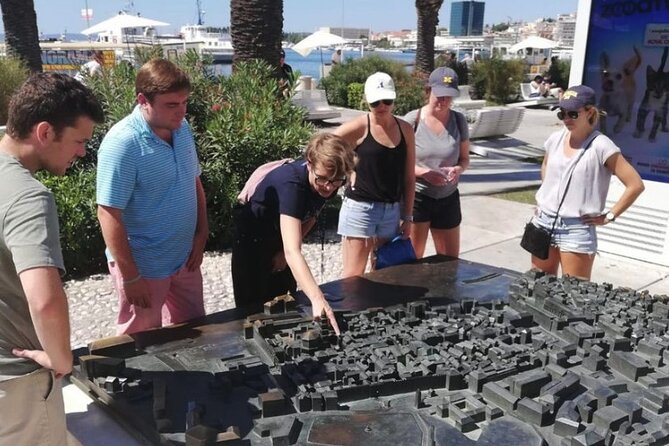
- Private for up to 10 people: The price is $238.34 per group, so the value improves when shared by a family or small party.
- A local view of Diocletian’s Palace: You see Roman walls alongside laundry, homes, shops, cafés, and modern city life.
- Mirjana is the main attraction: Her storytelling, flexibility, and ability to engage both adults and teenagers earn especially strong praise.
- A taste of Split is built in: The stop at Nadalina includes samples of locally flavored chocolate.
- The route covers more than Roman ruins: You visit the Riva, Peristyle, Cathedral of Saint Domnius, Jupiter’s Temple, Narodni Trg, the Golden Gate, and Grgur Ninski’s statue.
- Some admissions cost extra: Entry to the cathedral and Jupiter’s Temple is not included, while other listed stops are free or included.
Why a private walk helps you understand Split
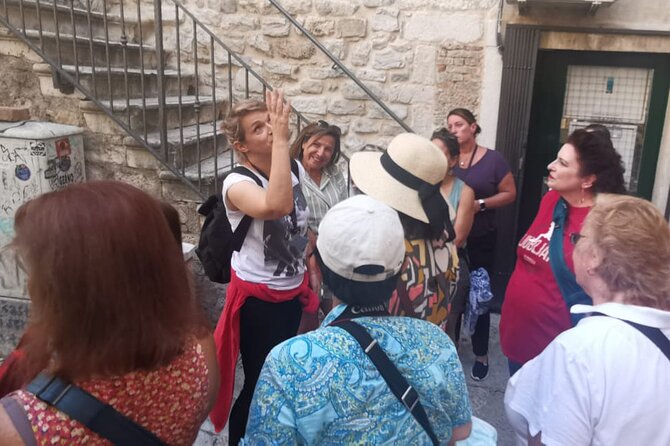
Split can feel confusing at first. The old town is not a separate historical quarter set apart from daily life. It grew inside and around Diocletian’s Palace, with homes, businesses, narrow lanes, and cafés occupying spaces first built for an emperor.
That is why a local guide matters here. A standard sightseeing walk can point out the palace walls, columns, and gates. This experience aims to explain how people still use those spaces. You are not simply looking at ancient stone. You are watching a living town function inside it.
The private format gives you room to ask questions and set the pace. If you care most about Roman history, folklore, local food, or modern Split, you can say so at the start. The route is planned, but the experience is customizable.
The group limit is 10 people. That is small enough for a more personal conversation and much easier to manage in the palace’s tight lanes than a large walking party. At $238.34 per group, it is not the cheapest choice for one or two people. For six to 10 people, though, the per-person cost becomes much more reasonable, especially since the guide is dedicated to your group.
A few more tours and experiences worth a look
- SPLIT-PRIVATE Walking Tour of Diocletian’s Palace & Old Town
★ 5.0 · 467 reviews - Private Krka Waterfalls tour with 30min Boat Cruse
★ 4.0 · 458 reviews - Split by Private Electric Rickshaw – Palace & Hidden Gems
★ 5.0 · 412 reviews
Start on the Riva, where Split slows down
The walk begins at Brass Gate, also called Porta Aenea, on the waterfront. This puts you on the Riva, Split’s broad harbor promenade and one of the best places to observe the city before entering its older core.
The introduction here is less about racing to a monument and more about seeing how locals spend time. People sit in the sun, drink coffee, talk, and watch the sea. The guide uses this setting to explain the local attitude of pomalo, a way of taking life at an unhurried pace.
That opening is useful because it gives the rest of the tour a human scale. You learn that Split is not only about emperors, dates, and stonework. It is also about routines, conversation, food, and the way public spaces belong to ordinary people.
A short stop for a bite is part of this opening section. The information does not specify exactly what the bite includes, so you should treat it as a small taste rather than a full meal. The stop lasts about 15 minutes, which is enough to add flavor without turning the walk into a food tour.
Enter Diocletian’s Palace through the substructures
From the waterfront, you move into the palace and visit its substructures. These lower rooms preserve the shape of the imperial complex and help explain how the upper streets were laid out.
The substructures are valuable because they make the palace easier to understand. Above ground, the old Roman plan is mixed with later buildings and modern activity. Below, the heavy stone walls give you a clearer sense of the palace as a planned imperial residence and fortified complex.
The scheduled visit lasts around 10 minutes. That is brief, so you should expect a focused explanation rather than a long archaeological visit. Admission is listed as free for this stop.
This part may appeal most to you if you like physical evidence of the past. The stones are not presented as decoration. They show the work and construction behind the palace, and the guide connects them with stories of trade, labor, and life over many centuries.
Peristyle brings Roman power into the open
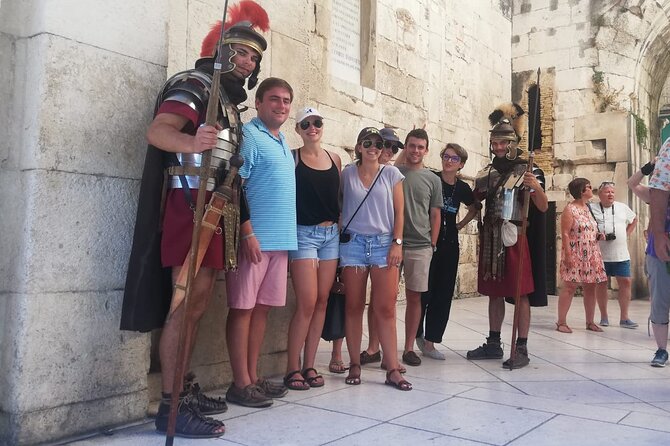
The Peristyle is the palace’s grand open square and one of the essential stops in Split. It is also where the tour’s Roman and modern themes meet most clearly.
The square was designed as an imperial space, but it now functions as part of the city. Your guide explains what happened behind the palace walls, then connects those older events with traditional customs and modern Split. The point is not just to identify a column or describe an emperor. It is to show how the square has changed while remaining central to local life.
The stop lasts about 15 minutes and includes admission. Since the Peristyle is an open public space, the value comes mainly from the guide’s interpretation. Without context, you may see a handsome stone square. With context, you can better understand its political purpose and its later role in the town.
Mirjana’s storytelling is especially important here. Her strength is linking old events to what you can see around you now. That approach was praised by families with teenagers and adults because it gives younger visitors a reason to pay attention without turning the tour into a school lecture.
Something different for another day:
- Split: Krka Waterfalls Trip with Boat Cruise and Swimming
★ 4.8 · 10,519 reviews - From Split: Krka Waterfalls, Food & Wine Tasting Tour
★ 5.0 · 9,326 reviews - Blue cave, Mamma Mia and Hvar, 5 islands speedboat tour
★ 5.0 · 7,150 reviews - From Split: Krka Waterfalls, Food & Wine Tasting Tour
★ 4.9 · 6,598 reviews
Saint Domnius Cathedral and the bell tower
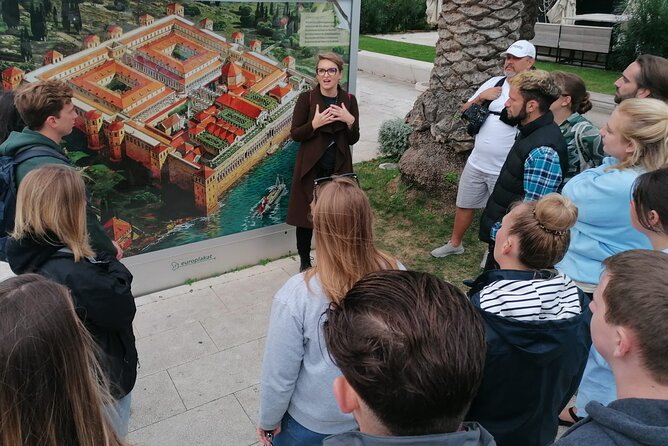
From the Peristyle, you see the tall bell tower of the Cathedral of Saint Domnius. The cathedral is tucked close to the Roman center, and its position shows how later Christian buildings took over important parts of the imperial complex.
The cathedral is described as one of the smallest and oldest cathedrals in the world. You receive an explanation of its place within the palace, but admission is not included. That matters if you want to go inside, since you should allow for an additional fee.
The listed stop lasts about 10 minutes. You may spend more time there if you choose to enter, but the tour schedule itself keeps the visit short. This is a useful distinction: the experience introduces the cathedral and its setting, but it is not designed as an extended cathedral visit or bell tower climb.
If your main interest is Roman architecture, the cathedral is still important even without going inside. It shows how Split’s religious life was built into the former imperial center rather than placed in a separate district.
Jupiter’s Temple and the narrowest street
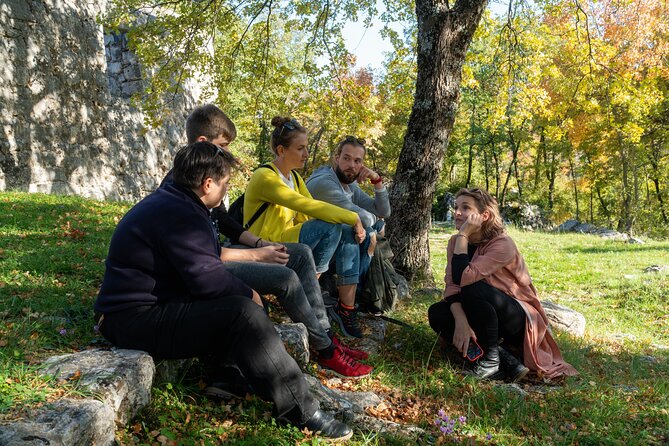
The route continues to Jupiter’s Temple, where the Roman emperor’s divine connection to Jupiter is explained. Jupiter was the Roman god of the sky and thunder and king of the gods, so the temple was meant to reinforce the emperor’s authority.
Later, the building became a baptistery dedicated to Saint John the Baptist. That change gives you a compact example of how Split’s buildings were reused rather than discarded. One structure can carry Roman religious meaning and later Christian purpose.
Admission to the temple is not included. The scheduled stop is about 10 minutes, so you can decide at the beginning how much emphasis you want to place on entering paid sites.
On the way, you pass Let Me Pass Street, locally called Pusti me da prodjem. It is a very short stop, about two minutes, in a narrow lane between the ancient temple and a medieval building that is now a hotel. Local belief identifies it as the narrowest street in town.
This is the sort of detail that gives a walking tour personality. It takes almost no time, but it helps you notice the awkward, layered construction that makes the old town feel like a real neighborhood rather than a preserved stage set.
Narodni Trg shows Split growing beyond the palace
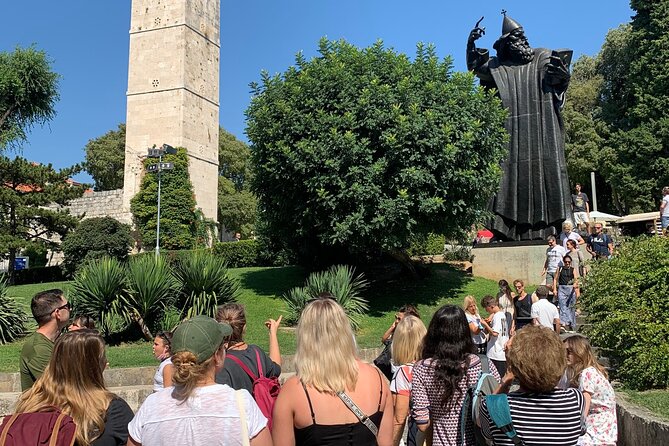
Narodni Trg marks the westward expansion of Split after the ancient city walls could no longer contain the town. It is often called the new old town, a useful phrase for an area that is later than the palace but still thoroughly historic.
The guide uses this square to explain how northern and southern European influences met in the city. You see another layer of Split, one that is not limited to Roman architecture. The stop lasts about five minutes, so the explanation is short, but it helps place the palace within the larger development of town.
This is also where the private format can help. You can ask Mirjana how the older palace area differs from later parts of Split, or steer the conversation toward architecture, food, current customs, or local concerns. Her ability to discuss both past events and present-day culture is one of the strongest reasons to choose this walk over a purely monument-focused route.
Nadalina chocolate adds a local taste
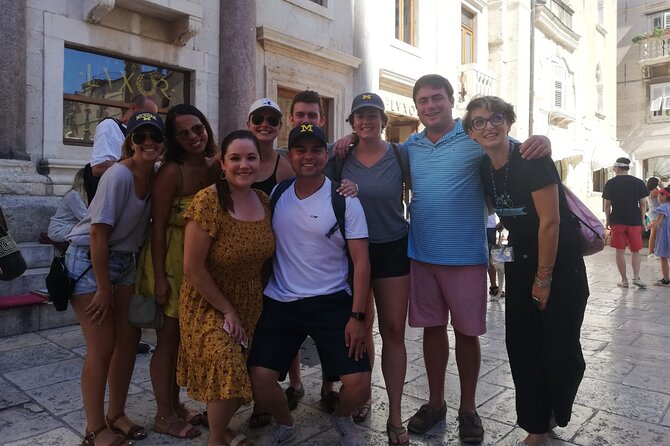
Near the end of the walk, you stop at Nadalina, a favorite local chocolate business. The visit lasts about eight minutes and includes samples of locally flavored chocolate.
This is a small stop, but it works well. After Roman ruins, medieval lanes, and civic squares, a food sample gives you a direct connection to contemporary Split. The guide also discusses food production, so the stop is more than a quick sweet treat.
Do not book this expecting a full tasting session or a meal. The time is limited, and the supplied details only promise samples. Still, it is a pleasant addition for families and anyone who likes food tied to place.
The Golden Gate explains the palace’s military side
The Golden Gate, or Porta Aurea, was one of the four main Roman entrances to Diocletian’s Palace. It faces north toward Salona, the capital of the Roman province of Dalmatia and Diocletian’s birthplace.
Here, the guide explains the military strategy behind the palace and points out less obvious buildings nearby. The stop lasts about 10 minutes and does not require an admission fee.
The gate is a good counterpoint to the ceremonial Peristyle. At the Peristyle, you think about imperial display and religious authority. At the Golden Gate, you think about movement, defense, and control. Seeing both helps you understand the palace as more than a private residence.
You also get a practical orientation point. The north gate is a clear landmark, and ending nearby makes it easy to continue exploring on your own, depending on the final arrangement with the guide.
Finish with Grgur Ninski and a local custom
The walk ends near the statue of Grgur Ninski, beside the northern palace wall. Grgur Ninski was a medieval bishop, and his large statue has become one of Split’s familiar public artworks.
The setting brings several periods together: fourth-century walls, twentieth-century sculpture, and modern city life. The guide invites you to respect a local tradition and make a wish at the statue.
The scheduled stop lasts around 15 minutes and admission is included. The official ending point is on Ulica Stari pazar, but you can request a different ending at the start of the tour. That flexibility is useful if you want to continue to a restaurant, return to your accommodation, or remain near the old town.
What the guide adds to the experience
Mirjana is a licensed tourist guide, storyteller, and certified history interpreter who was born and raised in Split. Those details matter because this tour promises local interpretation, not only a recital of dates.
Her strongest quality is flexibility. She has adjusted the experience for a large party with teenagers and adults, helped sort out pickup confusion, assisted with luggage arrangements, and offered suggestions for coffee and restaurants. Those are practical signs that she pays attention to the needs of the group in front of her.
You should also expect conversation. One group enjoyed sitting down for coffee with her, and another described the walk as similar to exploring an old city with a longtime friend. The tour does not formally promise a coffee stop, so do not assume it is included. But the guide’s willingness to talk and offer local suggestions appears to be a central part of the experience.
Her storytelling also helps the tour work for mixed ages. Teenagers may not want a long lecture on palace construction, while adults may want more historical detail. A private guide can change the emphasis as questions come up.
Timing, price, and practical value
The price is $238.34 per group of up to 10 people. For one person or a couple, that is a significant cost for a walk lasting about one hour to one hour 40 minutes. For a family, reunion group, or several friends, the price can be quite fair because you are paying for a dedicated licensed guide rather than a seat in a large public group.
The route itself includes many major sights, but two paid entries are not covered: Saint Domnius Cathedral and Jupiter’s Temple. All fees and taxes are also listed as not included. Check the additional costs before you start if entering both sites is important to you.
The route schedule totals roughly 100 minutes, which fits the longer end of the stated duration. Since the experience is customizable, the actual timing may depend on your questions, pace, and choices. Wear comfortable shoes because this is a walking tour through old streets and narrow lanes, although the provided information says most people can participate.
The walk is offered in English and uses a mobile ticket. It operates daily from 8:00 a.m. to 9:00 p.m. during the listed operating period, from January 29, 2023 through December 8, 2026. It is near public transportation, and service animals are allowed.
You receive confirmation at booking. Free cancellation is available up to 24 hours before the start time. Poor weather or failure to meet the minimum group size can lead to a rescheduled experience or full refund, according to the stated policy.
Who should book this Split walk?
I would choose this experience if you want a personal introduction to Split rather than a fast checklist of monuments. It is especially suitable for families, small friend groups, first-time visitors, and anyone who enjoys hearing how history connects with daily routines.
It also suits you if your group has mixed interests. One person can ask about Roman military planning, another about local chocolate, and someone else about restaurants or modern Croatian life. The private format gives the guide room to respond.
You may want a different option if you prefer a long archaeological lecture, extensive time inside paid monuments, or a full-day walking experience. The route covers a lot in a short period, and several stops are brief. You will get an excellent introduction, but you may still want independent time afterward at the cathedral, temple, or palace substructures.
Should you book Private Walks and Storytelling?
Yes, if you value a local voice and want Split to make sense quickly. The route covers the essential palace sights, but its real strength is the connection between Roman walls and present-day life.
The strongest case for booking is Mirjana’s mix of storytelling, local knowledge, flexibility, and practical help. The best value comes when several people share the $238.34 group price. If you are traveling alone or as a couple, compare the cost carefully.
Book it early if your dates are fixed, since the experience is often reserved well in advance. Choose this walk for stories, conversation, and a useful first look at Split, then leave extra time to return to any paid site that catches your interest.
FAQ
Where does the tour begin?
It begins at Brass Gate, also known as Porta Aenea, at Obala Hrvatskog narodnog preporoda 22 in Split.
Where does the tour end?
The listed ending point is Ulica Stari pazar 9 in Split. You can request another ending place at the beginning of the tour.
How long does the walking tour last?
The approximate duration is one hour to one hour 40 minutes. The planned stops add up to about 100 minutes.
How many people can join the private tour?
The maximum group size is 10 people.
What language is the tour offered in?
The tour is offered in English.
Is the price charged per person?
No. The listed price is $238.34 per group of up to 10 people.
Are cathedral and temple admission fees included?
No. Admission to the Cathedral of Saint Domnius and Jupiter’s Temple is not included.
Is food included during the walk?
A small bite is included during the Riva section, and the Nadalina chocolate stop includes samples of locally flavored chocolate. The experience is not described as a full meal.
Is the tour suitable for most people?
The supplied information says most people can participate. Service animals are allowed, and the tour is near public transportation.
What happens if the weather is poor or the minimum group size is not met?
You will be offered a different date or experience, or a full refund, if the tour is canceled for poor weather or because the minimum number of participants is not reached.
Just added around Split
- Private VIP Blue Lagoon and 3 Islands Tour★ 4.5 · 9 reviews
- Split highlights – Evening walking tour★ 5.0 · 9 reviews
- Private boat transfer Split – Bol★ 5.0 · 9 reviews
- Private Photography Activity in Split★ 5.0 · 9 reviews
- From Split: Trogir & Blue Lagoon Boat Tour with Snorkeling★ 4.6 · 9 reviews
- Bike, Beer & Poljud Stadium Tour★ 5.0 · 9 reviews
- From Hvar: Blue cave group speedboat tour full day★ 5.0 · 9 reviews
- Split Walking Tour: History, Legends & Tales★ 5.0 · 9 reviews
Split Tours, compared.

Krka Waterfalls Trip with Boat Cruise and Swimming
Read our review →
Blue cave, Mamma Mia and Hvar, 5 islands speedboat tour
Read our review →
Blue Cave, Mamma Mia, Hvar and 5 Island Tour
Read our review →
Blue Lagoon & 3 Islands Cruise with Lunch from Split
Read our review →