Reviewed · SPLIT TOURS
People of Split – meet the locals
Split opens like a Roman stage set. This private walking tour makes the old city feel personal, pairing Diocletian’s Palace with stories about modern Split, local customs, crafts, and daily life. I like the small-group format, which keeps the experience flexible, and I like that guide Mirjana focuses on people and lived culture rather than reciting dates. The main consideration is the price: $258.88 per group is reasonable for up to eight people, but costly for one or two guests.
The route takes about 1 hour 20 minutes to 1 hour 35 minutes and covers several central sights on foot. You will begin at the Split sign by Riva Harbor and finish near the Golden Gate, with snacks, photo suggestions, and a native Split guide included. It is a good choice if you want an introduction that feels more like a conversation than a formal lecture.
In This Review
- Key points at a glance
- Why this Split walk feels different
- Starting beside Riva Harbor and the Split sign
- Inside Diocletian’s Palace substructures
- The Peristyle, where Roman history meets daily life
- Dominisova ulica and the ordinary life of the palace
- Rubbing Gregory of Nin’s toe
- Pjaca and the old trades of Split
- Mirjana’s storytelling style
- What $258.88 means for your group
- Timing, walking, and practical details
- Who will enjoy this experience most
- Should you book People of Split?
- FAQ
- Where does the People of Split tour begin?
- Where does the tour end?
- How long does the tour take?
- What language is the tour offered in?
- How many people can join the private tour?
- Are snacks included?
- Can I cancel for a full refund?
Key points at a glance
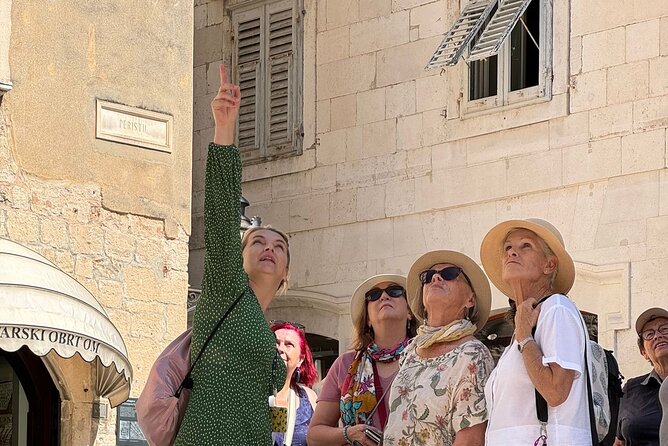
- A private tour for up to eight people: Your group is the only group taking part, so the pace and questions can feel more personal.
- Mirjana brings Split to life: Her storytelling covers Roman times, local customs, Croatian history, and the effects of the 1990s conflict.
- Diocletian’s Palace is still lived in: You see a historic structure that remains part of everyday city life, not just a preserved monument.
- Local details matter here: Laundry hanging from windows, traditional trades, artisans, market produce, and people-watching all have a place on the route.
- A compact introduction to central Split: Six stops fit into roughly 90 minutes, making this easy to add on arrival day.
- Useful extras are included: You receive snacks and suggestions for the best photo spots, while gratuities are not included.
Why this Split walk feels different
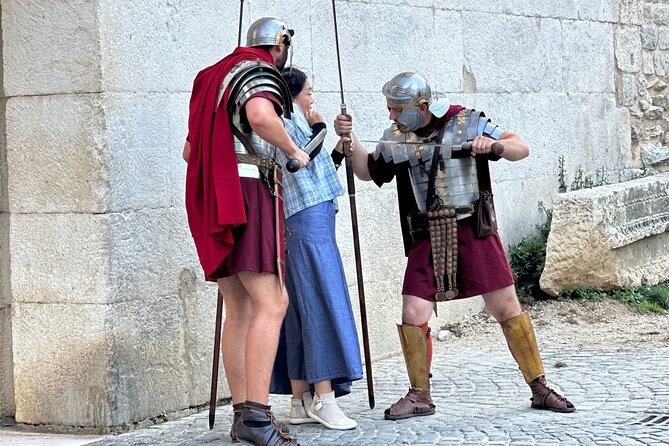
Many old-city walks focus on emperors, churches, stones, and dates. This one uses those things as a doorway into present-day Split. You still learn about Diocletian and his palace, but you also pause to notice how people live inside the old walls.
That difference matters in Split. Diocletian’s Palace is not an isolated archaeological park. Parts of it are woven into the city, with homes, businesses, narrow lanes, and public squares occupying spaces built many centuries ago. The tour asks you to look beyond the grand Roman remains and notice the human details around them.
Mirjana is the guide named in the tour information, and the praise for her style is unusually consistent. She is described as warm, funny, adaptable, and passionate about her hometown. Her approach includes more than ancient history. You can expect stories about Split, Dalmatia, Croatia, local culture, and the country’s difficult recent past.
That makes this a strong fit for you if you enjoy context and character. If you want a fast checklist of major monuments with little conversation, a standard sightseeing tour may suit you better.
Other Split trips people book alongside this one:
- Split: Krka Waterfalls Trip with Boat Cruise and Swimming
★ 4.8 · 10,519 reviews - From Split: Krka Waterfalls, Food & Wine Tasting Tour
★ 5.0 · 9,326 reviews - Blue cave, Mamma Mia and Hvar, 5 islands speedboat tour
★ 5.0 · 7,150 reviews
Starting beside Riva Harbor and the Split sign
The meeting point is in front of the Split sign at Riva Harbor. This is a practical place to begin because it gives you an immediate orientation to the city center and a clear photo opportunity before heading into the old town.
The opening photo may sound like a small detail, but it sets the tone. You are not simply being led from one famous building to the next. You are marking the start of a walk through a city that has been inhabited for roughly 1,700 years.
The first stop lasts about 15 minutes. No admission ticket is required, and the time allows your guide to introduce the route and suggest useful places for photographs. If you have just arrived in Split, this is also a sensible point to begin building a mental map of the center.
Riva itself is a major part of Split’s public life, but the tour does not spend the whole experience along the waterfront. The real focus begins as you move toward the palace and its lanes.
Inside Diocletian’s Palace substructures
The next stop takes you into the substructures of Diocletian’s Palace, a structure about 1,700 years old that is still in use. The area is also associated with filming for Game of Thrones, which may add extra appeal if you know the series.
The value here is not only the television connection. The substructures help explain the physical plan of the palace above. Roman building foundations and supporting spaces become easier to understand when you are standing within them, rather than viewing the palace only from a square.
This portion lasts about 10 minutes, so do not expect a full archaeological tour. Instead, treat it as a concise introduction to one of Split’s most recognizable historic spaces. The guide’s storytelling is likely to matter more than a long list of architectural measurements.
For me, the strongest point is the contrast between age and use. You are seeing an ancient structure that remains part of the city rather than a ruin cut off from daily life. That idea returns throughout the walk.
The Peristyle, where Roman history meets daily life
The Peristyle is the heart of the palace route. Diocletian built the palace in the fourth century as a retirement residence, and the space now sits within Split’s historic center. You will pause for photographs and hear stories about the myths and legends linked with the site.
This is the longest stop, at about 35 minutes. That gives Mirjana room to do more than point out columns and explain who Diocletian was. The tour description promises a look at less obvious corners, local produce sellers, and artisans whose work has continued across generations.
Those details help the Peristyle make sense as part of a living town. The square is not merely something to admire for five minutes before moving on. It is connected to trade, work, tradition, and the way people use the palace today.
The food element is modest but welcome. Snacks are included, and fresh produce from local vendors may be part of the experience. You should think of this as a small taste of local life, not a full food tour. The main subject remains Split’s history and community.
The guide’s storytelling style is especially important here. Mirjana has been praised for connecting ancient Roman times with modern Croatian history, including the country’s journey through the breakup of Yugoslavia and the war of the 1990s. That broader frame can turn a familiar Roman site into a more complete story about place and identity.
Something different for another day:
- From Split: Krka Waterfalls, Food & Wine Tasting Tour
★ 4.9 · 6,598 reviews - Split/Trogir: Blue Cave, Mamma Mia, Hvar and 5 Island Tour
★ 4.6 · 6,320 reviews - Blue Lagoon & 3 Islands Cruise with Lunch from Split
★ 4.5 · 5,756 reviews - Split: Old Town and Diocletian Palace Walking Tour
★ 4.9 · 4,727 reviews
Dominisova ulica and the ordinary life of the palace
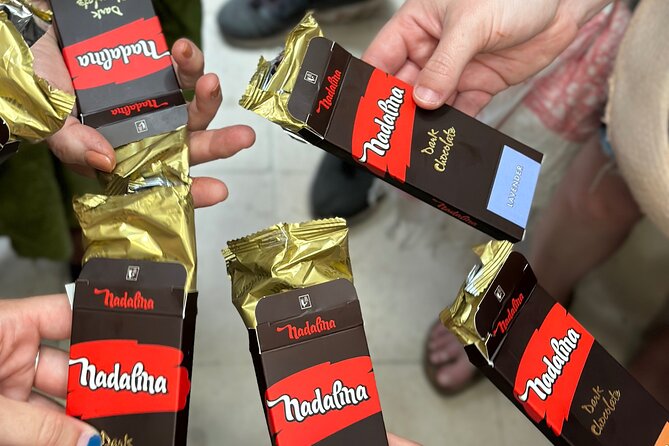
Dominisova ulica is a short stop, about 10 minutes, but it may be one of the most revealing. The street is known for its everyday character. Residents lean from windows, laundry hangs to dry, and ordinary routines unfold within the ancient palace walls.
This is the point where you are encouraged to slow down and observe. That sounds simple, yet it is easy to miss when you are busy photographing columns and doorways. A city becomes easier to understand when you notice how residents occupy it.
Dominisova ulica also shows why a local guide can add value. A visitor might pass through quickly and see only a narrow lane. Someone from Split can explain why the street matters and help you read the small signs of home life.
There is a useful travel lesson here: the most memorable part of a historic center is not always the largest monument. Sometimes it is a window, a drying shirt, or a resident using a space built for an entirely different era.
Because this stop is observational, the experience depends on your interest in everyday culture. If you prefer constant movement and major sights, it may feel quiet. If you want to understand how Split functions beyond tourism, it is a welcome pause.
Rubbing Gregory of Nin’s toe
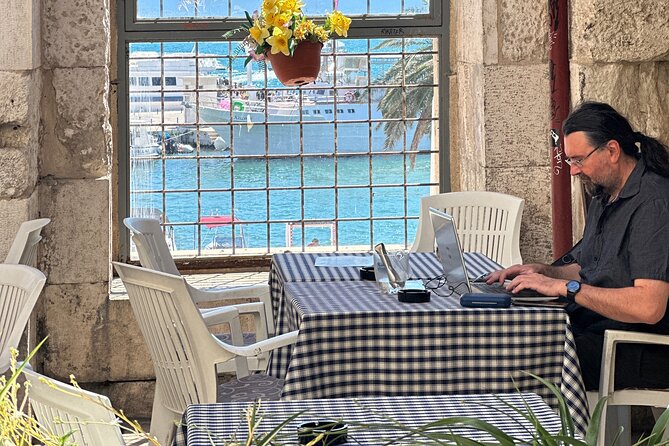
The walk continues to the statue of Grgur Ninski, or Gregory of Nin. You will rub the statue’s toe and hear why it has a place in Split.
This is a quick 10-minute stop with a playful ritual attached. It gives the tour a lighter moment after the more serious stories of Roman rule and Croatian history. The toe-rubbing tradition also makes the statue easy to remember, especially for families and first-time visitors.
The important point is the explanation. Without context, rubbing a bronze toe is just a photo opportunity. With a local story, it becomes part of the city’s customs and public memory.
The stop is near the Golden Gate area, and the tour ends at the Golden Gate on Dioklecijanova 7. The final location is useful if you want to continue exploring the palace independently after the walk.
Pjaca and the old trades of Split

The final listed stop is Narodni Trg, usually called Pjaca. It was the first square built outside the ancient city, and it has long served as a place for meeting, walking, people-watching, romance, and public activity.
The stop lasts about 10 minutes, though the square is the sort of place you may want to revisit on your own. The tour connects it with old trades, traditional craftsmen, and activism in Split. That gives you another view of the city, one based on work and public life rather than imperial architecture.
Pjaca helps complete the route’s movement through time. You begin beside the waterfront, enter the Roman palace, watch modern life in its lanes, hear stories connected with Croatian identity, and finish in a square that grew beyond the original city.
I like this ending because it leaves you in a useful central area rather than returning you to an out-of-the-way meeting point. You can continue toward the Golden Gate, revisit the palace, or simply sit nearby and watch Split carry on.
Mirjana’s storytelling style
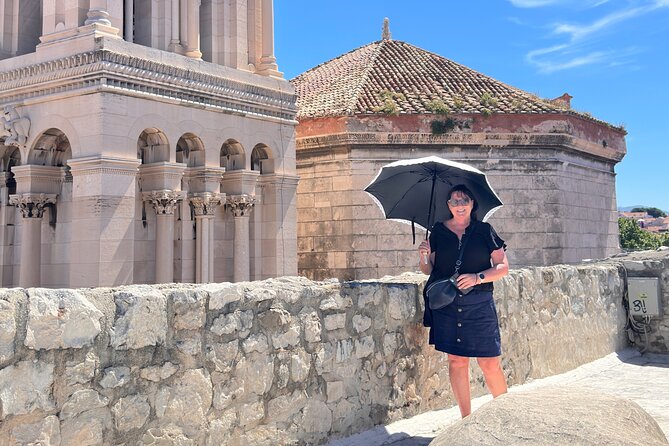
The strongest feature of this tour is the guide. Mirjana is described as a native of Split and as someone who adapts her explanations to the people in front of her. That matters on a private tour, especially when your group includes mixed ages or different levels of interest in history.
Her style is not built around dry facts. She uses anecdotes and personal energy to connect the Roman period, local traditions, cultural change, and recent Croatian history. One account describes a discussion that moved from physics and culture to the country’s conflicts and recovery. That suggests a guide who can handle both light moments and serious subjects.
Her English is described as very strong, and one group noted that she spoke clearly and confidently enough for everyone to hear. That is useful in narrow streets, where sound can bounce around and small groups may be spread out.
You should still keep expectations realistic. A tour lasting around 90 minutes cannot explain every layer of Split. Mirjana’s approach gives you selected stories and a sense of the city rather than an exhaustive academic survey.
What $258.88 means for your group
The price is $258.88 for a private group of up to eight people. That works out to about $32 per person if eight people join, but the per-person cost rises sharply for smaller parties.
For a full group, the value is strong. You receive a private guide, a local perspective, photo suggestions, snacks, and a focused route through several central sights. There is no separate admission charge listed for the stops, though that does not mean the tour itself is free.
For two people, the price requires more thought. You are paying for privacy and personal attention, not for a long duration or extensive included food. If you care about asking questions, setting the pace, and avoiding a large group, the cost may feel justified. If you simply want a broad introduction at the lowest price, a shared walk could be better value.
The short duration is part of the calculation. At roughly 80 to 95 minutes, this is an efficient orientation rather than a half-day activity. I would see it as a first look at Split, especially useful early in your stay.
Timing, walking, and practical details
This is a walking experience through central Split. The meeting point is the Split sign at Riva Harbor, and the end point is the Golden Gate at Dioklecijanova 7. The tour is offered in English and uses a mobile ticket.
Most people can participate, and service animals are allowed. The meeting point is near public transportation, which makes arrival fairly straightforward, though you should allow time to find the exact Split sign.
The old city includes narrow streets and historic surfaces, so comfortable shoes are a sensible choice. That is practical advice for any walking route through Diocletian’s Palace, though the supplied information does not specify the exact accessibility conditions of every lane.
The experience operates as a private activity. Only your group takes part, which can make it easier to pause for questions or spend more time on a story that catches your interest. The published duration is approximate, so avoid scheduling a tight connection immediately afterward.
Free cancellation is available if you cancel at least 24 hours before the start time. Cancellations made less than 24 hours ahead are not refunded, and changes inside that window are not accepted. Gratuities are not included, so plan for tips separately if you feel the guide has earned one.
Who will enjoy this experience most
I would recommend this walk to you if you want:
- A short first orientation to Split
- Stories about local life alongside Roman history
- A private guide for your own group
- A guide who can discuss both ancient and recent Croatian history
- Photo ideas and a few local food touches
- A route that ends near another major entrance to the palace
It should suit couples, families, and small groups who enjoy conversation. The private format also helps if your party wants to ask many questions or needs a flexible pace.
You may want another option if you are seeking a long archaeological tour, a full meal-based food experience, or entry to several paid museums. The tour includes snacks, not a full lunch, and its main focus is storytelling and local perspective.
Should you book People of Split?
Book it if you want to meet Split through its people as much as through its stones. The route covers the essential historic center, but the real value comes from the way Mirjana links Diocletian’s Palace with windows, laundry, crafts, markets, public squares, and Croatia’s more recent story.
The price makes the most sense for groups of four to eight. For a couple, book it when a private guide and personal storytelling matter more to you than finding the cheapest possible introduction.
If you have only one short window in Split, this is a practical choice. You will leave with the basic geography of the old city, several memorable stories, suggestions for photographs, and a better sense of why people still call this ancient palace home.
FAQ
Where does the People of Split tour begin?
The tour begins at the Split sign at Riva Harbor, 21000, Grad, Split, Croatia.
Where does the tour end?
The walk ends at the Golden Gate at Dioklecijanova 7, 21000, Split, Croatia.
How long does the tour take?
The approximate duration is 1 hour 20 minutes to 1 hour 35 minutes.
What language is the tour offered in?
The experience is offered in English.
How many people can join the private tour?
Up to eight people can participate in one private group.
Are snacks included?
Yes. Snacks are included, along with a heritage interpretation guide, a native local guide, and suggestions for the best photo spots in Split.
Can I cancel for a full refund?
Yes, if you cancel at least 24 hours before the experience start time. Cancellations made less than 24 hours ahead are not refunded.
Just added around Split
- Private VIP Blue Lagoon and 3 Islands Tour★ 4.5 · 9 reviews
- Split highlights – Evening walking tour★ 5.0 · 9 reviews
- Private boat transfer Split – Bol★ 5.0 · 9 reviews
- Private Photography Activity in Split★ 5.0 · 9 reviews
- From Split: Trogir & Blue Lagoon Boat Tour with Snorkeling★ 4.6 · 9 reviews
- Bike, Beer & Poljud Stadium Tour★ 5.0 · 9 reviews
- From Hvar: Blue cave group speedboat tour full day★ 5.0 · 9 reviews
- Split Walking Tour: History, Legends & Tales★ 5.0 · 9 reviews
Split Tours, compared.

Krka Waterfalls Trip with Boat Cruise and Swimming
Read our review →
Blue cave, Mamma Mia and Hvar, 5 islands speedboat tour
Read our review →
Blue Cave, Mamma Mia, Hvar and 5 Island Tour
Read our review →
Blue Lagoon & 3 Islands Cruise with Lunch from Split
Read our review →