Reviewed · VIP
Best of Split & Trogir: Private VIP Tour with Local Guide
Croatia’s past is built into its streets. This six-hour private tour links Diocletian’s Palace in Split with the compact medieval town of Trogir, giving you two major Dalmatian sights in one outing. I like the one-to-one format and the chance to hear local stories from guides such as Kristina and Andrea. The main drawback is price: at $228.78 per person, it makes the most sense for a small group that values private guiding.
The tour also keeps the sightseeing focused, with short visits at each major stop and pickup available. I like that you can avoid wrestling with crowds on your own, though several admission fees are extra, and six hours leaves little room for a leisurely lunch or unplanned wandering.
In This Review
- Key points at a glance
- Why Split and Trogir work well together
- Peristyle: the heart of Diocletian’s Palace
- Cathedral of Saint Domnius and the Temple of Jupiter
- Gregory of Nin and the polished lucky toe
- The Cellars of Diocletian’s Palace
- Trogir’s Central Square and medieval civic life
- St. Lawrence’s Cathedral: centuries of changing styles
- Kamerlengo Fortress and the Adriatic view
- The Town Loggia and Čipiko Palace
- What the $228.78 price really buys
- Guide quality and the private-tour advantage
- Who should book this six-hour tour?
- FAQ
- How long does the private Split and Trogir tour last?
- How much does the tour cost?
- Is the tour private?
- Is pickup available?
- What language is the tour offered in?
- Are admission tickets included?
- Can I cancel for a full refund?
- Should you book it?
Key points at a glance
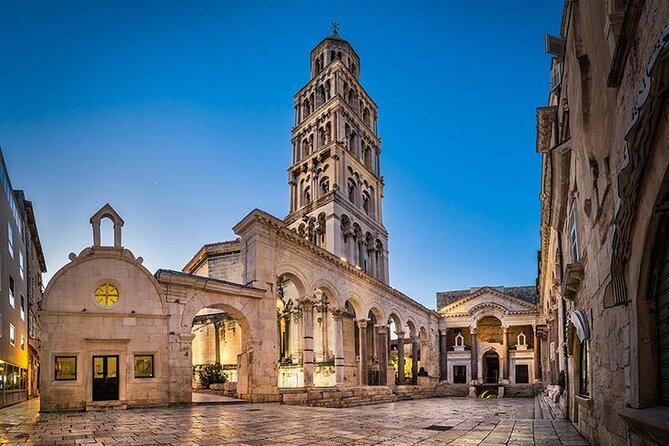
- One private group only: You do not share the guide with strangers, which makes questions and pace changes easier.
- Two UNESCO-listed old towns in one day: Split provides Roman imperial remains, while Trogir brings Venetian and medieval architecture.
- Local guides add personality: Kristina is praised for personal stories and pride in local traditions, while Andrea helped one group move through busy areas with ease.
- The route covers major landmarks quickly: Each listed stop receives about 15 minutes, so this is an overview tour rather than a slow architectural study.
- Several entry tickets cost extra: The Cellars of Diocletian’s Palace, St. Lawrence’s Cathedral, Kamerlengo Fortress, and Čipiko Palace are not included.
- Flexible cancellation: You can cancel for a full refund up to 24 hours before the start time.
Why Split and Trogir work well together
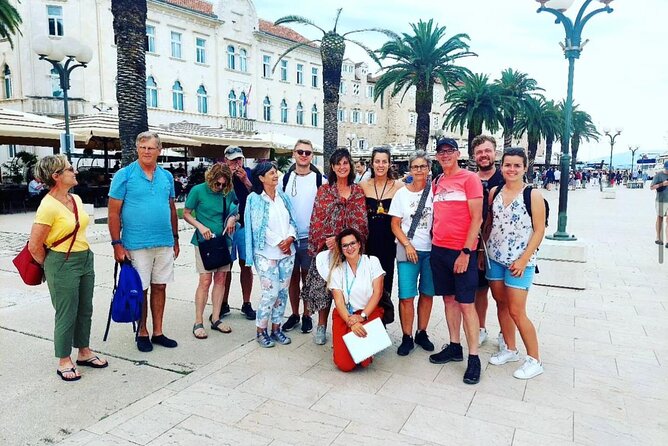
Split and Trogir are close enough to pair, yet different enough to keep the day interesting. Split grew around the palace of Roman Emperor Diocletian, whose fourth-century complex still forms the core of the modern old town. Trogir offers a smaller, more medieval setting with Venetian touches, stone lanes, public buildings, and a fortified waterfront.
I like this pairing because the contrast gives you a clearer sense of Dalmatia. Split feels like a living city built inside an ancient imperial shell. Trogir feels more compact and self-contained, with its central square, cathedral, loggia, palace, and fortress all packed into a short walk.
The private format matters here. Both old towns can be crowded, and a guide who knows the streets can keep the day moving. Andrea, one of the named guides, received special praise for handling crowds with ease. That is useful in Split, where narrow passages and popular photo spots can slow an independent visit.
The tour is offered in English and lasts about six hours. Pickup is available, but the supplied details do not specify the pickup area or transport arrangements, so you should confirm those points before booking. The itinerary lists short stops, generally 15 minutes each. That creates a tidy sightseeing plan, but you should not expect long visits inside every monument.
A few more tours and experiences worth a look
- SPLIT-PRIVATE Walking Tour of Diocletian’s Palace & Old Town
★ 5.0 · 467 reviews - Private Krka Waterfalls tour with 30min Boat Cruse
★ 4.0 · 458 reviews - Split by Private Electric Rickshaw – Palace & Hidden Gems
★ 5.0 · 412 reviews
Peristyle: the heart of Diocletian’s Palace
The Peristyle is the natural starting point for understanding Split. It sits where the palace’s two main roads crossed and was designed as the central open court of the imperial complex. Its colonnade gives the space a formal Roman shape, while the surrounding city shows how later generations adapted the palace for daily life.
I would pay close attention here to the way ancient stone and modern activity share the same setting. This is not an isolated ruin behind a fence. It is part of Split’s old town, so the square helps you see how a Roman palace became the foundation of a living city.
The listed visit lasts 15 minutes and admission is free. That is enough for an introduction and a few questions, but not much more. If you care about architecture, ask the guide to point out the relationship between the square, the palace roads, and the buildings that surround it.
Cathedral of Saint Domnius and the Temple of Jupiter
The Cathedral of Saint Domnius occupies a remarkable place in Split’s story. It was consecrated around the start of the seventh century and is regarded as the oldest Catholic cathedral still in use in its original structure, though its bell tower dates from the 12th century.
That detail makes the cathedral especially unusual. It began as part of Diocletian’s imperial complex, then became a Christian place of worship. The tour gives you the chance to see that change within the same ancient setting rather than treating Roman and medieval Split as separate attractions.
The Temple of Jupiter sits in the western part of the palace near the Peristyle. It was built between 295 and 305, during construction of the palace, and was dedicated to the Roman god Jupiter. Its position helps explain the palace’s religious and ceremonial planning.
The available details do not give a separate visit length or ticket price for the cathedral and temple. The short timing around the Peristyle means you may receive an exterior explanation or a brief interior visit, depending on the day’s pace and access. If entering the cathedral is important to you, ask exactly what is included before departure.
Gregory of Nin and the polished lucky toe
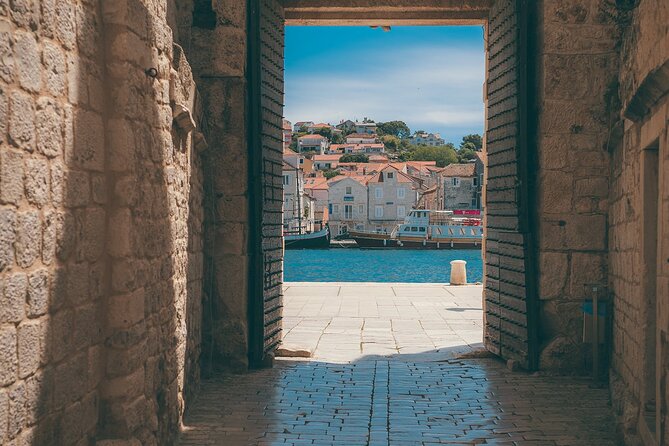
The 8.5-metre statue of Gregory of Nin is one of Split’s most playful stops. Created by Croatian sculptor Ivan Meštrović, it shows the medieval bishop in monumental form. The most famous feature is not the face or robes, but the shiny toe.
Local tradition says rubbing the statue’s toe brings good luck. Generations of hands have polished it smooth, making the custom easy to spot. I like this stop because it breaks up the formal history with a small piece of local folklore.
You receive about 15 minutes here, with no admission fee. That is plenty of time for a look, a photograph, and a quick explanation of Gregory of Nin’s place in Croatian history. It is also a practical pause between larger monuments.
Something different for another day:
- Split: Krka Waterfalls Trip with Boat Cruise and Swimming
★ 4.8 · 10,519 reviews - From Split: Krka Waterfalls, Food & Wine Tasting Tour
★ 5.0 · 9,326 reviews - Blue cave, Mamma Mia and Hvar, 5 islands speedboat tour
★ 5.0 · 7,150 reviews - From Split: Krka Waterfalls, Food & Wine Tasting Tour
★ 4.9 · 6,598 reviews
The Cellars of Diocletian’s Palace
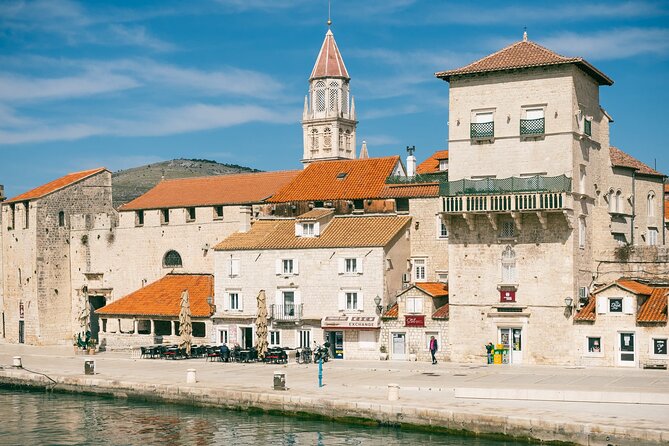
The palace substructures are among the strongest parts of the Split visit. These underground halls once supported the emperor’s private apartments above. They remain one of the best-preserved ancient complexes of this kind.
The value of the cellars is architectural as much as historical. They mirror the layout of the palace above, so the guide can help you understand how the imperial residence was built. You are not just looking at dark rooms. You are seeing the structural base of the palace and the reason the upper city has retained its ancient plan.
The planned stop lasts 15 minutes, and admission is not included. That extra cost is worth considering when you compare the tour price with a standard walking tour. A quick visit gives you the main idea, but you may want more time if underground Roman construction interests you.
Trogir’s Central Square and medieval civic life
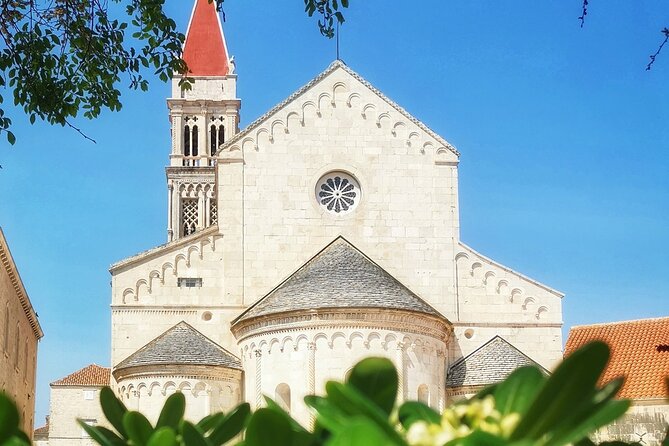
Trogir changes the mood of the day. Its Central Square, also called John Paul II Square, is the main gathering place of the old town. The square is surrounded by important civic and religious buildings, including the loggia and clock tower.
Trogir’s old town is recognized by UNESCO, and its Venetian character is easy to read in the stone buildings and compact public spaces. The loggia once served as a public courtroom, showing that this was not only a place for church ceremonies or noble homes. It was also a center of public decisions and legal life.
The listed stop lasts 15 minutes and is free. In summer, a nearby coffee bar can partly block the loggia’s pillars. You can still see the Relief of Justice, created by Nicholas Florentino, but the setting may not be as clear for photographs as you would hope.
One useful detail is that the tour order may not always be fixed. Andrea took one group to Trogir first before visiting Diocletian’s Palace. That can help with crowd control, but you should ask Discovery Tours which town comes first on your date.
St. Lawrence’s Cathedral: centuries of changing styles
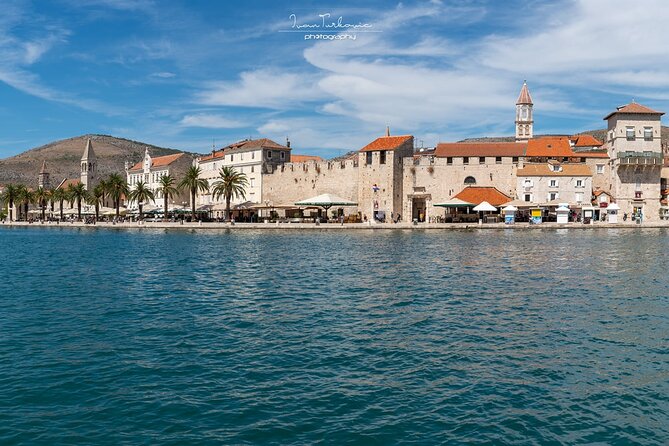
St. Lawrence’s Cathedral is Trogir’s most imposing monument. It is a three-nave basilica built in Romanesque and Gothic forms, with construction lasting across several centuries. As a result, it shows the changing architectural styles of Dalmatia rather than a single tidy design period.
That long building history gives the cathedral special value on a guided tour. I would ask the guide to point out which elements belong to which era, since the differences may not be obvious during a quick walk through the old town.
Admission is not included, and the visit is listed at 15 minutes. This is enough for a strong overview, but not a detailed study of every carving and architectural feature. If the cathedral is a priority, budget for the extra ticket and keep your questions ready.
Kamerlengo Fortress and the Adriatic view
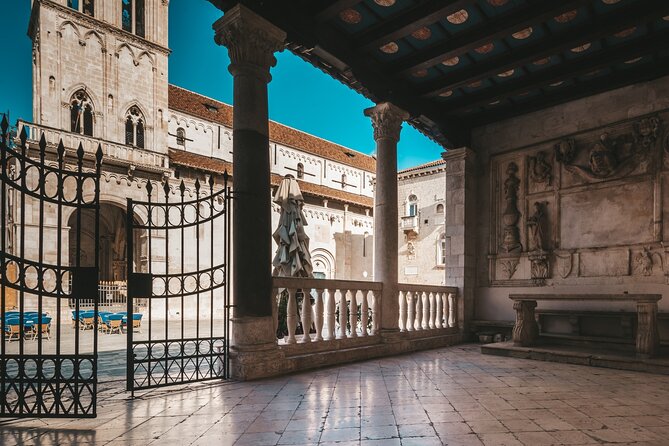
Kamerlengo Fortress dates from the 15th century, when Trogir was under Venetian rule. It was built to protect the town from naval attack and reflects Trogir’s importance as a coastal and maritime center.
The fortress adds a change of scale to the day. After narrow lanes and decorated façades, you get a defensive structure designed for control and protection. It also offers views toward the old town, marina, and nearby islands.
Entry is not included, and the planned visit lasts about 15 minutes. That makes this more of a fast viewpoint and historical stop than a long fortress exploration. If you want time to walk around the walls, confirm how much free time is allowed.
The Town Loggia and Čipiko Palace
The Town Loggia was a public meeting place where legal matters were discussed and important decisions were announced. It offers a useful counterpoint to the noble and religious buildings nearby. Trogir’s past was shaped not only by rulers and bishops, but also by civic institutions.
The tour also includes Čipiko Palace, the largest residential palace in Trogir. It belonged to the influential Čipiko family and combines Gothic and Renaissance features. The building gives you a look at the wealth of Trogir’s noble class and the role of powerful families in the town’s development.
Both stops are scheduled for about 15 minutes. The loggia is free, while Čipiko Palace admission is not included. The short visits keep the route practical, but they also mean you will rely on the guide to identify the details worth noticing.
What the $228.78 price really buys
At $228.78 per person, this is not a budget sightseeing walk. The value comes from privacy, a local English-speaking guide, pickup being offered, and the chance to cover Split and Trogir in one six-hour outing.
The price becomes easier to justify when shared among a small private group, especially if you want to ask questions or adjust the pace. It is less compelling if you mainly want transportation and a quick list of landmarks. In that case, public transport or a standard group tour may cost less, though the supplied information does not provide comparison prices.
You should also add the cost of entry to the Cellars of Diocletian’s Palace, St. Lawrence’s Cathedral, Kamerlengo Fortress, and Čipiko Palace. The free stops include the Peristyle, Gregory of Nin statue, Central Square, and Town Loggia. The exact total depends on which paid sites you enter.
This is best viewed as a guided introduction to two historic towns, not a full museum day. The short stop pattern covers a lot of ground, but you will trade depth for range.
Guide quality and the private-tour advantage
The strongest personal detail attached to this experience is the praise for Kristina. She is described as extremely well informed, easy to understand, warm, and proud of keeping local traditions alive. Her personal stories added something that a basic monument-by-monument walk cannot provide.
Andrea is also singled out for guiding a group through crowded areas with ease. That matters in Split, where the palace streets can become confusing and slow during busy periods.
Because the tour is private, only your group participates. You can ask for clarification, focus on Roman history, spend more time on churches, or request a different balance between Split and Trogir. The information does not promise a fully custom itinerary, so treat flexibility as a likely benefit of the private format, not a guaranteed change to every stop.
Who should book this six-hour tour?
I would recommend it to first-time visitors who want a strong introduction to Split and Trogir without arranging two separate visits. It also suits families and small groups who prefer a private guide and want help moving through crowded old-town streets.
History fans should like the mix of Roman, medieval, Gothic, Renaissance, and Venetian subjects. Architecture lovers will get the most from the Peristyle, palace substructures, St. Lawrence’s Cathedral, and Čipiko Palace.
You may want a different option if you prefer slow travel. Six hours and roughly 15 minutes per listed stop create a brisk schedule. Visitors who want long café breaks, extensive shopping, or detailed interior visits may feel rushed.
Service animals are allowed, the tour is near public transportation, and most people can participate. A mobile ticket is provided, and confirmation arrives at booking. The activity is offered in English.
FAQ
How long does the private Split and Trogir tour last?
The tour lasts approximately six hours.
How much does the tour cost?
The listed price is $228.78 per person.
Is the tour private?
Yes. Only your group participates in the activity.
Is pickup available?
Yes, pickup is offered. The supplied details do not specify the pickup area, so confirm the location when booking.
What language is the tour offered in?
The tour is offered in English.
Are admission tickets included?
Some stops are free, including the Peristyle, Gregory of Nin statue, Central Square in Trogir, and Town Loggia. Admission is not included for the Cellars of Diocletian’s Palace, St. Lawrence’s Cathedral, Kamerlengo Fortress, and Čipiko Palace.
Can I cancel for a full refund?
Yes. You can cancel at least 24 hours before the experience start time for a full refund. Cancellations or changes made less than 24 hours before the start time are not accepted for a refund.
Should you book it?
Book this tour if you want private guiding, local stories, and two major old towns in one day. Kristina’s personal approach and Andrea’s skill with crowded streets are strong reasons to value the guide rather than treating this as simple transport.
Think twice if you are watching every kuna or want long, unhurried visits inside each monument. The added admission fees and quick 15-minute stops raise the total cost and limit free time. For a small group that wants an organized first look at Split and Trogir, though, this is a well-focused way to get your bearings and understand how Roman, medieval, and Venetian Dalmatia fit together.
Just added around Split
- Private VIP Blue Lagoon and 3 Islands Tour★ 4.5 · 9 reviews
- Split highlights – Evening walking tour★ 5.0 · 9 reviews
- Private boat transfer Split – Bol★ 5.0 · 9 reviews
- Private Photography Activity in Split★ 5.0 · 9 reviews
- From Split: Trogir & Blue Lagoon Boat Tour with Snorkeling★ 4.6 · 9 reviews
- Bike, Beer & Poljud Stadium Tour★ 5.0 · 9 reviews
- From Hvar: Blue cave group speedboat tour full day★ 5.0 · 9 reviews
- Split Walking Tour: History, Legends & Tales★ 5.0 · 9 reviews
VIP, compared.

Elaphiti Islands On The Luxury Pirate Ship Karaka Dubrovnik
Read our review →
Luxury Blue Cave and Elaphiti Islands Small Group Tour
Read our review →
Luxury Blue Cave, Hvar and Vis Boat Tour from Split and Brac
Read our review →
Blue Cave & Hvar, 5 Islands Speedboat with Luxury Seats in Shade
Read our review →
Elaphite Islands Luxury Private Boat Tour with Cap Camarat 7.5
Read our review →
Bosnia Day Trip: Mostar and Kravice Waterfalls by Luxury Minibus
Read our review →