

Reviewed · GUIDED
Zadar Guided Tour with Virtual Reality Experience
History gets a clever visual reboot here. This two-hour walk pairs Zadar’s old streets with virtual reality scenes that rebuild vanished churches, Roman monuments, medieval attacks, and World War II damage. I like the way the tour reaches places you cannot normally enter, especially the interiors of St. Krševan Church and parts of St. Anastasia Cathedral. I also like the guide-led format, since a good explanation gives the VR scenes much more meaning.
The main catch is the technology. The guide receives strong praise for friendliness, clear English, and local knowledge, but the VR software can feel dated. Some scenes are simple panoramic views, and the graphics may remind you of an early computer game. At $36.04 per person, the price is fair if you want a guided introduction with unusual visuals, but less convincing if you expect modern, high-end VR.
In This Review
- Key points to know before booking
- What this Zadar VR tour is really like
- St. Krševan Church and a courtyard most people miss
- St. Simon’s Church and Zadar’s silver chest
- Five Wells, Roman gates, and Venetian defenses
- The Roman Forum rebuilt in front of your eyes
- The Bell Tower scene and Zadar’s wartime scars
- St. Anastasia Cathedral beyond the public areas
- The former market and the destruction of World War II
- The Sea Organ, the Crusader attack, and the final view
- The guide, headset, and limits of the technology
- Who will get the most from this $36.04 tour
- Should you book the Zadar VR tour?
- FAQ
- Where does the Zadar VR tour begin?
- Where does the tour end?
- What time does the experience start?
- How long does the Zadar guided VR tour last?
- Is the tour offered in English?
- Are VR headsets included?
- How many people can join the tour?
- Can I cancel for a full refund?
Key points to know before booking

- Hidden church access: VR lets you see inside St. Krševan Church, including its monastery courtyard and interior, even though it is closed to the public.
- Eight compact stops: The route covers Roman, medieval, religious, wartime, and modern Zadar in about two hours.
- The guide matters: The strongest part of the experience is the friendly explanation at each stop, not the graphics alone.
- World War II is central: Several scenes show bombing and buildings that disappeared, adding a serious layer to the walk.
- Easy old-town finish: You begin at Magic Croatia Travel Agency and end beside the Sea Organ on the waterfront.
What this Zadar VR tour is really like
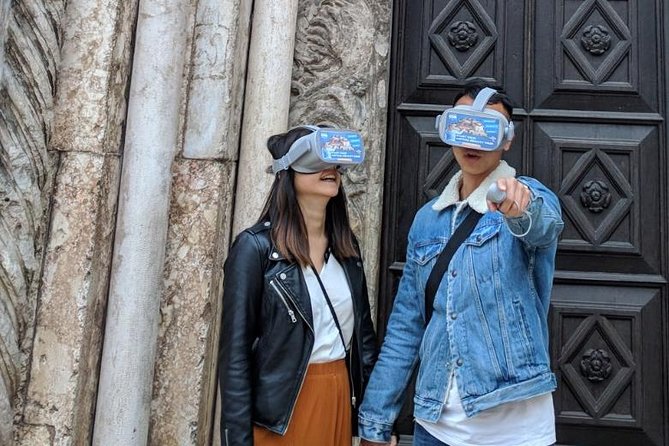
The tour begins at 10:00 a.m. at Magic Croatia Travel Agency on Poljana Pape Aleksandra III. The walk remains within Zadar’s historic center and ends at the Sea Organ on Obala kralja Petra Krešimira IV. You do not ride a bus or move between distant parts of the city, so the two-hour schedule is easy to fit into a morning.
The group can include up to 25 people. That is large enough that you may not receive constant one-to-one attention, but the guide is available to explain how the headset works and add context at each stop. One especially useful detail from the feedback is that the guide takes time to explain the equipment and offers extra information at individual sites.
The experience is offered in English, with tours in multiple languages also available. At $36.04, you are paying for a guided walk, the headset, and a series of visual reconstructions. It is not simply a standard walking tour with a gadget added at the end. Still, the value depends on your expectations. If you want polished, cinematic VR, the software may disappoint. If you want a lively way to connect scattered ruins and lost buildings, the price is easier to justify.
A few more tours and experiences worth a look
- Zadar: Plitvice Lakes Guided Day Tour with Tickets
★ 4.9 · 3,148 reviews - Zadar: Plitvice Lakes Full-Day Guided Tour with a Boat Ride
★ 4.7 · 807 reviews - Zadar: Guided Tour to Ugljan, Osljak, & Galevac by Speedboat
★ 4.9 · 523 reviews
St. Krševan Church and a courtyard most people miss
The first stop is the Church of St. Krševan, also called Chrysogonus in English. Built in 1175 as the church of a male Benedictine monastery, it is one of Zadar’s finest Romanesque buildings.
The outside is well preserved, but the church is closed to the public. That makes this an excellent use of VR. Instead of looking only at a locked doorway, you can use the headset to view the monastery courtyard and enter the church interior virtually.
This is one of the tour’s most useful moments because the technology solves a real sightseeing problem. You are not looking at a digital version of a room that you could easily visit on your own. You are seeing a part of Zadar that is normally off-limits.
The stop lasts about 10 minutes. That is enough for an introduction, but not enough for a long architectural discussion. Pay close attention to the guide’s explanation, since the visual scene alone may not tell you why the church matters.
St. Simon’s Church and Zadar’s silver chest
At St. Simon’s Church, the focus shifts to one of the city’s most important religious treasures: the silver-plated Gothic chest holding the relics of St. Simeon, a patron saint of Zadar.
You will see the church interior and learn why St. Simeon remains important to the city. The chest gives this stop a strong visual and cultural focus. It is not just another old church on a long list of stops. The guide connects the object to local devotion that continues today.
This visit also shows the tour’s pattern. Each location receives roughly 10 minutes, so you get a clear introduction rather than a full museum-style explanation. I would treat this walk as a first look. You can return later to sites that catch your attention, if opening hours allow.
Five Wells, Roman gates, and Venetian defenses
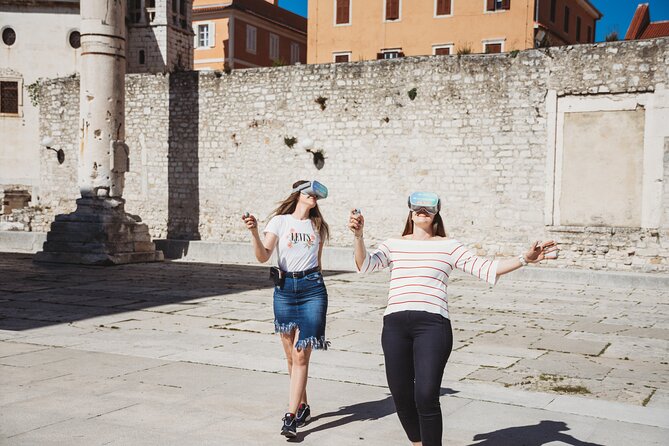
The Five Wells stop brings several periods together in a small area. Here, you learn about the Roman gates that once provided entry into ancient Zadar. The guide then explains the entrance to the medieval city and the later construction of the Venetian walls.
That sequence matters because Zadar’s defenses changed as the city changed. Roman access points, medieval boundaries, and Venetian fortifications were not built for the same threats. A normal walk can leave you looking at stones without seeing how the city’s shape developed. The explanation helps you connect those remains.
The stop lasts around 10 minutes. It is less dependent on dramatic VR than the church and Forum scenes, so the guide’s storytelling carries more weight. If you enjoy maps, fortifications, and the physical layout of old cities, this part should be particularly helpful.
Something different for another day:
- Zadar: Kornati Boat Trip with Lunch and Swim Stops
★ 4.5 · 1,498 reviews - Zadar: Plitvice Lakes with Boat Ride and Zadar Old Town Tour
★ 4.9 · 1,368 reviews - Zadar: Kornati and Telašćica Full-Day Boat Trip with Lunch
★ 4.1 · 1,193 reviews - From Zadar: Plitvice Lakes with Boat Ride & Zadar Old town tour
★ 5.0 · 1,129 reviews
The Roman Forum rebuilt in front of your eyes
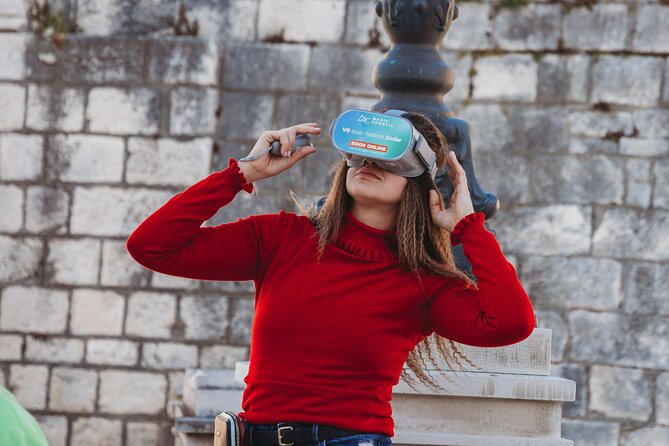
The Forum is the tour’s longest stop at about 15 minutes, and it earns the extra time. Built between the first and third centuries, it was the largest Roman forum in Croatia. Today, you see ruins, fragments, and open space rather than a complete civic center.
The headset changes that view. One sequence places you above the Forum, as if you are looking down from a hot-air balloon. An audio guide explains key facts while the Roman buildings and statues are reconstructed around you.
Another scene places you inside the Forum, surrounded by recreated structures. The final image shows the temple dedicated to Jupiter, Juno, and Minerva, dating from the first century BC. You also hear about ancient religious rituals linked to the temple.
The best moment comes when the VR ends and you look at the actual stones again. Some pieces of the original construction remain in place after more than 2,000 years. That contrast between the imagined Roman city and the fragments beneath your feet gives the stop its value.
There is one practical limitation. Looking down from the virtual balloon can feel odd because you do not see your legs or a clear floor beneath you. One person found the effect strange at first but still enjoyed it. If you are sensitive to VR movement, the guide’s help should make the transition easier, but the supplied information does not promise a specific comfort feature.
The Bell Tower scene and Zadar’s wartime scars
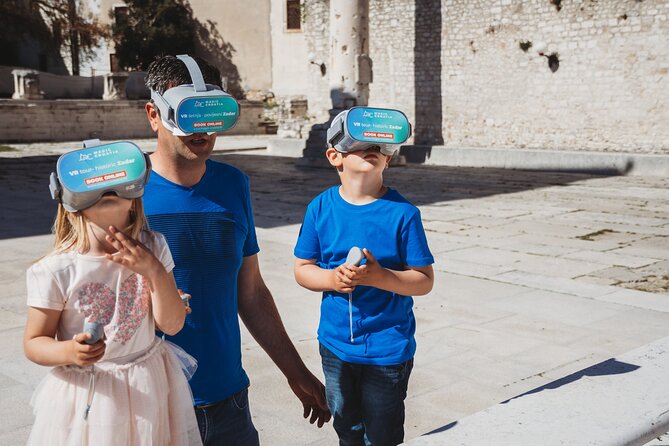
The Bell Tower stop offers a very different kind of reconstruction. You look toward Zadar’s old town from the height of St. Anastasia’s bell tower while a World War II air attack unfolds below.
The scene shows planes dropping bombs, buildings burning, and structures collapsing. At the end, a map identifies areas that suffered heavy damage and no longer exist.
This is not light sightseeing, and it should not be treated as a special effect alone. Zadar’s wartime destruction is easy to miss when you walk through the rebuilt center. The VR scene gives you a visual sense of what was lost and how much the city changed.
The stop lasts about 10 minutes. It is one of several moments that make the tour more than a Roman ruins walk. If you prefer strictly ancient history, this section may feel like a sharp change of subject. I see that change as useful, since modern Zadar cannot be understood through antiquity alone.
St. Anastasia Cathedral beyond the public areas
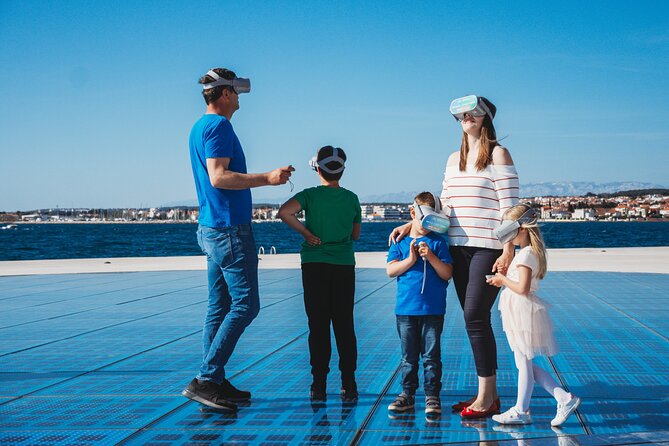
St. Anastasia’s Cathedral is the largest cathedral in Dalmatia and dates from the 12th and 13th centuries. St. Anastasia is one of Zadar’s protectors, and her relics are kept inside the cathedral.
The VR visit takes you beyond the regular public view. You can see the baptistery and sacristy, areas closed to the public, while hearing the story of St. Anastasia.
Like the St. Krševan stop, this is where the headset offers access rather than mere decoration. You get a look at spaces that are not part of an ordinary stroll. The 10-minute format keeps the pace moving, though anyone with a strong interest in church art or architecture may want a separate visit to the cathedral.
The tour does not present every period in equal detail. One rating specifically noted that the information felt thinner at some stops than at others. That is a fair criticism. The route covers a lot, and the short timings mean the guide must choose only the most important points.
The former market and the destruction of World War II
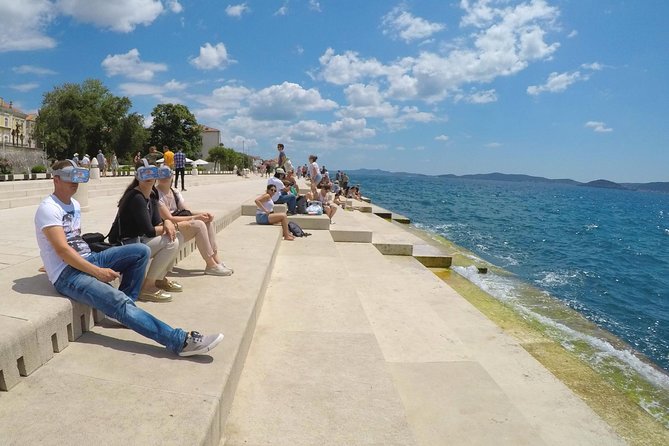
At Paseo Maritimo, the guide explains the former city market, where fish, fruit, vegetables, and other goods were once sold. The market disappeared after World War II bombing destroyed the area. Zadar’s present open market is on the opposite side of the city.
The VR scenes show residential buildings and a post office that no longer exist. You also see aircraft attacking the city. This stop gives a human scale to the wartime story. The Bell Tower scene shows destruction from above, while this section helps you picture ordinary streets, homes, and daily commerce.
It is another 10-minute stop, and the repeated bombing scenes may feel heavy. Still, they explain why parts of Zadar can appear newer than the city’s Roman and medieval identity suggests. I appreciate that the tour does not avoid this difficult chapter.
The Sea Organ, the Crusader attack, and the final view
The walk finishes on the waterfront at the Sea Organ and Greeting to the Sun. These modern installations were built in 2005, so they provide a clear link between old Zadar and the present city.
The VR scene rewinds the waterfront to the 13th century. Again, you look down from a hot-air-balloon viewpoint as Crusaders attack Zadar from the sea. The audio explains the background to the attack, including the fact that Zadar was a Catholic city.
That detail gives the scene moral and political weight. The attack was not simply an outside assault on an unrelated enemy. It involved a Catholic city, which makes the episode more complicated than a basic medieval battle story.
Ending at the Sea Organ is practical. You finish at one of Zadar’s most recognizable public spaces, where you can continue along the promenade after the guide leaves. The final stop lasts about 15 minutes, giving the tour a proper closing point rather than ending beside an ordinary street.
The guide, headset, and limits of the technology
The guide is the safest reason to book this experience. The strongest praise centers on friendliness, clear English, local information, and patient help with the headset. That support matters because VR can be confusing when you are standing on a busy street and trying to follow instructions.
The visual quality is more mixed. Some scenes use panoramic images that may be less useful than simply turning your head and looking around. The simulations have also been described as dated, with graphics similar to early-2000s computer games.
You should therefore think of the headset as a history aid, not a high-tech attraction. The best scenes are those that show places you cannot enter or buildings that no longer exist. The weaker scenes are those where the real view already gives you most of the information.
The group limit of 25 keeps the experience manageable, though it is not an intimate private tour. The guide’s ability to add information at each stop is important, especially when a VR scene feels thin.
Who will get the most from this $36.04 tour
I would recommend this tour to first-time visitors who want a quick orientation to Zadar. It covers the Roman Forum, churches, fortifications, the waterfront, and wartime destruction without requiring a full day.
It should also work well for families with teenagers. One German-language rating called it a good alternative to a normal city tour, especially with young people, and praised the fact that it was not too long. The VR element gives children and teens something active to do while still delivering real historical context.
History fans should enjoy the range of subjects, but they should arrive with realistic expectations. You receive a broad introduction, not a scholarly lecture. The guide’s explanation fills many gaps, but some locations receive only a brief treatment.
At $36.04, I consider the experience reasonably priced for a two-hour guided walk with equipment included. It offers stronger value if you are curious about inaccessible interiors and lost buildings. It offers weaker value if your main goal is a detailed architectural tour or cutting-edge graphics.
You can cancel for a full refund up to 24 hours before the 10:00 a.m. start time. Service animals are allowed, public transportation is nearby, and most people can participate. The confirmation arrives when you book, so the practical side is straightforward.
Should you book the Zadar VR tour?
Book it if you want to see what is missing from modern Zadar: closed church interiors, vanished markets, destroyed neighborhoods, and the Roman Forum before it became ruins. The route is well paced, the guide adds the human touch, and the final waterfront setting is convenient.
Skip it if you already know Zadar well or expect current-generation virtual reality. The software is the weak link, and a few scenes may feel basic. For most first-time visitors, though, the combination of a friendly guide, unusual access, and a compact route makes this a worthwhile introduction at a fair price.
FAQ
Where does the Zadar VR tour begin?
It begins at Magic Croatia Travel Agency, Poljana Pape Aleksandra III 7, 23000 Zadar, Croatia.
Where does the tour end?
The tour ends at the Sea Organ on Obala kralja Petra Krešimira IV, along Zadar’s sea promenade.
What time does the experience start?
The scheduled start time is 10:00 a.m.
How long does the Zadar guided VR tour last?
The experience lasts approximately two hours.
Is the tour offered in English?
Yes. English is offered, and tours are available in multiple languages.
Are VR headsets included?
Yes. VR headsets are included, and a guide is available to help you use them.
How many people can join the tour?
The maximum group size is 25 people.
Can I cancel for a full refund?
Yes. You can cancel at least 24 hours before the local start time for a full refund. Cancellations or changes made less than 24 hours in advance are not accepted for a refund.
Just added around Zadar
- Zadar Guided Electric Bike Tour★ 5.0 · 9 reviews
- Zadar: Private Half Day Speedboat Tour★ 4.4 · 9 reviews
- Zadar: Sunset Panorama Tour with Eco Tuk Tuk★ 5.0 · 9 reviews
- PRIVATE Romantic Sunset Boat Tour Zadar with Local Wine 1,5h★ 4.5 · 9 reviews
- National Park Krka Private Return Day Transfer by Minivan★ 4.5 · 9 reviews
- Krka Waterfalls private transfer with Pickup & Drop Off★ 5.0 · 9 reviews
- Private 3 Hour Sightseeing Tour of Major Attractions in Zadar★ 5.0 · 10 reviews
- Private Sunset Tour across Zadar shoreline★ 5.0 · 10 reviews
Guided, compared.


Plitvice & Rastoke Guided Day Trip with Ticket
Read our review →
Plitvice Lakes Guided Tour with Entry Tickets
Read our review →
Plitvice Lakes National Park Guided Day Tour from Split
Read our review →
Rastoke & Plitvice Lakes Guided Tour with Ticket
Read our review →
Zrmanja River: Half-Day Guided Kayaking Tour Near Zadar
Read our review →Browse the lists this tour appears in