
Reviewed · CYCLING TOURS
Classic Zagreb Bike Tour
Zagreb reveals itself best at bicycle speed. This three-hour ride links the cathedral, market, Upper Town, grand squares, and theater district while giving you a local guide, a modest break, and a useful first look at Croatia’s capital. I especially like the small-group format, capped at 12 people, and the way the route covers both the medieval hilltop and the orderly Lower Town. The included coffee, soft drink, or ice-cream stop is another welcome touch.
The main consideration is the equipment and traffic setting. Most riders describe an easy, relaxed route, but a few found the bikes or helmets worn, and Zagreb’s cobblestones, pedestrians, trams, and one steeper hill require attention. If you are a confident city cyclist, this is a practical way to get your bearings quickly. If you rarely ride, ask for a careful bike check before setting off.
In This Review
- Key points before you book
- Why a bicycle works so well in Zagreb
- From the cathedral to Dolac Market
- Tkalciceva Street and the old city divide
- Stone Gate and the Upper Town
- The 1892 funicular and Zagreb’s city views
- A sweet break, then the Lower Town
- King Tomislav Square and the green Lower Town
- Guides, group size, and the human side
- Is $54.44 a fair price?
- Who should book this ride?
- Should you book the Classic Zagreb Bike Tour?
- FAQ
- How long does the Classic Zagreb Bike Tour last?
- Where does the bike tour start?
- Where does the tour finish?
- What is included in the price?
- Is the funicular railway ticket included?
- Are alcoholic drinks included?
- What language is the tour offered in?
- How many people can join the tour?
- Can I cancel for a full refund?
Key points before you book
- Three hours covers Zagreb’s main historic zones: You see Kaptol, Gradec, the Upper Town, and the Lower Town without spending the whole day on your feet.
- The ride is mostly easy, but not completely flat: Several sections are gentle, with one notable uphill stretch that some riders chose to walk.
- A break is included: You can stop for coffee, a cold drink, or ice-cream, with alcoholic drinks excluded.
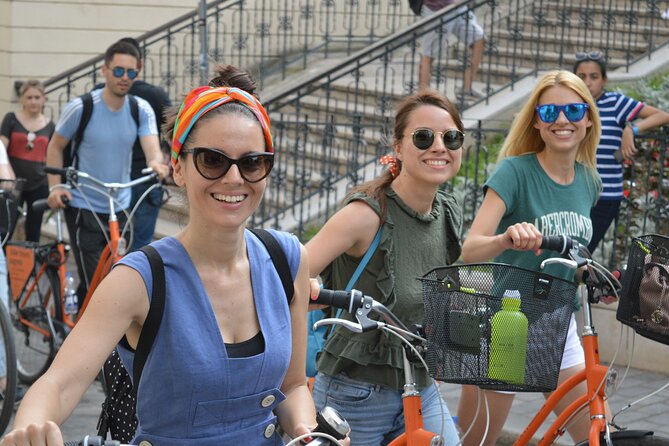
- Guides add local color: Filip, Iva, Eva, Željka, and Sandro are praised for clear explanations, humor, restaurant advice, and friendly conversation.
- The group limit is 12: That is small enough for questions and personal attention, though one complaint described a crowded start and poor bike condition.
- You see sights from outside: The tour gives you orientation, not museum visits or extended interior time.
Why a bicycle works so well in Zagreb
Zagreb’s center is compact, but its sights are spread between two different city areas. The old religious center of Kaptol and the former fortified town of Gradec sit above the Lower Town, where broad squares, parks, and public buildings create a very different feel.
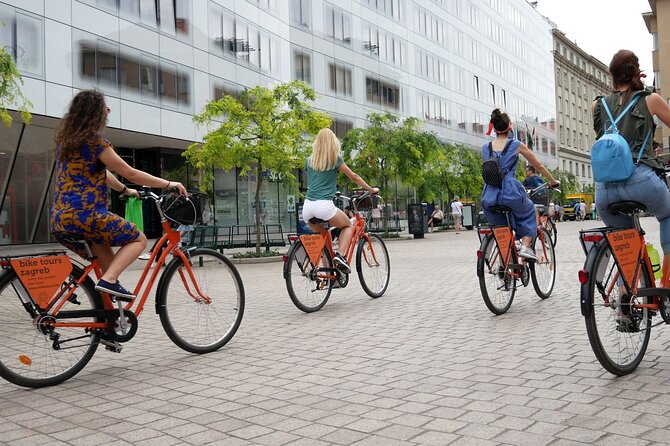
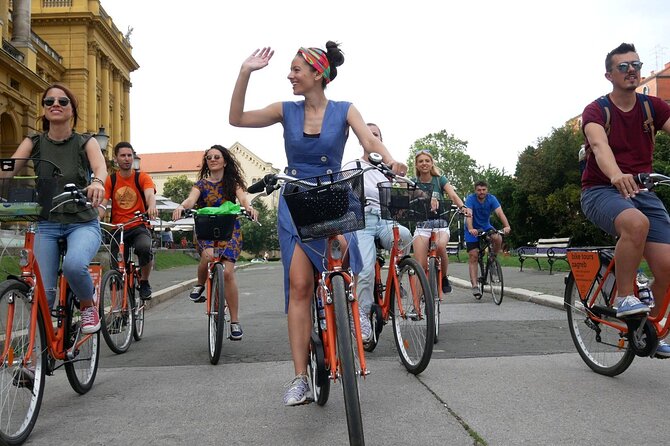
Walking works well here, but a bicycle lets you move between these areas without repeatedly retracing your steps. You can cover more ground in three hours and still stop often for explanations and photographs. The route is described as largely flat, with much of the riding on pavements, pedestrian areas, or gravel paths.
That wording matters. This is not a countryside cycling excursion or a fast athletic ride. You are maneuvering around people and city activity, often at a moderate pace. One participant noted that the eight-speed bike rarely left first gear because the route passed through crowded areas and around trams and buses.
You should be comfortable starting, stopping, steering around pedestrians, and riding over cobblestones. The route is manageable for ordinary cyclists, but it is not ideal for someone who has not ridden in years. Families have completed it with children as young as 10 when the children were confident riders.
The tour begins and ends at Jurišićeva ul. 19. A mobile ticket is accepted, confirmation arrives at booking, and the maximum group size is 12. The experience is offered in English.
More Bike Tours in Zagreb
- Zagreb Highlights Bike Tour
★ 5.0 · 208 reviews - Zagreb: 3–Hour Classic Bike Tour
★ 4.6 · 139 reviews - All of Zagreb Bike Tour
★ 5.0 · 97 reviews
From the cathedral to Dolac Market
The first stop is Zagreb Cathedral, where the story of the city begins in the tour’s historical telling. In 1093, the Hungarian king Ladislav founded the Diocese of Zagreb in the Kaptol area and raised the church to cathedral rank.
You get about 10 minutes here. That is enough for an exterior introduction and photographs, but not for a detailed look inside. The cathedral gives the ride an immediate sense of place: Zagreb did not grow from one single center, but from distinct communities that developed beside one another.
Next comes Dolac Market, known locally as the city’s belly. It is Zagreb’s largest farmers market and one of the best places to understand everyday life beyond grand monuments. The stop lasts about 10 minutes, so you will not have time for a full market visit or serious shopping.
I like this pairing. The cathedral explains the old religious center, while Dolac shows the city as a working place where food, conversation, and routine matter. If you want to return later, make a note of the market’s location before the tour moves on.
Tkalciceva Street and the old city divide
Tkalciceva Street is one of central Zagreb’s most social streets today, lined with places for food and nightlife. Its earlier reputation was very different. From the late 19th century through the 1930s, it served as Zagreb’s equivalent of Amsterdam’s red-light district.
The tour allows 15 minutes here, giving your guide room to explain how the street changed. This is the sort of detail that turns a pretty street into a place with layers and contradictions. You are not just seeing cafes and colorful facades. You are learning how the city’s social life shifted over time.
From there, the ride reaches Krvavi Most, or Bloody Bridge. The name recalls the old boundary between Gradec and Kaptol, separated by the Medveščak stream. Residents of the two communities frequently clashed, making this small crossing a reminder that Zagreb’s separate medieval centers were not always friendly neighbors.
The stop is brief, about 10 minutes, but it connects several earlier sights. Kaptol, the cathedral, the market, and Gradec were once distinct places, and the route makes that old division easier to understand.
Stone Gate and the Upper Town
Petrini Pyli refers to the Stone Gate, one of Zagreb’s most meaningful religious sites. The gate has housed a shrine to Our Lady of the Stone Gate for centuries, and she is regarded as the city’s patron saint.
You have roughly 10 minutes here. The stop is less about rushing through a landmark and more about seeing how devotion remains part of the city’s public spaces. The Stone Gate is a passageway as well as a shrine, which makes it a particularly memorable stop on a bicycle route.
St. Mark’s Church follows, with about 15 minutes. It is one of Zagreb’s oldest buildings and one of the city’s main symbols. The church appears in the 1334 Kaptol Statute, giving your guide a useful opening to discuss Zagreb’s medieval development.
The church is especially valuable as a visual stop, but you should not expect a long interior visit. The tour is designed to show you the setting, explain its importance, and keep moving. If you want extensive time at churches, museums, or historic interiors, plan a separate walking visit.
The Upper Town section includes some uneven surfaces and an uphill portion. Several riders describe the climb as the only serious effort, and it is perfectly reasonable to get off and walk the bicycle. That is not failure. It is good city riding.
More Bike Tours:
- Zagreb: 2.5-Hour Highlights Bike Tour
★ 4.8 · 93 reviews - Back to Socialism Bike Tour
★ 5.0 · 49 reviews - Best of Zagreb: 4-Hour Cycling Tour
★ 4.9 · 13 reviews - City Bike Tour of Split
★ 5.0 · 331 reviews
The 1892 funicular and Zagreb’s city views
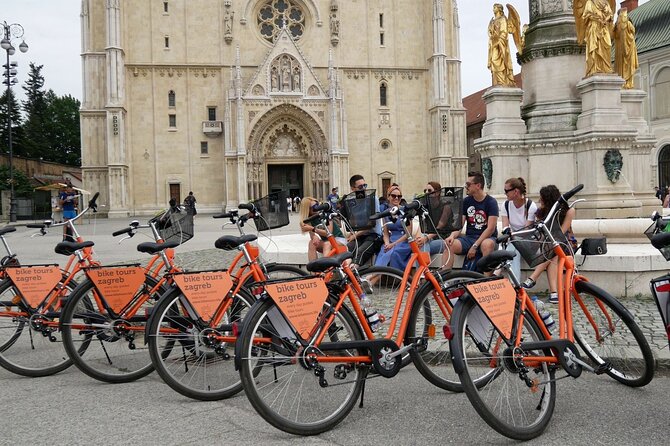
The funicular railway is listed as a 15-minute stop. Created in 1892, it is considered Zagreb’s oldest passenger public transport. The stop helps explain how the Upper and Lower Towns connect, and it gives you a useful look at one of the city’s most recognizable forms of transport.
The funicular ticket is not included. The tour may stop by the railway, but you should not assume that a ride is part of the package. Ask your guide if you want to know how to return later and use it independently.
This is also a point where the bicycle route offers a practical advantage. You can reach the Upper Town without relying on the funicular, then descend or continue by road. The reward is a better sense of Zagreb’s layout than you usually get from visiting isolated sights one at a time.
A sweet break, then the Lower Town
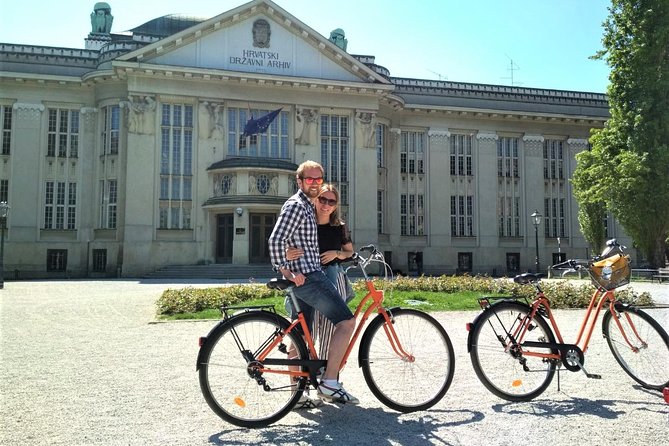
At some point during the ride, you stop for coffee, a refreshing drink, or ice-cream. The exact choice is yours, while alcohol is not included. This pause is more useful than it may sound. It breaks up the sightseeing, gives you a chance to talk with the group, and lets you ask your guide about restaurants or places to visit later.
The guides receive especially strong praise for this personal side of the tour. Filip is repeatedly described as funny, attentive, and good at answering questions. Iva and Eva are praised for adjusting explanations to the group, while Željka is noted for her friendly manner and practical recommendations. Sandro is described as combining history with humor.
Do not treat the break as a full meal. It is a short refreshment stop, not a food tour. Still, a coffee or ice-cream in the middle of a city ride is exactly the right scale for this experience.
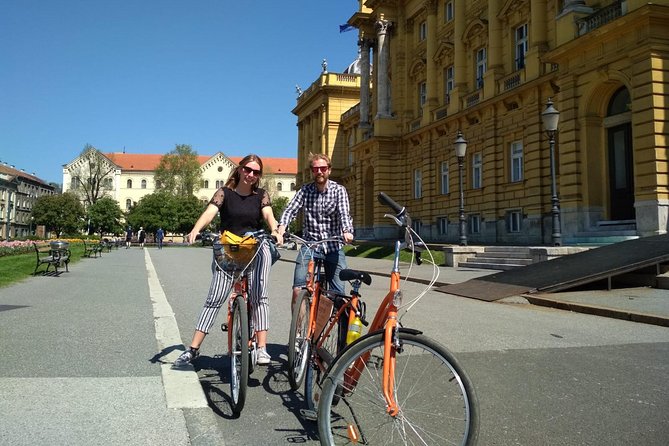
The route then heads toward the Croatian National Theatre, with about 20 minutes allocated there. Founded in 1860, the theater represented the long-held wish of Croatian cultural leaders, including Dimitri Demeter, for a theater using the Croatian language.
This stop shifts the story from medieval power to national culture. You see how Zagreb’s identity developed through language, performance, and public institutions. The building is also a strong photo stop, though again, this is an exterior-oriented city tour rather than a theater visit.
King Tomislav Square and the green Lower Town
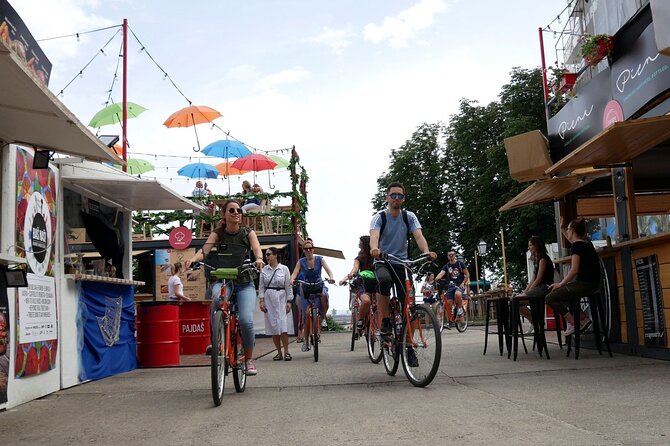
King Tomislav Square honors Croatia’s first king, who ruled from 925 to 928 after earlier governing the Croatian principality. The stop lasts about 10 minutes and introduces an important figure in Croatian national history.
The final major stop is Zrinjevac, where you have about 20 minutes. In 1876, an urban plan was adopted to shape the Lower Town by linking its squares into one planned framework. Zrinjevac helps you see this design in physical form: the Lower Town is not a random collection of streets, but part of a deliberate urban idea.
This is one of the tour’s best contrasts. Earlier, you have been threading through medieval lanes and historic boundaries. Here, the city opens into formal public spaces and planned greenery. Seeing both areas by bicycle makes the change feel immediate.
The ride returns to Jurišićeva ul. 19. The advertised duration is about three hours, though individual timing can vary slightly with the group. One useful detail from the feedback is that a participant praised the guide for arriving back exactly on time, which matters if you have a lunch booking or another afternoon plan.
Guides, group size, and the human side
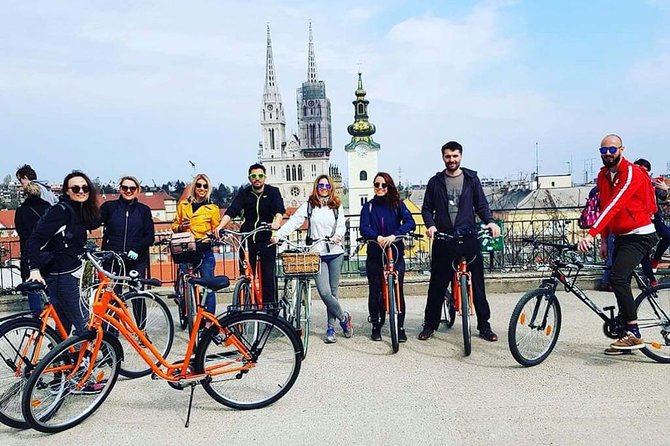
The strongest part of this experience is the guide. The historical facts are useful, but the difference between a routine city ride and a memorable one comes from delivery. The best guides on this route use humor, invite questions, and add practical advice about food, culture, sports, and places to visit.
That advice can save you time after the tour. Several participants specifically appreciated restaurant suggestions, and one family followed Filip’s recommendation to Tac, reporting a good meal. You can ask directly for local food ideas during the refreshment break.
A group of up to 12 is a sensible limit. It allows a guide to keep an eye on the riders and speak with people individually. The supplied information includes one serious complaint about being combined into a larger group, along with concerns about a missing brake, no kickstand, and poor helmets. The operator rejected those details and stated that bicycles are checked before departure.
The broader feedback is favorable, but the equipment concern should not be ignored. Other riders found the bikes comfortable and in good shape, while two four-star comments specifically wished for better bicycles. One rider also described a quick replacement after hitting a bump, suggesting that support was available when a problem arose.
My advice is simple: inspect both brakes, the saddle, the tires, and the helmet before you leave. If something feels wrong, say so immediately. A short check at the start is far better than trying to manage a problem on cobblestones.
Is $54.44 a fair price?
At $54.44 per person, the tour is not the cheapest way to see Zagreb, but the price includes the bicycle, helmet, English-speaking local guide, refreshment break, and a tour photograph. You are also paying for a route that connects distant parts of the center and for the guide’s local recommendations.
The value is strongest if this is your first day in Zagreb. Three hours gives you a city framework, and you can return later to the cathedral, market, museums, or theater areas that catch your interest. The tour does not include admission to attractions, and the funicular ticket is not included, so budget separately if you want to go inside or ride it.
A walking tour may suit you better if you prefer long explanations at each site. A bicycle tour gives you wider coverage, but each stop is necessarily short. You gain range and lose some detail.
The experience has a 4.9 rating from 193 ratings, with 98 percent recommending it. That is a strong record, though it does not erase the equipment and road-safety concerns raised by a small number of participants.
Who should book this ride?
I would choose this tour if you want an active introduction to Zagreb without committing to a strenuous day. It suits adults, confident older children, first-time visitors, and anyone who likes history delivered with jokes and local stories rather than a formal lecture.
It is particularly useful early in your stay. You can use the guide’s suggestions to plan meals and later visits, then return to the places that deserve more time. The flat sections and relaxed pace make it approachable, but you still need basic cycling confidence.
I would hesitate if you dislike riding near pedestrians, trams, buses, or uneven paving. You should also think twice if you need a very small bicycle, since one participant reported difficulty finding a suitable size. Service animals are allowed, most people can participate, and the tour is near public transportation, but the supplied information does not specify an adapted bicycle or detailed mobility accommodations.
Should you book the Classic Zagreb Bike Tour?
Yes, if you want to see a lot of central Zagreb in one morning or afternoon and you are comfortable on a bicycle. The route covers the city’s main historical story, from the cathedral and medieval town divide to the theater district and planned Lower Town squares.
Book it for the guide-led context, easy pace, local recommendations, and included coffee or ice-cream. Before departure, check the bicycle and helmet carefully, and tell the guide if you need to walk a hill or keep a slower pace. With that small bit of preparation, this is a good-value city orientation that gives you both the big sights and a feel for how Zagreb fits together.
FAQ
How long does the Classic Zagreb Bike Tour last?
The tour lasts approximately three hours.
Where does the bike tour start?
It starts at Jurišićeva ul. 19, 10000 Zagreb, Croatia.
Where does the tour finish?
The activity ends back at the same meeting point.
What is included in the price?
The price includes bicycle use, helmet use, a local guide, a coffee, refreshing drink, or ice-cream during the break, and a photograph from the tour.
Is the funicular railway ticket included?
No. Admission for the funicular railway is not included.
Are alcoholic drinks included?
No. Alcoholic drinks are excluded from the experience.
What language is the tour offered in?
The tour is offered in English.
How many people can join the tour?
The maximum group size is 12 participants.
Can I cancel for a full refund?
Yes. You can cancel at least 24 hours before the local start time for a full refund. Changes or cancellations made less than 24 hours before the start time are not accepted for a refund.
Just added around Zagreb
- Zagreb: VR 3D Immersive Film Experience – Voucher★ 4.6 · 9 reviews
- Zagreb GRAND Private Walking Tour★ 4.5 · 9 reviews
- Zagreb: Explore with an Art Historian – Private Walking Tour★ 4.9 · 9 reviews
- From Zagreb: Plitvice Lakes & Rastoke Private Tour★ 5.0 · 9 reviews
- Croatian cuisine cooking class with Dolac market tour★ 5.0 · 9 reviews
- Private Guided Tour of Ljubljana and Lake Bled from Zagreb★ 5.0 · 9 reviews
- Picturesque Samobor & Samobor Castle Half-day Tour★ 4.5 · 9 reviews
- Zagreb to Split Private Transfer via Plitvice Lakes National Park★ 5.0 · 9 reviews
Cycling Tours, compared.
Quad Biking Off Road Tour starting 10 minutes drive from Split
Read our review →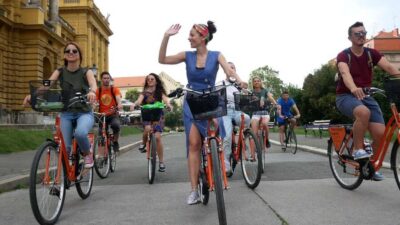
Browse the lists this tour appears in